Clear Aligners in China: Fees, Top Clinics, and How to Book
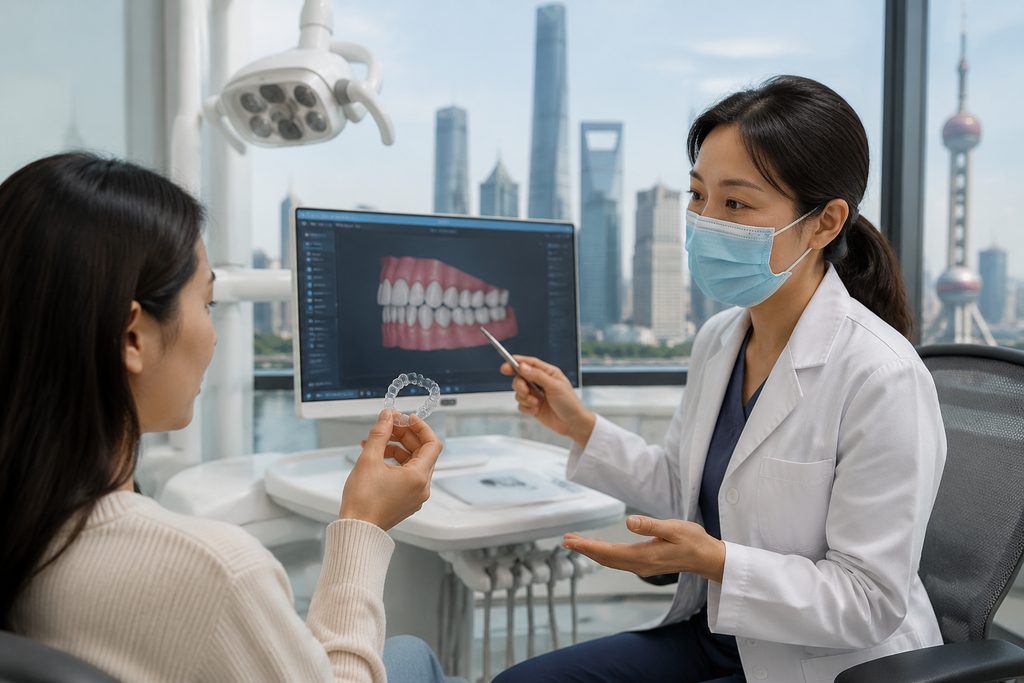
A full Invisalign case in the United States averages $5,000 to $8,000, and in the UK private market £3,000 to £5,500. In Shanghai and Beijing, the same category of treatment — doctor-supervised clear aligner therapy using imported systems — typically runs $2,200 to $4,500. That gap explains why so many international patients now ask us about clear aligners in China, and why the clear aligners cost China question has become one of the most common inquiries our team receives.
But price is the easy part. The harder questions are: which clinic, how long, and what happens if you fly home halfway through treatment?
How This Actually Works, Step by Step
Orthodontics is not a one-visit procedure, so the sequence matters more than the price tag. Here is the real path, from first email to final retainer.
Step 1 — You send records. Most international patients start by emailing or uploading photographs of their teeth from several angles, a panoramic X-ray if they have one, and a short note about what bothers them. Some clinics also ask for a lateral cephalometric X-ray. If you have none, that is fine — imaging can be done on arrival.
Step 2 — A Chinese orthodontist reviews the file. At a public hospital’s international department or a private international clinic, a licensed orthodontist reviews the images and gives a preliminary read: is this a straightforward alignment case, a moderate case needing extractions, or something that requires in-person examination before any plan is possible. Nobody credible will quote you a final price at this stage.
Step 3 — You choose between written second opinion, video consultation, or direct booking. A written second opinion on your records typically runs $300 to $500 at top-tier hospitals. A video consultation with an orthodontist runs $100 to $300 at a standard international department, or $500 to $800 with a senior specialist. If your case is simple and you already know you are traveling, you can skip straight to appointment coordination.
Step 4 — In-person consultation and scans. This is where the actual plan is made. The orthodontist takes intraoral scans (digital impressions), photographs, and often a CBCT scan. You sit with the doctor, see a 3D simulation of the projected movement, and receive a written treatment plan with a fixed price.
Step 5 — Aligners are manufactured and fitted. For imported systems such as Invisalign, the digital plan goes to the manufacturer and trays arrive in roughly two to four weeks. Domestic Chinese aligner brands — Angelalign is the best known — often turn around faster, in one to two weeks.
Step 6 — You wear them, with periodic reviews. This is the part that catches people out, and we will come back to it.
What Clear Aligners Cost in China, and Why the Range Is Wide
Prices depend on the system, the complexity of your case, the city, and whether you are treated in a public hospital’s international wing or a private clinic. Here is what our team sees in practice.
| Treatment type | Typical price in China | Typical price in the US |
|---|---|---|
| Domestic aligner brand, mild to moderate case | $1,500 – $2,800 | $3,000 – $5,000 |
| Invisalign, full case | $2,500 – $4,500 | $5,000 – $8,000 |
| Invisalign with complex movement or extractions | $4,000 – $6,500 | $7,000 – $10,000+ |
| Retainers after treatment | $150 – $400 | $300 – $800 |
These figures are estimates and vary by hospital and case complexity. Public hospital international departments often sit at the lower end for the aligner itself but charge separately for imaging, consultations, and follow-up visits. Private international clinics bundle more into one number and charge more for the convenience.
Choosing a Clinic: What “Best” Actually Means Here
Patients often search for the best orthodontist Shanghai clear aligners options, and the honest answer is that the best clinic is the one whose follow-up schedule you can actually keep. Shanghai and Beijing both have strong orthodontic departments — Shanghai Ninth People’s Hospital is widely recognized for stomatology, and Peking University School of Stomatology in Beijing is a long-standing national reference point. Private international clinics such as United Family and Jiahui offer English-speaking staff, direct insurance billing, and evening appointments.
What separates a good outcome from a mediocre one is rarely the brand of plastic. It is the orthodontist’s planning, the number of review appointments, and whether anyone is checking that your teeth are actually tracking the digital plan.
Two practical filters help. First, does the clinic give you a written plan with an estimated number of trays and a defined review interval? Second, will they hand over your records — scans, plan, and progress photos — in a format you can take to another provider? A clinic that refuses the second request is telling you something.
You can browse orthodontics and stomatology departments ranked among China’s top facilities on our specialty department pages, and compare public versus private options on the private international hospital list.
A Realistic Timeline
Clear aligner treatment is measured in months, and the logistics around it add weeks. Here is a realistic schedule for an international patient starting from overseas.
| Stage | Realistic duration |
|---|---|
| Records gathering and email review | 3 – 10 days |
| Written second opinion or video consultation | 3 – 7 days after records arrive |
| Appointment coordination and confirmation | 1 – 3 weeks, longer for senior specialists |
| Visa (S2 short-stay, medical treatment purpose) | 1 – 3 weeks, varies by consulate |
| In-person consultation, scans, and plan | 1 – 2 days in China |
| Aligner manufacturing | 1 – 4 weeks depending on system |
| Active aligner phase | 6 – 24 months, most cases 12 – 18 months |
| Retention phase | Ongoing, typically 12 months full-time then nights |
How long does clear aligner treatment take? For mild crowding, some cases finish in six to nine months. Moderate cases usually land between twelve and eighteen months. Anything involving significant bite correction, extraction, or jaw positioning can run two years or more. Anyone promising you a fixed number before seeing your scans is guessing.
What Can Go Wrong — and What Happens Then
We would rather you hear the failure modes now than discover them at tray fourteen.
You go home and cannot continue. This is the single biggest problem. Aligners need periodic professional review — typically every six to ten weeks. If you return to your home country mid-treatment, many local orthodontists will not take over another clinic’s case, or will only do so with a new full-price plan. Some Chinese clinics will coordinate a remote handover, but this depends entirely on the individual doctor and is never guaranteed.
Teeth stop tracking. Aligners only work if the trays fit the teeth as planned. If a tooth stalls, the plan needs revision — new scans, new trays, extra cost. This happens in a meaningful share of cases even with excellent compliance.
You need attachments or extractions discovered later. Some cases look simple on photographs and turn out to need composite attachments, interproximal reduction, or extraction. Your quoted price can move upward after the in-person exam.
The clinic is not what it appeared online. Marketing photography is not a clinical credential. Ask for the treating orthodontist’s license and specialization, and confirm who actually performs the reviews — the senior doctor or a junior associate.
Is It Safe to Get Braces or Aligners in China?
Yes, with caveats — and this is the question patients worry about most. China’s top-tier public hospitals and JCI-accredited private hospitals maintain infection control and clinical standards comparable to Western institutions. The instruments are sterilized, the aligner systems are the same global brands, and the orthodontists are trained in recognized residency programs.
The genuine risks are not clinical hygiene. They are continuity, communication, and consumer protection. A clinic that cannot explain your plan in English, or that treats you as a transaction rather than a patient, is a bigger threat to your outcome than the equipment.
Three things reduce the risk substantially. Choose a facility with a real international department. Insist on a written treatment plan with defined review intervals. And decide, before you start, what you will do if you have to leave China early.
Booking an Appointment: How It Really Works
Here is a fact that surprises many international patients: at most Chinese public hospitals, you cannot book a routine outpatient orthodontic slot from overseas in advance. Registration generally happens on the day, in person, or through the hospital’s own app with a Chinese mobile number. Surgery and major procedures require an in-person consultation first — that rule is universal.
What you can do from abroad is work through a hospital’s international or VIP department, which handles overseas scheduling, English-language service, and pre-payment. Expect pricing roughly 1.5 to 2 times the standard channel for that convenience.
So how do you book clear aligners appointment China plans without flying blind? The practical route is a staged one: send records, get a remote opinion, confirm the clinic and doctor, then coordinate a specific appointment window before booking flights. Our team handles that coordination — registration, hospital card creation, and where needed an in-person proxy visit using your records — through our patient consultation service. Any actual admission or treatment remains subject to hospital rules.
For a broader view of how foreign patients access Chinese hospitals, including the full range of facilities, see the China Medical Services homepage.
Practical Considerations: Visas, Payment, and Follow-Up
Visa. Medical treatment in China falls under the S2 short-stay visa, issued for private affairs including medical treatment, with supporting documents from the hospital. Stays beyond 180 days use S1. Accompanying family members apply for S2 as well. Requirements change, so confirm current rules with your nearest Chinese embassy or consulate. Note that the M visa is for commercial and trade activity and is not the right category for medical treatment.
Payment. Public hospitals require prepayment; international insurance is usually reimbursed afterward. Private international hospitals more often bill insurers directly. Bring a card that works internationally, and ask about installment structures for longer treatment plans.
Language. Top public hospitals see enormous daily patient volumes. Without Mandarin, navigating registration, payment, and imaging is genuinely difficult. A bilingual medical companion — from $300 per day for registration, queueing, payment, wayfinding, and interpretation — is often the difference between a smooth visit and a lost day.
Follow-up at home. Before your final appointment in China, ask for your complete records: initial and final scans, the ClinCheck or equivalent plan file, progress photographs, and a written summary of what was done. Your future dentist will thank you.
Frequently Asked Questions
Substantially, yes. A full Invisalign case in China typically runs $2,500 to $4,500, against $5,000 to $8,000 in the US and £3,000 to £5,500 privately in the UK. The aligner system is the same; the difference is clinical labor cost and overhead. Final pricing varies by hospital and case complexity.
Sometimes, but you must arrange it in advance. Some Chinese orthodontists will prepare a handover package for a dentist abroad, but many overseas providers decline to take over another clinic’s active case, or charge for a fresh plan. Confirm this in writing before you begin.
Most cases run twelve to eighteen months of active wear, with mild cases finishing in six to nine months and complex cases extending past two years. Retention follows, usually twelve months of full-time wear and then nights. Your orthodontist can narrow this range after reviewing your scans.
Not at a private international clinic or a public hospital’s international department, where English-speaking staff are standard. At a standard public outpatient department, you will need interpretation for registration, payment, and clinical discussion. A bilingual medical companion covers all of it.
It happens, and it is not a disaster. The orthodontist rescans, revises the digital plan, and orders new trays. Expect additional cost and additional time. This is one reason a mid-treatment move to another country is risky — the revision requires an in-person scan.
Your Next Step
Clear aligner treatment in China can cost roughly half of what you would pay in the US or UK, using the same systems and well-trained orthodontists — provided you plan the logistics as carefully as the treatment. The two things that decide your outcome are the clinic you choose and what happens after you fly home.
Our team helps international patients gather records, obtain a written or video orthodontic opinion, and coordinate appointments at suitable hospitals across 340+ top-ranked hospitals in 37 cities. We are a coordination and interpretation service, not a medical provider, and we do not promise specific doctors or outcomes. If you would like a straightforward read on whether treatment in China makes sense for your case, start with a free consultation — no pressure, no obligation.
This article is for general information only and is not medical advice. Treatment decisions should be made with a qualified orthodontist who has examined you in person.
For more medical information and treatment options in China, visit chinamedservices.com (China Medical Services).
