Composite Veneers in China: Costs Explained for 2026
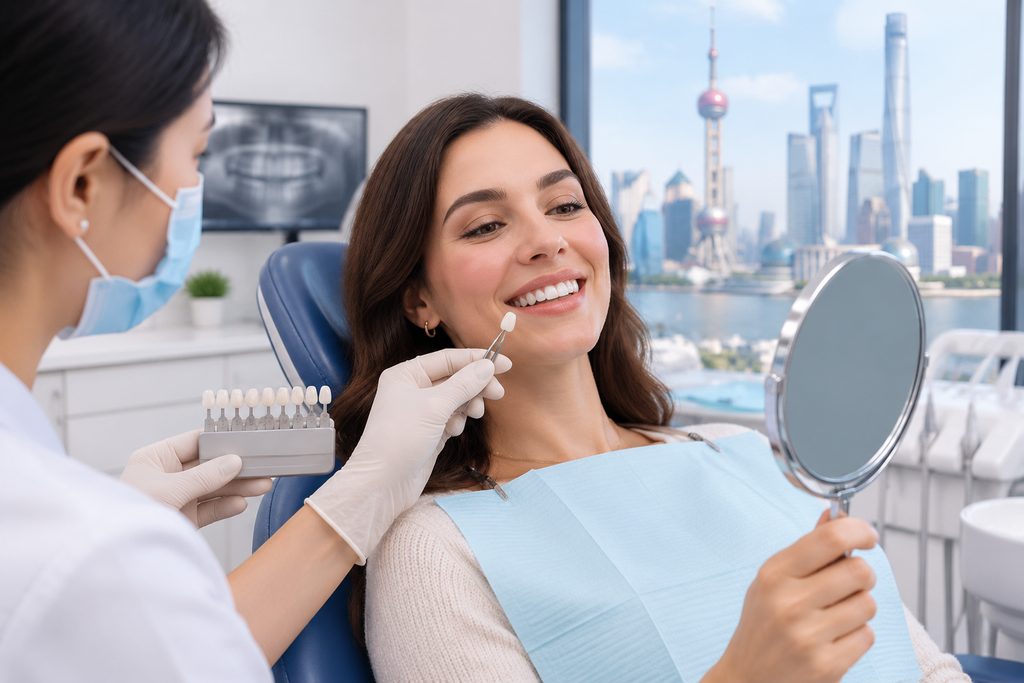
Composite Veneers in China: The Short Answer
Composite veneers cost China patients roughly $150 to $400 per tooth at reputable private and international clinics, and about $80 to $200 per tooth at public hospital dental departments. A full smile of eight to ten veneers typically lands between $1,500 and $3,500. Compare that to $800 to $2,500 per tooth in the United States, and the savings become obvious.
Composite veneers are thin layers of tooth-colored resin bonded directly onto the front surface of your teeth. No drilling down to a stump, usually no lab work, often a single visit. That simplicity is exactly why the price gap between countries matters so much — the procedure is fast, so you are paying mostly for materials and the dentist’s time, not for a week of lab fabrication.
The catch? Not every clinic is equal, and the cheapest quote is rarely the best one. This article walks through real price ranges, who should consider traveling for this work, and how to tell a good clinic from a risky one.
Who This Is Right For — and Who It Isn’t
Composite veneers solve a specific set of problems. They are not a universal fix, and a good clinician will tell you so.
You are likely a good candidate if:
- You have chipped, cracked, or mildly misaligned front teeth
- You want to close small gaps or correct minor discoloration
- You prefer a reversible procedure — composite can be removed, unlike porcelain
- You need a fast turnaround, often a single appointment
- You are budget-conscious but still want a natural look
You should probably not pursue this if:
- You grind your teeth heavily at night — composite wears down faster than porcelain
- You have significant decay or gum disease that needs treatment first
- You want a permanent, stain-resistant result for 15+ years
- You smoke or drink coffee constantly — composite stains more readily
- You expect a two-day trip with no follow-up planning
Here is the honest part. Composite veneers last roughly 4 to 8 years with good care. Porcelain can last 10 to 15. If longevity is your priority and budget is secondary, porcelain is the better investment. If you want a lower-cost, reversible improvement, composite makes sense.
The Options, Compared
Prices below reflect 2026 ranges at accredited Chinese clinics. Figures vary by hospital, city, and case complexity.
| Option | Cost per Tooth (USD) | Typical Lifespan | Best For |
|---|---|---|---|
| Composite veneers, public hospital (China) | $80–$200 | 4–8 years | Budget-focused, simple cases |
| Composite veneers, private/international clinic (China) | $150–$400 | 5–8 years | English service, comfort, speed |
| Porcelain veneers (China) | $300–$700 | 10–15 years | Durability, stain resistance |
| Composite veneers (USA) | $800–$2,500 | 4–8 years | Local convenience |
| Porcelain veneers (USA) | $1,000–$3,000 | 10–15 years | Long-term aesthetic result |
Which column suits you depends on two things: how long you want the result to last, and how much you value English-speaking staff and Western-style clinic environments. A public hospital in Shanghai may quote you $120 per tooth, but you will likely queue, pay upfront, and manage the language barrier yourself. A private international clinic charges more, but the experience feels closer to what you know at home.
How Much Do Composite Veneers Cost in Shanghai vs. Beijing?
City matters, but less than you might expect. Shanghai and Beijing both host top-tier dental facilities, and their prices sit within about 15% of each other.
In Shanghai, private clinics generally quote $200 to $400 per tooth for composite veneers, with international hospitals at the higher end. Public hospital stomatology departments — like those affiliated with major universities — run $100 to $220 per tooth. Shanghai has a dense concentration of internationally trained dentists, which pushes quality up but also keeps premium pricing firm.
Beijing follows a similar pattern. Expect $180 to $380 per tooth at private clinics, and $90 to $200 at public facilities. The city’s top stomatology hospitals attract complex cases from across the country, so simple cosmetic work sometimes gets less priority in scheduling.
What actually drives the variance? Three things: the dentist’s training and reputation, whether the clinic uses a rubber dam and isolation techniques, and whether digital scanning replaces traditional impression putty. Those details affect both comfort and how long the veneers last.
Is Dental Work in China Safe?
This is the question that stops people from booking. It deserves a straight answer.
China’s top-tier hospitals follow the same sterilization protocols you would find in Europe or North America: autoclave sterilization, single-use needles, and disposable barriers. The country has 35,000+ hospitals, and the top 5% — the ones ranked by Fudan University and accredited by JCI — meet international safety standards. Many private international dental clinics in Shanghai and Beijing are staffed by dentists trained in the US, UK, or Australia.
The risk is not the country. It is choosing the wrong clinic.
Low-cost dental shops in tourist areas sometimes cut corners on materials or skip isolation steps. That is true in Bangkok, Istanbul, and Tijuana too. The solution is the same everywhere: verify credentials, ask about materials, and avoid anyone quoting prices far below the market range.
For readers weighing broader treatment decisions, our guide to China’s top-ranked hospitals explains how the Fudan ranking system works and why tier matters.
How to Book Composite Veneers in China
Booking a composite veneers appointment in China is not like booking one at home. Public hospitals generally do not accept overseas advance bookings for standard outpatient dental visits. You queue on the day, take a number, and wait. For surgery, you must have an in-person consultation before anything gets scheduled.
Private international clinics work differently. Most accept email or online inquiries, offer English-speaking coordinators, and can hold an appointment slot once you confirm. That is the practical route for most foreign patients.
Here is a realistic timeline:
- 2–4 weeks before travel: Send photos of your teeth and any dental records. Get a preliminary quote.
- 1–2 weeks before: Confirm the appointment and pay any deposit.
- Day of arrival: In-person exam, digital scan, shade selection.
- Same day or next day: Bonding, usually 2–4 hours for a full set.
- 1 week later: Follow-up check and bite adjustment if needed.
A single-visit treatment is possible for simple cases. Complex cases — where teeth need reshaping or gums need attention first — may require two or three appointments across several days. Plan for a week in the country to be safe.
For a full picture of how medical and dental visits are structured here, see our patient coordination service overview.
Practical Considerations: Visa, Payment, and Follow-Up
Dental tourism to China involves logistics beyond the chair. Get these right and the trip is smooth.
Visa. Foreign patients traveling for medical or dental treatment typically use the S2 visa, which covers short-stay private affairs including medical treatment. Accompanying family members apply under the same category. The M visa is for commercial and trade activities only — it is not a medical visa, despite what some outdated blogs claim. Requirements change, so confirm current rules with your nearest Chinese embassy or consulate and bring supporting documents from the clinic.
Payment. Public hospitals require prepayment, and international insurance reimbursement happens after you return home. Private international clinics often bill insurance directly if they have a partnership with your provider. Bring a credit card that does not charge foreign transaction fees, and confirm whether the clinic accepts international cards before you arrive.
Records. Bring your dental history, recent X-rays if you have them, and a list of medications. If you have had prior veneers or crowns, tell the dentist — bonding over old restorations changes the approach.
Follow-up. Composite veneers need polishing every 6 to 12 months. Your dentist at home can usually handle this. Ask the Chinese clinic for a written treatment summary and material specifications so your local dentist knows what is in your mouth.
Language. Top private clinics in Shanghai and Beijing have English-speaking staff. Public hospitals mostly do not. If you go the public route, arrange a bilingual companion or use a translation app and expect longer waits.
Frequently Asked Questions
Shanghai private clinics charge roughly $200–$400 per tooth; public hospitals $100–$220. In the US, the same procedure runs $800–$2,500 per tooth. Even after flights and hotels, a full set of eight veneers in Shanghai often costs less than half the US price.
At accredited hospitals and international clinics, yes. Sterilization standards match Western norms, and many dentists trained abroad. The risk lies in unverified low-cost shops, not in the country itself. Check credentials and material brands before committing.
Private international clinics usually accept advance bookings by email or online form. Public hospitals generally do not — you queue on the day for standard visits, and surgery requires an in-person consultation first. Plan around this difference.
Expect 4 to 8 years with good care. Chips can be repaired with additional composite, often in one short visit. If a veneer fails while you are still in China, most clinics will fix it at no charge within a warranty period — ask about this before treatment.
Beijing’s top stomatology hospitals and several JCI-accredited international clinics offer strong cosmetic dentistry. The right choice depends on your case complexity, budget, and whether you need English-language service. Compare facilities on our Beijing hospital directory before deciding.
Your Next Step
Composite veneers in China cost a fraction of Western prices, and the quality at accredited clinics holds up. The decision comes down to choosing the right facility and planning the trip properly — not to whether the savings are real.
We are China Medical Services, a coordination platform connecting international patients with 340+ top-ranked hospitals across 37 cities. We are not a dental clinic and we do not provide diagnoses. What we do is help you compare options, prepare records, and navigate the logistics so your trip is not wasted.
If you want a clear picture of your options before booking anything, start with a free consultation. No pressure, no obligation — just a conversation about what fits your case.
This article is for general information only and does not constitute medical or dental advice. Treatment decisions should be made with a qualified clinician who has examined you in person.
For more medical information and treatment options in China, visit chinamedservices.com (China Medical Services).
