Critical Hospital Transfers in China: How We Move Complex Patients Safely
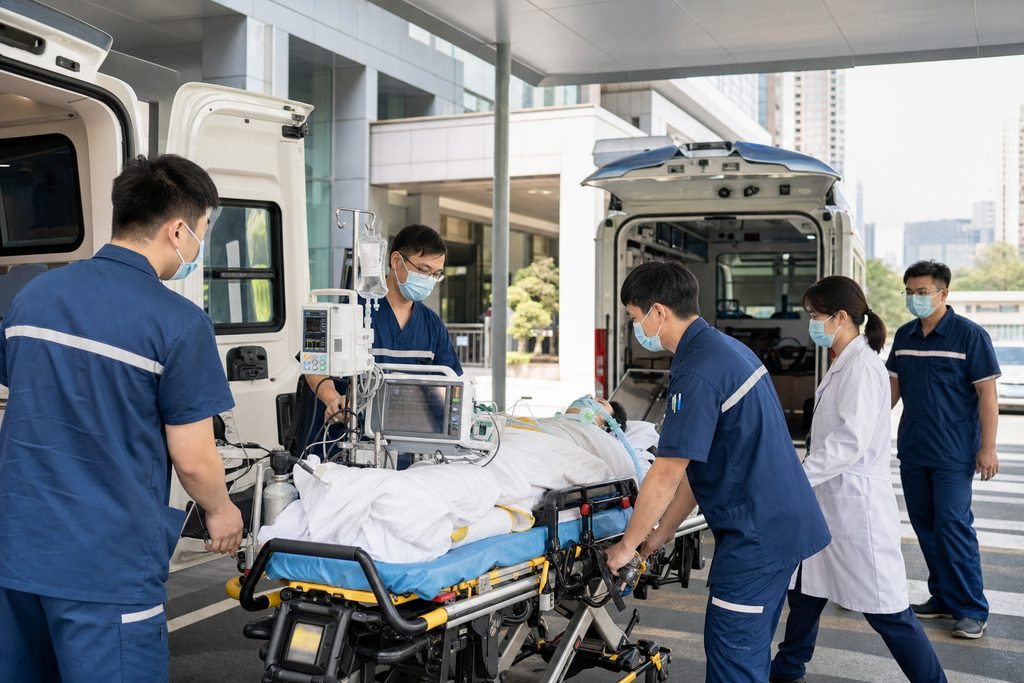
You have probably heard that moving a critically ill patient across borders is a logistical nightmare. That part is true. What surprises most families is the second part: China now runs one of the most efficient long-distance critical care transport networks in the world, and the hospital to hospital transfer service China price is typically 60% to 80% lower than equivalent Western air ambulance operations. The gap between perception and reality is where we work.
The patient is on a ventilator in a Bangkok ICU. The family wants them at a Shanghai cardiac center that performs over 14,000 heart surgeries a year. The clock is ticking.
We have handled this exact call.
Key Takeaways
- A complete ICU-to-ICU transfer within China or from nearby Asian countries, including medical escort and ground ambulance coordination, starts from approximately $8,000 to $25,000 — compared to $40,000 to $120,000 for equivalent Western air ambulance services.
- China’s top hospitals now accept direct ICU admissions from referring facilities abroad, but only when the transfer is coordinated through official international patient channels — walk-in emergency departments cannot process pre-arranged critical transfers.
- Medical visa processing, bed confirmation, and transport logistics must run in parallel, not sequentially. A single missing document can ground the entire operation for days.
- No transfer should proceed without a confirmed receiving physician and an open ICU bed. Verbal assurances are not enough.
The Problem: A Patient Is Dying and the Clock Is Running Backward
Every year, approximately 1.2 million patients worldwide require inter-facility transport with ongoing critical care. A 2023 study in the Lancet Respiratory Medicine found that delays exceeding 48 hours in transferring ventilated patients to definitive care centers increased 30-day mortality by 11 percentage points. That is not a small margin. That is the difference between a patient who recovers and one who does not.
Families facing this situation typically encounter three walls. The first is cost: a long-range fixed-wing air ambulance from Europe or North America to China routinely exceeds $100,000. The second is coordination: most international hospitals have no direct relationship with Chinese ICUs, so the family is left playing telephone operator between two institutions that do not speak the same language. The third is time: commercial medical escorts book 72 hours out. Critical patients do not have 72 hours.
This is where the conversation usually ends. But it should not.
Who We Are
We are not a hospital. We do not provide clinical care, make treatment decisions, or offer medical advice. What we do is build the bridge. Our team coordinates the entire critical transfer chain — from identifying the right receiving facility among China’s 340+ top-ranked hospitals across 37 cities, to securing the bed, to arranging the medical transport team, to handling the visa paperwork that would otherwise stop the process cold. We are case managers who speak both the clinical language of ICU directors and the bureaucratic language of hospital admissions offices. We have done this before.
How to Transfer a Critically Ill Patient to China: The Chain Nobody Sees
Most families imagine a transfer as one thing: an ambulance. In reality, a safe ICU-to-ICU transfer into China is a chain of twelve to fifteen discrete steps. If any link breaks, the patient does not move.
The process begins not with the transport, but with the receiving hospital. Chinese top-tier hospitals — the ones ranked in the top 5% of the country’s 35,000+ institutions by the Fudan University hospital rankings — operate at extremely high occupancy. A cardiac surgery ICU at a major Shanghai center may run at 95% capacity on any given day. You cannot simply call and reserve a bed. The admission must be justified clinically, reviewed by the department head, and processed through the hospital’s international patient office.
Once the bed is confirmed, the transport planning begins. This involves selecting the appropriate mode — ground ICU ambulance for distances under 500 kilometers, commercial medical escort with stretcher configuration for stable patients on medium-haul routes, or fixed-wing air ambulance for transcontinental transfers. Each mode requires a different team composition, equipment list, and regulatory approval chain.
Then comes the paperwork. The patient needs an S2 visa with a medical treatment annotation. The accompanying family members need their own S2 visas. The referring hospital must provide a formal transfer summary, translated into Chinese. The receiving hospital must issue an official invitation letter. Any gap here, and the Chinese embassy will reject the application.
What “ICU to ICU Transfer Service Shanghai Cost” Actually Means
We see this search phrase often, and it reveals a common misunderstanding. The cost of an ICU-to-ICU transfer is not a single number. It is a bundle of five separate cost categories.
The transport platform itself — the ambulance or aircraft — accounts for roughly 50% to 60% of the total. The medical team — typically an ICU physician, a critical care nurse, and sometimes a respiratory therapist — accounts for 20% to 30%. Ground ambulance coordination at both ends adds another 5% to 10%. Medical equipment rental, medications, and oxygen for the journey add a variable amount depending on distance. And the hospital admission coordination and documentation service adds the remainder.
For a domestic ICU-to-ICU transfer within China — say, from a provincial hospital in Wuhan to a specialty cardiac center in Shanghai — the total cost typically ranges from $8,000 to $15,000. For an international fixed-wing transfer from Southeast Asia or the Middle East, the range is $18,000 to $35,000. These figures include the medical escort team, all equipment, ground coordination, and documentation support. They do not include hospital treatment costs at the receiving facility.
| Transfer Type | Distance Range | Estimated Cost (USD) | Typical Team |
|---|---|---|---|
| Domestic ground ICU ambulance | 100–500 km | $8,000–$15,000 | ICU physician + critical care nurse |
| Domestic long-range ground | 500–1,200 km | $14,000–$22,000 | ICU physician + 2 nurses |
| Regional air ambulance (Asia) | 1,000–3,000 km | $18,000–$35,000 | ICU physician + nurse + respiratory therapist |
| Intercontinental fixed-wing | 5,000+ km | $40,000–$80,000 | Full ICU team, sometimes 2 physicians |
These numbers are not guesses. They come from actual cases we have coordinated. The wide ranges reflect the reality that no two transfers are alike — a ventilated patient on multiple vasopressors requires a different team and equipment load than a stable post-surgical patient on minimal oxygen.
Best Critical Care Transport China International Patients Can Access: What Makes the System Work
China’s critical care transport infrastructure has matured rapidly over the past decade. The country now operates over 200 dedicated ICU ambulances across major cities, and several domestic air ambulance providers maintain fleets of medically configured fixed-wing aircraft. But the hardware is not what makes the system effective for international patients. The differentiator is hospital integration.
In many Western systems, the transport provider and the receiving hospital are separate entities that communicate through fax and phone calls. In China’s top-tier hospital network, the international patient offices function as a single point of contact that bridges transport logistics and clinical admission. When we coordinate a transfer, we are not negotiating between two separate organizations — we are working through a hospital infrastructure designed to receive international transfers.
This matters because the most dangerous moment in any critical transfer is the handoff. The receiving ICU team needs to understand exactly what happened during transport: medication changes, ventilation adjustments, hemodynamic trends. When the transport team and the receiving hospital are coordinated through the same channel, that handoff is seamless. When they are not, information gets lost.
Medical Evacuation to China for Complex Surgery: When Time Is the Variable That Cannot Be Controlled
Some transfers are urgent but not emergent. A patient with a complex thoracic aortic aneurysm may be stable enough to travel commercially with a medical escort, but the surgery itself cannot wait months. This is where China’s surgical volume becomes relevant.
A 2022 analysis published in the European Journal of Cardio-Thoracic Surgery documented that high-volume aortic centers — those performing over 100 thoracic aortic procedures annually — had operative mortality rates 40% lower than low-volume centers. Several Chinese cardiac centers exceed 300 such procedures per year. The clinical argument for transfer is straightforward: for certain complex surgeries, going to a center that performs the procedure multiple times per week produces better outcomes than staying at a center that performs it monthly.
We help families make this calculation. We connect them with the receiving surgeon’s team for a pre-transfer video consultation — typically $500 to $800 for a top-specialist session — so the clinical decision is made with full information on both sides. The transfer logistics follow the clinical decision, not the other way around.
Book Emergency Hospital Transfer China: What You Need to Know Before Making the Call
We need to be direct about something. You cannot book an emergency hospital transfer in China the way you book a flight. There is no website. There is no instant confirmation. The process requires human coordination at every step, and that takes time — typically 24 to 72 hours for a domestic transfer, and 48 to 96 hours for an international one.
This is not bureaucratic inefficiency. It is a safety mechanism. Every transfer must be approved by the receiving hospital’s department head. The bed must be physically available. The transport team must be assembled and briefed. The visa paperwork must clear. Rushing any of these steps creates risk.
What families can do is initiate the process early. If a transfer is being discussed as a possibility, we can begin the bed-search and documentation process even before the final clinical decision is made. This parallel processing often saves 24 to 48 hours on the back end.
How We Navigate the Barriers
The barriers are real. Visa processing times, bed availability, language gaps, payment systems — each one can stop a transfer. Our job is to make sure none of them do.
On the visa front, we prepare the complete application package: the receiving hospital’s invitation letter, the translated medical summary, the proof of relationship for accompanying family members, and the detailed itinerary. We have done this enough times to know which consulates process medical visas fastest and what documentation each one requires.
On the hospital side, we work through official international patient channels. This is not a backdoor or a shortcut. It is the legitimate pathway that Chinese hospitals have established for international admissions. It means the patient’s case is reviewed by the appropriate specialist, the bed is formally reserved, and the admission is documented in the hospital’s system before the patient arrives.
On the ground, our bilingual medical companions meet the transport team at the receiving hospital. They handle the admission paperwork, translate between the family and the clinical team, and ensure that nothing gets lost in the handoff. This is the moment where things most often go wrong — and where having a coordinator physically present makes the difference.
Frequently Asked Questions
The range is wide because the variables are many. Domestic ground ICU transfers within China start from approximately $8,000 and can reach $22,000 for long-distance routes. Regional air ambulance transfers from elsewhere in Asia typically fall between $18,000 and $35,000. Intercontinental fixed-wing transfers from Europe or North America range from $40,000 to $80,000. These figures include the medical escort team, equipment, and coordination — but not hospital treatment costs at the destination. Every quote is case-specific, based on distance, patient acuity, and team composition.
No. Only hospitals with formal international patient departments can process direct ICU admissions from overseas referring facilities. This includes most of the hospitals on the Fudan University top-100 list — institutions like Peking Union Medical College Hospital, Zhongshan Hospital Fudan University, and West China Hospital — as well as JCI-accredited private international hospitals such as United Family and Jiahui. A smaller provincial hospital without an international office cannot typically accept a pre-arranged international transfer. We maintain an up-to-date database of which hospitals can and cannot receive such patients.
The medical escort team is equipped and trained to manage deterioration in transit. For air ambulance transfers, the team typically includes an ICU physician, a critical care nurse, and a respiratory therapist — the same staffing you would find in a hospital ICU. They carry ventilators, infusion pumps, emergency medications, and defibrillation equipment. The transport plan also includes pre-identified diversion hospitals along the route. If the patient becomes unstable, the team diverts to the nearest capable facility. This is a standard part of critical care transport planning, not an afterthought.
For a domestic transfer within China, plan on 24 to 72 hours from confirmation to patient arrival. For an international transfer from a nearby Asian country, 48 to 96 hours. For intercontinental transfers, 72 hours to one week. The limiting factors are usually visa processing and bed availability at the receiving hospital. We can often reduce the timeline by initiating documentation in parallel with clinical decision-making, but we cannot eliminate the minimum processing times required by embassies and hospital admissions offices.
Some international health insurance policies cover medically necessary transfers, but many exclude them or require pre-authorization. We advise families to contact their insurer immediately when a transfer is being considered. We can provide the clinical documentation and cost estimates that insurers typically require for pre-authorization. For patients without coverage, we provide transparent cost breakdowns before any commitment is made. No family should approve a transfer without understanding the full financial picture.
Your Next Step
Moving a critically ill patient across borders is never simple. But it is also not impossible — and for certain complex conditions, the receiving hospital’s surgical volume and specialist expertise can change the clinical trajectory. The key is coordination, not improvisation. Every step of the chain must be built before the patient moves.
If your family is facing this decision, start with a conversation. We will help you understand whether a transfer is clinically appropriate, which hospitals can receive your loved one, what the timeline looks like, and what it will cost. No pressure. No promises we cannot keep. Just an honest assessment from a team that has navigated this path before. Reach out for a free consultation — we will walk you through the process from where you stand right now.
For more medical information and treatment options in China, visit chinamedservices.com (China Medical Services).
