Teeth Whitening in China vs at Home: Real Costs, Clinics, and Safety
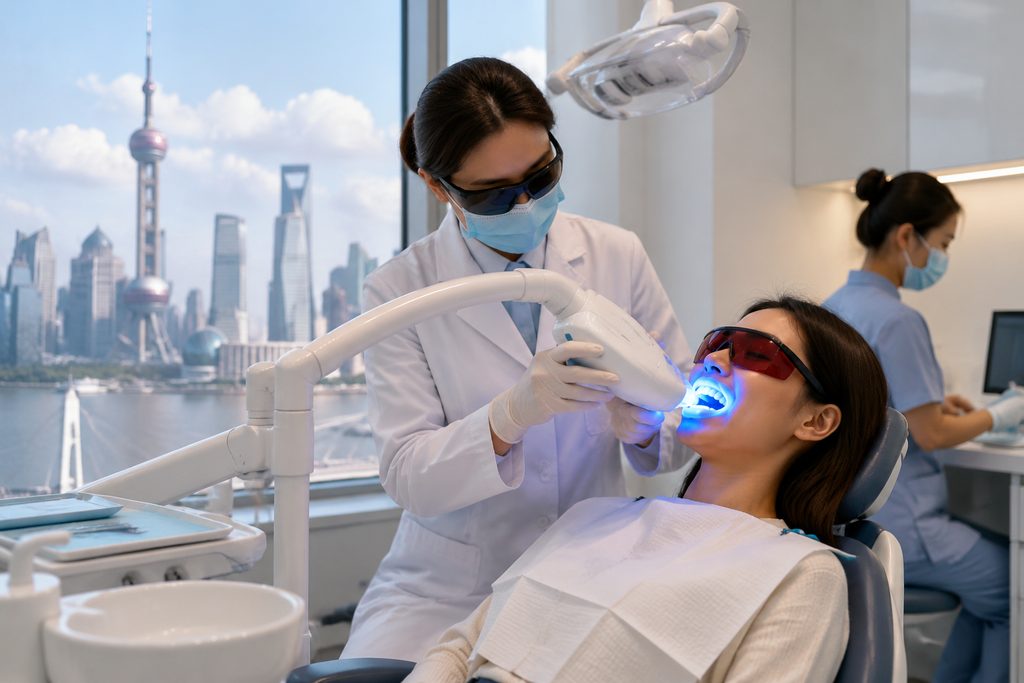
Teeth Whitening in China vs at Home: A Complete Comparison
Teeth whitening is the cosmetic dental procedure that uses a peroxide-based gel — usually hydrogen peroxide or carbamide peroxide — to break down stains inside the enamel and dentin. That is the whole mechanism. No drilling, no removal of tooth structure, no anesthesia in most cases. Which is exactly why so many international patients ask us whether it is worth flying to China for it, or whether they should just walk into a clinic near their home. The honest answer depends on three variables: the teeth whitening cost in China, the standard of the clinic you choose, and how much of your trip you were already planning to make.
Our team coordinates care at 340+ top-ranked hospitals and dental centers across 37 cities in China. We are not dentists, and nothing here is individual medical advice. What we can do is show you the numbers, the process, and the parts of this decision that most comparison articles leave out.
How This Actually Works, Step by Step
Here is the real sequence, from your living room to a whiter smile. Skip any step and the trip gets harder.
- You send records first. Clear intraoral photos, a recent panoramic X-ray if you have one, and a short note on what you want — general brightening, or a fix for a specific discoloration. Staining from coffee responds differently than tetracycline staining or a single dark tooth after trauma.
- A Chinese dental team reviews the file. This usually happens within 2–5 business days. What comes back is a written assessment: which whitening method fits (in-office LED-accelerated, take-home trays, or internal bleaching for a non-vital tooth), how many sessions are realistic, and whether you need a cleaning or filling first.
- You get a written quote and a proposed schedule. In-office whitening is typically a single 60–90 minute appointment. Take-home trays require impressions, a lab turnaround of 3–7 days, and then 1–2 weeks of nightly wear at home.
- You book the appointment. Public tertiary hospitals in China generally do not allow overseas patients to pre-book an ordinary outpatient slot from abroad. To lock a specific date in advance, you go through the hospital’s international department or VIP channel — this is where our appointment coordination service comes in.
- You arrive, get treated, and receive aftercare instructions. Most clinics provide a shade guide record before and after, plus a desensitizing gel and a 48-hour diet list (no coffee, red wine, tomato sauce, or tobacco).
One detail people miss: whitening is often bundled with a scaling and polishing appointment. If you have not had a professional cleaning in over a year, the dentist will usually insist on it first. Budget one extra visit.
Teeth Whitening Cost in China vs the US, UK, and Australia
This is where the gap becomes obvious. In-office professional whitening in a major US metro runs $500–$1,000 for a single session, and take-home custom trays run $300–$600. In the UK, private in-office whitening sits around £350–£700. Australia lands at AUD $600–$1,200.
In China, at a reputable public tertiary hospital dental department or a JCI-accredited private international clinic, the same procedure typically costs the equivalent of $120–$350 for in-office whitening, and $80–$200 for custom take-home trays. Even at the upper end — a private international clinic in Shanghai with English-speaking staff and direct insurance billing — you are usually looking at roughly a third of US pricing.
| Procedure | United States | United Kingdom | China (public tertiary) | China (private international) |
|---|---|---|---|---|
| In-office whitening, single session | $500–$1,000 | £350–£700 | $120–$250 | $250–$350 |
| Custom take-home trays | $300–$600 | £200–£400 | $80–$150 | $150–$200 |
| Scaling and polishing | $75–$200 | £60–£120 | $30–$70 | $70–$120 |
| Consultation and shade assessment | $50–$150 | £30–£80 | $10–$30 | $30–$80 |
These figures vary by hospital and case complexity, and they are reference ranges — not quotes. A single dark non-vital tooth needing internal bleaching costs more than a routine whole-mouth session. So does a case requiring gum treatment first.
A Realistic Timeline
Here is what a whitening-focused trip actually looks like, including the waiting steps nobody mentions.
| Stage | Typical Duration | What Happens |
|---|---|---|
| Day 1–5 | 3–5 business days | You send photos and X-rays; the dental team returns a written assessment and quote |
| Week 1–2 | 5–10 business days | Written second opinion or video consultation; you confirm the plan and choose a city |
| Week 2–4 | 10–15 business days | S2 visa application (medical treatment purpose), hospital appointment coordination, flights and hotel |
| Arrival day | 60–90 minutes | Consultation, shade assessment, scaling if needed |
| Treatment day | 1 session, or 3–7 days for trays | In-office whitening in one visit; take-home trays require impressions plus lab time |
| Follow-up | 3–6 months | Shade check with your home dentist; touch-up trays used every 6–12 months |
Visa processing is the step that quietly eats a week. Foreign nationals coming to China for medical treatment normally apply under the S2 category, with supporting documents from the receiving hospital. Family members accompanying a patient apply under the same category. Processing times shift with consulate workload, so always confirm current requirements with the embassy or consulate handling your application. And to be clear about a common mix-up: the M visa is for commercial and trade activity. It is not a medical visa.
What Can Go Wrong — and What Happens Then
Whitening is low-risk, but “low-risk” is not “no-risk.” Here are the failure modes we see, and the real recourse for each.
Tooth sensitivity. This is the most common complaint, affecting a meaningful share of patients for 24–72 hours after in-office treatment. It is usually managed with desensitizing gel and avoidance of extreme temperatures. If it persists beyond a week, the clinic should reassess — sometimes the peroxide concentration was too high for your enamel.
Uneven results. Existing fillings, crowns, and veneers do not whiten. If you have a visible composite filling on a front tooth, it will stay its original shade while the surrounding enamel lightens. The fix is replacing that restoration after whitening — an extra cost you should know about before you start, not after.
No result at all. Intrinsic staining — from tetracycline use, fluorosis, or trauma — often resists standard whitening. A good clinic tells you this during the assessment. A clinic that promises results without seeing your X-rays is telling you something about itself.
Language and consent gaps. This is the one that catches international patients. China’s top public hospitals are enormous — some see over 10,000 outpatient visits a day — and English signage is not universal. If you cannot read the consent form, you cannot meaningfully consent. That is precisely why bilingual accompaniment exists as a service category, and why we treat it as a safety feature rather than a convenience.
Refund and recourse. Public hospitals require prepayment and you claim insurance afterward; most private international clinics bill insurers directly. If a treatment goes wrong, your recourse runs through the hospital’s patient affairs office. Having a local coordinator who can file that complaint in Chinese changes the outcome materially.
Is Teeth Whitening Safe in China? Evaluating Clinics Properly
Yes — at the right facility. The question is how you tell the right facility from the wrong one before you book. Four criteria do most of the work.
Check the hospital tier and accreditation. China’s public hospitals are graded, and the tertiary tier (often called “Class A tertiary” or 三甲 in Chinese, though we use the English designation) represents the top band. The roughly 340 hospitals in our database sit within the top 5% of China’s 35,000+ hospitals, ranked by the Fudan Hospital Ranking and JCI accreditation. For a cosmetic procedure, you may not need the top cardiac center in the country — but you do want a dental department inside a properly accredited institution.
Ask who performs the procedure. In China, whitening is performed by licensed dentists, and in teaching hospitals often by a resident under supervision. That is normal and generally fine. What matters is whether a senior dentist reviewed your case and set the protocol. If you are specifically searching for the best dental clinic in Shanghai for whitening, look at the dental departments of Fudan-affiliated hospitals and the JCI-accredited private international clinics — both appear in our specialty rankings by department.
Insist on a pre-treatment shade record. Reputable clinics photograph your teeth against a shade guide before and after. Without a baseline, “it looks whiter” is not a measurable claim.
Watch for the package pitch. Dental tourism packages in China that bundle whitening with hotel and airport transfer can be good value — or can quietly route you to a clinic chosen for commission rather than quality. Ask which hospital, which department, and who the treating dentist is. If the answer is vague, walk.
Practical Considerations: Records, Visas, Payment, and Follow-Up
Records. Bring any recent dental X-rays (within 12 months is ideal), a list of current medications, and your dental history — especially previous whitening, bonding, or orthodontic work. If you have dental insurance, get a pre-treatment estimate from your insurer before you travel; most policies exclude cosmetic procedures outright, but some cover whitening when it is medically indicated.
Visa. The S2 category is the standard route for short-stay medical treatment, and accompanying family members apply under the same category. Requirements change, so verify with the Chinese embassy or consulate responsible for your jurisdiction and allow at least two to three weeks. Do not book non-refundable flights before your visa is issued.
Payment. Public hospitals generally require prepayment, with insurance reimbursement handled afterward in your home country. Private international clinics in Beijing, Shanghai, Guangzhou, and Shenzhen often bill international insurers directly. Confirm which model applies before your appointment.
Language. Assume you will need interpretation unless you are going to a private international clinic. Even there, the paperwork is frequently bilingual but not always.
Follow-up at home. Whitening results fade. Most patients need a touch-up every 6–12 months, which you can do at home with trays made in China. Ask the clinic to give you your tray molds and the peroxide concentration in writing so your home dentist can replicate the protocol safely.
Frequently Asked Questions
In the US, laser-assisted in-office whitening typically runs $500–$1,000 per session; in the UK, £350–£700. In China, the equivalent procedure at a reputable public tertiary hospital or JCI-accredited private clinic generally falls between $120 and $350. Prices vary by hospital and case complexity, and the “laser” label sometimes describes an LED-accelerated process rather than a true laser — ask which light source the clinic uses.
You can, but not the way you would book a restaurant table. Ordinary outpatient slots at Chinese public hospitals are generally not reservable from abroad. To secure a specific date in advance, you go through the hospital’s international or VIP department. Our team handles that coordination, and if we cannot secure the appointment you requested, the coordination fee is refunded in full.
At an accredited facility with a licensed dentist, yes — the procedure itself carries the same risk profile as anywhere else, dominated by temporary sensitivity. The real variables are clinician qualification, peroxide concentration, and whether anyone explained the risks to you in a language you understood. Those are checkable things, not matters of luck.
Yes, provided you leave with documentation. Ask for your pre- and post-treatment shade records, the peroxide type and concentration used, and your tray impressions if you had custom trays made. A one-page treatment summary in English is a reasonable request and most international departments will provide it.
Sometimes, but rarely on whitening alone. Once you add airfare, accommodation, and time off work, a $200 procedure does not justify the trip. The economics work when whitening is part of a broader treatment plan — implants, crowns, orthodontics — or combined with a general health checkup at one of China’s top hospitals. Compare the total trip cost, not the procedure line item.
Your Next Step
Whitening in China is cheaper, generally safe at accredited facilities, and logistically manageable — but it only makes sense as part of a trip you would take anyway, or alongside a larger dental plan. The savings are real; the trip is not free.
Our team at China Medical Services connects international patients with hospitals across 37 cities, handles appointment coordination, bilingual accompaniment, and visa guidance. We are not dentists and we do not provide medical advice or guarantee any clinical outcome — we handle the logistics so your dentist can focus on your teeth. If you would like a written assessment and a cost estimate for a specific clinic, start with a free consultation and we will tell you honestly whether the trip is worth it for your case.
For more medical information and treatment options in China, visit chinamedservices.com (China Medical Services).
