Declaring Medication at China Customs: What Every Patient Must Know
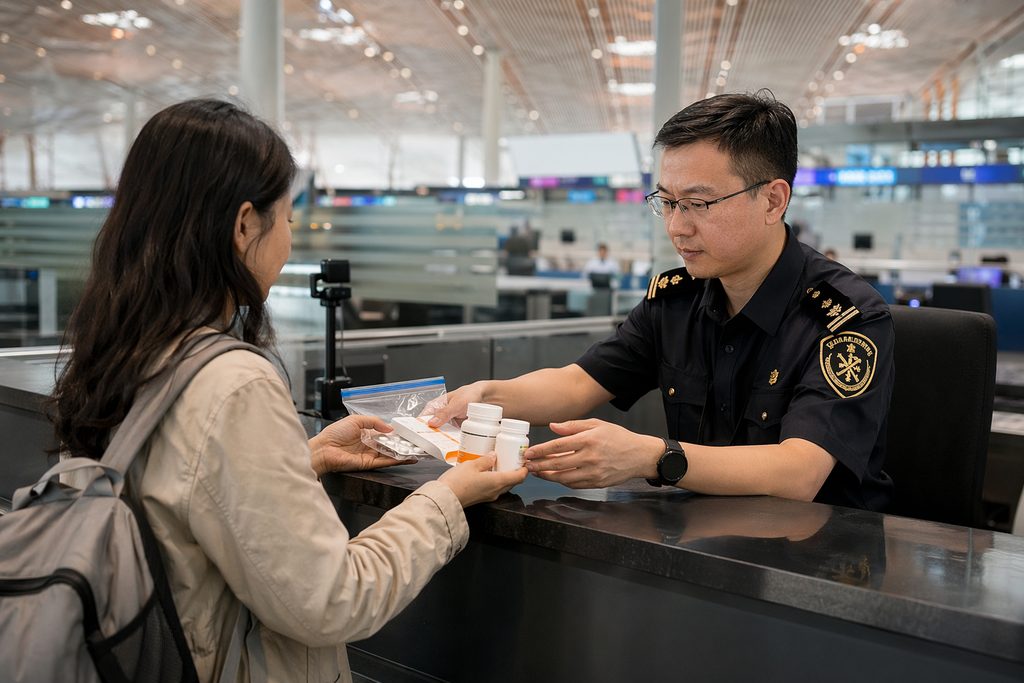
Most people assume that if their doctor prescribed a medication, they can carry it anywhere without question. That assumption gets travelers stopped at Chinese border control every single week. So let’s answer the question directly: can I bring prescription medication into China? Yes — but only within specific limits, and only if you follow China customs medication rules for tourists and patients. Personal-use quantities are generally permitted, typically up to a 30-day supply for most drugs. Anything beyond that, or any controlled substance, requires advance paperwork and a red-channel declaration. Get it wrong and the best case is confiscation. The worst case involves fines, detention, or serious legal trouble.
Here’s the part that catches people off guard. China classifies certain common Western medications as controlled substances. Some cold medicines, sleeping aids, and ADHD drugs fall into this category. What’s routine at home can be restricted here.
Can I Bring Prescription Medication Into China: The Short Answer
For ordinary prescription drugs — blood pressure tablets, thyroid medication, antibiotics, insulin — the answer is yes, in personal-use amounts, carried in original packaging with a copy of your prescription. Declare them if the total value is high or the quantity is large. For controlled drugs, the answer changes entirely. You need an import permit approved before you travel, and you must declare them at customs using the China customs controlled drugs declaration form. No permit means no entry for those drugs. There is no negotiating at the counter.
The core rule: personal-use quantities of standard prescription medication are generally allowed. Controlled substances require pre-approved documentation. The burden of proof is always on you, not the customs officer.
Who This Is Right For — and Who It Isn’t
This guidance applies to most international patients traveling to China for treatment, consultation, or recovery. But there are clear cases where it doesn’t fit.
You’re likely fine traveling with medication if:
- You carry a 30-day supply or less of a non-controlled prescription drug
- Your medication stays in its original pharmacy packaging with your name on the label
- You have a doctor’s letter and a copy of your prescription in English
- Your drugs are not on China’s controlled substances list
You should not attempt to bring medication without professional guidance if:
- You take opioids, amphetamines, or benzodiazepines regularly
- Your treatment requires more than a 90-day supply
- You use medical cannabis in any form — it is illegal in China
- Your medication contains pseudoephedrine or similar restricted compounds in high doses
If you fall into the second group, the honest answer is that you should consult the Chinese embassy or consulate in your country before booking anything. Some patients arrange to have medications prescribed or substituted by a Chinese physician after arrival. That’s a conversation to have with a qualified doctor, not a decision to improvise at the airport.
The Options, Compared
How you handle your medication depends on what you’re carrying. Here’s how the main scenarios break down.
| Medication Type | Typical Allowance | Documentation Needed | Declaration Channel |
|---|---|---|---|
| Standard prescription (non-controlled) | Up to 30-day supply | Prescription copy + doctor’s letter | Green channel unless quantity is large |
| Controlled substances | Only with pre-approved permit | Import permit from Chinese authorities | Red channel, mandatory declaration |
| Over-the-counter drugs | Reasonable personal quantity | None typically required | Green channel |
| Medical cannabis / CBD products | Not permitted | Not applicable | Prohibited entirely |
| Injectable medications (e.g., insulin) | Personal supply with cooling case | Prescription + medical certificate | Declare if carrying needles |
Which column matters most to you? If you’re in the first row, you’re in straightforward territory. Pack properly and you’ll likely pass through without issue. If you’re in the second row, start your paperwork weeks before your flight. The third and fourth rows are simple: OTC drugs are rarely a problem, and cannabis products are a hard no.
How to Declare Medication at China Customs Without Trouble
Arriving at Beijing Capital or Shanghai Pudong, you’ll see two channels: green (nothing to declare) and red (goods to declare). If you’re carrying controlled drugs, or a quantity that exceeds personal use, go red. Hand the officer your passport, your permit, and your medication. Answer questions directly. Don’t volunteer extra information, and don’t try to explain your medical history unless asked.
For standard prescriptions, most patients use the green channel. But there’s a nuance worth knowing. If the total value of your medication exceeds the duty-free allowance, or if you’re carrying more than a 30-day supply, declaring it voluntarily protects you. A customs officer who finds undeclared medication during a random bag check will not accept “I didn’t know” as an answer.
Practical tip: Keep all medication in your carry-on, never in checked luggage. If your bag is lost, you lose your treatment. Also carry a printed summary of your diagnoses and current medications in English. It helps at customs and at every hospital you visit afterward.
Do I Need to Declare Medicine at Beijing Airport Customs?
Then you need an import permit approved before departure. Without it, the medication will be confiscated, and you may face penalties. Contact the Chinese embassy or consulate in your country for the current application process. Do not assume your home prescription is sufficient — it is not.
It depends on the medication and quantity. Standard prescriptions in reasonable amounts may result in a warning and confiscation of any excess. Controlled substances without a permit can lead to fines, detention, or deportation. Cooperate fully, provide documentation, and do not attempt to conceal anything.
If you remain in the international transit area and do not pass through Chinese immigration, customs declaration does not apply. If you enter China — even for a connecting domestic flight — you pass through customs and the rules apply. Check your itinerary carefully.
Your Next Step
Traveling to China with medication is manageable when you know the rules. The patients who run into trouble are the ones who assumed their home prescription was enough, or who didn’t check whether their drug was controlled. A few hours of preparation prevents weeks of problems. We’re China Medical Services — a medical navigation service, not a hospital and not a doctor. We don’t diagnose or prescribe. What we do is help international patients plan their entire journey, including the customs and documentation details that trip people up. If you’re considering treatment in China and want to understand the full process, start with a free consultation at our patient services page. No pressure, no obligation — just clear answers.
This article is for informational purposes only and does not constitute medical or legal advice. Medication regulations change and enforcement varies. Always verify current requirements with Chinese customs authorities, your embassy, or a qualified professional before traveling. Consult a licensed physician regarding any medical decisions.
Frequently Asked Questions
Yes. The hospitals used for international patients are JCI-accredited and follow the same international safety standards as top hospitals in the US and Europe. Surgical teams perform high volumes of procedures — often more than their Western counterparts — which studies show leads to better outcomes.
Costs vary by procedure and hospital, but international patients typically save 40-80% compared to US prices — even when factoring in travel and accommodation. A consultation with our team will give you an exact, all-inclusive quote with no hidden fees.
Send us your existing medical reports to get started. We handle everything from hospital selection and appointment scheduling to visa assistance and post-operative recovery planning. Your medical records are reviewed by the specialist before you even book a flight.
For more medical information and treatment options in China, visit chinamedservices.com (China Medical Services).
