Early Gastric Cancer in China: Where to Treat and What It Costs
Early Gastric Cancer in China: Where to Treat — The Short Answer
For early gastric cancer in China, where to treat usually comes down to a handful of hospitals: Zhongshan Hospital Fudan University in Shanghai, Peking Union Medical College Hospital and the Cancer Hospital of the Chinese Academy of Medical Sciences in Beijing, and West China Hospital in Chengdu. These sit in the Fudan Top 100 and rank among China’s top 10 for oncology and gastroenterology. A typical endoscopic resection runs roughly $6,000 to $15,000 all-in at a top public hospital — versus $30,000 to $60,000 in the United States.
Here’s the complication. You cannot simply book surgery from abroad. Chinese public hospitals require an in-person outpatient consultation before any procedure is scheduled, and standard outpatient slots are not reservable from overseas. That single rule reshapes the entire journey.
Who This Is Right For — and Who It Isn’t
Early gastric cancer means the tumor is confined to the mucosa or submucosa, regardless of lymph node status. That definition matters, because it determines whether you’re a candidate for endoscopic resection or need a gastrectomy.
You are typically a good fit for treatment in China if:
- You have a confirmed or strongly suspected T1 lesion and complete endoscopy, biopsy, and CT records
- You’re medically fit for anesthesia and either ESD or surgery
- You’re paying out of pocket or have international insurance that reimburses overseas care
- You can travel and stay 2–4 weeks, plus a companion
- You want Western-standard oncology at a fraction of Western pricing
You should think twice if:
- Your lesion is advanced or already metastatic — treatment goals change entirely
- You have severe cardiopulmonary disease that makes travel itself risky
- You need a guaranteed surgery date before you fly. No hospital will promise that.
- You have no tolerance for a system that runs on Chinese, at scale, with crowds
Being honest about that last point matters more than any brochure.
The Options, Compared
Early gastric cancer can be managed several ways. The table below compares the realistic paths an international patient faces.
| Path | Typical Cost (USD) | Wait Time | Language Support | Best For |
|---|---|---|---|---|
| China — top public hospital, standard channel | $6,000–$15,000 | Days to weeks after in-person consult | Limited; interpreter needed | Cost-conscious, flexible patients |
| China — public hospital international/VIP unit | $9,000–$25,000 | Faster scheduling, English staff | Full English service | Patients wanting predictability |
| China — private international hospital | $20,000–$40,000 | Fastest, direct insurance billing | Western-style care | Insured patients, expats |
| United States | $30,000–$60,000+ | 2–6 weeks | Native | Local continuity of care |
| Western Europe | $15,000–$35,000 | Varies by country | Native | Residents with public coverage |
Which column suits you depends less on money than on how much uncertainty you can absorb. The public standard channel is cheapest and slowest to lock down. The international unit costs more but removes most of the friction.
Which Hospitals Actually Lead in Early Gastric Cancer
China treats a very high volume of gastric cancer — the disease is far more common there than in North America or Western Europe. That volume translates into surgical and endoscopic experience you won’t find in most Western centers.
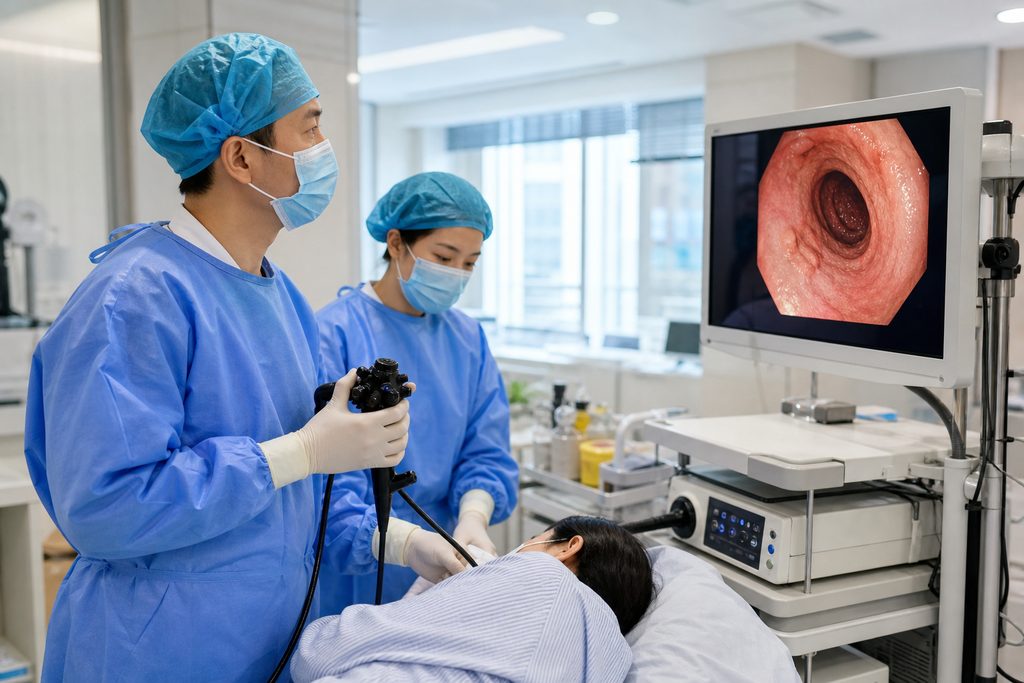
Zhongshan Hospital Fudan University is consistently ranked among China’s top 10 for gastroenterology in the Fudan specialty reputation rankings. Its endoscopy unit performs high volumes of endoscopic submucosal dissection, the technique used to remove early lesions without cutting out the stomach.
Peking Union Medical College Hospital in Beijing carries prestige across nearly every specialty and is a common first stop for complex referrals. The Cancer Hospital of the Chinese Academy of Medical Sciences focuses specifically on oncology and sees a deep bench of gastric cases.
West China Hospital in Chengdu is one of the largest single hospitals in the world by patient volume, with oncology and gastroenterology departments that rank near the top nationally.
You can browse these institutions by city on our Fudan Top 100 hospital directory, or filter by specialty on the oncology and gastroenterology department pages.
What It Costs — and What Drives the Variance
Endoscopic submucosal dissection at a top Chinese public hospital typically lands between $6,000 and $15,000. That figure usually bundles the procedure, anesthesia, a short hospital stay, pathology, and follow-up endoscopy.
A partial or total gastrectomy with lymph node dissection runs higher — $12,000 to $30,000 depending on the hospital tier and length of stay.
What pushes the number up or down:
- Hospital tier and whether you use the standard or international channel
- Whether the lesion needs one resection or a staged approach
- Length of stay and any complications
- Pre-operative workup you may need repeated in China
- Interpreter and companion costs
What’s usually not included: flights, accommodation, meals, and any treatment after you return home. Chinese public hospitals require prepayment; insurance is reimbursed afterward. Private international hospitals often bill insurers directly.
For context, coronary bypass in China’s top public hospitals costs $12,000–$20,000 against $120,000+ in the US. Gastric cancer care follows a similar ratio.
Practical Considerations for International Patients
Records come first. You’ll need your endoscopy report, biopsy pathology, CT or MRI imaging, and any lab work — translated into English or Chinese. Chinese specialists review these before you travel, which is exactly what a written second opinion is for.
On visas: medical travel to China uses the S2 visa, with a notation for medical treatment. Stays beyond 180 days require S1. Accompanying family members apply for S2 as well. Note that the M visa is strictly for commercial and trade activity — it is not a medical visa, despite what some outdated guides claim. Always confirm current requirements with your nearest Chinese embassy or consulate.
The scheduling reality is blunt: standard outpatient appointments cannot be reserved from overseas, and no procedure is scheduled until a doctor sees you in person. If you need a locked-in plan before flying, the international or VIP department is the realistic route — at roughly 1.5 to 2 times standard pricing.
Payment methods vary. Public hospitals generally accept international cards and wire transfers; confirm before arrival, since some departments prefer local payment channels.
Follow-up after you go home is the piece patients underestimate. Arrange a local oncologist before you leave China, and carry your operative and pathology reports with you.
Frequently Asked Questions
No — not directly. Public hospitals require an in-person consultation before scheduling any procedure. The workaround is remote evaluation first: send your records, get a written opinion or video consultation, then travel once a plan is feasible. This avoids flying blind.
The procedure itself is genuinely cheaper — often one-fifth to one-tenth of US pricing. But add flights, accommodation, a companion, and interpreter costs, and the gap narrows. For a $6,000–$15,000 endoscopic resection, the savings usually still hold. For minor procedures, they may not.
This is a real concern, not a hypothetical. Complications from endoscopic resection — bleeding, perforation, stricture — can appear weeks later. Have a local gastroenterologist identified before you leave, and make sure your Chinese hospital provides complete records in a language your home doctor can read. Continuity of care is your responsibility to arrange.
Your Next Step
Early gastric cancer found at the mucosa or submucosa stage is highly treatable, and China’s top hospitals handle these cases at volumes most Western centers never approach. The barrier isn’t quality — it’s navigation.
We’re China Medical Services, a coordination team that connects international patients with 340+ top-ranked hospitals across 37 cities. We are not a hospital and we don’t diagnose or treat anyone. What we do is translate your records, arrange a written second opinion or video consultation with the right specialty, and — if you decide to travel — handle appointments, bilingual accompaniment, and visa guidance. A written second opinion from a top hospital specialist starts at $300, and any consultation fee is credited in full toward on-the-ground coordination if you come within 90 days.
Start with a conversation, not a commitment. Tell us about your diagnosis and we’ll map the realistic options — no pressure, no obligation.
This article is for general information only and is not medical advice. Treatment decisions should be made with a qualified physician who has reviewed your individual case. Costs are estimates and vary by hospital and case complexity.
For more medical information and treatment options in China, visit chinamedservices.com (China Medical Services).
