Facelift Recovery in China: What to Expect Week by Week and Real Costs
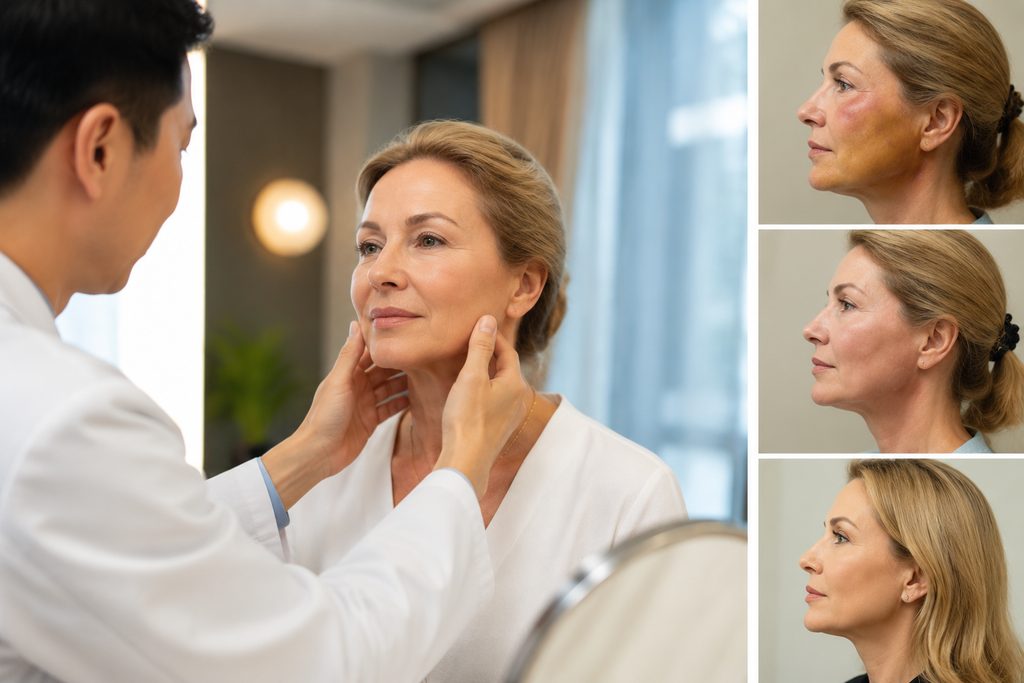
When 54-year-old Elena from Manchester started researching a facelift, the quotes she received at home stopped her cold. A full SMAS facelift with a reputable UK surgeon came in at £18,000 to £25,000. Recovery would mean two weeks hidden away, then months of subtle swelling she would have to manage around work. She wondered if there was another way. That search led her to questions about facelift cost China — and to a recovery process that was far more structured than she expected.
Elena’s situation is not unusual. The American Society of Plastic Surgeons reported that facelift procedures in the United States cost an average of $8,005 for the surgeon’s fee alone in 2023. That figure excludes anesthesia, operating room fees, and aftercare. In Western Europe, prices run higher still. But cost is only part of the story. Anyone considering surgery abroad needs to understand something more important: what recovery actually feels like, week by week, and how to plan for it.
Key Takeaways
- Facelift recovery follows a predictable timeline: visible bruising fades in 10-14 days, but residual swelling takes 3-6 months to fully resolve.
- In China, a full facelift at a top-tier public hospital‘s international department typically costs $4,000 to $8,000 — roughly one-third to half of Western prices.
- Language barriers and hospital navigation are real challenges; planning for interpretation support before you travel is essential.
- You should not book a flight home until a surgeon has cleared you to fly — usually 10 to 14 days after surgery.
The Problem: Facelift Recovery Is Longer and More Complex Than Most People Expect
A facelift is not a lunchtime procedure. It is real surgery. Skin is lifted, underlying muscle and connective tissue are repositioned, excess skin is removed, and incisions are closed under tension. Your body’s response to that is inflammation, swelling, bruising, and tightness. A 2022 review in Aesthetic Surgery Journal noted that patient satisfaction after rhytidectomy correlates strongly with realistic preoperative expectations about recovery duration. Patients who expect to look “normal” in a week are consistently disappointed.
So what does recovery actually look like? The first 48 hours involve significant swelling and the need to keep your head elevated at all times. Drains may be in place. By day five, most patients feel well enough to move around the house but still look visibly bruised. Social recovery — the point where strangers would not notice anything unusual — takes two to three weeks. Full tissue settling takes three to six months. That is the honest timeline.
And if you are planning surgery abroad, you need to add logistics to that timeline. You need somewhere to stay for at least two weeks. You need someone to check on you. You need a surgeon who will see you for follow-up before you board a long-haul flight. These are the questions that make or break the experience.
Why China Has Become a Serious Option for Facelift Surgery
Volume matters in facial surgery. A surgeon who performs 300 facelifts a year has seen more anatomical variation, more complication scenarios, and more healing patterns than one who performs 30. In China’s tier-one cities, top cosmetic surgery departments operate at scale. A single department at a major public hospital may perform over 1,000 facial aesthetic procedures annually. That repetition translates into efficiency in the operating room and fewer surprises in recovery.
When patients ask about facelift cost China, the answer is not a single number. It is a range shaped by hospital tier, surgeon seniority, and surgical technique. At a public hospital’s international department in Shanghai, a full SMAS facelift typically runs $4,000 to $8,000. At a private international hospital like Jiahui or United Family, expect $8,000 to $15,000. Compare that to the United States, where total costs including facility and anesthesia fees commonly reach $20,000 to $30,000. The gap exists because of lower labor costs, higher patient throughput, and a different hospital cost structure — not because of lower surgical standards.
China’s top hospitals are enormous. A single outpatient building can see 10,000 patients a day. Without Chinese language ability, navigating that system is nearly impossible. But major hospitals in Shanghai, Beijing, and Guangzhou operate dedicated international departments with English-speaking coordinators, priority scheduling, and private recovery rooms. These departments charge more than the standard public channel — roughly 1.5 to 2 times — but they are still far cheaper than Western private care. For a foreign patient recovering from facial surgery, that infrastructure is not a luxury. It is the difference between a smooth recovery and a stressful one.
What to Expect After Facelift Abroad: A Week-by-Week Recovery Timeline
Recovery from a facelift in China follows the same biological timeline as anywhere else. The difference is in how you plan around it. Here is what to expect, based on standard postoperative guidance from facial plastic surgery departments.
Days 1-3: The Acute Phase
You wake up with a compression dressing around your face and neck. Drains may be in place behind your ears. Swelling peaks around day two or three. Your face feels tight, numb in places, and sore rather than sharply painful. You must sleep with your head elevated at 30 to 45 degrees. You will not want to be alone. In China, many international patients stay in the hospital for the first one to three nights, which simplifies wound checks and drain removal.
Days 4-7: Drains Out, Bruising Peaks
Drains come out between day two and day four. Bruising often looks worse before it looks better — expect yellow and purple discoloration spreading down toward the jawline. Sutures or staples may be removed around day five to seven, depending on the surgeon’s technique. You can shower carefully. Walking is encouraged. You still look visibly “operated on,” but you are mobile.
Days 8-14: The Social Turning Point
This is when most patients feel ready to go out in public with light makeup. Bruising has faded enough to cover. Swelling is still present but soft, not dramatic. If you traveled to China for surgery, this is the window when your surgeon will typically clear you for a flight home — usually day 10 to 14. Flying earlier is not advisable. Cabin pressure changes and prolonged sitting increase the risk of swelling and, in rare cases, deep vein thrombosis.
Weeks 3-6: The Subtle Phase
You look presentable. Friends may say you look “rested.” But you still feel tightness, especially around the ears and neck. Numbness persists. Sleeping flat becomes comfortable again around week three or four. Exercise can resume gradually after week four, but heavy lifting and high-impact activity should wait for surgeon clearance.
Months 3-6: The Final Result
Residual swelling — the kind only you notice — takes months to fully clear. The final jawline definition and scar maturation take six months or more. Scars behind the ears fade from red to pale. This is the timeline no one wants to hear, but it is the truth.
Is Facelift Recovery Painful in China? What Patients Actually Report
The short answer: less painful than most people fear. A facelift is not a bone procedure. The pain is soft-tissue soreness, tightness, and occasional sharp twinges as nerves wake up. Most patients rate the pain as 3 to 4 out of 10 in the first few days, well-managed with oral analgesics. Chinese hospitals typically use a multimodal pain protocol — local anesthetic infiltration during surgery, oral acetaminophen and NSAIDs afterward, and ice packs as needed. Opioids are used far more sparingly than in the United States, which many patients prefer.
What surprises patients more than pain is the tightness. Your face feels pulled, especially when you turn your head or open your mouth wide. That sensation fades over weeks, but it is the most common complaint in the first month. Numbness around the ears and upper neck can last for months. None of this is unique to China — it is the nature of the surgery — but knowing it in advance makes the experience manageable.
Practical tip: If you are considering facelift packages China medical tourism, ask specifically what the package includes. Some include hospital stay, translator, and hotel recovery time. Others cover only the surgical fee. Get the breakdown in writing before you commit.
How Long Is Facelift Recovery in China? Planning Your Stay
The biological recovery is the same as anywhere. But the practical answer to how long is facelift recovery in China depends on your travel plan. You should budget a minimum of 14 days in-country. That allows for preoperative consultation and tests, surgery day, early postoperative care, suture removal, and a final clearance check before flying. If you want to do any sightseeing — and Shanghai and Beijing are worth seeing — add another week. But do not plan active tourism during the first 10 days. Your face needs rest, not pollution and crowds.
Here is what a realistic 14-day surgical trip looks like:
| Day | Milestone | What You Can Do |
|---|---|---|
| Day 1 | Preoperative consultation and blood work | Light sightseeing, finalize surgical plan |
| Day 2 | Surgery | Hospital overnight or nearby hotel with nurse check |
| Days 3-4 | Drain removal, first wound check | Rest, short walks indoors |
| Days 5-7 | Suture removal, bruising peaks | Light walking, reading, quiet meals |
| Days 8-13 | Bruising fades, swelling softens | Museums, gentle shopping, restaurants |
| Day 14 | Final surgeon check, flight clearance | Fly home |
Choosing a Surgeon: What the Numbers Mean and What They Hide
Searching for the best facelift surgeon Shanghai price will return a mix of hospital websites, medical tourism agencies, and review platforms. The challenge is that “best” is not a regulated term. A surgeon with a polished website and strong English may be a junior attending. A senior professor with 25 years of experience may speak no English and have no online presence. This is where the structure of China’s hospital system actually helps.
Public hospitals in China rank their clinical staff by title: attending physician, associate chief physician, and chief physician. The chief physician title requires years of clinical practice, published research, and peer review. When you book through an international department, you can request a chief physician with specific experience in facial rejuvenation. That title is not a guarantee of aesthetic skill — no title is — but it is a verifiable credential that means something. In the United States, by contrast, any board-certified plastic surgeon can market themselves as a “facelift specialist” regardless of annual procedure count.
You should also ask three questions before committing to any surgeon, in China or elsewhere:
- How many facelifts do you perform per year? (Look for at least 50; top-volume surgeons do 200+)
- What technique do you recommend for my face, and why? (SMAS, deep plane, MACS lift — each has trade-offs)
- What is your revision policy if I am unhappy with the result? (A surgeon who dismisses this question is a red flag)
Practical Considerations: Documentation, Visa, and Payment for Surgery in China
Planning a facelift in China involves more than choosing a surgeon. You need the right visa, the right payment method, and a plan for aftercare when you return home.
Visa: Foreign nationals traveling to China for medical treatment apply for an S2 visa, which covers short-term private affairs including medical care. The hospital’s international department will issue an invitation letter and treatment confirmation, which you submit with your application. Family members accompanying you also apply for S2 visas. Processing typically takes one to two weeks. Do not book flights until the visa is approved.
Payment: Public hospitals in China require prepayment. International departments accept major credit cards and bank transfers. Private international hospitals may bill your insurance directly if you have a policy with international coverage. Most patients pay out of pocket and seek reimbursement later. Confirm the payment schedule before you travel — some hospitals require a deposit of 30% to 50% to schedule surgery.
Records: Bring any previous facial surgery notes, current medication list, and allergy information. If you have had fillers or threads in the face, tell the surgeon — they affect the surgical plan. You will need to stop blood-thinning medications and supplements like fish oil, vitamin E, and ginkgo at least two weeks before surgery.
Follow-up at home: Before you leave China, ask for a written operative report and a postoperative care plan. Your home surgeon or family doctor can manage late wound checks if needed. Scar care — silicone sheets or gel — starts around week three and continues for months. You do not need to return to China for routine follow-up, but you should have a way to contact the surgical team if questions arise.
Our team at China Medical Services works with patients to coordinate these logistics — hospital selection, appointment scheduling, interpretation, and recovery support. We do not perform surgery and we do not make medical decisions. We handle the coordination so you can focus on healing.
Frequently Asked Questions
Is a facelift in China safe?
Safety depends on the hospital and surgeon you choose, not the country. Top-tier public hospitals in Shanghai and Beijing follow international surgical safety protocols, including preoperative clearance, sterile technique, and postoperative monitoring. The risk comes from choosing an unaccredited clinic based on price alone. Stick to hospital-affiliated departments with verifiable surgeon credentials.
How much does a facelift actually cost in China?
At a public hospital’s international department, expect $4,000 to $8,000 for a full SMAS facelift. Private international hospitals charge $8,000 to $15,000. These figures include surgeon, anesthesia, and hospital fees but exclude travel, accommodation, and aftercare supplies. Prices vary by surgeon seniority and case complexity.
What if I have a complication after I fly home?
Serious complications after facelift surgery are rare — hematoma occurs in roughly 1% to 3% of cases, and infection in under 1%. Most issues that do arise happen in the first 72 hours, while you are still in China. Before you leave, your surgeon will assess your wounds and clear you for travel. You should also have a local contact at home — a family doctor or plastic surgeon — who can see you if a late issue develops. The Chinese surgical team should provide a written report to share with that local clinician.
Will I look “overdone” or unnatural?
The “wind-tunnel” look comes from aggressive skin-only lifts and poor technique, not from geography. Chinese plastic surgeons trained in modern SMAS and deep plane techniques aim for natural repositioning, not stretching. The best way to avoid an unnatural result is to choose a surgeon who shows you before-and-after photos of patients with faces similar to yours, and to be clear about your goals in the preoperative consultation.
Can I combine a facelift with other procedures?
Yes, and many international patients do. Common combinations include upper blepharoplasty (eyelid surgery), brow lift, and neck liposuction. Combining procedures reduces total anesthesia exposure and overall cost compared to separate surgeries. But it also extends recovery time. Discuss the trade-offs with your surgeon during the consultation phase.
Your Next Step
Facelift recovery is a real commitment, whether you have surgery at home or abroad. The advantage of planning it in China is that the cost savings are substantial and the hospital infrastructure in major cities is strong. The disadvantage is the distance from home and the need to manage logistics in a foreign system.
That is what we do at China Medical Services. We are not a hospital and we do not provide medical advice. We help you identify suitable hospitals, coordinate appointments, arrange interpretation, and plan your recovery stay. If you are considering a facelift in China, start with a conversation about your goals and timeline. The
For more medical information and treatment options in China, visit chinamedservices.com (China Medical Services).
