Finger Replantation Surgery Cost in China: 2026 Price Guide for Foreigners
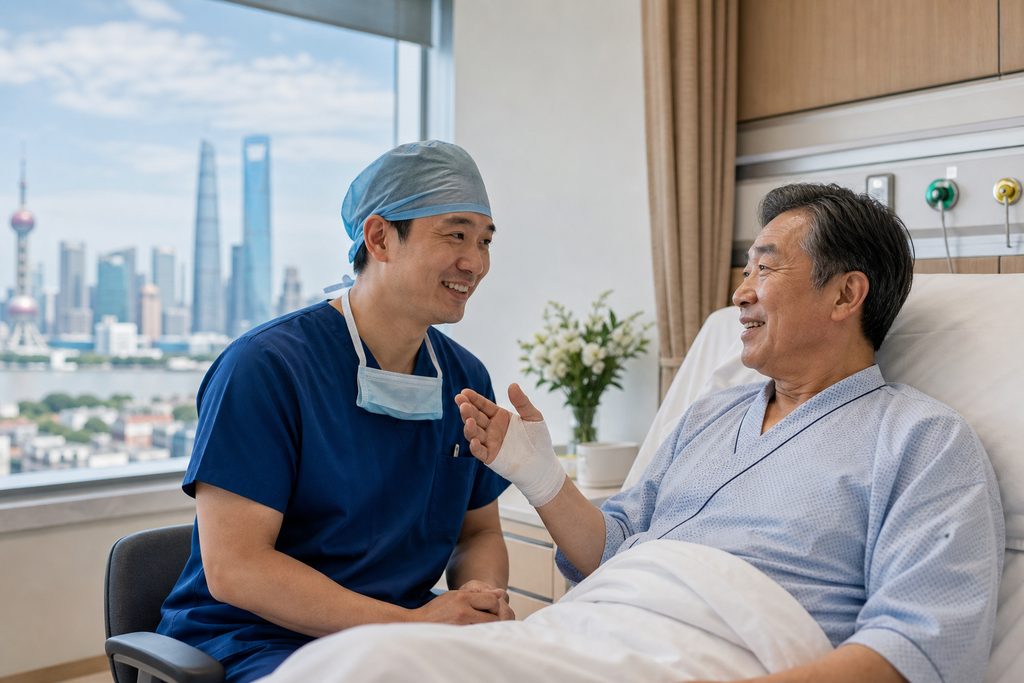
Finger Replantation Surgery Cost in China: A Complete Guide for International Patients
When 38-year-old Marcus lost the tip of his right index finger to a table saw in his garage workshop, his first thought was the emergency room. His second, three hours later, was the bill. Finger replantation surgery cost in China typically runs between $8,000 and $25,000 at top-tier public hospitals — a fraction of the $50,000 to $100,000 a comparable microsurgical procedure costs in the United States. That gap is why a growing number of Western patients now ask whether flying to Beijing or Shanghai for emergency hand surgery makes sense.
The honest answer is: sometimes yes, sometimes no. Replantation is time-critical. Muscle and nerve tissue begin to die within hours of devascularization, and the window for a successful reattachment is measured in hours, not days. Understanding that constraint is the first step toward making a rational decision.
Finger Replantation Surgery Cost in China: The Short Answer
At a leading Chinese public hospital, replantation of a single digit costs roughly $8,000–$18,000. Multi-digit or thumb replantation, which demands longer operating time and more complex vessel grafting, pushes into the $15,000–$25,000 range. Private international hospitals in Shanghai and Beijing charge 1.5 to 2 times those figures but offer English-speaking staff and direct insurance billing.
What complicates every quote is that no surgeon can price a replantation before seeing the injury. A clean guillotine amputation at the proximal phalanx is a different operation from an avulsion injury with crushed vessels. The cost depends on the level of amputation, the number of digits, whether veins must be grafted, and how long the surgery runs. Any figure you see online — including ours — is a planning range, not a binding estimate.
Key takeaway: Chinese public hospitals deliver replantation at roughly one-fifth to one-eighth of US prices. But replantation is an emergency procedure. If you are reading this with a fresh injury, call local emergency services first — do not book a flight.
Who This Is Right For — and Who It Isn’t
Medical tourism for hand trauma is not the same as medical tourism for a hip replacement. Timing rules everything.
Reasonable candidates for treatment in China:
- Patients with a planned or semi-elective reconstruction — for example, a failed previous replantation needing revision, a non-union, or a delayed tendon and nerve reconstruction
- People already in Asia, or able to reach a Chinese city within the surgical window
- Patients whose home-country quote is financially out of reach and whose injury is stable enough to travel
- Those needing complex microsurgical revision that few centers worldwide perform
Who should not pursue this:
- Anyone with a fresh, warm-ischemia amputation. Get to the nearest emergency department. Now.
- Patients with uncontrolled diabetes, active infection, or significant vascular disease, where replantation failure rates climb sharply
- Crush or avulsion injuries with destroyed vessels — many of these are not replantable anywhere, and a second opinion may confirm that
- Anyone who cannot tolerate a long flight or a 6–12 hour operation
Being blunt here matters. A clinic that tells every amputee “yes, come” is not giving you medical advice. It is giving you a sales pitch.
The Options, Compared
Here is how the realistic alternatives stack up on cost and access. Figures are planning ranges for a single-digit replantation and vary by hospital and case complexity.
| Option | Typical Cost (USD) | Wait / Access | English Support | Insurance |
|---|---|---|---|---|
| US hospital (emergency) | $50,000–$100,000+ | Immediate (ER) | Yes | Billed, then reimbursed |
| Western Europe (public) | $0–$15,000 out-of-pocket | Immediate if emergency | Varies | Often covered |
| China — top public hospital | $8,000–$18,000 | Emergency or scheduled | Limited; interpreter advised | Prepay, reimburse later |
| China — private international hospital | $15,000–$30,000 | Scheduled | Full | Direct billing common |
| China — multi-digit / thumb | $15,000–$25,000 | Emergency or scheduled | Limited; interpreter advised | Prepay, reimburse later |
Which column suits you? If you are a US patient with good insurance and a fresh injury, the ER down the street is almost always the right call — the out-of-pocket maximum caps your exposure, and time is tissue. If you are uninsured, underinsured, or facing a reconstruction that your local system has quoted at five figures, the Chinese public tier becomes genuinely attractive. And if language and logistics are your main worry, the private international tier buys you peace of mind for a real premium.
Finding the Best Microsurgery Hospital in China for Finger Replantation
China’s strength in replantation is not marketing. It is volume. Chinese hand surgery units handle a caseload that few Western centers can match, and high volume correlates with refined technique. The country’s 35,000+ hospitals include a top 5% ranked by the Fudan University Hospital Rankings and JCI accreditation, and several of those sit at the global forefront of microsurgery.
When patients ask where to go, we point to two things: the Fudan specialty reputation rankings and the hospital’s actual microsurgery department, not its general orthopedic reputation. A hospital can be famous for joint replacement and still not be the right place for a digital artery anastomosis. You can browse the ranked hand and microsurgery programs through our department-by-department Top 10 listings, which cover 45 specialties including orthopedics and plastic surgery.
Geography matters too. Beijing hosts 21 of the Fudan Top 100 hospitals, Shanghai 18, and Guangzhou 10. For international patients, Shanghai and Beijing have the deepest English-language infrastructure, while Guangzhou and Shenzhen serve many Southeast Asian patients. City pages such as our Shanghai guide break down which hospitals serve foreign patients and how to reach them.
Practical tip: Ask any hospital one question before committing — “How many replantations does your unit perform per year, and what is your revision rate?” A confident microsurgery department will answer. A vague one will change the subject.
How Much Does Finger Replantation Cost in Shanghai?
Shanghai deserves its own section because it is the most common destination for international hand patients, and its pricing reflects that. At a top public hospital in Shanghai, a single-digit replantation generally lands between $9,000 and $18,000. Private international hospitals in the city — the ones with English-speaking surgeons and direct insurance billing — run $16,000 to $30,000 for the same procedure.
What drives the spread within a single city? Four factors, mostly.
- Level of amputation. Distal tip replantation is technically demanding but short. Proximal replantation near the palm requires more vessel and nerve repair and longer anesthesia.
- Number of digits. Each additional digit adds operative time, sometimes non-linearly.
- Vein grafting and revision. If the surgeon must harvest vein grafts to restore outflow, add $2,000–$5,000.
- Length of stay. Replanted digits need monitoring for vascular compromise, often 5–10 days inpatient.
Beijing prices track Shanghai closely. The “Beijing vs abroad” comparison is where the gap opens widest — a Beijing public hospital quote of $12,000 against a US quote of $70,000 is not unusual for the same injury.
Is Finger Replantation Safe in China Hospitals?
Safety is the question every patient asks last and worries about first. The answer depends entirely on which tier you choose.
At China’s top public hospitals, microsurgical outcomes are internationally comparable. These are high-volume units with experienced hands, modern operating microscopes, and established postoperative monitoring protocols. The catch is not clinical quality — it is the patient experience. Public hospitals are enormous, with outpatient volumes exceeding 10,000 visits per day at the largest institutions. Signage, forms, and most staff communication are in Chinese. Without a bilingual companion, a foreign patient can get lost in the system even after a successful operation.
Private international hospitals solve the language problem and offer Western-style care, JCI accreditation, and direct insurance billing. What they may lack is the sheer microsurgical volume of a dedicated public hand unit. For a straightforward replantation, either tier can work. For a complex avulsion or a revision of a failed replant, the high-volume public unit is usually the stronger choice.
Caution: Replantation is not guaranteed to succeed anywhere. Published failure rates for digital replantation range widely depending on injury type, and even the best centers see some digits fail. Ask about revision options before surgery, not after.
Practical Considerations for International Patients
Several logistics apply specifically to this procedure and are worth planning before you travel.
Records and imaging. Bring your original injury imaging, operative notes from any prior surgery, and a clear timeline of the injury. Chinese surgeons will want to see the mechanism of injury and any previous attempts at repair. If you had a failed replantation elsewhere, the prior operative report is essential.
Visa. For medical treatment in China, the applicable short-stay category is the S2 visa, which covers medical treatment and private affairs; stays beyond 180 days fall under S1. Accompanying family members also apply under S2. Requirements are set by the latest embassy and consulate guidance, and supporting hospital documents are part of the application. Note that the M visa is for commercial and trade activities and is not the medical route. Approval is never guaranteed, so build in time.
Payment. Chinese public hospitals require prepayment; you settle the bill and seek reimbursement from your insurer afterward. Private international hospitals more often bill insurers directly. Bring a payment method that works internationally and confirm the deposit amount in writing.
Follow-up after you return home. Replantation recovery involves weeks of hand therapy, and hand therapists in your home country may not be familiar with the specific repair. Arrange a local therapist before you leave China, and ask your Chinese surgeon for a written protocol you can hand over.
Frequently Asked Questions
Almost never for a fresh injury. Warm ischemia time is short, and a flight of 10+ hours will likely cost you the digit. Go to your nearest emergency department. Travel to China makes sense for planned reconstruction, revision of a failed replant, or a stable injury where your local options are financially out of reach.
Rarely. Most quotes cover surgeon fees, operating room time, anesthesia, and a set number of inpatient days. They typically exclude implants or vein grafts, extended ICU monitoring, take-back surgery if circulation fails, medication after discharge, and hand therapy. Ask for an itemized estimate and a written statement of what happens financially if a revision is needed.
This is the hardest scenario, and you should plan for it before surgery. A failed replant may require amputation revision or a secondary reconstruction. Discuss with your surgeon what follow-up support they can offer remotely, and identify a hand surgeon near your home who is willing to take over care. Do not assume the Chinese hospital can manage a complication from 6,000 miles away.
For a single-digit replantation, expect 5–10 days inpatient for vascular monitoring, sometimes longer for multi-digit cases. Total time in China, including pre-op assessment and a post-op check before flying, is commonly two to three weeks.
At a public hospital, yes — strongly recommended. At a private international hospital, less so, though it still helps with registration and scheduling. A bilingual medical companion handles queuing, registration, payment, and translation so you can focus on recovery.
Your Next Step
If you are weighing finger replantation or revision surgery in China, the sensible first move is a written second opinion, not a plane ticket. Send your imaging and operative reports, and a Chinese microsurgery team can review them and tell you whether the procedure is feasible, what it would likely cost, and how long you would need to stay.
We are China Medical Services, a coordination service — not a hospital, and we do not diagnose or treat. We connect international patients with 340+ top-ranked hospitals across 37 cities, arrange written second opinions and video consultations, and provide bilingual companions on the ground. If it would help to talk through your situation, start with a free consultation. No pressure, and no obligation to travel.
This article is for general information only and is not medical advice. Treatment decisions should be made with a qualified physician who has reviewed your individual case. Costs are planning ranges that vary by hospital and case complexity.
For more medical information and treatment options in China, visit chinamedservices.com (China Medical Services).
