Flying After Cataract Surgery: What Medical Tourism to China Really Involves
Flying After Cataract Surgery: What Medical Tourism to China Really Involves
You have probably been told that combining eye surgery with international travel is reckless. The truth is more nuanced. Thousands of patients travel for cataract surgery every year, and the question is not whether flying after cataract surgery is possible — it is whether the timing and the logistics are managed properly. When you look at the cataract surgery cost China offers compared to Western prices, the gap is wide enough that many patients seriously consider the trip. But the surgery itself is only half the equation. The other half is knowing when your eye is stable enough to board a plane, and how to arrange everything in between.
How This Actually Works, Step by Step
Here is the real sequence, stripped of marketing language.
Step one: You send us your existing eye examination reports — biometry readings, OCT scans, corneal topography, your current prescription, and any relevant medical history. These are the documents a Chinese ophthalmologist needs to evaluate your case remotely.
Step two: The relevant specialty team at a partner hospital reviews your file. They provide a written second opinion covering whether you are a suitable candidate, which intraocular lens (IOL) options make sense, and what the likely surgical approach would be. This typically costs $300–500 and takes three to seven business days depending on how quickly your records are translated and reviewed.
Step three: If you want to speak directly with the medical team, a video consultation can be arranged — $100–300 with a standard hospital international department, or $500–800 with a top-tier specialist. You explain your symptoms and goals; they explain what they can and cannot do.
Step four: Once a plan is agreed, we coordinate your hospital appointment. This is where the practical reality of Chinese public hospitals matters: routine outpatient slots cannot be booked from overseas in advance. You generally register on the day. If you want to lock in a specific surgeon and a specific surgical date before you fly, that requires the hospital’s international or VIP channel, which typically costs 1.5 to 2 times the standard fee.
Step five: You arrive, attend the in-person consultation, complete pre-operative testing, and undergo surgery — usually on a separate day from the initial consultation.
Step six: Post-operative checks happen the next day, then again at roughly one week. Only after the surgeon clears you should you book your flight home.
Can I Fly After Cataract Surgery — and How Soon?
This is the question that drives most searches, so let us answer it directly.
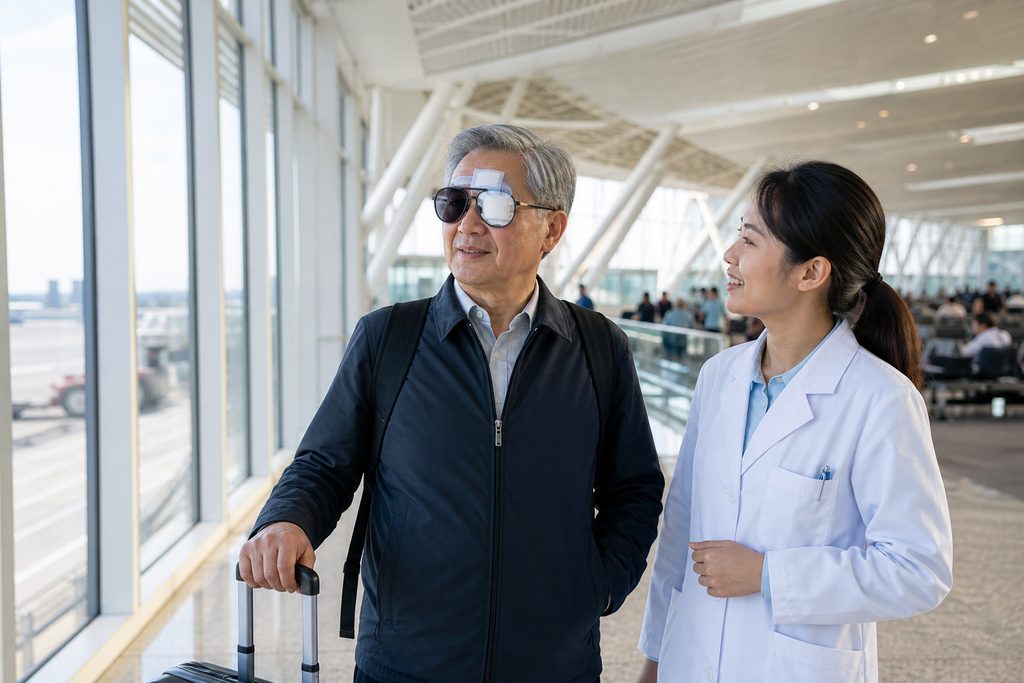
Most ophthalmologists advise waiting at least one week after uncomplicated cataract surgery before flying. Some say 24 to 48 hours is acceptable for a short flight if there are no complications. Others prefer a full week. The variation exists because the real concern is not cabin pressure itself — modern aircraft are pressurized to a cabin altitude of roughly 6,000 to 8,000 feet, which does not harm a healing eye. The concerns are dry cabin air, the physical strain of travel, and the difficulty of getting urgent follow-up care if something goes wrong mid-flight.
Here is the practical rule our team relays to patients: do not book your return flight until your surgeon has examined you at the post-operative check and explicitly cleared you to travel. That usually means planning for a stay of at least seven to ten days in China.
If your surgery involved a complication — a torn capsule, significant inflammation, or a secondary procedure — the waiting period may extend to two weeks or longer. Your surgeon’s clearance overrides any general guideline you read online.
How Soon Can I Fly After Cataract Surgery If I Choose a Premium Lens?
The type of intraocular lens does not typically change the flying timeline, but it does change your visual recovery curve. Monofocal lenses settle quickly. Multifocal and toric lenses can take several weeks for your brain to adapt to the new optics, and some patients notice halos or glare at night during that period. Flying with these temporary visual disturbances is not dangerous, but it can be uncomfortable and disorienting in an unfamiliar airport.
If you are considering a premium lens, factor in an extra few days before your return flight. And ask your surgeon specifically about night vision before you travel, because overnight flights in a dim cabin are the worst-case scenario for someone still adapting to a multifocal implant.
A Realistic Timeline
Every case differs, but here is a realistic range based on how our coordination process typically unfolds. The waiting steps people forget — document translation, appointment lead time, visa processing — are included.
| Stage | What Happens | Typical Duration |
|---|---|---|
| Records collection | You gather eye exam reports and medical history | 3–7 days |
| Translation and review | Documents translated; specialty team reviews | 3–7 business days |
| Written second opinion | Report returned with surgical assessment | Included above |
| Video consultation (optional) | Direct discussion with the medical team | Scheduled within 1–2 weeks |
| Visa application (S2) | Short-stay visa for medical treatment | 4–15 business days, varies by consulate |
| Travel and arrival | Flight to China, airport transfer, hotel check-in | 1–2 days |
| In-person consultation and pre-op testing | Examination, biometry confirmation, surgical planning | 1–2 days |
| Surgery | Usually 15–30 minutes per eye | Day of procedure |
| Post-op check one | Next-day examination | Day 1 after surgery |
| Post-op check two | One-week review; travel clearance given | Day 7 after surgery |
| Return flight | Only after surgeon clearance | Day 7–10 onward |
Total time from first contact to flying home: roughly four to eight weeks, depending on visa speed and how quickly you gather your records. If you need surgery on both eyes, many surgeons stage the procedures one to two weeks apart, which extends the stay.
What Can Go Wrong — and What Happens Then
Honest failure modes matter more than success stories.
Your records are incomplete. This is the most common delay. Without proper biometry and corneal imaging, no surgeon can recommend a lens. We will tell you exactly what is missing, but gathering it depends on your home eye doctor. Budget extra time.
You are not a suitable candidate. Severe corneal disease, uncontrolled glaucoma, or active infection may rule out surgery. A written second opinion exists precisely to catch this before you buy a plane ticket.
The visa is delayed. S2 processing times vary by consulate and season. Apply early. Never book non-refundable flights before the visa is in hand.
A complication occurs after you fly home. This is the scenario nobody wants. If you experience sudden pain, vision loss, or a shadow in your field of vision after returning home, you need to see an ophthalmologist immediately — not wait for a scheduled follow-up. Before you leave China, ask your surgeon for a written post-operative summary in English that your home doctor can act on.
The surgical date shifts. Hospital schedules can change. We coordinate, but we do not control the operating room. Build a buffer into your travel plans.
Choosing Where to Have Surgery: Beijing, Shanghai, or Elsewhere
If you are searching for the best eye hospital in Beijing for cataract surgery, you will find several top-tier public hospitals with dedicated ophthalmology departments and high surgical volumes. Beijing has the largest concentration of Fudan-ranked hospitals in China — 21 of the top 100. Shanghai follows with 18.
Patients who want to book cataract surgery Shanghai often choose it for a different reason: the city has a strong cluster of private international hospitals with English-speaking staff, JCI accreditation, and direct insurance billing. That combination reduces friction for foreign patients considerably.
The trade-off is straightforward. Public hospitals offer lower prices and enormous surgical experience. Private international hospitals offer convenience and language support at a higher cost. Both are legitimate choices. Our directory of top-ranked Chinese hospitals lets you compare by city and specialty, and the ophthalmology department rankings show which institutions carry the strongest reputations in eye care.
Practical Considerations: Records, Visa, Payment, and Follow-Up
Records. Bring printed copies of everything, plus digital files. Chinese hospitals may want to repeat certain tests, but having your baseline data speeds the process.
Visa. Foreign patients coming to China for medical treatment typically apply for the S2 visa, which covers short stays for medical treatment and private affairs. Family members accompanying you apply for the same category. Requirements change, so confirm current rules with your nearest Chinese embassy or consulate. The M visa is for commercial and trade activities — it is not a medical visa.
Payment. Public hospitals require prepayment; you seek reimbursement from your insurer afterward. Private international hospitals often bill insurance directly. Confirm your coverage before committing.
Language. China’s top hospitals handle enormous patient volumes daily. Without Mandarin, navigating registration, payment, and pharmacy queues is genuinely difficult. A bilingual medical companion handles those logistics so you can focus on your recovery.
Follow-up at home. Arrange a post-operative appointment with your local eye doctor before you travel. Give them your surgical summary when you return.
Frequently Asked Questions
Most surgeons advise against it. While cabin pressure itself is not harmful, the risk of undetected complications and the lack of immediate follow-up care make same-day or next-day flights unwise. Wait for your surgeon’s clearance, which usually comes at the one-week post-operative check.
The cataract surgery cost China offers is generally a fraction of US prices. Standard phacoemulsification with a monofocal lens typically runs $1,500–3,500 per eye at top public hospitals, while the same procedure in the US often exceeds $6,000–10,000 per eye without insurance. Premium lenses and private international hospitals cost more. Final pricing varies by hospital and case complexity.
Often yes, but surgeons usually stage the procedures one to two weeks apart to allow the first eye to stabilize and to reduce the risk of bilateral complications. That extends your stay in China to roughly two to three weeks minimum.
Contact your local ophthalmologist immediately. Do not wait for a routine appointment. This is why we insist patients leave China with a written post-operative summary in English — it gives your home doctor the information they need to act quickly.
Your Next Step
The core message is simple: flying after cataract surgery is manageable when the timing is planned around your surgeon’s clearance, not your airline’s schedule. The savings are real, but they only materialize if the logistics are handled properly from the start.
China Medical Services connects international patients with 340+ top-ranked hospitals across 37 cities. We are not doctors and we do not provide medical advice. We handle the coordination — records, appointments, bilingual accompaniment, visa guidance — so you can make an informed decision without pressure. If you would like to understand your options, start with a free consultation and we will walk you through what is realistic for your case.
For more medical information and treatment options in China, visit chinamedservices.com (China Medical Services).
