Inpatient Companion: Meals and Dietary Help in China
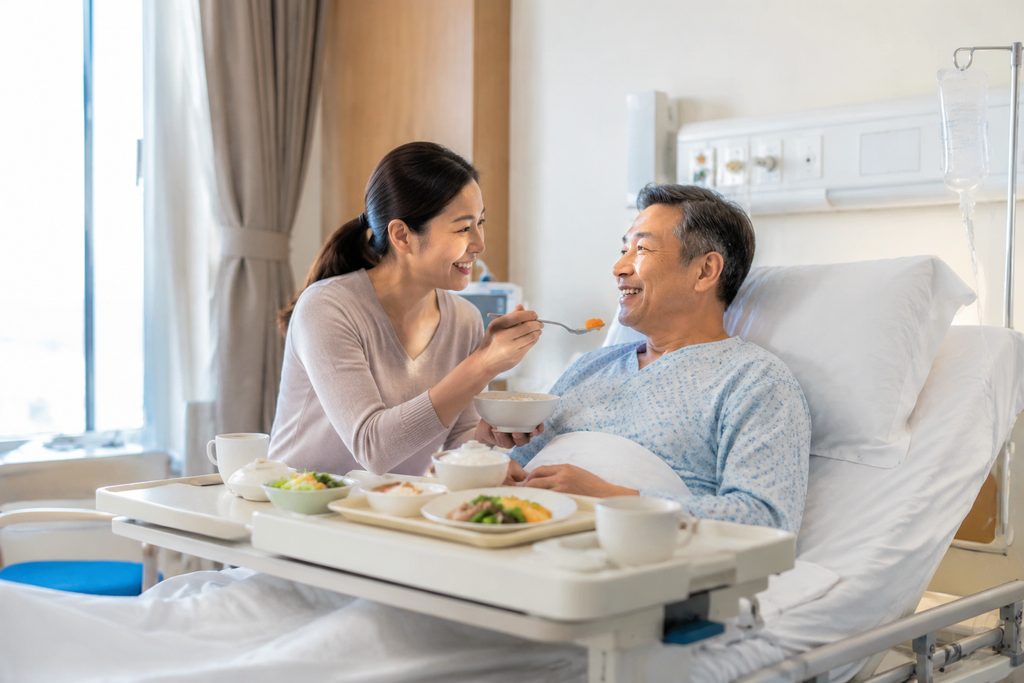
When 52-year-old Omar from Riyadh scheduled his cardiac procedure at a Shanghai hospital, his first question wasn’t about the surgery. It was about food. He has strict halal requirements, and his wife wanted to know whether she could stay with him and what she would eat during the two-week recovery. These are the questions nobody thinks to ask until they’re already packing.
The short answer: yes, inpatient companion meal services exist in Chinese hospitals, and they’re more affordable than you might expect. But the details vary enormously between a public hospital’s international ward and a private facility like United Family or Jiahui. Let’s break down exactly what you’ll pay, what you’ll get, and how to arrange dietary support before you travel.
Inpatient Companion Meal Service Cost China: The Short Answer
For most public hospital international departments in Beijing, Shanghai, and Guangzhou, a companion’s daily meal plan runs between $8 and $25 per day. That typically covers three basic Chinese meals delivered to the ward. If you need Western meals, halal certification, or a dedicated companion room with meal service, expect to pay $30 to $60 per day. Private international hospitals charge more — often $50 to $100 daily for a companion meal package — but the food quality and dietary flexibility are significantly better.
The caveat: “meal service” in a Chinese public hospital usually means the patient’s tray, plus an extra portion for the companion. It does not mean a menu with choices. You eat what the hospital kitchen prepares that day, unless you’ve made prior arrangements through the international department.
Who This Is Right For — and Who It Isn’t
Hiring a bilingual companion who also handles meals and dietary coordination makes sense in specific situations.
Good candidates:
- Patients traveling alone who need someone to order food, verify ingredients, and communicate with the ward kitchen
- Family members with strict religious or medical dietary needs (halal, kosher, gluten-free, diabetic)
- Elderly patients who need assistance eating or monitoring fluid and calorie intake
- Parents with a hospitalized child, where one adult must stay on the ward around the clock
Who should not pursue this:
- Patients at private international hospitals with English-speaking dietary staff — you likely don’t need an extra companion for meals
- Short-stay patients (under 3 days) who can manage with restaurant delivery apps
- Anyone expecting hospital kitchens to replicate Western meal plans exactly — Chinese hospital food is Chinese hospital food
Being explicit about that last point matters. If you need precise macronutrient control or very specific Western dishes, you’ll need to arrange outside food delivery, not hospital meal service.
The Options, Compared
Here’s what you’re actually choosing between when you think about meals and dietary help during an inpatient stay in China.
| Option | Daily Cost (Companion) | Dietary Flexibility | Who Handles It | Best For |
|---|---|---|---|---|
| Public hospital standard companion tray | $8–25 | Low — fixed daily menu | Ward kitchen | Budget-conscious stays, flexible eaters |
| Public hospital international ward meal package | $30–60 | Moderate — some choice, advance requests honored | International department coordinator | Halal, vegetarian, or soft-diet needs |
| Private international hospital companion plan | $50–100 | High — Western menu, allergen labeling | In-house dietary team | Families wanting familiar food, less stress |
| Bilingual companion + outside food coordination | $300/day (companion fee, meals separate) | Highest — any restaurant or delivery | Your hired companion | Strict religious diets, complex needs |
If you’re staying at a public hospital and your dietary needs are simple, the standard companion tray is fine. If you need halal in Beijing or gluten-free in Shanghai, the international ward package — or a bilingual companion who can order from outside — is worth the extra cost.
What Meals Are Provided for Medical Tourists in Chinese Hospitals
This is the question we get most often from patients planning a stay longer than a week. The honest answer: it depends entirely on the hospital tier.
Public hospital wards serve Chinese-style meals: rice porridge for breakfast, a meat and vegetable dish with rice for lunch, something lighter for dinner. The international departments of top hospitals like Peking Union Medical College Hospital or Zhongshan Hospital offer a slightly upgraded version — often with a Western breakfast option and the ability to request no pork, no shellfish, or vegetarian preparation.
Private hospitals are a different world. Jiahui, United Family, and Parkway Health all maintain Western-style menus with clear allergen labeling. Some have in-house dietitians who will meet with you on admission day. That’s the difference between a $25 companion tray and a $100 meal plan — the latter includes actual dietary assessment, not just food delivery.
Dietary Assistance During Hospital Stay Shanghai Price
Shanghai deserves its own section because it has the widest price spread in China.
At a public hospital’s international ward in Shanghai, dietary assistance — meaning a coordinator who arranges your companion’s meals, communicates with the kitchen, and handles special requests — adds roughly $20 to $40 per day on top of the base meal cost. At a private hospital like Jiahui, the same service is bundled into the companion package, which runs $70 to $100 daily.
What drives the variance? Hospital location (Pudong vs. Puxi), whether the companion stays overnight in the patient’s room or a separate companion room, and the complexity of the dietary request. A simple “no pork” request costs nothing extra. A full halal certification with separate prep area may require the hospital to source from an outside vendor, which adds $15 to $30 daily.
Can I Get Halal Food as Inpatient in Beijing Hospital
Yes, but you need to arrange it before admission — not after you’re in the bed.
Beijing’s large public hospitals serve a significant Muslim patient population, especially those near the Niujie area. Many have halal-certified kitchen sections or contracts with halal food suppliers. The international departments at Peking Union and Beijing Friendship Hospital can usually accommodate halal requests with 48 to 72 hours’ notice.
But here’s the catch: “halal” in a Chinese public hospital context typically means no pork and meat sourced from halal-certified suppliers. It does not always mean a fully separate preparation area. If that level of strictness matters to you, a private hospital or a bilingual companion who sources meals from Beijing’s halal restaurants is the safer route.
How Do I Order Special Diet Meals in Chinese Hospital
The process is straightforward if you know the sequence.
First, notify the international department when you book your admission. Tell them your dietary restrictions in writing. Second, on admission day, ask to speak with the ward’s dietary coordinator — every hospital ward has one, though they rarely speak English. Third, if you’ve hired a bilingual companion, have them confirm the restrictions with the kitchen directly and check the first meal that arrives.
Do not assume the message got through. Hospital kitchens in China serve thousands of meals daily. A “vegetarian” request can easily become “no beef” if the note gets lost. Verify the first tray. Check it again the next day. This is exactly the kind of detail work a companion handles.
Private Hospital Meal Plan for International Patients China
If food quality and dietary precision are non-negotiable for you, book a private international hospital.
The meal plans at facilities like United Family Healthcare or Raffles Hospital include a Western menu, allergen labeling, and the ability to speak directly with a dietitian. Companion meal plans run $50 to $100 daily, but you’re paying for certainty — not just calories. You know what’s in the food, you can request modifications, and you won’t spend every meal wondering whether the kitchen understood “no dairy.”
The trade-off is cost. A two-week companion meal plan at a private hospital in Shanghai can run $700 to $1,400. The same two weeks at a public hospital’s international ward might cost $200 to $500. That’s a meaningful difference, especially when you’re already paying for surgery and travel.
What It Costs
Let’s put concrete numbers on a typical two-week inpatient stay with a companion.
| Expense | Public Hospital International Ward | Private International Hospital |
|---|---|---|
| Companion meal plan (14 days) | $420–840 | $700–1,400 |
| Dietary coordination (one-time) | $50–150 | Usually included |
| Bilingual companion (if hired, 14 days) | $4,200 | $4,200 (or not needed) |
| Outside food delivery (if hospital food unsuitable) | $15–40/day | Rarely needed |
The companion fee of $300 per day is for a full bilingual medical companion — someone who handles registration, translation, meal coordination, and communication with nurses. That’s separate from the meal cost itself. If you only need meal help, some companions offer half-day rates starting around $150.
What’s not included: the patient’s own meals (usually bundled into the hospital room rate), any specialized medical nutrition (enteral feeding, post-surgical liquid diets prescribed by the doctor), and restaurant delivery beyond the hospital’s standard service.
Practical Considerations: Documentation, Payment, and Timing
Bring written documentation of your dietary needs. A doctor’s note stating “patient requires gluten-free diet due to celiac disease” carries far more weight with a Chinese hospital kitchen than a verbal request. If you need halal or kosher certification, bring a letter from your religious authority. The international department will translate these documents for the kitchen.
Payment is almost always prepaid. Public hospital international wards require a deposit on admission, and meal costs are deducted from that deposit. Private hospitals may bill separately or bundle meals into the room package. Bring a credit card that works in China, or arrange payment through your medical coordinator before you arrive.
Visa matters too. You’ll enter on an S2 visa for medical treatment, and your companion applies for the same category. The hospital will provide supporting documents for both applications. Timing matters — start the visa process at least 4 to 6 weeks before your scheduled admission, because the hospital’s invitation letter must be issued first.
Language is the biggest practical barrier. Ward kitchens in public hospitals do not have English-speaking staff. The international department coordinators do, but they’re not standing in the kitchen when your tray is prepared. A bilingual companion who can physically check the food and speak to the kitchen staff is worth more than any document.
Frequently Asked Questions
Most Chinese hospitals provide a companion meal tray if you request it through the international department or ward nursing station. It’s usually an extra portion of the patient’s meal, billed separately at $8 to $25 per day in public hospitals. Private hospitals include companion meals in their packages. You don’t need to arrange outside food unless you have dietary restrictions the hospital kitchen cannot meet.
This happens more often than hospitals admit. If the kitchen cannot guarantee halal or kosher preparation, you have two options: arrange delivery from certified restaurants through a bilingual companion, or switch to a private hospital with a dedicated dietary program. Beijing and Shanghai both have extensive halal restaurant delivery networks. A companion can manage this daily for you.
Yes, in most cases. Public hospital wards generally allow outside food, though they may restrict it for patients on specific medical diets. Companions can bring food freely. The practical issue is storage — most wards do not have refrigerators for companion use. You’ll need to buy fresh daily or rely on delivery apps.
This is a real risk. Hospital kitchens in China serve thousands of meals and miscommunication happens. Carry emergency medication (antihistamines, epinephrine if prescribed). Have your companion check every meal before it’s eaten. If a mistake occurs, report it to the international department immediately — not just the ward nurse. The international department has the authority to escalate kitchen issues.
Your Next Step
Meals and dietary support are the details that determine whether a hospital stay feels manageable or miserable. The costs are modest compared to the surgery itself — $8 to $100 per day depending on hospital tier and complexity — but the coordination matters more than the money.
Our team at China Medical Services helps international patients arrange hospital admissions, bilingual companions, and dietary coordination across 340+ top-ranked hospitals in 37 cities. We are not a hospital and we do not provide medical advice or diagnoses. What we do is handle the logistics — so you can focus on recovery, not on whether the kitchen understood “no shellfish.”
If you’re planning a hospital stay in China and have questions about companion meal arrangements, dietary accommodations, or anything else about the process, send us a note through our free consultation page. We’ll walk you through the options for your specific hospital and dietary needs.
For a broader look at how hospital selection affects your overall experience, see our guide to top-ranked hospitals by city or explore private international hospitals if dietary flexibility is a priority for you.
For more medical information and treatment options in China, visit chinamedservices.com (China Medical Services).
