Is a Full-Body MRI Worth It? Cost, Accuracy, and Smarter Alternatives in China
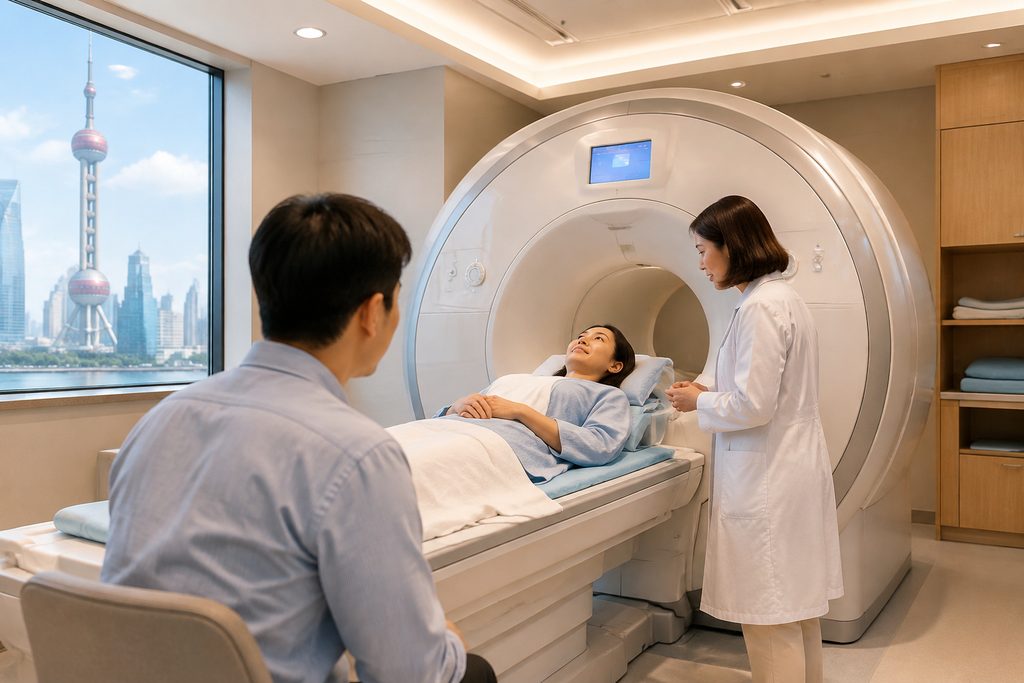
A full-body MRI is a head-to-thigh scan that uses magnetic fields to image your organs, spine, and soft tissues without radiation. It sounds like the ultimate health check. But the honest answer to whether it’s worth it is: usually not for healthy people, and sometimes yes for high-risk individuals. The full body mri cost China varies dramatically depending on hospital tier and scan protocol — from roughly $800 at a public hospital to $2,500 at a private international facility.
That price gap matters. So does the false-positive rate, which runs between 30% and 40% in asymptomatic populations. Before you book a flight and a scan, you need to understand what a whole-body MRI actually finds, what it misses, and when a targeted scan at a top Chinese hospital makes more sense.
Is a Full-Body MRI Worth It? The Short Answer
For most people without symptoms or a strong family history of cancer, no. The evidence doesn’t support routine whole-body screening. For people with a known genetic mutation like BRCA1, BRCA2, or Li-Fraumeni syndrome, or those with a prior cancer diagnosis, the calculation changes. A whole body mri screening abroad can be a reasonable surveillance tool in those specific cases.
Here’s the core problem. A full-body MRI produces hundreds of images. Radiologists flag anything that looks unusual. In healthy people, most flagged findings turn out to be benign — cysts, scars, normal variants. But each flagged finding triggers follow-up scans, biopsies, and anxiety. A 2019 review in Radiology found that whole-body MRI in asymptomatic adults detected abnormalities in 32% of scans, yet only 1.4% led to a clinically significant cancer diagnosis. That’s a lot of chasing shadows.
Who This Is Right For — and Who It Isn’t
We coordinate scans for international patients at 340+ top-ranked hospitals across 37 cities. Our team has seen both sides: patients who flew to Shanghai for a full-body scan and left reassured, and patients who spent weeks chasing a false alarm that turned out to be nothing.
Who typically benefits:
- People with confirmed hereditary cancer syndromes (BRCA, TP53, PTEN, etc.)
- Patients with a prior cancer diagnosis who need periodic surveillance
- Individuals with multiple unexplained symptoms that targeted scans haven’t resolved
- People who have already decided on screening and want it done at a reputable facility
Who should generally skip it:
- Healthy people under 40 with no family history of early cancer
- Anyone with metal implants, pacemakers, or severe claustrophobia (unless an open MRI is available)
- People with kidney disease who cannot receive gadolinium contrast safely
- Anyone who wants a definitive “all clear” — no scan can promise that
If you’re in the first group, the question shifts from “should I” to “where should I.” And that’s where hospital selection matters more than the scan itself.
The Options, Compared
Not all full-body MRI scans are equal. Machine strength, slice count, contrast protocols, and radiologist experience all drive both price and diagnostic quality. Here’s how the main options stack up for international patients considering China.
| Option | Typical Cost | Scan Time | Radiologist Review | Best For |
|---|---|---|---|---|
| Public hospital (3.0T, no contrast) | $800–$1,200 | 45–60 min | Standard report, Chinese language | Budget-conscious, healthy baseline |
| Public hospital international department (3.0T, with contrast) | $1,500–$2,000 | 60–75 min | English report, senior radiologist | High-risk patients needing thorough review |
| Private international hospital (JCI-accredited) | $2,000–$2,500 | 60–90 min | English report, Western-style service | Patients wanting direct insurance billing |
| Executive health check package (MRI + CT + labs) | $3,000–$5,000 | Half-day | Multi-specialty review | Comprehensive annual screening |
For a healthy person who wants a baseline scan, the public hospital option at the lower end of the full body mri cost China range is reasonable. For someone with a BRCA mutation, we’d steer them toward an international department where a senior radiologist reads every sequence. The difference in interpretive skill is the difference between a useful scan and a stack of images.
What a Full-Body MRI Actually Misses
This is the section most marketing materials skip. A whole-body MRI is not a cancer-detection guarantee. It has specific blind spots.
Lung cancer — the leading cause of cancer death globally — is poorly visualized on MRI. Air-filled lungs don’t image well with magnetic resonance. Low-dose CT is the screening standard for lung cancer. So a full-body MRI that gives you a clean lung report is giving you false confidence.
Colon cancer is another gap. MRI can see large masses but misses small polyps that a colonoscopy would catch and remove on the spot. If you’re over 45 and haven’t had a colonoscopy, a full-body MRI is not a substitute.
Also, MRI without contrast can miss small liver lesions and some vascular abnormalities. Contrast improves sensitivity but carries its own risks, including rare gadolinium retention and allergic reactions. At top-ranked Chinese hospitals, radiologists typically recommend contrast only when clinical risk justifies it — not as a default for every screening patient.
So the real question isn’t “is full body mri worth it for cancer” but “is it worth it for the cancers MRI can actually detect.” For brain, spine, soft tissue, and abdominal organ tumors, yes. For lung and colon, you need different tools.
Full Body MRI Scan Price Shanghai and Other Cities
Shanghai is the most common entry point for international patients, and the full body mri scan price Shanghai reflects that demand. Public hospital international departments in Shanghai typically charge $1,500–$2,000 for a comprehensive whole-body protocol. Private facilities like Jiahui and United Family run $2,200–$2,500.
Beijing prices are similar, with Peking Union Medical College Hospital and other top-tier institutions offering international department scans in the $1,600–$2,200 range. Guangzhou and Shenzhen trend slightly lower, around $1,300–$1,800. Chengdu and Hangzhou can be 20–30% cheaper than Shanghai for equivalent machine quality.
What drives the variance? Three things: hospital tier, contrast use, and whether you need an English-language report. A 3.0T Siemens or GE scanner at a Fudan-ranked hospital costs more than a 1.5T machine at a general hospital. Contrast adds $200–$400. And a senior radiologist’s English interpretation adds another $150–$300. These are not markups — they’re the cost of having someone who reads thousands of these scans annually review yours.
Practical Considerations: Booking, Records, and Follow-Up
If you decide to book full body mri China package, the logistics matter as much as the scan. Here’s what actually happens.
First, you need a doctor’s referral in most Chinese hospitals. Unlike some countries where you can self-refer to imaging centers, Chinese public hospitals require a physician to order the scan. That means a preliminary consultation — either in person or via video — before the MRI is scheduled. Our team arranges this through the hospital’s international department so you’re not navigating the system alone.
Second, bring prior imaging. If you’ve had CTs, ultrasounds, or previous MRIs, bring the discs and reports. A radiologist comparing old and new images can distinguish stable findings from new ones. Without priors, every incidental finding looks suspicious.
Third, plan for the report. A standard Chinese-language report takes 2–3 days. An English translation adds another day or two. If you need a senior radiologist’s second read, that’s additional time. Budget a week in-country if you want to review results before flying home.
Visa logistics: medical travel to China typically uses an S2 visa with supporting documents from the hospital. We provide the invitation letter and appointment confirmation that consulates require. Processing takes 1–2 weeks depending on your home country. You can find more detail on our China medical services overview page.
Payment: public hospitals require prepayment at the cashier. Private international hospitals may bill insurance directly. If you’re using insurance, confirm coverage before you travel — many policies exclude screening scans in asymptomatic patients.
Frequently Asked Questions
For the cancers it can see — brain, spine, liver, kidney, pancreas, soft tissue — sensitivity is high, typically above 90% for lesions over 1 cm. But it misses early lung cancer and small colon polyps. And in healthy people, the false-positive rate is 30–40%. That means roughly one in three scans flags something that turns out to be nothing. Accuracy depends heavily on who reads the scan. A radiologist at a high-volume cancer center sees patterns that a general radiologist might miss.
At most public hospitals, no. Chinese regulations require a physician’s order for MRI. Some private international clinics offer self-referred screening packages, but the quality of interpretation varies. The better path is a brief consultation first — either remotely or on arrival — where a physician reviews your history and orders the appropriate protocol. That consultation also protects you from paying for a scan you don’t need.
This is where being in China at a major hospital becomes an advantage. If the MRI flags a suspicious lesion, the same hospital can typically schedule a targeted follow-up — a biopsy, a PET-CT, or a specialist consultation — within days. In many Western systems, that follow-up takes weeks or months. But you should know that follow-up costs are separate from the scan fee. A biopsy runs $500–$1,500 depending on site and complexity. We help patients budget for this possibility rather than being surprised by it.
Yes, significantly. A whole-body MRI in the US typically costs $3,000–$6,000 out of pocket. In the UK, private scans run £2,000–£4,000. In China, the same 3.0T machine with a senior radiologist’s read costs $1,500–$2,500. The savings come from lower operational costs, not lower quality. The machines are the same Siemens, GE, and Philips models used in Western hospitals. What differs is the price of labor and facility overhead.
No. A full-body MRI does not replace mammography, colonoscopy, low-dose lung CT, or PSA testing. Those screenings are evidence-based and proven to reduce mortality. Whole-body MRI is not. If you’re considering it, treat it as a supplement for specific risk profiles — not a substitute for the screenings your doctor recommends based on your age and family history.
Your Next Step
The decision to get a full-body MRI shouldn’t be made from a marketing brochure. It should be made with a clear understanding of what the scan can and cannot do, what it costs, and who will read it. We help international patients evaluate whether whole-body screening makes sense for their risk profile, then coordinate the scan at a top-ranked Chinese hospital department with English-language reporting.
We’re not a hospital and we don’t diagnose anything. We handle the logistics — hospital matching, appointment coordination, bilingual accompaniment, and follow-up planning. If you’re considering a full-body MRI in China, start with a free consultation at our patient services page. We’ll tell you honestly whether it’s worth it for you, and if not, what would be.
For more medical information and treatment options in China, visit chinamedservices.com (China Medical Services).
