Heart Scan for Heart Attack: What a Cardiac CT Can and Cannot Predict
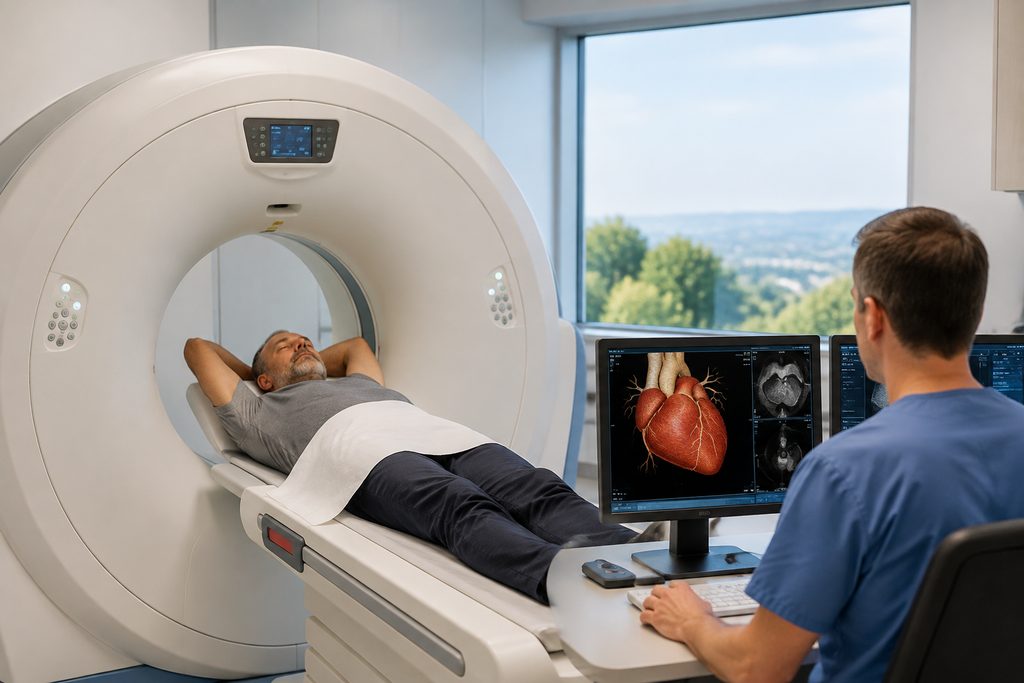
Heart Scan for Heart Attack: What a Cardiac CT Can and Cannot Predict
While a standard cardiac CT in the United States often runs between $800 and $1,500 out of pocket, the same heart scan cost China typically ranges from $150 to $350 at top-tier public hospitals. That is a five-fold difference for the same diagnostic information. But the more pressing question is not what you pay. It is whether the scan actually tells you something useful about your future heart attack risk.
We get this question constantly from patients weighing whether to fly to China for a comprehensive cardiac evaluation. The honest answer: yes, with important caveats. A coronary artery calcium (CAC) scan is one of the strongest predictors of future cardiac events available today. But it does not “see” soft plaque, and it cannot tell you when a heart attack will happen. What it does is stratify risk with remarkable precision — and that information, combined with the right follow-up imaging, can genuinely change outcomes.
Key Takeaways
- A CAC score of zero predicts a 10-year heart attack risk below 1%, making it one of the most powerful negative predictors in cardiology.
- In China, a coronary calcium scan costs $150–$350 versus $800–$1,500 in the US, with same-week scheduling available at most major cardiac centers.
- Cardiac CT cannot see soft, non-calcified plaque — the kind most likely to rupture and cause sudden events. A CT angiogram is needed for that.
- No scan, regardless of quality, can predict the exact timing of a heart attack. It estimates probability, not certainty.
The Problem: Heart Attack Risk Is Invisible Until It Is Not
Half of all men and 64% of women who die suddenly from coronary heart disease had no prior symptoms. That number comes from the Framingham Heart Study, and it should stop you cold. The first sign of heart disease for roughly 150,000 Americans each year is sudden cardiac death. Not chest pain. Not shortness of breath. Death.
Standard risk calculators — the ones your primary care physician uses — miss a substantial portion of these people. The Pooled Cohort Equations, which power the American College of Cardiology’s risk estimator, rely on age, cholesterol, blood pressure, smoking status, and diabetes. They do not measure the disease itself. They measure risk factors for the disease. There is a difference, and it matters enormously.
So what actually predicts a heart attack? The answer lies in the artery wall. Atherosclerosis — the buildup of plaque — begins decades before symptoms appear. By the time you feel chest pain, the disease is advanced. The goal of any predictive scan is to catch that plaque early, quantify it, and use that number to guide treatment.
Why a Cardiac CT Scan Delivers Real Predictive Power
Coronary Calcium Scoring: The Strongest Single Predictor We Have
The Multi-Ethnic Study of Atherosclerosis (MESA), which followed 6,814 participants for over a decade, produced the most-cited data in this field. A CAC score of zero carried a 10-year event rate of just 0.4% — even among people with multiple traditional risk factors. A score above 300 pushed that rate above 13%. That is a 30-fold difference in risk, measured from a single 10-minute scan.
No blood test comes close to that discrimination. No family history questionnaire. No stress test. The calcium score is not a perfect measure — it only detects calcified plaque, which represents roughly 20% of total plaque burden. But calcified plaque correlates strongly with total plaque, and that correlation is what gives the test its power.
How Accurate Is Cardiac CT for Blocked Arteries?
This is where precision matters. A plain CAC scan tells you if calcium is present and how much. It does not tell you where the narrowing is or how severe the blockage might be. For that, you need a coronary CT angiography (CCTA).
CCTA has a sensitivity of 95–99% for detecting significant coronary stenosis, according to multiple meta-analyses published in the Journal of the American College of Cardiology. That means it almost never misses a blockage that matters. Its specificity — the ability to rule out disease correctly — runs around 85–90%. When a CCTA shows clean arteries, you can be very confident the arteries are actually clean. That negative predictive value is what makes CCTA so useful for ruling out coronary disease in patients with atypical symptoms.
But CCTA has limits too. It can overestimate stenosis severity in heavily calcified vessels. It requires a contrast agent and a low, controlled heart rate. And it costs more — typically $400 to $700 for the scan in China, compared to $2,000 to $4,000 in the US. Both scans have roles. The question is which one answers your specific question.
Can a CT Scan Predict Heart Attack? The Plaque Composition Problem
Here is the uncomfortable truth: most heart attacks are caused by plaque that was not causing significant blockage before it ruptured. Studies using intravascular ultrasound have shown that the lesions responsible for acute myocardial infarction are often less than 50% stenotic — meaning they would not have shown up as “significant” on a traditional angiogram. They were small, soft, lipid-rich plaques that suddenly ruptured and formed a clot.
A standard CAC scan would likely have missed these entirely, because soft plaque contains little or no calcium. A CCTA might have seen them, but even CCTA cannot reliably predict which soft plaques will rupture and which will remain stable. This is the frontier of cardiac imaging research — and it is why no honest cardiologist will tell you a scan can “predict” your heart attack with certainty.
What the scan does is shift probabilities. A zero CAC score drops your near-term risk dramatically. A high score, combined with a CCTA showing soft plaque and positive remodeling, identifies you as someone who needs aggressive medical therapy — statins, possibly aspirin, lifestyle changes — right now. That is not prediction in the fortune-telling sense. It is risk stratification, and it saves lives.
Heart Scan Cost China: What You Actually Pay and Why It Is Lower
Let us talk numbers, because the cost differential is the reason many patients consider traveling. At Fuwai Hospital in Beijing — the highest-volume cardiac surgery center in the world, with over 14,000 cardiac operations annually — a coronary calcium scan costs approximately $150 to $250. At Ruijin Hospital in Shanghai, expect $180 to $300 for the same study. A full CCTA with contrast runs $400 to $700, depending on the hospital tier and whether you use the international VIP department.
Compare that to the United States, where hospital-based CAC scans average $800 to $1,200, and CCTA frequently bills at $2,500 to $4,000 before insurance. Even insured patients often face $500 to $1,500 in deductibles and copays for these scans. The structural reasons for the gap are straightforward: lower physician and staff labor costs, higher patient volume per machine, and a hospital payment system that does not inflate imaging charges to cross-subsidize other departments.
| Cardiac Imaging Test | China (Top Public Hospital) | United States (Hospital-Based) | What It Shows |
|---|---|---|---|
| Coronary Calcium Scan (CAC) | $150 – $350 | $800 – $1,500 | Calcified plaque burden; risk score |
| Coronary CT Angiography (CCTA) | $400 – $700 | $2,000 – $4,000 | Location and severity of stenosis; soft plaque |
| Stress Echocardiogram | $100 – $250 | $1,000 – $2,500 | Wall motion abnormalities under stress |
| Cardiac MRI | $500 – $900 | $2,500 – $5,000 | Myocardial viability, fibrosis, inflammation |
Prices vary by hospital and case complexity. The figures above reflect self-pay rates at major public hospital international departments. Private international hospitals in China — United Family, Jiahui, Parkway — charge more, typically 1.5 to 2 times the public hospital rates, but still below US benchmarks. The point is not that China is “cheap.” It is that the cost structure is different, and the imaging equipment is the same. Fuwai Hospital runs Siemens and GE CT scanners that are identical to what you would find at Massachusetts General or Cedars-Sinai.
Coronary Calcium Scan Price Shanghai: What to Expect at Each Hospital Tier
Shanghai has three distinct tiers for cardiac imaging, and the coronary calcium scan price Shanghai reflects which tier you choose. At the top are the Fudan-affiliated public hospitals — Zhongshan Hospital and Huashan Hospital — where the international VIP department charges $200 to $350 for a CAC scan and $500 to $700 for CCTA. These are the hospitals ranked among China’s top 10 for cardiology and cardiac surgery by the Fudan specialty reputation rankings.
The mid-tier includes other tertiary public hospitals with strong cardiac departments but less international infrastructure. Expect $150 to $250 for CAC, but be prepared for limited English support. The third tier is private international hospitals — Jiahui International Hospital and Shanghai United Family — where English-speaking staff and direct insurance billing are standard, and CAC scans run $350 to $500. You are paying for convenience and language, not better imaging.
One practical note: public hospital international departments in Shanghai generally accept self-pay patients without a referral. You can book directly through the hospital’s international office, though response times vary. The process is faster with a local coordinator who knows the system, but it is not impossible to do alone.
Best Cardiac Imaging Hospital Beijing for Foreigners: Fuwai vs. Anzhen vs. PUMCH
Beijing has three serious contenders, and the best cardiac imaging hospital Beijing for foreigners depends on what you prioritize. Fuwai Hospital (Chinese Academy of Medical Sciences) is the global volume leader in cardiac surgery and has a well-established international department. Its imaging center runs continuously, and wait times for a CAC scan are typically under one week. For patients who want the highest-volume center with the most experienced readers, Fuwai is the default choice.
Beijing Anzhen Hospital is the other major cardiac specialty center. Its imaging department has particular strength in CCTA and cardiac MRI, and its international patient volume is lower than Fuwai’s, which can mean more personalized attention. Peking Union Medical College Hospital (PUMCH) offers the strongest general reputation in China and an excellent radiology department, but cardiac imaging is one specialty among many rather than the institutional focus.
For a straightforward CAC scan, any of the three will provide accurate results on modern equipment. For a comprehensive evaluation — CAC plus CCTA plus echocardiography with a cardiologist’s integrated interpretation — Fuwai and Anzhen have the deepest bench of cardiac imagers. Our team works with all three, and the choice often comes down to scheduling and the specific clinical question.
How the Process Works: From Booking to Report in Five Days
Let us walk through what actually happens when you book heart screening package China, because the logistics are different from what Western patients expect. Day one: you submit your basic information, medical history, and any prior cardiac imaging through the hospital’s international office. No referral is required for a self-pay CAC scan at most public hospital international departments. Day two or three: you arrive for the scan. The CAC itself takes 10 minutes — no contrast, no IV, no fasting required. You hold your breath a few times while the scanner does its work.
Day three to five: a radiologist reads the scan and generates your Agatston score — the number that quantifies your coronary calcium. The report includes your absolute score, your percentile ranking against age- and sex-matched controls, and a risk category. If you booked a CCTA instead, expect the scan to take 30 to 45 minutes with contrast injection, and the report to include a detailed assessment of plaque location, stenosis severity, and plaque composition.
The key difference from the US process is speed. In most American health systems, a CAC scan requires a physician order, insurance pre-authorization, and a wait of two to six weeks for scheduling. In China, you can often book a CAC scan for the same week you inquire, pay cash at the hospital, and walk out with your report the same day or the next. That speed is not because the system is lax — it is because the system is built for volume.
Who Should Not Rely on a Heart Scan Alone
A cardiac CT is not for everyone, and we say this plainly because patients sometimes over-invest in imaging while neglecting the basics. If you are under 40 with no risk factors and no symptoms, a CAC scan is unlikely to change your management. The radiation dose is low — about 1 millisievert for a modern CAC scan, roughly the same as a mammogram — but it is not zero, and the pre-test probability of finding significant calcium in a low-risk young person is small.
If you have known coronary disease, prior stents, or prior bypass surgery, a CAC scan adds little. You already have the disease. What you need is a CCTA or invasive angiography to assess stent patency or graft function — and that decision belongs to your cardiologist, not to a screening protocol. If you have atrial fibrillation or a very high heart rate, CCTA image quality can degrade, and the hospital may need to give you beta-blockers to slow your heart first.
And if you are symptomatic — chest pain on exertion, unexplained shortness of breath, jaw pain with activity — do not book a screening scan and call it done. See a cardiologist urgently. A screening scan is for risk stratification in asymptomatic people. Symptoms change the calculus entirely.
Frequently Asked Questions
For risk stratification, it is the best single test available. A CAC score of zero predicts a 10-year event rate below 1% in the MESA cohort, while a score above 300 predicts a rate above 13%. But it estimates probability — it cannot tell you whether or when a specific plaque will rupture. No test can.
A normal CCTA — meaning no calcified or non-calcified plaque anywhere in the coronary tree — is very reassuring. The negative predictive value exceeds 95% for significant disease. But plaque can develop over time, and a clean scan today does not guarantee clean arteries a decade from now. Risk factor management still matters.
A modern CAC scan delivers approximately 1 millisievert — comparable to a mammogram or about four months of natural background radiation. A CCTA with dose-modulation techniques typically delivers 3 to 5 millisieverts. These are low doses, but not zero, which is why the scan should be clinically indicated rather than routine.
Yes, at most public hospital international departments. Self-pay patients can book a CAC scan directly through the international office. For CCTA, some hospitals prefer a brief cardiology consultation first to confirm the indication and review kidney function before contrast administration. That consultation adds $50 to $100 and is usually same-day.
It depends on your policy. Many US insurers will not cover self-pay international imaging unless it was pre-authorized as medically necessary and no equivalent was available domestically. Some international health insurance plans — Bupa, Cigna Global, Allianz — do cover diagnostic imaging at recognized Chinese hospitals. Check with your insurer before booking, and ask for a detailed receipt with CPT-equivalent codes to support any claim.
Your Next Step
If you are considering a cardiac scan, the first decision is which test answers your actual question — CAC for risk stratification, CCTA for anatomical detail. The second is where to get it done well and at a price that makes sense. China Medical Services maintains a database of 340+ top-ranked hospitals across 37 cities, including the cardiac centers discussed here, and we help international patients navigate booking, language, and logistics. We are not a hospital and we do not provide diagnoses — we connect you with the specialists who do. If you want help thinking through the options, start with a free consultation. No pressure, just a clear conversation about what makes sense for your situation.
For more medical information and treatment options in China, visit chinamedservices.com (China Medical Services).
