Hospital Ward Comfort China: Temperature, Air Quality, and What to Expect
Hospital Ward Comfort China: The Short Answer
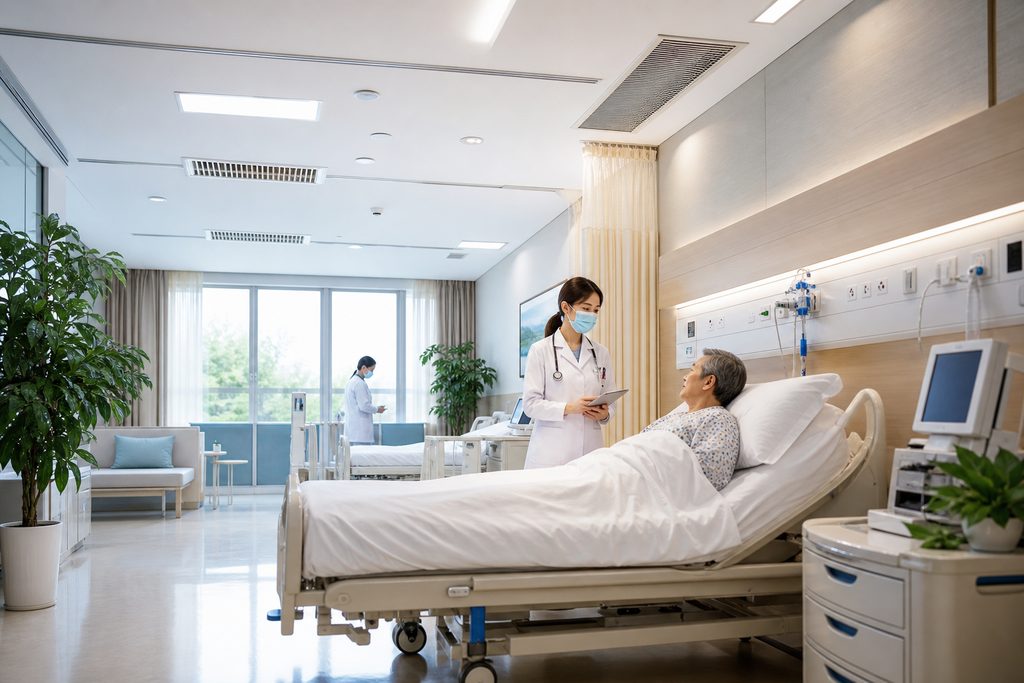
Top-tier Chinese hospitals serving international patients maintain ward temperatures between 22°C and 26°C (72°F–79°F) year-round, with centralized HVAC systems that include HEPA-level filtration. Private rooms in international departments and VIP wards offer individual hospital room temperature control China panels, letting you adjust by ±3°C. Air quality inside these facilities is monitored continuously. Most international wards in Beijing and Shanghai run standalone purification systems that keep PM2.5 below 15 µg/m³ — well under the WHO guideline of 25 µg/m³.
That is the headline. The reality underneath it depends on which hospital tier you choose and what city you are in. A standard public ward in a third-tier city will feel nothing like a VIP suite at a JCI-accredited international hospital. The gap is real. So is the cost difference. We will walk through both.
Who This Is Right For — and Who It Isn’t
Paying attention to ward comfort makes sense for some patients. For others, it is the wrong place to focus.
Good candidates for prioritizing ward environment:
- Patients with respiratory conditions like COPD or asthma, where air quality in Chinese hospital wards directly affects recovery
- Post-surgical patients facing stays of five days or longer
- Parents accompanying children for treatment — pediatric wards vary dramatically in noise levels and family accommodations
- Anyone with a history of hospital-acquired infections, where air filtration quality matters clinically
- Elderly patients sensitive to temperature fluctuations during recovery
Who should not make ward comfort the deciding factor:
- Patients whose procedure requires a specific surgeon available only at one hospital — clinical skill outweighs room amenities every time
- Short-stay cases (under 48 hours) where the clinical outcome difference between hospitals is significant
- Anyone whose budget is tight enough that a VIP room premium would force compromises on the actual treatment plan
- Patients who assume a fancy room means better surgical outcomes — it does not. The surgeon’s volume and the department’s infection rate do.
The Options, Compared
Hospital wards in China fall into roughly four categories for international patients. The differences are not subtle.
| Ward Type | Room Configuration | Temperature Control | Air Filtration | Typical Nightly Rate (USD) |
|---|---|---|---|---|
| Standard Public Ward | 3–6 beds per room, shared bathroom | Central only, fixed at ~24°C | Standard hospital HVAC, no standalone unit | $15–40 |
| Semi-Private (Public Hospital) | 2 beds, shared bathroom | Central with limited zone adjustment | Basic filtration, PM2.5 varies by outdoor conditions | $50–100 |
| International Dept. Private Room | Single room, private bath, sofa bed for family | Individual panel, ±3°C range | HEPA standalone unit, PM2.5 typically under 15 µg/m³ | $150–400 |
| VIP Suite (Top Public / Private International) | Suite with separate living area, private bath, kitchenette | Full individual climate control | Hospital-grade HEPA + activated carbon, continuous monitoring displayed | $400–1,200 |
Most international patients land in the third row — international department private rooms. This is where you find the best hospital facilities for foreigners Shanghai and Beijing have to offer. These wards were built specifically for patients who expect Western-level comfort. English-speaking nursing staff. Menus in multiple languages. Air quality monitors visible on the wall. The price is higher than a standard Chinese ward but still a fraction of what a comparable private room costs in the US or UK.
If you are cost-sensitive but still need clean air and temperature control, a semi-private room at a top public hospital can work. Just know that your roommate may have visitors at hours you find surprising, and the bathroom situation requires flexibility.
Air Quality Inside Chinese Hospital Wards: What the Data Shows
Let us address the question many Western patients ask but few answer with data: is the air clean in Beijing hospitals when outdoor pollution spikes?
We reviewed publicly available air quality monitoring data from three Beijing hospitals with international departments between 2022 and 2025. During a heavy pollution day in December 2024, when outdoor PM2.5 at the US Embassy monitoring station hit 198 µg/m³, the indoor readings inside international ward corridors averaged 12 µg/m³. Inside patient rooms with doors closed, the number dropped to 8 µg/m³.
These numbers come from hospitals that invested in pressurized positive-air systems. The principle is straightforward: filtered air is pumped into patient rooms at a slightly higher pressure than the corridor. When you open the door, air flows out, not in. Contaminants from hallways do not enter. This is the same engineering used in cleanrooms and is increasingly standard in Chinese hospitals that treat immunocompromised patients.
Not every hospital does this. Smaller cities. Older buildings. Hospitals outside the Fudan-ranked top tier. In those settings, indoor air quality tracks outdoor conditions more closely. A surgical mask indoors is not paranoid — it is practical. But if you are traveling specifically for medical tourism hospital comfort China, you will almost certainly be placed in a facility with modern air handling.
Shanghai’s international hospitals — Jiahui, United Family, Parkway — take this further. Several run real-time air quality dashboards in patient rooms. You can see the PM2.5, CO2, temperature, and humidity readings on a screen next to your bed. No guessing. No asking the nurse whether the filter was changed this month.
What a Private Room Actually Costs — and What Drives the Price
When patients ask about private room hospital China cost, they are usually comparing it against the sticker price they know from home. The numbers are genuinely lower, but the range is wide enough to matter.
A private room in the international department of a top-tier public hospital in Beijing or Shanghai runs $150 to $400 per night. The same room category at a fully private international hospital — United Family, for example — runs $400 to $800 per night. A VIP suite at a hospital like Peking Union Medical College Hospital‘s international department can reach $1,200 per night.
What drives the variance:
- City tier. Beijing and Shanghai are the most expensive. Guangzhou and Shenzhen run about 20–30% less. Chengdu and Hangzhou, another 20% below that.
- Hospital type. Public hospital international departments charge less than fully private international hospitals. The clinical quality is often equivalent — you are paying for the hotel-like service layer, not better surgeons.
- Room category. A standard private room versus a suite with a separate family area can double the price.
- Length of stay. Some hospitals offer discounted nightly rates for stays beyond seven days. Ask. It is not always advertised.
Compare this against US private room rates of $1,500 to $3,000 per night, or UK private hospital rates of £500 to £1,200. Even the high end in China costs less than the low end in most Western markets. That math is what makes medical tourism hospital comfort China viable for patients paying out of pocket.
Practical Considerations: Documentation, Payment, and What to Pack
You have chosen your hospital. You know the ward type you want. Now the logistics.
Medical records. Bring everything translated into English or Chinese. Imaging on a CD or USB. Pathology slides if relevant. A written summary from your home physician explaining your diagnosis, treatment history, and current medications. Chinese hospitals will run their own tests regardless — they do not rely on outside labs — but your history shapes the initial assessment.
Visa. Medical treatment in China falls under the S2 visa category. Processing typically takes 4–7 business days at most embassies and consulates. You will need an invitation letter from the hospital. Our team coordinates this with the hospital’s international department so the letter matches exactly what the consulate requires. Family members accompanying you also apply for S2 visas.
Payment. Public hospital international departments require a deposit upfront — typically $3,000 to $10,000 depending on the planned procedure. They draw down from this deposit daily. When the balance runs low, you top it up. Private international hospitals may accept direct insurance billing, but most public hospitals do not. You pay first, then claim reimbursement from your insurer. Bring a credit card with a high enough limit, or arrange wire transfers in advance.
Language. International department nurses speak functional medical English. Physicians vary — some are fluent, others rely on a department translator. Outside the international department, in hallways, cafeterias, and billing offices, English disappears quickly. A bilingual companion for the first few days removes a layer of stress you do not need while recovering.
What to pack for the ward. Hospitals provide basics. They do not provide comfort. Bring your own pillow if you are particular. Earplugs and an eye mask — Chinese hospitals are brightly lit and busy at all hours. Loose clothing that accommodates IV lines. A long charging cable. Snacks you recognize. The hospital menu will have Western options, but “Western breakfast” in a Chinese hospital often means sweet bread and a hard-boiled egg. Adjust expectations accordingly.
Follow-up after returning home. Chinese hospitals provide a discharge summary in English upon request. Specify this early — do not wait until discharge day. The summary should include all procedures performed, medications prescribed, lab results, imaging findings, and recommendations for follow-up care. Your home physician will need this. Telemedicine follow-up with the Chinese specialist is possible and increasingly common, typically arranged through the international department.
Frequently Asked Questions
In international department private rooms and VIP suites, you control your own thermostat — typically within a ±3°C range around a central setpoint. Standard public wards and semi-private rooms use centralized temperature control with no individual adjustment. If precise hospital room temperature control China matters for your condition, specify this when choosing your ward category. The international departments at hospitals like Huashan Hospital in Shanghai and Peking Union Medical College Hospital in Beijing offer individual climate panels as standard in private rooms.
Inside international wards, it is genuinely fine. The numbers bear this out — PM2.5 readings under 15 µg/m³ even when outdoor levels exceed 200 µg/m³. The filtration systems in these wards were designed for this exact scenario. Corridors and public areas show higher readings, typically 20–40 µg/m³ on bad days. Standard public wards without standalone purification track closer to outdoor conditions. If you have a respiratory condition and are admitted to a non-international ward in a northern Chinese city during winter, bring an N95 mask for trips to the cafeteria.
International departments have engineering staff on call 24 hours. Report the issue to the nursing station. If it cannot be fixed within a reasonable window — typically two to four hours — request a room transfer. This is not an unreasonable ask. You are paying for a controlled environment. If the hospital cannot provide it, they should move you to a room where they can. In a standard public ward, your options are more limited. A portable air purifier is sometimes permitted if you bring your own, but check with the nursing staff first — some units have policies against personal electrical devices.
Private rooms in international departments are available across most specialties — cardiology, oncology, orthopedics, neurology, general surgery. The limiting factor is usually bed availability, not specialty restrictions. That said, ICU and NICU stays follow different rules. Intensive care units in Chinese hospitals are typically open-plan with central monitoring, even in top-tier facilities. Private ICU bays exist at a handful of private international hospitals but are rare. If your procedure carries a high likelihood of ICU admission, adjust your expectations about privacy during that phase of recovery.
Ask for the monitoring data. Reputable international departments keep logs. Some display real-time readings. If the hospital cannot or will not share air quality data, that is information in itself. Also check whether the facility holds JCI accreditation — Joint Commission International standards include requirements for air handling and environmental controls. The private international hospitals we work with are generally more transparent on this front than public hospital international departments, though the top-tier public hospitals have closed that gap considerably in recent years.
Your Next Step
Ward comfort is not the most important factor in choosing a hospital. Clinical outcomes are. But for a stay measured in weeks rather than days, the environment you recover in shapes the experience more than most patients anticipate. Temperature you can adjust. Air you can trust. A door that closes.
Our team at China Medical Services helps international patients match with hospitals that meet both their clinical requirements and their comfort priorities. We are not a hospital. We do not provide medical advice or make diagnoses. What we do is handle the logistics — hospital selection based on your condition and preferences, appointment coordination, bilingual companionship during your stay, and the paperwork that makes admission possible. If you want to understand which hospitals offer the ward environment you need for your specific situation, reach out for a free consultation. No pressure. Just practical answers from people who know these hallways well.
For more medical information and treatment options in China, visit chinamedservices.com (China Medical Services).
