Jiangsu Medical Escort Service: One Contact for Nanjing, Suzhou, and Across the Province
While patients in the UK wait a median 14.6 weeks just to start specialist treatment after a GP referral, the challenge in China isn’t the queue—it’s the maze. A single top-tier hospital in Nanjing can process over 15,000 outpatient visits in a day. The system moves fast. Brutally fast. Without Mandarin fluency and local know-how, a foreign patient can spend hours lost in the wrong building, holding the wrong form, standing in the wrong line. The Jiangsu medical escort service price reflects something straightforward: paying for a guide who stops that from happening. It’s not a luxury add-on. It’s the operational layer that makes the entire medical trip functional.
Our team connects international patients with hospitals across Jiangsu—from the oncology and cardiology departments in Nanjing to the advanced surgical centers in Suzhou and beyond. We handle one piece of the puzzle: the on-the-ground logistics. We don’t practice medicine. We don’t promise outcomes. What we do is make sure you arrive at the right consultation room, with the right paperwork, at the right time, accompanied by a bilingual professional who translates both the language and the unspoken rules of Chinese hospital culture.
How This Actually Works, Step by Step
Most people imagine a medical escort as someone holding a sign at the airport. That’s about ten percent of it. The real work happens in the weeks before you land, and in the chaotic corridors of the hospital itself.
The sequence typically unfolds like this:
First contact and case intake. You send us your existing medical records—reports, scans, imaging files, current medication list. We need to know what you’re dealing with before we can map a route. This isn’t a five-minute phone call. A complex case might require a written second opinion from a relevant Chinese specialty team before we even discuss travel dates. That step alone can take 5 to 10 business days, depending on the hospital department’s review queue.
Hospital and department matching. Jiangsu has 340+ top-ranked hospitals in our database across 37 cities. Nanjing alone hosts several institutions ranked among China’s top tier for specialties like general surgery, nephrology, and traditional Chinese medicine. Suzhou has rapidly emerging centers for orthopedics and minimally invasive procedures. We don’t pick the most famous name. We match the specific subspecialty to your condition. A cardiac valve issue goes to a different team than a complex arrhythmia, even within the same hospital.
Appointment coordination. This is where the rhythm of Chinese public hospitals hits. You cannot book an outpatient slot from overseas through a public registration app without a Chinese ID and local phone number. The hospital’s international medical center or VIP department is the channel we use. We submit translated records, confirm the specialist’s availability, and lock in a consultation slot. Lead time varies wildly—from 3 days to 3 weeks. A sought-after specialist at Jiangsu Province Hospital might have a two-week backlog. We tell you the real date, not the optimistic one.
Visa documentation. With a confirmed appointment letter from the hospital, you apply for an S2 visa at your local Chinese embassy or consulate. The S2 is specifically for short-term private affairs, including medical treatment. Your accompanying family member applies under the same category. We provide the hospital invitation and a detailed itinerary. Visa processing times depend entirely on the consulate—ranging from 4 business days to 2 weeks. We don’t control this step, but we make sure your documentation package is complete.
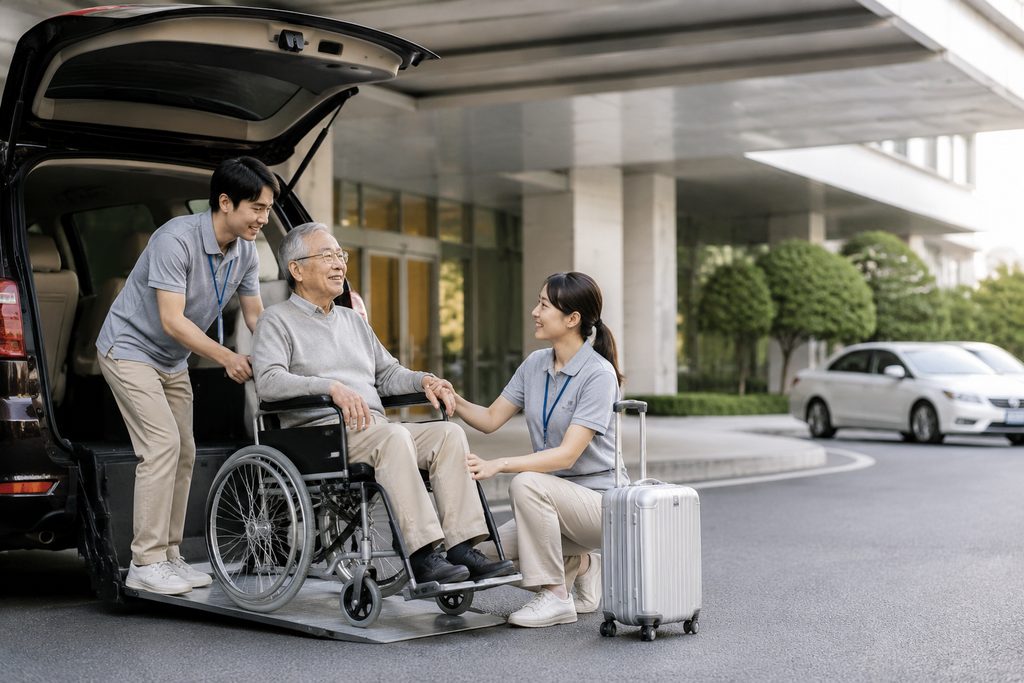
Arrival and the escort day. The bilingual medical companion meets you at your hotel or the hospital entrance. From that moment, they handle registration card creation, appointment check-in, queue management, payment processing at the cashier window, and real-time translation during the doctor’s consultation. If the specialist orders blood work, an MRI, or a CT scan, the escort navigates you to each department, collects results, and brings them back to the doctor. A single outpatient visit can span four buildings and three floors. Without an escort, a non-Mandarin speaker simply cannot complete this loop in one day.
Post-consultation coordination. If the doctor recommends admission for surgery or treatment, the escort facilitates the inpatient paperwork, deposit payment, and ward orientation. If you need follow-up appointments, we schedule them before you leave the hospital. If you return home with a treatment plan, we can arrange remote follow-up video consultations to keep the continuity.
What a Medical Escort Actually Does in China—and What They Don’t
The phrase “medical escort” conjures different images depending on where you’re from. In some countries, a medical escort is a clinical professional who monitors a patient during transport. In China, the role is fundamentally different. This distinction matters because it directly shapes the Jiangsu medical escort service price and your expectations.
In the Chinese hospital context, a bilingual medical companion is a logistics and communication specialist. They are not nurses. They do not administer medication, interpret lab results, or offer clinical opinions. Their value is operational fluency.
Here’s what the role covers on a typical day at a Nanjing or Suzhou hospital:
- Creating the hospital medical card—a prerequisite for any interaction in a Chinese public hospital. This requires a passport, a local contact number, and navigating a kiosk system that is entirely in Mandarin.
- Checking in at the specialist’s clinic door using the barcode from the registration slip. Miss this step and the system marks you as a no-show, even if you’re sitting three meters away.
- Paying for each service at a separate cashier window. Consultation, blood test, CT scan, pharmacy—each has its own queue and its own payment slip. The escort handles the payments using your deposit and provides you with a consolidated receipt.
- Translating the doctor’s questions and explanations in real time. A Chinese specialist might ask about symptom onset, prior treatments, and family history in rapid succession. The escort ensures nothing is lost.
- Guiding you physically through the hospital. A single campus can house over 20 buildings. The MRI center might be in Building 8, the blood draw station in Building 3, and the pharmacy in Building 1. Signage is predominantly in Chinese characters.
- Collecting printed reports and imaging CDs from self-service kiosks. These machines print results on thermal paper and burn DICOM files to discs. The escort gathers everything and organizes it for the return consultation.
What the escort does not do: prescribe medication, guarantee a specific specialist will see you, bypass clinical triage protocols, or promise admission. Public hospitals follow strict internal rules. The escort works within those rules, not around them.
A Realistic Timeline
Yes, when you hire through a registered service provider with verifiable hospital partnerships. The risk is in hiring an unvetted individual through social media or a freelance platform. A legitimate escort is background-checked, trained in hospital protocols, and backed by an organization that takes liability for their conduct. Ask your provider: “Are your escorts employees or contractors? What training do they receive? What happens if there’s a dispute?” A credible service answers these directly.
The process starts with a free consultation. You describe your medical situation and which hospital or specialty you’re targeting. We review your records, confirm the feasibility, and provide a service scope and price quote. If you proceed, we coordinate the appointment, prepare your documents, and assign a bilingual companion for your visit dates. You don’t need to book the escort separately from the hospital appointment—they’re part of the same coordination package.
A day with a bilingual medical companion starts from $300. Doing it alone means navigating a 15,000-patient-per-day hospital in a language you don’t speak. The hidden cost of going solo isn’t financial—it’s the missed appointments, the repeated tests because you went to the wrong department, and the specialist who can’t assess you properly because no one translated your history accurately. The escort fee is an efficiency cost, not a luxury expense.
No, and any service that claims otherwise is misleading you. Chinese public hospital specialists operate on fixed schedules, and their outpatient slots fill through the hospital’s internal system. We can request a specific specialist through the international department channel. We cannot override the hospital’s scheduling or bump other patients. What we can guarantee: if we cannot secure an appointment with the requested department within your travel window, we refund the coordination fee in full.
Your Next Step
Navigating Jiangsu’s top hospitals doesn’t require you to learn Mandarin or decode the Chinese healthcare system on your own. It requires one reliable point of contact who already knows the layout, the process, and the people. That’s where we come in. Our team has coordinated care for international patients at leading institutions across Nanjing, Suzhou, and the wider province. We don’t practice medicine, and we don’t make clinical promises. We handle the logistics so you and your doctor can focus on the treatment.
If you’re considering medical travel to Jiangsu, start with a conversation. Visit our patient services page to share your situation and get a clear, honest assessment of what’s possible—no pressure, no vague promises, just the practical path forward.
Frequently Asked Questions
Yes. The hospitals used for international patients are JCI-accredited and follow the same international safety standards as top hospitals in the US and Europe. Surgical teams perform high volumes of procedures — often more than their Western counterparts — which studies show leads to better outcomes.
Costs vary by procedure and hospital, but international patients typically save 40-80% compared to US prices — even when factoring in travel and accommodation. A consultation with our team will give you an exact, all-inclusive quote with no hidden fees.
Send us your existing medical reports to get started. We handle everything from hospital selection and appointment scheduling to visa assistance and post-operative recovery planning. Your medical records are reviewed by the specialist before you even book a flight.
For more medical information and treatment options in China, visit chinamedservices.com (China Medical Services).
