Knee Replacement China vs Thailand: Why Looking Beyond Bangkok Makes Sense
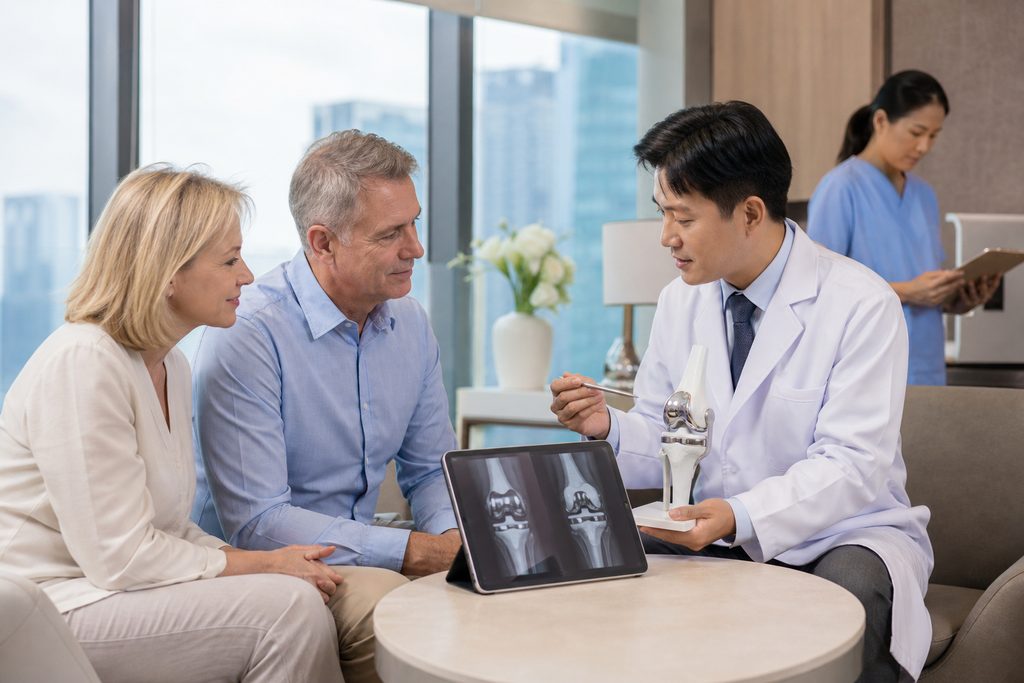
You have probably seen the glossy brochures. Bangkok hospitals with hotel-like lobbies, packages that bundle surgery with a beach recovery. The message is clear: Thailand owns medical tourism for joint replacement. The brochures leave out a different story. One where surgical volume, implant access, and a specific type of high-volume orthopedic specialization create a different value equation entirely. A 2023 report in *The Lancet Regional Health* placed China’s annual knee replacement volume above 400,000 procedures, a number that reshapes how we should think about where to go when your own knee no longer works.
Knee Replacement Cost China vs Thailand: The Short Answer
For a standard total knee replacement, the all-inclusive hospital bill in a top-tier Chinese public hospital international wing typically runs between $14,000 and $22,000 USD. A comparable JCI-accredited private hospital in Bangkok quotes between $13,000 and $20,000. The sticker prices overlap. The difference hides in what each system optimizes for — and that difference matters more than the flight cost.
Who This Is Right For — and Who It Isn’t
This path makes sense for a specific patient. Someone with severe osteoarthritis, a BMI under 35, no active infection, and a cardiopulmonary system cleared for a 2-3 hour procedure. You are not looking for a vacation with a surgery attached. You want a surgeon who does this exact procedure eight to ten times every single week, on patients whose anatomies and comorbidities mirror your own.
It is the wrong move if you have uncontrolled diabetes, a recent cardiac event, or a BMI that makes wound healing a genuine risk. It is also wrong if you need a complex revision of a failed implant and cannot travel with all prior operative notes and implant records. No reputable center will touch a revision without knowing exactly what is in your bone right now. And if your primary motivation is saving $2,000 while adding a language barrier and a longer flight — stay home. The margin is too thin to justify the friction.
The Options, Compared
A knee replacement is not a commodity. The implant, the surgeon’s annual volume, the navigation system in the operating room — these variables change the outcome more than the city on the hospital’s address. Here is how the two destinations stack up on the factors that actually predict a good result.
| Factor | China (Top-Tier Public Intl. Wing) | Thailand (JCI Private Hospital) |
|---|---|---|
| Surgeon annual knee volume | 300–600+ (high-volume joint centers) | 100–250 (typical private hospital) |
| Implant options | Zimmer Biomet, Stryker, DePuy Synthes, domestic brands | Zimmer Biomet, Stryker, DePuy Synthes |
| Computer-assisted navigation | Widely available; robotics in major centers | Available; robotics in flagship hospitals |
| All-inclusive cost (implant + hospital + surgeon fee) | $14,000–$22,000 | $13,000–$20,000 |
| Language barrier in clinical setting | International wing staff speak English; ward nurses may not | English widely spoken in private hospitals |
| Post-op rehab protocol | Inpatient 5–10 days; outpatient physio available | Inpatient 4–7 days; strong rehab tourism culture |
| Visa complexity | S2 visa (private affairs/medical); documentation required | Medical visa or visa exemption (varies by nationality) |
Thailand wins on ease. The visa process is lighter for many passport holders, English is more pervasive, and the patient experience feels closer to a Western private hospital. China wins on surgical density. If you believe — as the orthopedic literature does — that a surgeon who performs 400 knees a year has complication rates measurably lower than one who performs 100, then that volume gap is not trivial. A 2019 study in *The Journal of Arthroplasty* found that surgeons performing fewer than 50 total knee replacements annually had a revision rate nearly double that of high-volume surgeons. This is the calculation that matters more than the lobby furniture.
What “High-Volume Surgeon” Actually Means in a Chinese Joint Center
Bangkok private hospitals market their surgeons’ credentials. Fellowship training in Germany or the US. Board certifications. These are real and valuable. What they rarely disclose is annual case volume. A private orthopedic surgeon in Bangkok may perform two or three knee replacements per week. At a dedicated joint replacement center in Shanghai or Beijing, a single surgical team may complete twelve to fifteen primary knees in a standard operating week.
This is not a marketing claim. It is a structural difference. China’s population of 1.4 billion, combined with a public hospital system that funnels complex cases to tertiary centers, creates a clinical environment where joint replacement teams operate at a scale almost unmatched globally. The surgeon you consult via video before traveling may have performed more total knee replacements by March of this year than a typical Western community orthopedic surgeon performs in three years.
Does volume guarantee a good outcome? No. Infection control, implant positioning, soft tissue balancing — these are technical skills. But volume is the best proxy we have for technical proficiency when you cannot directly observe the surgery. And it is the variable most patients never think to ask about.
Is Knee Replacement in China Safe? What the Data Says
This question surfaces in every initial consultation. It is fair. Western media coverage of Chinese healthcare focuses on overcrowded public wards and scandals, not on the international wings of Fudan-ranked hospitals where medical travel actually happens.
The safety question splits into three parts. First, infection rates. A 2021 multicenter study across Chinese tertiary hospitals published in *Antimicrobial Resistance & Infection Control* reported a surgical site infection rate following primary total knee replacement of 0.6% to 1.2% in major centers — in line with rates reported in US and European registries. The international wings where foreign patients receive care typically report rates at the lower end of that range.
Second, implant quality. The top-tier Chinese hospitals use the same implant systems you would receive in Minneapolis or Munich. Zimmer Biomet’s Persona knee. Stryker’s Triathlon. DePuy Synthes Attune. These are not copies. They are the same CE-marked and FDA-cleared devices, sourced through the manufacturers’ official Chinese distribution channels. Some centers also offer domestic implant systems that have undergone rigorous clinical trials within China’s regulatory framework, though most international patients opt for the global brands they recognize.
Third, venous thromboembolism prophylaxis. Chinese joint replacement protocols have standardized significantly over the past decade. Current guidelines from the Chinese Orthopaedic Association mirror the American Academy of Orthopaedic Surgeons recommendations for chemical and mechanical VTE prevention. You will receive low-molecular-weight heparin and compression devices unless contraindicated.
The safety gap is not clinical. It is logistical. If a complication develops after you return home, your local orthopedic team will need to manage it. That means the Chinese surgical team must provide comprehensive operative notes, implant stickers, and a direct line for your home surgeon to call with questions. We have seen this work smoothly. We have also seen it create friction when the documentation is incomplete. This is where a coordination service earns its fee — ensuring the handoff packet is complete before you board your return flight.
What Is Recovery Time for Knee Replacement Overseas?
This is the complication every patient fears and every surgeon works to prevent. If a periprosthetic joint infection develops weeks or months after your return, your local orthopedic surgeon manages it. The Chinese surgical team provides all operative records, implant details, and culture data to your home team. Treatment follows the same algorithmic approach regardless of where the original surgery occurred — typically debridement with implant retention for acute infections, or two-stage revision for chronic ones. The original surgical team remains available for remote consultation, but physically returning to China for infection management is rarely practical or necessary. Your home country’s healthcare system handles complications. This is why we emphasize that you need a local orthopedic surgeon willing to manage post-operative issues before you travel for surgery abroad.
Look at who else they treat. The top-tier Chinese joint replacement centers primarily serve domestic patients — often complex cases referred from lower-level hospitals that could not manage them. International patients represent a small fraction of their volume. The hospital’s reputation depends on outcomes in the domestic patient population, which is large, visible, and unforgiving of poor results. A center that does 1,500 knees a year for Chinese patients and 30 for international patients is not a factory for foreigners. It is a high-volume domestic center that also accommodates overseas patients through a separate administrative channel. Ask during your video consult: “How many total knees did your department perform last year? How many were on international patients?” The ratio tells you what the institution is actually built to do.
It can be. This is not a resort experience. You will be in a hospital room, then a nearby serviced apartment, in a city where you may not speak the language. Your companion or family member is essential — not just for practical help, but for morale. The days between discharge and flight clearance can feel long. Some patients find the focused, distraction-free recovery environment helpful. Others find it isolating. Be honest with yourself about which type you are before booking. If you need a social, resort-like recovery atmosphere, Thailand’s established medical tourism infrastructure may suit your personality better, even if China offers a surgical volume advantage.
Your Next Step
The decision between China and Thailand for knee replacement ultimately turns on what you value more: the ease and familiarity of a mature medical tourism destination, or the surgical volume and subspecialty depth of a system that performs more joint replacements than almost anywhere else on earth. Both are defensible choices. What is not defensible is choosing either without first having a qualified surgeon review your specific imaging and medical history.
Our team at China Medical Services does not provide medical advice or make clinical recommendations. We are not a hospital and we do not employ doctors. What we do is connect your records to the right surgical department, facilitate the conversations you need to make an informed decision, and manage the logistics if you choose to proceed. If you would like a written second opinion from a high-volume Chinese joint replacement center — with no obligation to travel — start with a free consultation to discuss your situation and determine whether this path makes clinical and financial sense for you.
Frequently Asked Questions
Yes. The hospitals used for international patients are JCI-accredited and follow the same international safety standards as top hospitals in the US and Europe. Surgical teams perform high volumes of procedures — often more than their Western counterparts — which studies show leads to better outcomes.
Costs vary by procedure and hospital, but international patients typically save 40-80% compared to US prices — even when factoring in travel and accommodation. A consultation with our team will give you an exact, all-inclusive quote with no hidden fees.
Send us your existing medical reports to get started. We handle everything from hospital selection and appointment scheduling to visa assistance and post-operative recovery planning. Your medical records are reviewed by the specialist before you even book a flight.
For more medical information and treatment options in China, visit chinamedservices.com (China Medical Services).
