Your Care at First Affiliated Hospital Kunming Medical University: Yunnan Gateway Full Service
How This Actually Works, Step by Step
You have medical records in hand and a diagnosis you are trying to solve. The question is not whether the First Affiliated Hospital of Kunming Medical University can help. The question is how to get from an email inquiry to sitting in a specialist’s office without losing weeks to confusion.
Here is the real sequence.
First, you send us your existing documents. Discharge summaries, imaging reports, pathology slides, current medication lists. We need the raw clinical picture, not a summary. Our team translates these materials into clinical Chinese and prepares a submission package formatted to the hospital’s international department standards. This step typically takes two to three business days.
The hospital reviews your file. A department head or senior specialist determines whether your case falls within their scope and whether remote evaluation is feasible or if an in-person visit is necessary from the start. You receive a written preliminary assessment. This costs from $300 for a written second opinion and reaches $500 to $800 if you need a top-specialist video consultation to discuss findings face-to-face.
Once the hospital confirms they can take your case, we move to logistics. Appointment dates, visa support letters, accommodation recommendations near the Chenggong campus or the city-center facilities. You apply for an S2 visa with the hospital’s invitation documentation. Processing times vary by consulate, but four to six weeks is a realistic planning window.
You arrive in Kunming. A bilingual medical companion meets you at the airport, handles registration, guides you through the consultation, translates every word between you and the physician, and stays with you through admissions if surgery is indicated. That day-one chaos that terrifies international patients? It dissolves into a structured sequence.
What Full Service Medical Tourism in Yunnan Actually Costs
Let us talk numbers directly. The First Affiliated Hospital Kunming Medical University international patient price structure differs from what domestic patients pay, and understanding why saves you from sticker shock later.
The hospital operates a dual-track system. The public track serves thousands daily at government-regulated rates. The international VIP track serves foreign patients through a dedicated coordination office with English-speaking staff, priority scheduling, and private consultation rooms. That infrastructure costs more to run, and the pricing reflects it.
Expect consultation fees with a senior specialist through the international department to range from $150 to $400, depending on the professor’s seniority and the complexity of the initial workup. Diagnostic imaging — MRI, CT, PET-CT — runs $300 to $1,200, which is a fraction of U.S. hospital imaging charges. Surgical procedures vary dramatically by specialty. A complex orthopedic reconstruction might cost $15,000 to $30,000 all-in, including implant hardware, operating theater fees, and a private recovery room. Cardiac interventions sit in a similar band. These are the full service medical tourism Yunnan China cost realities, not the domestic patient price list.
| Service Category | Estimated Range (USD) | Notes |
|---|---|---|
| Written Second Opinion | $300 – $500 | Document review by relevant specialist |
| Specialist Video Consultation | $500 – $800 | Live discussion with senior physician |
| In-Person Consultation (VIP Track) | $150 – $400 | Varies by professor seniority |
| MRI / CT / PET-CT | $300 – $1,200 | Significantly below Western imaging costs |
| Surgical Procedure (Complex) | $15,000 – $30,000 | Includes hardware, theater, private room |
| Bilingual Companion Service | from $300/day | Full-day translation and navigation |
Coordination fees for our case management start from $300 for appointment scheduling. A full VIP end-to-end coordination — everything from pre-arrival document handling through discharge and follow-up planning — ranges from $5,000 to $8,000. That coordination fee covers our labor, translation, and logistics. It does not cover hospital treatment charges, which you pay directly to the hospital cashier.
One detail that matters: any consultation fee you pay — written second opinion or video consultation — gets credited in full toward coordination services if you proceed to treatment within 90 days. It is a one-time credit applied to our coordination fee only, never to hospital treatment costs. This means your early evaluation is not a sunk cost.
A Realistic Timeline
Medical travel is not a weekend trip. Here is what the calendar actually looks like when you are planning care at the Yunnan Gateway facility.
| Stage | Duration | What Happens |
|---|---|---|
| Document Collection & Translation | 3 – 5 business days | You gather records; we translate into clinical Chinese |
| Hospital Preliminary Review | 5 – 10 business days | Department reviews your file, confirms feasibility |
| Remote Consultation | 1 – 2 weeks | Written opinion delivered or video call scheduled |
| Visa Processing (S2) | 4 – 6 weeks | Application with hospital invitation letter; varies by consulate |
| Travel & Appointment Scheduling | 2 – 4 weeks | Flights, accommodation, hospital slot confirmation |
| In-Person Consultation & Workup | 3 – 7 days | Face-to-face evaluation, additional imaging if needed |
| Treatment / Surgery | 1 – 4 weeks | Procedure plus initial recovery in Kunming |
| Post-Treatment Follow-up | 1 – 2 weeks | Final consultation, discharge summary, home-care plan |
Total realistic timeline from first contact to completing treatment: three to five months. Some cases move faster. Some need more diagnostic work before a surgical plan firms up. We have seen orthopedic cases complete the entire sequence in eight weeks. We have also seen oncology workups stretch to five months because the hospital wanted additional molecular pathology before committing to a treatment protocol.
Kunming’s altitude is 1,890 meters. That matters. Patients with certain cardiovascular or respiratory conditions may need a day or two of acclimatization before the hospital proceeds with elective procedures. The physicians here know this and factor it into scheduling. It is not a complication. It is just a reality of geography.
What Can Go Wrong — and What Happens Then
Let us be blunt about failure modes. Trust is built on honesty about what breaks and how it gets fixed.
The hospital declines your case after review. Not every condition is suitable for remote evaluation followed by international travel. Some cases are too unstable. Some require a treatment approach the department does not offer. When this happens, you are not stranded. We pivot to alternative hospitals in our network of over 340 top-ranked institutions across 37 cities. Your translated records are already prepared. We submit to the next appropriate center, often within the same week. The coordination work already done is not lost.
The specialist you requested is unavailable. Top professors have packed schedules. They lecture, they operate, they attend academic conferences. If your preferred physician cannot see you within your travel window, the international department assigns another senior specialist within the same department. You are not handed off to a junior resident. The department’s reputation rides on its international patient outcomes, and they protect that reputation.
Your condition changes between remote evaluation and arrival. A scan done six weeks ago may not reflect today’s reality. The hospital will repeat key imaging upon arrival. This can alter the treatment plan. It can also increase costs. Budget for a 15 to 20 percent buffer above the initial estimate for precisely this reason. If the new imaging reveals a less severe picture, you may avoid surgery altogether. That outcome is a win, not a wasted trip.
Visa delay. Consulates move at their own pace. We provide the invitation documentation the hospital issues. We cannot accelerate a consular officer’s decision. If your visa is delayed, we reschedule appointments. The hospital’s international department understands this is part of the process and does not penalize you with cancellation fees for consulate-caused rescheduling.
Is First Affiliated Hospital Kunming Safe for Foreigners? What the Data Shows
This question surfaces in nearly every initial consultation: is First Affiliated Hospital Kunming safe for foreigners? The short answer is yes, with context that matters.
The First Affiliated Hospital of Kunming Medical University is a Grade III, Class A hospital — the highest classification in China’s hospital tier system. It serves as the primary teaching hospital for Kunming Medical University and operates over 4,000 beds across multiple campuses. The hospital handles more than 3 million outpatient visits annually and performs tens of thousands of surgeries. Volume builds competence. A surgical team that performs a procedure 500 times a year operates differently than one that performs it 50 times.
Infection control protocols follow national standards audited by the National Health Commission. The international department maintains dedicated inpatient wards with nursing ratios that exceed what the public wards provide. Private rooms, English-speaking nursing staff, and visiting hours that accommodate family presence are standard on the VIP track.
Safety for foreign patients also means communication safety. A misheard medication instruction or a misunderstood consent form is a clinical risk. This is why the hospital requires international patients to route through the international department rather than attempting to navigate the public registration system. The department assigns English-capable coordinators and works with bilingual companions to close any remaining language gaps.
Kunming itself adds a layer of practical safety. The city’s infrastructure is modern, with an international airport offering direct flights from Southeast Asian and Middle Eastern hubs. Accommodation near the hospital ranges from budget hotels to international chains. Pharmacies stock Western medications alongside traditional Chinese formulations. You are not in a remote outpost. You are in a provincial capital of six million people with the amenities that implies.
What Services Does Yunnan Gateway Hospital Offer International Patients?
The question what services does Yunnan Gateway hospital offer international patients deserves a structured answer, because the hospital’s capabilities extend well beyond what a casual web search suggests.
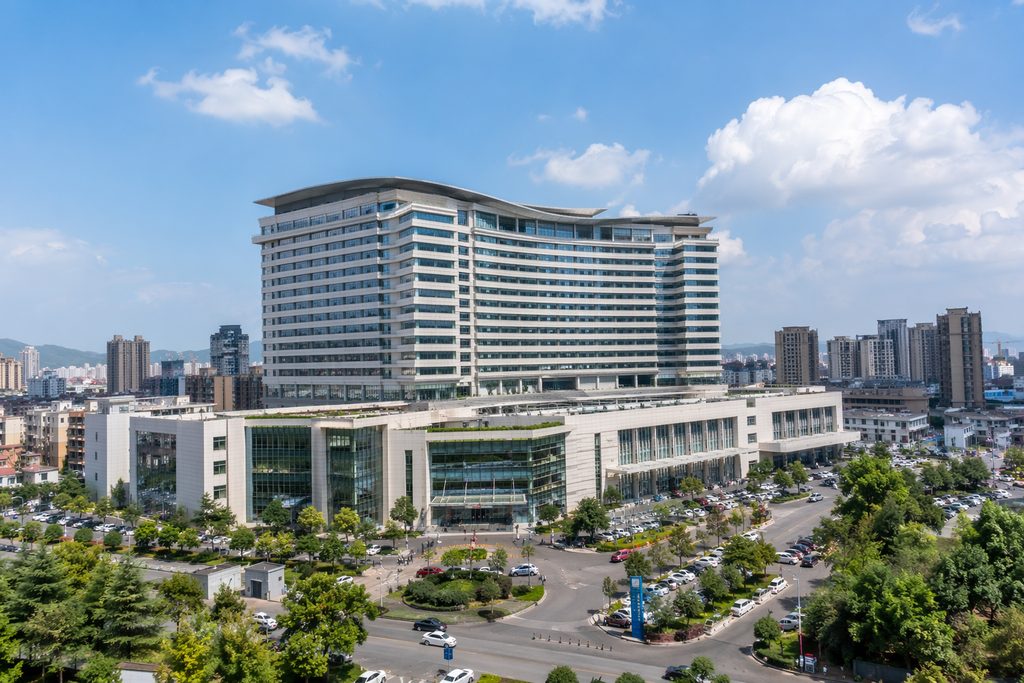
The hospital operates across several campuses. The main Chenggong campus houses the bulk of inpatient services. The city-center locations handle outpatient consultations and day procedures. International patients typically interact with the dedicated international medical center, which coordinates across departments.
Core clinical strengths include oncology, with a particular depth in thoracic and gastrointestinal tumor surgery. The cardiovascular department performs complex interventions including valve replacements and coronary artery bypass grafting. Orthopedics handles joint replacements, spinal surgery, and trauma reconstruction. The neurology and neurosurgery departments manage stroke intervention and brain tumor resection. The hospital also runs a large reproductive medicine center and a comprehensive Traditional Chinese Medicine department that integrates with Western treatment protocols for pain management and post-operative recovery.
For international patients specifically, the hospital provides English-translated medical records, dedicated appointment scheduling, private consultation rooms, and direct admission to VIP inpatient wards. The international department can coordinate interpreter services, though availability of rare-language interpreters should be confirmed in advance. Dietary accommodations — halal, vegetarian, low-sodium — are available with advance notice.
The hospital does not operate as a spa resort. It is a working academic medical center. The VIP wards are comfortable, not luxurious. Expect a clean private room with a bathroom, television, and space for one family member to stay overnight. Expect competent clinical care. Do not expect a concierge arranging day trips to the Stone Forest.
How to Book Treatment at Kunming Medical University Hospital as an International Patient
The mechanics of how to book treatment at Kunming Medical University hospital China differ from what Western patients are accustomed to. You cannot simply call the hospital switchboard, request an appointment with Professor Li, and show up the following Tuesday.
Public hospital registration in China operates through real-name systems tied to a Chinese ID number or a hospital-issued medical card. Walk-in registration queues start forming before dawn. Specialists see dozens of patients in a morning session. Appointment slots for famous professors fill weeks in advance through domestic booking platforms inaccessible to overseas patients.
The international patient pathway bypasses this entirely. You do not compete for a public registration number. The international department allocates dedicated consultation slots from a separate scheduling pool. This is not queue-jumping. It is a parallel system designed for patients who require longer consultation times, language support, and coordination across multiple departments.
To initiate the process, you need a complete medical file. We submit this to the international department with a summary of your treatment goals. The department reviews and responds with a feasibility assessment and a proposed specialist. You approve the plan. We lock the appointment date. You apply for your visa. That is the sequence.
Attempting to book directly without an intermediary is possible but difficult. The hospital’s international department does accept direct inquiries. Response times vary. Language barriers in email correspondence are common. If you arrive without pre-arranged coordination, you will find yourself in a sprawling campus with signage predominantly in Chinese and registration kiosks that require Chinese-language input. It is not impossible. It is exhausting and error-prone.
Practical Considerations: Records, Visa, Payment, and Follow-up
Let us address the logistics that determine whether this works or falls apart.
Medical records. The hospital needs raw data, not summaries. DICOM files from imaging, not screenshots. Pathology slides or blocks if a second pathology read is needed. Operative notes from prior surgeries. Current medication list with dosages. All of this must be translated into clinical Chinese by someone who understands medical terminology. A general translation service will mistranslate drug names and anatomical terms. We use medical translators for precisely this reason.
Visa. The S2 visa covers short-term private affairs including medical treatment. Processing requires an invitation letter from the hospital, proof of accommodation, a valid passport with at least six months remaining, and a completed application form. Processing times range from four days to six weeks depending on your nationality and the consulate’s workload. Plan conservatively. Your accompanying family member applies for the same S2 category.
Payment. Chinese public hospitals, including their international departments, operate on a prepayment model. You deposit funds at admission. The hospital draws against that deposit for each test, medication, and procedure. When the balance runs low, you top it up. At discharge, any remaining balance is refunded. Credit cards are accepted at the international department, though transaction limits may apply. Wire transfers are also possible. The hospital does not bill your overseas insurance directly. You pay the hospital, obtain detailed receipts and translated discharge summaries, and submit the claim to your insurer yourself.
Follow-up at home. Before you leave Kunming, your attending physician provides a discharge summary in both Chinese and English. This includes the diagnosis, procedures performed, medications prescribed, and a recommended follow-up schedule. You take this to your local physician. The hospital does not provide ongoing remote monitoring. If complications arise after you return home, you see your local doctor first. If the issue relates directly to the procedure performed in Kunming, we can facilitate a follow-up video consultation with the operating surgeon.
Frequently Asked Questions
There is no single package price. Costs depend entirely on your diagnosis and the required intervention. A straightforward surgical procedure with a five-day inpatient stay might total $12,000 to $20,000 in hospital charges plus coordination fees. A complex oncology treatment spanning surgery and chemotherapy runs higher. We provide a detailed cost estimate after the hospital reviews your medical file. Anyone quoting a fixed price before seeing your records is guessing.
Is First Affiliated Hospital Kunming safe for foreigners who do not speak Chinese?
Clinically, yes. The international department physicians are qualified specialists, and the facility meets national standards. The risk is communication. Without a bilingual companion, you will struggle with registration, pharmacy instructions, and informed consent discussions. The hospital provides some English support, but it is not comprehensive. We
For more medical information and treatment options in China, visit chinamedservices.com (China Medical Services).
