LASIK in China: Actual Procedure Time, Costs, and What Foreigners Should Know
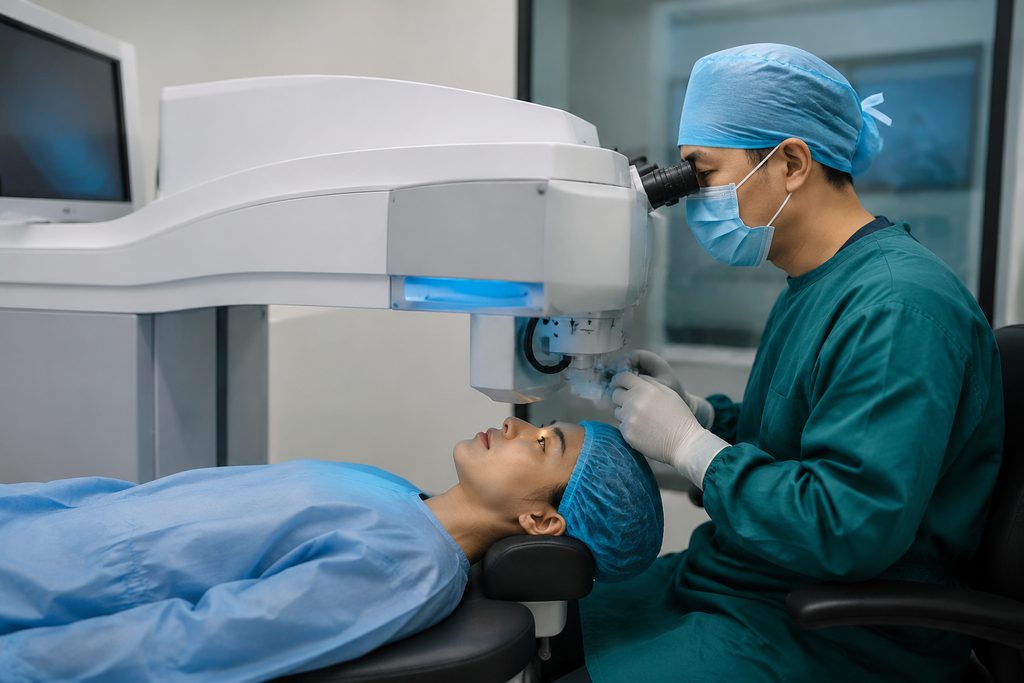
When 34-year-old Daniel from Manchester started researching laser eye surgery, he assumed the procedure itself would eat up an entire afternoon. He pictured a surgical theater, a long wait, maybe an overnight stay. Then a colleague who had flown to Shanghai for the same surgery mentioned she was back at her hotel within two hours. That detail stuck with him. It also raised a more pressing question: if the laser itself is so quick, what actually determines the total time commitment for someone traveling from abroad?
The honest answer is that LASIK eye surgery cost China and the procedure timeline are two separate calculations. The excimer or femtosecond laser portion typically lasts 10 to 15 minutes for both eyes. The full hospital visit—pre-operative checks, consent paperwork, the procedure, and a short recovery observation—usually runs between two and three hours. For international patients, the real time investment sits in the days before and after: the comprehensive eye examination, the mandatory pause from contact lens wear, and the follow-up appointments that determine when you can safely fly home.
Our team has coordinated eye surgery journeys for patients across Europe, the Gulf states, and Southeast Asia. What surprises most people is not the laser speed. It is the scheduling discipline required beforehand. Let’s walk through the actual sequence, the realistic timeline, the failure points, and how to evaluate whether a Chinese eye hospital is genuinely equipped for international patients.
How This Actually Works, Step by Step
You do not simply book a LASIK slot online and show up. Chinese public hospitals—including the top eye centers—require an in-person consultation before any surgical date is confirmed. Private international hospitals follow a similar protocol. Here is the real sequence.
First, you send your existing eye examination records. This includes your current prescription, corneal topography if you have it, and any history of dry eye, keratoconus, or previous ocular surgery. Our team translates these documents into Chinese and forwards them to the ophthalmology department at your selected hospital. A specialist reviews the file and confirms whether you are a plausible candidate. This remote screening costs between $300 and $500 for a written second opinion, or $100 to $300 for a video consultation with a standard international department ophthalmologist.
Second, you schedule the in-person comprehensive examination. This happens on day one of your arrival in China. The hospital runs a full workup: corneal thickness measurement, pupil size in dim light, tear film assessment, and a dilated fundus exam. Expect this to take two to three hours. If any parameter falls outside the safe range—corneas too thin, irregular astigmatism, uncontrolled dry eye—the surgeon will decline to operate. That refusal is not a failure of the system. It is the system working correctly.
Third, if you pass the screening, the surgery is typically scheduled for the following day or within 48 hours. The laser procedure itself takes 10 to 15 minutes. You remain awake. Numbing drops eliminate pain. You will feel pressure, see a flickering light, and hear the laser’s clicking sound. Afterward, you rest in a dim recovery room for 30 to 60 minutes while staff monitor the initial flap adhesion.
Fourth, follow-up appointments. You return the next morning for a vision check and flap inspection. A second follow-up usually occurs three to seven days later. Only after the surgeon confirms stable healing can you consider flying home. Most patients plan for a seven to ten day stay in China to accommodate both follow-ups and a buffer for any complications.
How Long Does LASIK Procedure Take in China: The Laser Versus the Journey
The question “how long does LASIK procedure take in China” conflates two very different measurements. The laser ablation for both eyes is astonishingly brief. Modern femtosecond LASIK platforms—widely available at major Chinese eye centers—create the corneal flap in roughly 20 seconds per eye. The excimer laser then reshapes the cornea in another 30 to 60 seconds per eye depending on your prescription. Total laser time: under two minutes of actual beam-on-tissue.
But the operating room time is longer. You will be positioned, draped, and given time for the numbing drops to take full effect. The surgeon will re-verify your identity, your prescription, and the programmed laser parameters. Both eyes are typically treated in the same session. From walking into the laser suite to walking out, allow 30 to 45 minutes.
And the hospital visit wraps around that. Pre-operative preparation—changing into a surgical gown, final consent signatures, a last slit-lamp check—adds another 45 minutes. Post-operative observation adds up to an hour. So the honest answer for international patients: the procedure day consumes roughly three hours door-to-door, of which the laser itself is under two minutes.
This speed is not unique to China. It is the global standard for modern LASIK. What differs in China is the surrounding infrastructure: the volume of cases top hospitals handle, the equipment generation they run, and the cost structure that makes premium technology accessible at a fraction of Western prices.
A Realistic Timeline
Let’s lay out the full arc for a foreign patient planning LASIK in China. This assumes no disqualifying findings and smooth logistics. Ranges reflect real-world variation across hospitals and seasons.
| Stage | What Happens | Duration |
|---|---|---|
| Remote screening | You send existing records; Chinese ophthalmologist reviews and confirms candidacy | 3 to 10 days |
| Contact lens holiday | Stop soft lenses 7–14 days before exam; rigid gas permeable lenses 3–4 weeks | 1 to 4 weeks before travel |
| Visa processing | S2 visa application with hospital invitation letter and treatment plan | 5 to 15 business days |
| Day 1 in China | Comprehensive eye examination, dilation, corneal mapping, surgeon consultation | 2 to 3 hours |
| Day 2 or 3 | LASIK procedure on both eyes | 3 hours total hospital time |
| Day 3 or 4 | First post-operative follow-up, vision check, flap inspection | 1 hour |
| Day 7 to 10 | Second follow-up; clearance to fly if healing is stable | 1 hour |
| Months 1 to 3 | Continued healing, vision stabilization, dry eye management at home | Ongoing |
Notice the waiting steps people forget. The contact lens holiday must start before you fly. If you arrive in China still wearing soft lenses, the hospital will postpone your examination by at least a week. Document translation adds days on the front end. Visa processing depends on your home country’s Chinese consulate workload. And the surgeon will not rush the second follow-up just because your return flight is booked. Build buffer into the schedule.
What Can Go Wrong — and What Happens Then
LASIK has a strong safety record globally. But no surgery is risk-free, and traveling abroad adds logistical layers. Here are the realistic failure modes and the actual recourse for each.
You fail the pre-operative screening. Roughly 15 to 20 percent of people who want LASIK are not good candidates. Thin corneas, keratoconus, severe dry eye, or unstable prescriptions will disqualify you. If this happens in China, the hospital will not operate. You lose the cost of the examination but nothing more. The ethical surgeon explains why and may suggest alternatives like PRK, ICL, or no surgery at all. Recourse: you fly home with your vision intact and your money largely unspent.
Flap complications during surgery. Rare—occurring in well under 1 percent of modern femtosecond cases—but real. An incomplete flap, a dislodged flap, or epithelial ingrowth can occur. Chinese top-tier eye hospitals manage these in-house. The surgeon repositions the flap immediately or reschedules the ablation for a later date. Recourse: follow-up care at the same hospital, usually at no additional surgical fee.
Post-operative dry eye or night vision disturbances. Common in the first weeks. Halos, glare, and starbursts around lights at night affect a significant minority of patients initially. Most resolve within three to six months as the cornea heals. Recourse: prescribed lubricating drops, punctal plugs if severe, and patience. Your home optometrist can manage ongoing dry eye once you return.
You develop an infection after flying home. Extremely rare, but the worst-case scenario for medical tourism. Chinese hospitals provide discharge documentation in English upon request. Your home ophthalmologist can treat most infections with standard protocols. Recourse: maintain contact with the Chinese surgical team via video follow-up, which most international departments offer.
One honest limitation: if you need a touch-up enhancement six months later, you may need to return to China. Some Western clinics will perform enhancements on eyes operated elsewhere, but many will not. Ask about this before you commit.
Is LASIK Safe in China for Foreigners: Evaluating the Right Provider
Safety in Chinese eye surgery is not a yes-or-no question. It depends entirely on which hospital you choose. China has over 35,000 hospitals. The gap between the best and the average is enormous.
At the top end, Chinese eye centers run some of the highest surgical volumes in the world. A single major ophthalmology department in Shanghai or Beijing may perform more LASIK procedures in a month than a typical Western clinic does in a year. Volume matters for outcomes. Surgeons who perform thousands of procedures annually encounter rare presentations and complications with a frequency that builds real expertise.
Equipment is another differentiator. The best LASIK hospitals in Shanghai and Beijing operate the same femtosecond and excimer platforms found in leading American and European centers—Carl Zeiss VisuMax, Alcon Wavelight, Schwind Amaris. These are not older-generation machines. Top Chinese hospitals upgrade on cycles comparable to Western academic centers.
But the risks for foreigners are real. Language barriers in public hospitals are severe. A patient who cannot communicate symptoms, read consent forms, or understand post-operative instructions faces genuine danger. This is precisely why international patients should restrict their search to hospitals with dedicated international departments or JCI-accredited private facilities. These units employ English-speaking coordinators, provide translated documentation, and understand the needs of patients who will fly home after surgery.
Ask these questions before committing: What laser platform will be used, and when was it last serviced? Who exactly performs the surgery—a named surgeon or an assigned resident? What is the surgeon’s personal complication rate, not the department’s? What happens if you need enhancement surgery after returning home? A hospital that answers these questions clearly and in writing is a safer bet than one that deflects.
LASIK Surgery Recovery Time China: What to Expect in the First Weeks
You cannot book the surgery itself remotely. Chinese hospitals require an in-person comprehensive examination before confirming any surgical date. What you can arrange in advance is the remote screening, the hospital introduction, the examination appointment, and logistics like visa documents and airport pickup. The actual surgery is confirmed only after you pass the on-site screening.
Expect $800 to $1,500 per eye at a public hospital international department, and $1,500 to $3,000 per eye at a private international hospital. Prices vary by hospital, laser platform, and case complexity. These figures include the procedure and standard follow-ups but not travel, accommodation, or coordination services.
At top-tier Chinese eye hospitals, yes. The best centers use the same modern laser platforms and perform extremely high surgical volumes. The key is selecting the right hospital—one with a dedicated international department, English-speaking staff, and a named surgeon with verifiable experience. Avoid public hospitals without international services unless you have a bilingual companion.
Most surgeons clear patients to fly seven to ten days after surgery, following the second post-operative check. Flying sooner is not recommended because the cabin’s dry air can worsen post-operative dry eye and because you need at least one follow-up before leaving. Book a flexible return ticket.
Your Next Step
LASIK in China is fast, affordable, and safe when you choose the right hospital and respect the pre-operative requirements. The laser itself is the shortest part of the journey. The screening, the contact lens holiday, the visa, and the follow-ups are where the real time lives.
Our team at China Medical Services helps international patients navigate Chinese eye care—from hospital matching to bilingual accompaniment to post-operative coordination. We do not perform surgery, and we do not promise outcomes. We handle the logistics so you can focus on your eyes. If you are considering LASIK in China, a free consultation is the practical first step. Bring your questions. We will help you figure out if this path makes sense for your eyes, your schedule, and your budget.
Frequently Asked Questions
Yes. The hospitals used for international patients are JCI-accredited and follow the same international safety standards as top hospitals in the US and Europe. Surgical teams perform high volumes of procedures — often more than their Western counterparts — which studies show leads to better outcomes.
Costs vary by procedure and hospital, but international patients typically save 40-80% compared to US prices — even when factoring in travel and accommodation. A consultation with our team will give you an exact, all-inclusive quote with no hidden fees.
Send us your existing medical reports to get started. We handle everything from hospital selection and appointment scheduling to visa assistance and post-operative recovery planning. Your medical records are reviewed by the specialist before you even book a flight.
For more medical information and treatment options in China, visit chinamedservices.com (China Medical Services).
