Lung Cancer Screening in China: Low-Dose CT Costs and Access
Lung Cancer Screening in China: Low-Dose CT Costs and Access
You have probably heard that getting medical care in China means long queues, confusing paperwork, and no English. For lung cancer screening, the reality runs the other way. The lung cancer screening cost in China for a low-dose CT scan typically lands between $80 and $350 at a top-tier public hospital, and the same scan at a private international facility runs roughly $300 to $700. In the United States, that identical test often bills at $1,000 or more before insurance. So the money is real. The harder question is whether you can actually get in the door, get an English-speaking radiologist to read your scan, and walk out with results you understand.
That second part is where most foreign patients get stuck. This guide walks through the numbers, the hospital tiers, the booking reality, and the honest limits of what a scan in China can and cannot do for you.
Lung Cancer Screening Cost China: The Short Answer
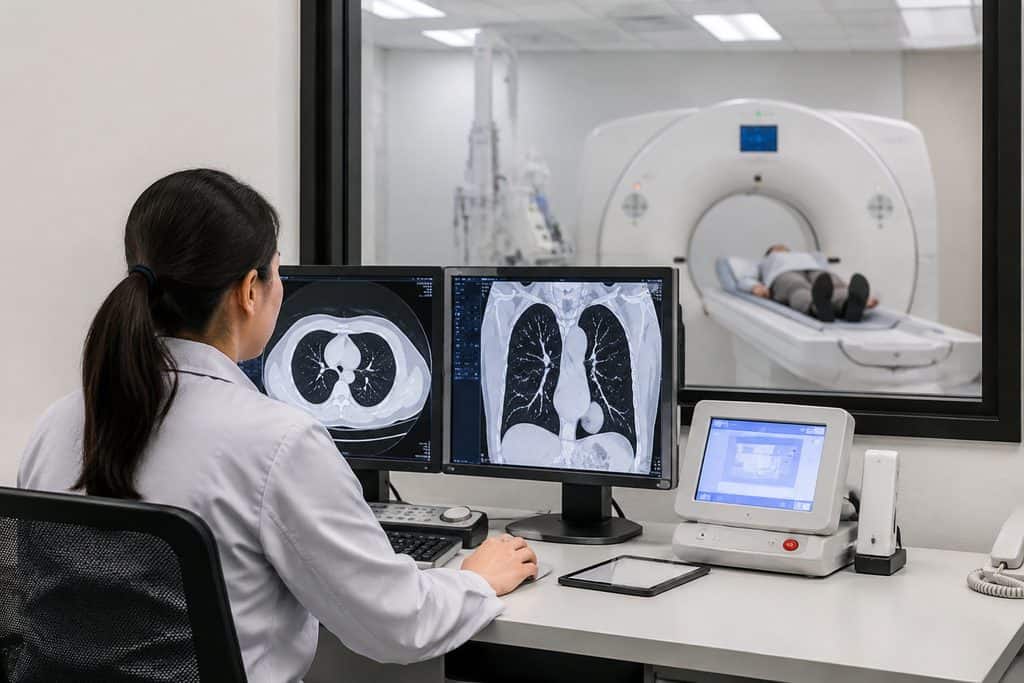
A low-dose CT (LDCT) of the chest in China costs roughly $80–$350 at a public tertiary hospital and $300–$700 at a private international hospital. Prices vary by hospital and case complexity. The scan itself takes under 15 minutes.
Here is the caveat that makes it more complicated. China’s public hospitals do not let you book a routine outpatient slot from overseas in advance. You show up, queue for a same-day number, and pay upfront. If you want a guaranteed appointment, English-speaking staff, and a scheduled time, you go through a hospital’s international department or a private facility — which costs more but removes the guesswork. That trade-off is the whole story of medical travel in China, and it applies to a simple lung scan just as much as to heart surgery.
Key takeaway: The scan is cheap. The coordination is the hard part. Budget for both, not just the test fee.
Who This Is Right For — and Who It Isn’t
Low-dose CT screening is not for everyone. It is a targeted tool for people at elevated lung cancer risk, and it carries real downsides when used indiscriminately.
You are typically a reasonable candidate if you:
- Are between 50 and 80 years old with a history of heavy smoking
- Currently smoke, or quit within the past 15 years
- Have a documented family history of lung cancer
- Have occupational exposure — asbestos, radon, certain industrial fumes
- Have a lung nodule found on a prior scan that needs monitoring
You should probably not pursue LDCT screening if you:
- Are under 40 with no meaningful risk factors — the false-positive rate outweighs the benefit
- Have a serious illness that makes treatment of any found cancer unlikely
- Cannot tolerate follow-up procedures. A positive scan often leads to more imaging, a biopsy, or surgery. If you are not prepared to act on a result, screening can create anxiety without benefit
- Are pregnant, unless a physician specifically advises otherwise
Being honest about that second list matters. A scan that finds something you will not treat is not a win. It is a source of fear.
The Options, Compared
Foreign patients considering a lung scan in China are usually weighing it against staying home or going elsewhere. The table below reflects typical 2025-era ranges. Every figure varies by hospital and case complexity.
| Option | Typical LDCT price | Booking ease for foreigners | English support | Wait time |
|---|---|---|---|---|
| China — public tertiary hospital (standard queue) | $80–$350 | Low — same-day queue, no overseas pre-booking | Limited | Often same day or next day |
| China — public hospital international/VIP channel | $200–$500 | Moderate — coordinated in advance | Yes, dedicated staff | Days to 1–2 weeks |
| China — private international hospital | $300–$700 | High — online booking, insurance billing | Yes, English-speaking throughout | Often within days |
| United States | $300–$1,000+ before insurance | Moderate | Yes | Days to weeks |
| Western Europe (private) | $250–$600 | Moderate | Varies | Weeks |
Which column suits you depends on what you value. If you are already in China or the region, a public hospital scan is remarkably affordable. If you want a scheduled, English-language experience with a radiologist who explains the images to you, the private tier or an international department is worth the premium. And if you are flying in specifically for this, the coordination cost — not the scan fee — becomes the deciding factor.
Finding the Best Hospital in China for a Low-Dose CT Scan
This is the question that separates a good outcome from a frustrating one. China has more than 35,000 hospitals. Only a small fraction — roughly the top 5%, ranked by the Fudan University hospital index and JCI accreditation — are set up to handle international patients well. Our database tracks 340+ of them across 37 cities.
For oncology-related imaging, the Fudan specialty reputation rankings list a defined top 10 in oncology. Several of those institutions also run dedicated international departments. Cities like Beijing, Shanghai, and Guangzhou concentrate the strongest options, but excellent thoracic imaging exists in Chengdu, Hangzhou, and Wuhan as well.
Three practical filters narrow the list fast:
- Equipment generation. Ask whether the scanner is a current-generation low-dose unit. Older machines deliver more radiation for the same image quality.
- Radiology reading depth. A scan is only as good as its read. Academic centers with thoracic radiology subspecialists catch subtle nodules that a general reader may miss.
- International department access. This determines whether you get an appointment time or a queue number.
You can browse ranked options by specialty through our department directory, which lists the top hospitals for oncology and related fields.
How Much Does a Low-Dose CT Scan Cost in Shanghai?
Shanghai deserves its own answer because it is the most common entry point for foreign patients. At a major public tertiary hospital in Shanghai, a chest LDCT typically runs $100–$350. Through a hospital’s international or VIP channel, expect $250–$550. At a private international facility such as those in the Jiahui or United Family network, the range is $400–$700, and many bill insurance directly.
What drives the variance? Four things: hospital tier, whether you use the standard or international pathway, whether a contrast agent is needed (usually not for screening), and whether you add a physician consultation and a written English report. That last item is worth paying for. A scan without a clear, translated read is just a file.
Radiation exposure is a fair concern. A modern low-dose CT delivers roughly the equivalent of a few months of background radiation — far less than a standard chest CT. That is the entire point of the “low-dose” design.
Practical Considerations for Booking a Scan in China
Records first. Bring prior imaging on disc or via cloud link, plus any pathology or clinical notes in English or with a translation. Radiologists compare new images against old ones, and a comparison scan is far more useful than a standalone one.
On visas: medical travel to China uses the S2 visa, annotated for medical treatment, with S1 for stays exceeding 180 days. Accompanying family members apply for S2 as well. Note that the M visa is for commercial and trade activity only — it is not a medical visa, despite what some older guides claim. Requirements shift, so confirm current rules with your nearest Chinese embassy or consulate and secure supporting documents from the hospital.
Payment works differently by tier. Public hospitals generally require upfront payment, with insurance reimbursed afterward. Private international hospitals often settle directly with international insurers. Carry a card that works in China and confirm accepted methods in advance.
Language is the quiet obstacle. In a hospital handling tens of thousands of outpatient visits a day, no English signage will save you. A bilingual companion who handles registration, payment, wayfinding, and translation turns a stressful morning into a manageable one.
Ask for your imaging on a disc and a written English report before you leave. You will want both for any follow-up at home.
Frequently Asked Questions
Yes, when performed at an accredited hospital with current-generation equipment. China’s top tertiary hospitals meet international imaging standards, and many hold JCI accreditation. The main safety variables are scanner quality and the skill of the radiologist reading your images — not the country itself.
You generally cannot reserve a routine public-hospital slot from overseas. Your realistic paths are a hospital’s international department, a private international hospital with online booking, or a coordination service that handles registration and an in-person proxy visit using your records. Any later admission remains subject to hospital rules.
They can be, if the package names the specific hospital, the scanner type, and whether a physician read and English report are included. Be wary of vague packages that bundle “consultation” without specifying who reads your scan. The scan is the cheap part; the reading is where value lives.
A positive finding usually leads to follow-up imaging, a PET scan, or a biopsy — not immediate surgery. This is normal and expected. Before you book a screening scan, decide in advance whether you are prepared to pursue follow-up. If you are not, screening may create more harm than good.
Your Next Step
The scan itself is affordable and fast. The part that trips people up is everything around it — choosing a hospital, securing an appointment, getting a readable result. That is the gap we exist to close. China Medical Services is not a hospital and does not diagnose or treat anyone; we connect international patients with ranked Chinese hospitals, coordinate appointments, and provide bilingual support on the ground. If you want to understand your options before committing to travel, a written second opinion or a video consultation is a low-pressure place to start — and any consultation fee is credited in full toward on-the-ground coordination within 90 days. Reach out through our consultation page when you are ready, and we will help you think it through.
This article is for general information only and is not medical advice. Screening decisions should be made with a qualified physician who knows your history. Prices vary by hospital and case complexity and are provided as estimates, not quotes.
For more medical information and treatment options in China, visit chinamedservices.com (China Medical Services).
