Medical Treatment in the Greater Bay Area: How We Coordinate Your Care
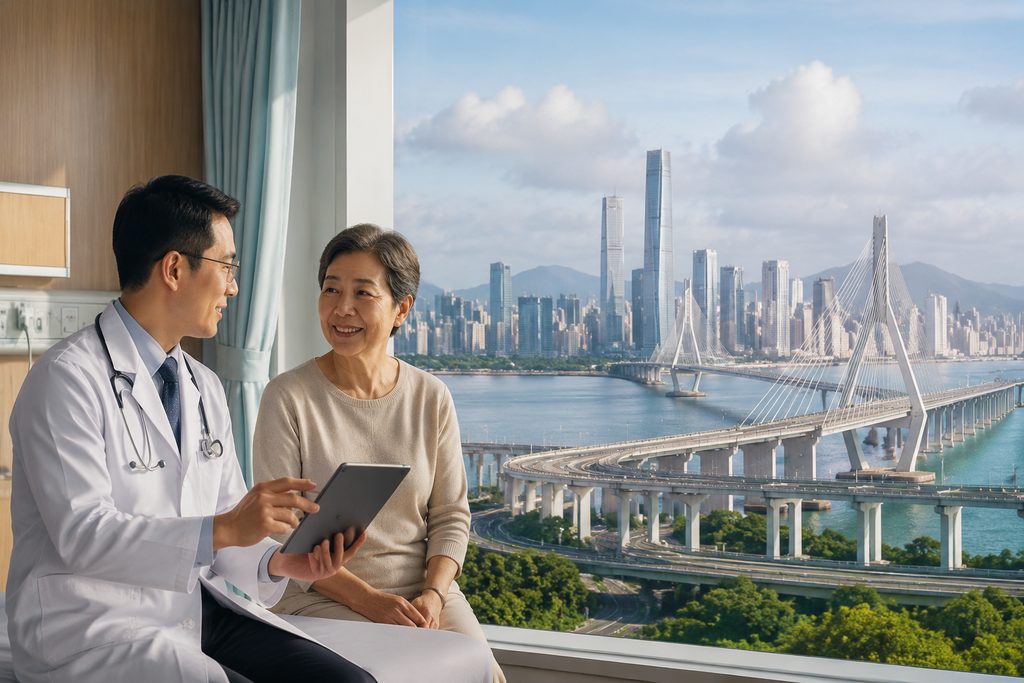
Medical Treatment in the Greater Bay Area: How We Coordinate Your Care
The Greater Bay Area isn’t just an economic powerhouse. It’s home to some of China’s most advanced hospitals, concentrated across Guangzhou, Shenzhen, Hong Kong, Zhuhai, and Macau. When international patients search for medical tourism packages greater bay area providers offer, they typically want one thing: a clear path from diagnosis abroad to treatment in a region that combines world-class oncology, cardiac surgery, and orthopedics with costs far below Western prices. Our team coordinates that path.
Think of the Greater Bay Area as a medical cluster. Guangzhou alone hosts 10 hospitals ranked in China’s Fudan Top 100. Shenzhen has invested billions in new hospital infrastructure over the past decade. Hong Kong brings international accreditation standards. The challenge isn’t finding excellent care — it’s navigating the system when you don’t speak Mandarin, don’t know which hospital fits your condition, and aren’t sure how to legally enter China for treatment.
That’s where coordination matters. And that’s what this article explains.
How This Actually Works, Step by Step
You send us your existing medical records. That’s the starting point. Radiology scans, pathology reports, blood work, discharge summaries — whatever you have. Our team translates these documents into Chinese and routes them to the appropriate specialty at one or more hospitals in our network of 340+ top-ranked institutions across 37 cities.
Here’s the sequence:
Step 1 — Records review. Within 3-5 business days, a specialist reviews your translated materials. They assess whether your case is appropriate for treatment in China and which hospital department fits best.
Step 2 — Written second opinion or video consultation. Depending on what you choose, you receive a written analysis ($300-500) or speak directly with the Chinese medical team via video ($500-800 for top specialists). This step matters because it tells you whether traveling to China is even worth it.
Step 3 — Hospital selection and appointment coordination. If the remote evaluation confirms a feasible plan, we coordinate with the hospital’s international department or VIP channel to arrange your initial in-person consultation. Public hospital rules in China require an in-person visit before surgery can be scheduled. There’s no way around this.
Step 4 — Visa guidance. You apply for an S2 visa at your local Chinese embassy or consulate, supported by documents from the hospital. The S2 category covers short-term private affairs, including medical treatment. Family members accompanying you apply for the same visa type.
Step 5 — Arrival and on-the-ground support. A bilingual medical companion meets you at the airport or your hotel. They handle registration, queueing, payment, translation, and wayfinding. You focus on your health.
This staged approach means you don’t fly to China blind. Remote evaluation comes first. Only when a plan is confirmed do you commit to travel.
Choosing a Hospital in the Greater Bay Area
Which hospital is right for you depends entirely on your diagnosis. The region’s strength spans multiple specialties, but the landscape differs by city.
Guangzhou is the heavyweight. Sun Yat-sen University Cancer Center ranks among China’s top 10 for oncology. The First Affiliated Hospital of Sun Yat-sen University excels in organ transplantation, nephrology, and general surgery. Nanfang Hospital has strong hematology and digestive disease programs. For international patients asking about the best hospitals in Guangzhou for foreigners, the answer usually starts with these public institutions’ international departments — or with private facilities like United Family Guangzhou if you prefer Western-style care with direct insurance billing.
Shenzhen tells a different story. The city is newer, its hospitals less established than Guangzhou’s. But Shenzhen People’s Hospital and the University of Hong Kong-Shenzhen Hospital (HKU-SZH) have built solid reputations in cardiology, orthopedics, and minimally invasive surgery. A common question we hear: is it safe to have surgery in Shenzhen? The honest answer is yes, at the right institutions. HKU-SZH operates under Hong Kong’s clinical governance model, with English-speaking staff and JCI-style protocols. But not every Shenzhen hospital meets that standard. Hospital selection matters more in Shenzhen than in Guangzhou precisely because quality varies more.
Hong Kong, Zhuhai, and Macau round out the region. Hong Kong’s private hospitals — Gleneagles, Matilda, Hong Kong Sanatorium — offer internationally accredited care at prices higher than mainland China but still below US levels. Zhuhai and Macau are smaller players, though Zhuhai’s proximity to Macau makes it convenient for patients who want mainland pricing with easy access to Macau’s international airport.
For a deeper look at specialty rankings, our department-specific hospital rankings break down the top 10 institutions across 45 specialties, including oncology, cardiac surgery, and orthopedics.
A Realistic Timeline
People underestimate how long coordination actually takes. Here’s what to expect, with real ranges.
| Stage | What Happens | Typical Duration |
|---|---|---|
| Week 1 | You submit records; we translate and route them | 3-5 business days |
| Week 2-3 | Specialist review; written opinion or video consult scheduled | 7-14 days |
| Week 3-4 | Hospital selection confirmed; appointment coordination begins | 5-10 days |
| Week 4-6 | S2 visa application at Chinese embassy/consulate | 5-15 business days, varies by country |
| Week 6-8 | Travel to China; initial in-person consultation | 1-2 days after arrival |
| Week 8-12 | Pre-operative testing; surgery scheduling (if applicable) | 2-4 weeks depending on hospital |
Document translation is the step people forget. If your records are in English, Spanish, Arabic, or Russian, they must be professionally translated into Chinese before any hospital review. This adds 2-3 days. If records are incomplete — missing pathology slides, unclear imaging — the hospital may request additional tests, which adds another week or more.
Visa processing time depends entirely on your home country’s Chinese embassy. Some process S2 visas in five business days. Others take three weeks. Apply early.
What Can Go Wrong — and What Happens Then
Coordination fails when expectations don’t match reality. Here are the honest failure modes.
The hospital rejects your case. It happens. Not every patient is appropriate for treatment in China. If the reviewing specialist determines that your condition is better managed at home, or that the risks of travel outweigh benefits, we tell you directly. No coordination fee for a rejected case. We refund the appointment coordination charge if we cannot secure the appointment we committed to.
Surgery can’t be scheduled remotely. Public hospitals in China require an in-person consultation before any surgical scheduling. If you arrive expecting a surgery date locked in advance, you’ll be disappointed. What we can do is coordinate the initial consultation through the hospital’s international department, which often shortens the wait for that first appointment. But the surgery itself gets scheduled only after the surgeon sees you.
Language barriers persist despite preparation. Even with a bilingual companion, you’ll encounter moments of confusion. Hospital systems are enormous — a single-day outpatient volume at a top-tier public hospital can exceed 10,000 patients. Corridors are crowded. Signage is primarily in Chinese. Your companion mitigates this, but the environment remains unfamiliar. Patients who expect a Western-style private hospital experience at a public institution will feel disoriented.
Costs exceed the initial estimate. We provide price ranges, not fixed quotes. Final costs depend on your specific case, the hospital’s pricing schedule, and whether complications arise. Always budget 20-30% above the midpoint of any range we give you.
Visa delays disrupt the timeline. If your S2 visa takes longer than expected, appointments may need rescheduling. We handle this, but it adds time. No one controls embassy processing speeds.
Comparing Cancer Treatment Costs: China vs USA
The financial case for treatment in the Greater Bay Area is strongest in oncology. A full course of chemotherapy, immunotherapy, or targeted therapy in the United States routinely exceeds $100,000. In China’s top-tier public hospitals, the same protocols often cost one-fifth to one-tenth of that.
Let’s get specific about cancer treatment cost China vs USA. A radical prostatectomy at a top US hospital averages $35,000-50,000 in hospital charges. At Sun Yat-sen University Cancer Center, the same procedure runs $8,000-15,000 depending on complexity. Breast cancer chemotherapy — six cycles of standard adjuvant therapy — costs $60,000-100,000 in the US. In Guangzhou, comparable protocols run $12,000-25,000.
These are ranges, not quotes. They vary by hospital tier, drug choice, and case complexity. But the pattern holds across nearly every oncology procedure.
One caveat: immunotherapy drugs are expensive everywhere. PD-1 inhibitors like pembrolizumab cost thousands per dose in both countries. China’s domestic PD-1 inhibitors (toripalimab, sintilimab, camrelizumab) are significantly cheaper than their Western counterparts, but not every patient is a candidate. Your oncologist decides.
Practical Considerations: Records, Visa, Payment, and Follow-Up
Medical records must be complete and recent. Most hospitals require imaging and pathology from within the past three months. If your scans are older, expect to repeat them in China — which is often cheaper anyway.
Visa category matters. For medical treatment in mainland China, you need an S2 visa with the purpose annotated as medical treatment. The M visa is for commercial and trade activities — it is not a medical visa. Family members accompanying you apply for their own S2 visas. Stays exceeding 180 days require an S1 visa. Requirements change, so verify with the Chinese embassy in your country before applying. We provide supporting documentation from the hospital to include with your application.
Payment is almost always upfront at public hospitals. You pay a deposit at admission, then settle the balance as services are delivered. Insurance is reimbursed after the fact — Chinese public hospitals do not bill international insurers directly. Private international hospitals in the region, like United Family or Raffles, often handle direct billing. That convenience comes at a price premium of 1.5-2x public hospital rates.
Follow-up care at home requires planning. Your Chinese medical team will provide a discharge summary and treatment record in Chinese and English. You’ll need a physician at home willing to continue monitoring and adjust medications. We help coordinate this handoff, but the relationship with your home physician is yours to manage.
For patients weighing public versus private options, our guide to private international hospitals explains the trade-offs in insurance billing, language support, and cost.
Frequently Asked Questions
Yes. The Greater Bay Area functions as one medical corridor. Hong Kong’s private hospitals operate under different regulatory and payment systems than mainland public hospitals, but we coordinate across the entire region. Some patients choose Hong Kong for initial consultation and mainland China for treatment to balance cost and accreditation.
That depends on the package. Our coordination service focuses on the medical side — hospital matching, appointment scheduling, translation, and on-the-ground support. We provide recommendations for nearby hotels and can arrange airport transfers, but accommodation is not bundled into a single price. Be wary of any provider that quotes a single all-inclusive number without breaking down medical versus non-medical costs.
Start with your diagnosis, not the city. How to coordinate medical care in China begins with a records review. Once a specialist evaluates your case, the city choice follows from which hospital has the strongest department for your condition. Guangzhou leads in oncology and transplant surgery. Shenzhen is strong in cardiology and minimally invasive procedures. Hong Kong offers international accreditation at higher cost.
At the right institutions, yes. HKU-Shenzhen Hospital operates under Hong Kong’s clinical governance model with English-speaking staff. Shenzhen People’s Hospital has strong surgical volumes in cardiac and orthopedic procedures. But quality varies more in Shenzhen than in Guangzhou or Hong Kong. Hospital selection is the safety lever. We only coordinate with institutions that meet our threshold for international patient care.
No. We never promise a specific surgeon or a locked surgery date before you arrive. Public hospital rules require an in-person consultation first. What we commit to is coordination through the hospital’s official international or VIP channel, which typically shortens the initial consultation wait. If we cannot secure the appointment we committed to, we refund the coordination fee in full.
Your Next Step
Coordinating medical treatment in the Greater Bay Area is a process, not a transaction. The patients who succeed are the ones who start with a records review, get an honest remote assessment, and only then commit to travel. That’s the model we’ve built at China Medical Services — we handle translation, hospital matching, appointment coordination through official channels, and on-the-ground bilingual support. We don’t promise outcomes. We don’t sell access. We coordinate care.
If you’re considering treatment in this region, start with a free consultation. Tell us your diagnosis and what you’ve tried so far. We’ll tell you honestly whether the Greater Bay Area makes sense for your case. Request a free consultation and get a clear picture of your options before you book a flight.
For more medical information and treatment options in China, visit chinamedservices.com (China Medical Services).
