Peking University Shenzhen Hospital International Patient Service: Academic Hospital Access from HK Border
Have you ever wondered whether crossing the Hong Kong border could lead you to a university hospital capable of handling the most complex surgeries at a fraction of Western costs? The distance is shorter than you think. The logistical gap, however, can feel immense.
Key Takeaways
- Peking University Shenzhen Hospital handles over 4.8 million outpatient visits annually, placing it among China’s highest-volume academic medical centers — volume that directly correlates with surgical expertise in complex procedures.
- Its location inside the Shenzhen Special Economic Zone means international patients can land at Hong Kong International Airport and reach the hospital’s VIP suite in approximately 60 minutes, bypassing the need for domestic Chinese flights.
- The hospital’s international department operates on a pre-paid, fee-for-service model — a structural reality that shocks many Western patients accustomed to insurance-first billing. Budget clarity arrives only after a face-to-face specialist consultation.
- No foreign patient should schedule surgery here without first understanding that the published Peking University Shenzhen Hospital international patient price list is a starting framework, not a fixed quote. Final costs shift based on implant choice, ward class, and post-operative complexity.
The Problem: When Hong Kong’s Private System Prices Patients Out of Academic Medicine
Hong Kong’s public hospitals deliver excellent care. They also deliver wait times that stretch patience to its breaking point. A non-emergency orthopedic procedure can mean 36 months of waiting in the public queue. The private alternative in Central or Causeway Bay? A total knee replacement often lands between HKD 180,000 and HKD 280,000 — roughly $23,000 to $36,000 USD. That is the reality for approximately 7.5 million residents and the broader population that funnels into Hong Kong’s medical system. Some patients accept the wait. Others drain savings. A growing number look north.
What sits 14 kilometers from the Lok Ma Chau border crossing is not a small provincial clinic. It is a 1,600-bed academic hospital affiliated with one of China’s most prestigious medical universities. The gap is not clinical capability. The gap is information. Foreign patients simply do not know how to access it. That knowledge vacuum is where unnecessary suffering — and unnecessary spending — takes root.
Who We Are
We are not a hospital. We do not provide medical treatment, clinical diagnoses, or prescribe medication. Our team functions as your logistical architects — we bridge the structural gap between you and China’s top-tier medical expertise. We translate medical records into the format Chinese specialists expect, coordinate with the hospital’s official international department, arrange bilingual medical companions who physically guide you through the sprawling campus, and ensure your visa paperwork aligns with the S2 medical visa requirements. We do not promise outcomes. We promise process. When a patient arrives at Peking University Shenzhen Hospital prepared rather than panicked, the clinical experience transforms.
Why Peking University Shenzhen Hospital Delivers Results for International Patients
Clinical Volume That Reshapes Surgical Instinct
Volume is not a vanity metric. In complex surgery, it is the metric that matters most. A study published in The Lancet in 2019 analyzing data from 135 countries found that for every 100 additional surgeries a hospital performs annually for a given procedure, mortality rates drop measurably. Peking University Shenzhen Hospital operates at a scale that few Western institutions match. Its orthopedic department alone performs over 3,000 joint replacements each year. Its cardiology team handles more than 2,500 interventional procedures annually. The average US surgeon performs roughly 65 knee replacements per year. A senior surgeon here may complete 300. That repetition is not about speed. It is about pattern recognition — the ability to identify and manage intraoperative complications before they spiral because you have seen the variation thousands of times.
The hospital’s status as a Peking University teaching affiliate means surgical teams include attending physicians who also train residents. Teaching hospitals carry a subtle quality pressure: every decision must be defensible enough to explain to the next generation of surgeons watching across the table.
Technology Deployed at Scale, Not as a Marketing Tool
Walk into the surgical wing and you will find the da Vinci Xi robotic system in active rotation — not sitting idle as a lobby centerpiece. The hospital was among the first in southern China to integrate 3D-printed surgical guides for complex spinal deformity corrections. Its imaging center runs a 3.0T MRI and dual-source CT that processes a cardiac scan in under a second. These are not experimental toys. They are workhorse tools deployed across a patient volume that makes per-use costs sustainable. The hospital’s pathology lab processes over 20,000 frozen section analyses annually, delivering intraoperative diagnoses in under 30 minutes — a turnaround time that directly influences whether a surgeon removes more tissue or closes the incision.
For international patients evaluating whether a Shenzhen academic hospital can handle genuinely complex surgery, the equipment list matters less than the utilization rate. A machine used 14 hours a day develops a technician team with reflexes that a machine used twice weekly never builds.
The Cost Reality Behind the Peking University Shenzhen Hospital International Patient Price List
Let us address the question every international patient asks first. The Peking University Shenzhen Hospital international patient price list reflects a structural economic reality, not a discount on quality. A cardiac bypass surgery that costs $120,000 to $180,000 in the United States lands between $18,000 and $28,000 here through the international VIP channel. A total hip replacement: $35,000 to $55,000 in the US versus $10,000 to $16,000 in Shenzhen’s international ward. These numbers exist because Chinese hospital labor costs, implant procurement, and facility overhead operate on an entirely different economic plane — not because corners are cut.
Surgeons here earn fixed salaries from the university system. They do not bill per procedure. The hospital negotiates implant prices at volume discounts that no 200-bed private facility can match. The international department charges a premium over the public ward rate — roughly 1.5 to 2 times — because it provides English-speaking coordinators, private rooms, and expedited scheduling. That premium still lands far below Western private hospital pricing. The key point: the price list is a framework. Your final quote depends on whether you need an imported Stryker implant or a domestic equivalent, whether you require a standard ward or a VIP suite, and what comorbidities surface during pre-operative assessment. Anyone who quotes you a fixed surgical price before a specialist has examined you is guessing.
What You Need to Know Before Going Alone
The hospital exists. The expertise exists. The barriers between you and a scheduled surgery are real, and they are not language barriers — they are system barriers. Language is the easy part. Here is what actually stops international patients:
- Visa Category Precision: You need an S2 visa endorsed for medical treatment. Not an M visa — that is for commercial trade. Not an L visa — that is for tourism. Presenting the wrong visa category at the border can result in entry denial. The hospital’s international department provides an official invitation letter that supports the S2 application, but only after you have a confirmed specialist consultation scheduled. The chicken-and-egg problem is real: you need the appointment to get the letter, and you need the letter to get the visa. Our team resolves this sequencing every week.
- Payment Architecture: The international department operates on a deposit-then-treat model. Expect to place a deposit of 50% to 100% of the estimated procedure cost before admission. The hospital accepts wire transfers, UnionPay, and major credit cards — but international card processing can hit daily limits that delay admission. We have seen a patient’s Visa card cap at $5,000 per transaction, requiring five separate swipes to clear the deposit. Knowing this in advance prevents a 45-minute payment standoff at the admissions desk.
- Medical Documentation Standards: Chinese specialists expect imaging on a CD or USB with DICOM files, not a printed radiology report. They want pathology slides, not just the pathologist’s summary. They will re-read your scans themselves — a practice that frustrates some Western patients accustomed to trusting their home radiologist’s interpretation. This is not distrust. It is standard operating procedure in a system where the surgeon bears direct responsibility for the pre-operative diagnosis. Arrive without the raw DICOM files, and your first day will be spent re-scanning — at your expense and on your timeline.
How We Help You Navigate This
These barriers exist for structural reasons. Chinese public university hospitals were not designed for walk-in international patients. They were designed to serve domestic patient volumes that dwarf anything in the West. The international department is a bridge — but you still need someone who knows which side of the bridge to stand on.
Our process starts with your medical records. We translate them into clinical Chinese — not conversational Chinese, but the precise terminology that a specialist at a Peking University-affiliated hospital expects to read. We submit those records through the hospital’s official international patient channel, not through the public registration system. That distinction matters. The public channel cannot pre-schedule a specialist consultation from overseas. The international channel can. Once the specialist reviews your case and confirms they will accept it, we coordinate the appointment date, generate the hospital invitation letter for your S2 visa application, and arrange your bilingual medical companion.
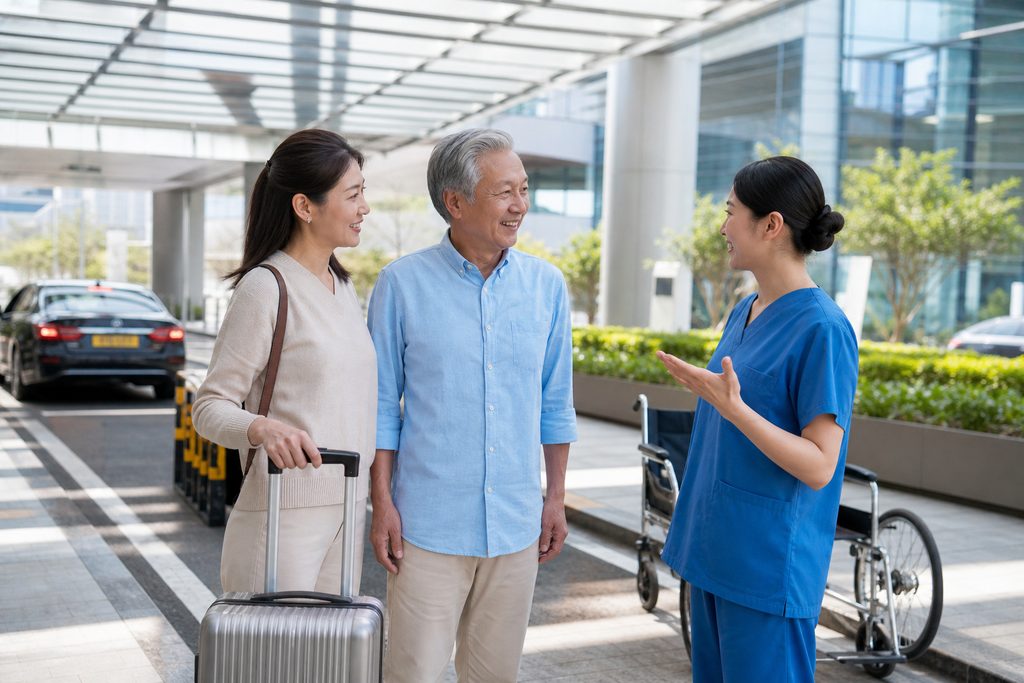
On the day of your consultation, your companion meets you at the hospital entrance. Not at a coffee shop nearby. At the entrance. They handle registration, payment queue navigation, and real-time translation during your specialist consultation — not just translating words, but translating clinical concepts so you understand exactly what the surgeon is proposing and why. If surgery is recommended, they coordinate the admission deposit, ward selection, and pre-operative testing schedule. After discharge, they manage follow-up appointment booking and pharmacy runs. You focus on recovery. We focus on everything else.
The cost for this coordination starts from $300 for appointment scheduling and scales based on complexity. Bilingual medical companionship starts from $200 per day. These are coordination fees — they are separate from hospital charges and never applied to your treatment bill. But here is the structure that matters: any consultation or coordination fee you pay is credited in full toward our on-the-ground coordination service if you proceed with treatment within 90 days. We built it this way so your initial investment in clarity converts directly into action.
How to Get to Peking University Shenzhen Hospital from Hong Kong Border
The geography is surprisingly simple. The hospital sits at 1120 Lianhua Road in Shenzhen’s Futian District. From Hong Kong International Airport, you have three viable routes. The fastest: take the Airport Express to Kowloon Station, transfer to the Tung Chung Line to Nam Cheong, then the Tuen Ma Line to Lok Ma Chau. Cross the border on foot — the Futian Checkpoint on the Shenzhen side is directly connected. From there, it is a 12-minute taxi ride or a 25-minute metro trip on Line 2 to Jingtian Station, which exits approximately 400 meters from the hospital’s main gate. Total transit time: roughly 70 to 90 minutes depending on border queue length.
The alternative is the High-Speed Rail from West Kowloon Station to Shenzhen North, then a 20-minute taxi. Faster border processing, but the train schedule is less forgiving if your flight arrives late. The third option — a cross-border private car service — costs around HKD 800 to 1,200 and handles the border crossing without you leaving the vehicle. This is the option we arrange for post-surgical patients who cannot manage the walking distance at the Lok Ma Chau checkpoint. A wheelchair and a border turnstile are a bad combination. Plan accordingly.
Is Peking University Shenzhen Hospital Good for Complex Surgery?
The short answer: yes, for the procedures it specializes in at high volume. The longer answer requires specificity. The hospital’s neurosurgery department handles over 1,200 brain tumor resections annually and was an early adopter of awake craniotomy techniques for glioma patients. Its hepatobiliary surgery team performs complex liver resections using 3D reconstruction planning that maps every vessel before the first incision. The urology department runs one of the highest-volume robotic prostatectomy programs in southern China.
But no hospital excels at everything. If you need a rare pediatric cardiac procedure performed only a few dozen times annually worldwide, you may be better served by a dedicated national center like Fuwai Hospital in Beijing — a hospital that performs over 14,000 cardiac surgeries each year, the highest volume globally. The question is not whether Peking University Shenzhen Hospital is “good.” The question is whether its specific surgical volume in your specific procedure is high enough to drive the outcomes you want. Our job is to help you answer that question honestly, even when the honest answer points to a different hospital.
Frequently Asked Questions
The price list covers the international department’s service fees — private ward rates, English-speaking coordinator access, and expedited scheduling. It does not include surgeon fees, implant costs, anesthesia, or post-operative medications. Those are billed separately based on the specific procedure and materials used. Expect the total package for a major surgery to land between $10,000 and $30,000 USD depending on complexity. The hospital provides an itemized estimate after your face-to-face specialist consultation, not before. Anyone offering a fixed price before the surgeon has seen your imaging is guessing.
Yes, through the international department — not through the public registration system. The public system requires in-person queueing on the day of consultation. The international department accepts pre-scheduled appointments with specific specialists, but only after reviewing your medical records and confirming the specialist agrees to take your case. This process typically takes 5 to 10 business days from record submission to confirmed appointment date. Our team handles this coordination directly with the hospital’s official international patient office, using the same channel that domestic VIP patients use.
This is the question every patient should ask and few do. Chinese law provides a medical dispute resolution pathway through the local Medical Association’s expert review panel. The hospital carries mandatory medical liability insurance. In practice, the international department has a strong incentive to resolve complications directly — its reputation with foreign patients depends on it. That said, the legal framework differs from Western malpractice systems. Settlements are typically negotiated rather than litigated. We recommend all international patients carry their own medical travel insurance that includes complication coverage and medical evacuation provisions. We do not sell insurance. We do insist you have it.
A university hospital international department like Peking University Shenzhen typically charges 30% to 50% less than a fully private international hospital such as United Family or Jiahui for equivalent procedures. The trade-off: the private hospital offers a hotel-like experience with entirely English-speaking staff and direct insurance billing. The university hospital offers academic specialists who teach and publish — clinicians who see rare presentations because their department handles massive volume. You are choosing between polished hospitality and raw clinical depth. Both have their place. For a routine procedure where bedside manner matters most, the private hospital may suit you better. For a complex surgery where the surgeon’s lifetime case volume is the variable that determines your outcome, the university hospital’s case for itself is strong.
Your Next Step
Peking University Shenzhen Hospital sits at a geographic and clinical intersection that few international patients fully exploit. It is close enough to Hong Kong to make medical travel logistically simple. It carries the academic rigor of a Peking University affiliation. Its surgical volumes in orthopedics, neurosurgery, cardiology, and urology place it among the most experienced centers in southern China. The barriers — visa sequencing, payment architecture, documentation standards — are real but entirely navigable with the right preparation. The question is not whether the hospital can handle your case. The question is whether you can handle the logistics of getting there alone. Most patients cannot. That is not a failure of intelligence. It is a structural reality of crossing healthcare systems. We exist to make that crossing feel less like a leap and more like a step.
If you are considering surgery at Peking University Shenzhen Hospital, start with a conversation — no commitment, no pressure. Our team can review your medical records, assess whether this hospital is the right match for your specific condition, and outline exactly what the scheduling and pricing pathway would look like. Visit our patient coordination page to begin. The hospital is 14 kilometers from Hong Kong. The right information is closer than that.
For more medical information and treatment options in China, visit chinamedservices.com (China Medical Services).
