Plastic Surgery Cost in China: Real Prices, Top Hospitals, and Safety
How This Actually Works, Step by Step
Wondering what a facelift or rhinoplasty would cost outside the US — and whether the savings are real? They usually are. But the path to getting there is not a shopping cart. It runs through hospital international departments, medical records, and a visa category most people have never heard of.
Here is the sequence, start to finish.
Step one: you send records, not a deposit. Photos, prior surgical history, lab work, medication list, and a short note on what you want changed. A surgeon cannot quote a real number without seeing the starting point. Anyone who quotes you a firm price off a photo alone is guessing.
Step two: a Chinese specialty team reviews the file. At a top public hospital, this happens through the international department or VIP channel. Expect a written assessment and a price range within roughly 3 to 10 business days, depending on department workload.
Step three: you speak with the surgeon by video. This is where goals get clarified — implant size, incision placement, recovery expectations. Video consultation fees typically run $100–300 at a standard international department, or $500–800 for a top-specialist session.
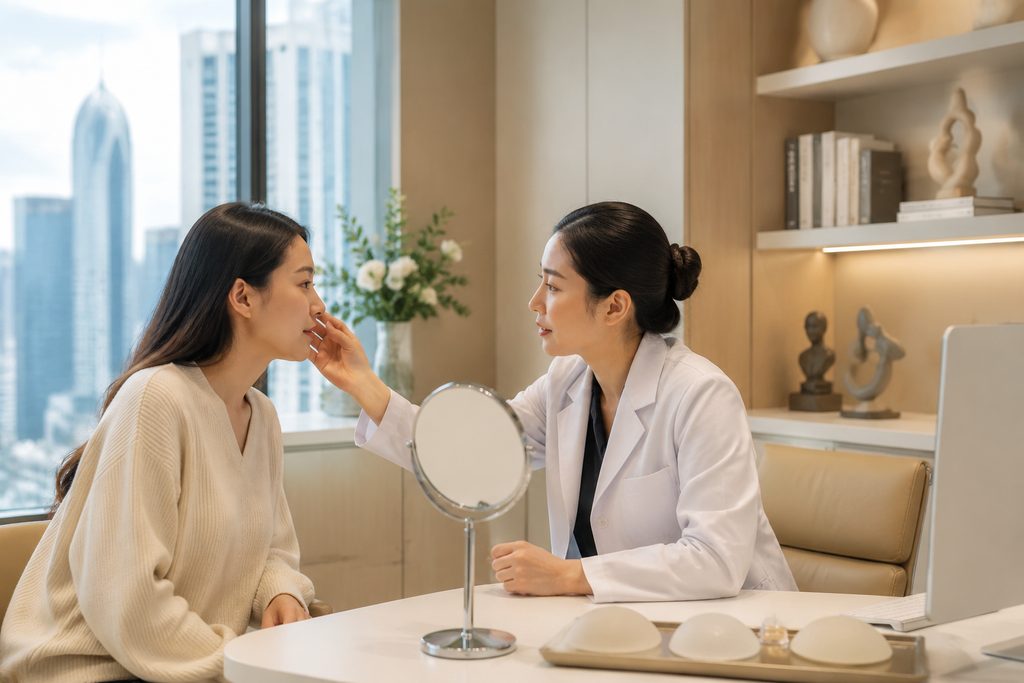
Step four: you travel and get examined in person. No reputable Chinese hospital schedules surgery without a face-to-face consult first. That is a hard rule across the public system, and it exists to protect you.
Step five: surgery, recovery, and follow-up. Most aesthetic procedures involve a 1–3 day hospital stay for more complex cases, or same-day discharge for minor ones, followed by 7–14 days in-country before you are cleared to fly.
Notice what is missing from that list: booking a specific operating date from overseas. Public hospitals do not work that way. If a provider promises you a locked-in surgery date before any examination, treat that as a warning sign.
What Plastic Surgery Cost in China Actually Looks Like
Now the numbers. Plastic surgery cost China-wide varies enormously by procedure, city, and hospital tier. The figures below are typical ranges at reputable public tertiary hospitals and JCI-accredited private international hospitals. They are not quotes.
| Procedure | China (USD) | United States (USD) |
|---|---|---|
| Rhinoplasty | $4,000–$10,000 | $8,000–$20,000 |
| Double eyelid surgery | $1,500–$4,000 | $3,500–$8,000 |
| Facelift | $6,000–$15,000 | $15,000–$40,000 |
| Breast augmentation | $5,000–$12,000 | $8,000–$15,000 |
| Liposuction (single area) | $2,500–$7,000 | $6,000–$15,000 |
| Orthognathic (jaw) surgery | $8,000–$20,000 | $40,000–$90,000 |
Complex reconstructive work is where the gap widens most. A craniofacial or jaw reconstruction that runs $60,000–$100,000 in the US can land in the $10,000–$25,000 range at a top Chinese center, largely because surgeon fees and facility charges are set far lower.
Two things drive your final number more than anything else: whether you use the standard public channel or the international/VIP channel (roughly 1.5–2x the standard price, for English-speaking staff and shorter waits), and how much revision or grafting the case requires. A primary rhinoplasty and a third revision rhinoplasty are not the same operation.
Finding the Best Plastic Surgery Hospitals: Shanghai Price Levels and Beyond
Patients searching for the best plastic surgery hospitals Shanghai price comparisons often assume Shanghai is automatically the most expensive city. It is not. Beijing and Shanghai carry a premium of maybe 10–20% over Chengdu or Xi’an, but the difference is smaller than most people expect.
What actually matters is the hospital’s specialty depth. China has more than 35,000 hospitals. Our own database covers 340+ top-ranked institutions across 37 cities — the top 5% by Fudan University rankings and JCI accreditation. Within plastic and reconstructive surgery, a handful of centers carry national reputations built on volume: thousands of cleft lip and palate repairs, major burn reconstruction, and microsurgery cases each year.
For a patient comparing options, the practical split looks like this:
- Top public tertiary hospitals — deepest surgical expertise, highest case volumes, lowest prices. English support exists mainly through the international department, and you will queue for appointments.
- Private international hospitals — English-speaking staff throughout, JCI accreditation, direct insurance billing, Western-style rooms. Prices run 2–4x the public channel, still often below US rates.
- Specialty aesthetic clinics — convenient and marketing-savvy, but vet credentials carefully. Not all are hospital-grade facilities with anesthesia backup.
You can browse ranked institutions by specialty through our department rankings, and compare public versus private options on the private international hospitals page.
One more consideration for anyone weighing medical tourism plastic surgery Beijing or Shanghai: the surgeon’s revision rate matters more than the price. Ask directly how many revisions the surgeon performs per year. A cheap primary surgery that needs a $12,000 correction is not a bargain.
A Realistic Timeline
Most patients underestimate the calendar, not the cost. Here is how the weeks actually unfold.
| Stage | Typical Duration |
|---|---|
| Records gathered and translated | 3–7 days |
| Specialist review and written assessment | 3–10 business days |
| Video consultation scheduling | 1–2 weeks |
| Appointment coordination at chosen hospital | 2–4 weeks |
| S2 visa application and processing | 1–3 weeks |
| Travel and in-person examination | 2–4 days after arrival |
| Surgery and hospital stay | 1–5 days |
| In-country recovery before flying | 7–14 days |
Add it up and you are looking at roughly 6 to 12 weeks from first contact to surgery, with the visa and appointment lead times being the two steps people forget. Peak seasons — around Chinese New Year and summer — push appointment availability out further.
What Can Go Wrong — and What Happens Then
This is the section most articles skip. Here is the honest version.
Your expectations and the surgeon’s plan don’t match. This is the single most common failure, and it is usually caught at the video consultation stage. If the surgeon says your goal is not achievable with the anatomy you have, believe them. Getting a second opinion costs $300–500 and can save you a revision.
The appointment you wanted isn’t available. Top surgeons book out. A coordination service that promises a specific doctor on a specific date is overpromising. The realistic commitment is: we try, and if the appointment can’t be secured, the coordination fee is refunded.
Something goes wrong after you fly home. This is the real risk with any overseas surgery. Before you book, ask what follow-up looks like from 7,000 miles away — who removes sutures, who handles a seroma, who you call at 2 a.m. Get it in writing. Reputable hospitals provide a written post-operative plan and will communicate with your local physician.
The price changes. It can, and legitimately so — if intraoperative findings require more work than imaging suggested. What should never happen is a surprise facility fee. That is why itemized estimates matter.
Is Plastic Surgery in China Safe? How to Judge It Yourself
Is plastic surgery in China safe? At accredited hospitals, the surgical safety record is comparable to Western centers — JCI accreditation, which many top Chinese hospitals hold, enforces the same international standards you would find in the US or Europe. The variable is not the country. It is the specific facility and surgeon.
Four checks cut through most of the noise:
Credentials. Chinese plastic surgeons hold a chief physician or associate chief physician title at hospital level. Ask for it. A surgeon operating at a top-ranked tertiary hospital has passed a national board process and works under peer review.
Volume. High-volume centers produce better outcomes in complex reconstruction. Ask how many of your specific procedure the surgeon performs annually.
Facility grade. Surgery should happen in a hospital with a full anesthesiology department and intensive care backup, not a standalone clinic without a blood bank.
Language and consent. You must understand the consent form you sign. If no one in the room speaks your language, that is a safety problem, not a convenience problem. This is exactly where a bilingual medical companion earns their fee — from $300 per day for interpretation, registration, payment, and accompaniment throughout.
Practical Considerations: Records, Visas, and Payment
Records first. Gather operative reports from any prior surgery, recent labs, medication list, and clear pre-operative photos from multiple angles. Non-English documents need certified translation, which adds 3–7 days.
On visas: foreign patients coming to China for treatment use the S2 visa, annotated for medical treatment purposes. Stays beyond 180 days require the S1. Accompanying family members apply under S2 as well. Note that the M visa is a commercial and trade category and has nothing to do with medical treatment — if anyone tells you otherwise, they are wrong. Requirements shift, so confirm current rules with the nearest Chinese embassy or consulate and bring your hospital’s invitation and appointment documents.
Payment works differently by facility. Public hospitals require prepayment, with insurance reimbursement handled afterward in your home country — and many US insurers will not cover elective aesthetic surgery abroad regardless. Private international hospitals frequently bill insurance directly. Budget for the possibility that you pay out of pocket and seek reimbursement later.
And plan your follow-up before you leave. Ask the hospital for a written recovery protocol and the name of a contact who will respond to your home physician’s questions. Then arrange a local surgeon for wound checks once you are back.
Frequently Asked Questions
Primary rhinoplasty typically runs $4,000–$10,000 at reputable hospitals, with revision cases costing more because of grafting and scar tissue. The final figure depends on the hospital tier, the surgeon’s seniority, and whether implants or cartilage grafting are involved. Always request an itemized estimate rather than accepting a single bundled number.
You can arrange a video consultation and appointment coordination in advance, but no ethical hospital will confirm a surgery date before examining you in person. Be cautious with any “book plastic surgery in China package” offer that guarantees a specific operating date from overseas — that promise cannot be kept under standard hospital rules.
At JCI-accredited and top-ranked tertiary hospitals, yes — safety standards match international norms. The risks concentrate in unaccredited clinics, language barriers during consent, and inadequate follow-up planning after you return home. Vet the facility, confirm the surgeon’s credentials, and arrange post-operative care on both ends.
Reconstructive procedures may be partially covered depending on your policy; purely cosmetic procedures almost never are. Public hospitals generally require upfront payment with reimbursement claims filed afterward, while private international hospitals often bill insurers directly. Confirm coverage in writing with your insurer before committing.
Your Next Step
The savings are genuine — often 50–70% below US rates for the same procedure — but the value comes from choosing the right hospital and surgeon, not the cheapest quote. Get the assessment first, then decide.
We are China Medical Services. Our team connects international patients with 340+ top-ranked hospitals across 37 cities, coordinates appointments through official international departments, and provides bilingual companions on the ground. We are not doctors, and we do not promise admission, specific surgeons, or clinical outcomes — we handle the logistics and the language so your surgeon can focus on your care. Any consultation fee is credited in full toward on-the-ground coordination if you travel within 90 days.
Start with a free consultation and a records review. No pressure, no obligation — just a clear picture of what your procedure would cost and where it should happen. Visit our patient consultation page when you are ready.
This article is for general information only and is not medical advice. Surgical decisions should be made with a qualified physician who has examined you in person. Prices vary by hospital and case complexity and are subject to change.
For more medical information and treatment options in China, visit chinamedservices.com (China Medical Services).
