Pleural Tumor in China: Shanghai Case Assessment for Global Patients
Key Takeaways
- Shanghai’s top-tier hospitals see thousands of complex thoracic cases each year, and international departments exist specifically to handle overseas patients from first email to discharge.
- A pleural tumor in China can be assessed remotely before you book a flight — written second opinions typically cost $300–500 and video consultations $100–800, with those fees credited toward on-the-ground coordination within 90 days.
- The hard part is not the medicine. It is the queue. Public hospital outpatient slots cannot be reserved from abroad, so most foreign patients enter through international or VIP channels — and pay roughly 1.5 to 2 times the standard rate for that access.
- No hospital, in China or anywhere else, can promise a diagnosis or outcome before the pathology is in hand. Anyone who does is selling something other than care.
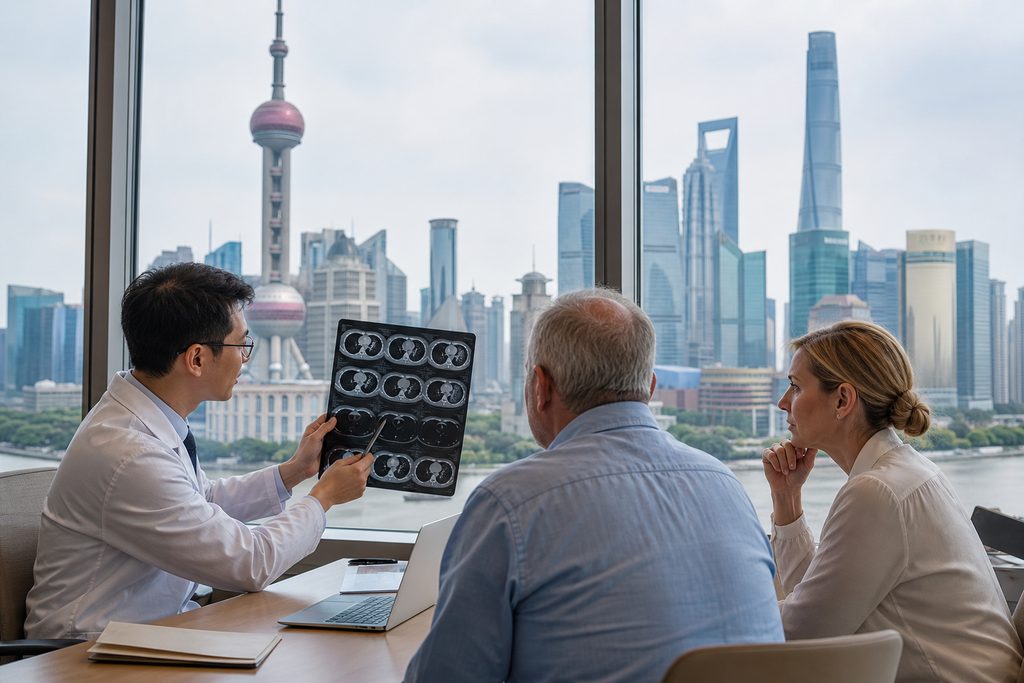
You have probably heard that seeking care in China means compromising on quality. For a pleural tumor in China, the reality runs in the opposite direction. Shanghai’s flagship hospitals handle thoracic case volumes that most Western centers never approach, and their international departments were built for exactly the situation you are in right now — a suspicious scan, a specialist who wants more information, and a decision that cannot wait indefinitely.
What follows is not a sales page. It is an honest map of how case assessment actually works in Shanghai, what it costs, and where the friction points are.
The Problem: A Rare Tumor and a Slow System
Pleural tumors sit in an uncomfortable category. Malignant pleural mesothelioma, for instance, is diagnosed in roughly 2,000 to 3,000 Americans each year, according to the American Cancer Society — rare enough that many oncologists see only a handful of cases in a career. Solitary fibrous tumors of the pleura are rarer still.
Rarity creates delay. A patient in the UK or Canada with an indeterminate pleural mass may wait weeks for a CT-guided biopsy, then more weeks for a multidisciplinary review. In Canada, median wait times from referral to treatment for thoracic oncology have stretched past the benchmarks set by the Canadian Institute for Health Information in multiple provinces. In the US, the barrier is often financial rather than temporal — a pleural biopsy with immunohistochemistry can run $8,000 to $15,000 before any treatment begins.
And then there is the question nobody wants to ask out loud: does the person reading my scans actually see this disease often enough to recognize its variants?
Why Shanghai Delivers Results for Complex Thoracic Cases
Volume changes what a radiologist sees
China’s top-ranked hospitals are ranked by the Fudan University Hospital Rankings and JCI accreditation, and the database we work from covers 340+ hospitals across 37 cities. Shanghai alone holds 18 hospitals in the Fudan Top 100 — second only to Beijing. That concentration matters. A thoracic imaging team at a Shanghai tertiary hospital may review more pleural pathology in a year than a regional Western center sees in five.
Volume does not automatically equal skill. But pattern recognition is a real clinical asset, and it is built from repetition.
Diagnostics move faster than the queue suggests
Here is the operational reality that surprises most patients. Once you are inside the system — properly registered, with an international department handling your file — imaging and pathology turnaround in Shanghai is often measured in days, not months. A contrast CT can be scheduled within 48 hours of an in-person consultation. Biopsy results typically return in three to seven working days.
The bottleneck is the front door, not the corridor. Public hospital outpatient registration cannot be reserved from overseas; you queue on the day, in Chinese, at a facility that may process 10,000+ outpatient visits daily. That is the actual obstacle, and it is a logistics problem, not a medical one.
Cost without a quality trade-off
Complex thoracic surgery in a top Chinese public hospital generally runs one-fifth to one-tenth of comparable US pricing. A pleural decortication or extended pleurectomy that would bill at $80,000–150,000 in the United States often lands between $12,000 and $30,000 in Shanghai, depending on hospital tier and case complexity.
Why the gap? Not because anything is skipped. It reflects lower labor costs, high hospital throughput, state-supported infrastructure, and pharmaceutical pricing negotiated at national scale. The surgeon’s fee is a small fraction of a US bill; the imaging, the ICU bed, and the pathology are all priced on a different curve.
How a Shanghai Case Assessment Actually Unfolds
This is the sequence a global patient should expect. It is not a menu — it is a staged process, and each stage exists to prevent an unnecessary flight.
Stage one: records out, written opinion back. You send existing CT or PET imaging, biopsy slides if you have them, pathology reports, and a short clinical summary. The relevant Shanghai thoracic or oncology specialty reviews the file and returns written analysis with treatment direction. Turnaround is typically three to seven business days. Cost: $300–500.
Stage two: face-to-face on video. If the written opinion leaves questions open, a video consultation lets you speak directly with the Chinese specialty team — symptoms, goals, what you are and are not willing to undergo. A standard international department session runs $100–300; a top-specialist session $500–800; a multidisciplinary team review $1,500–2,000.
Stage three: proxy or in-person consultation. Some patients designate a specific hospital, department, or specialist and have us attend on their behalf with their materials — registration, medical card creation, and an in-person proxy visit. Others prefer to travel once a plan is clear. Coordination fees start at $800–1,200 for top-specialist in-person consultation.
Stage four: treatment in China. Only after remote evaluation clarifies a feasible plan and you agree to it does arrival coordination begin. Admission itself always remains subject to hospital rules and the treating team’s judgment.
Reading the Numbers: What a Shanghai Quote Does and Does Not Tell You
You keep the written opinion or the video session you paid for. The 90-day credit toward on-the-ground coordination only applies if you do travel. Nothing is refundable as cash, and nothing obligates you to proceed.
It happens, and we say so plainly. Some cases are better managed closer to home — particularly advanced disease where travel itself carries risk, or where a domestic clinical trial is the stronger option. A remote assessment that rules out travel has still done its job. That is the point of doing it before booking a flight.
Your Next Step
A pleural tumor is rare enough that the quality of the team reviewing your scans matters more than the country on the hospital’s sign. Shanghai offers genuine depth in thoracic oncology, faster diagnostic turnaround than most patients expect, and pricing that changes what is financially possible. The friction is logistical, not clinical — and it is solvable.
We are China Medical Services, a coordination service, not a hospital. We do not diagnose, treat, or promise outcomes. We match your case to appropriate hospitals, arrange written second opinions and video consultations, and support you on the ground if you decide to travel. A free initial consultation through our patient services page is the lowest-commitment way to find out whether Shanghai makes sense for your situation.
This article is for general information only and does not constitute medical advice. Treatment decisions should always be made with a qualified physician who has reviewed your complete medical records.
Frequently Asked Questions
Yes. The hospitals used for international patients are JCI-accredited and follow the same international safety standards as top hospitals in the US and Europe. Surgical teams perform high volumes of procedures — often more than their Western counterparts — which studies show leads to better outcomes.
Costs vary by procedure and hospital, but international patients typically save 40-80% compared to US prices — even when factoring in travel and accommodation. A consultation with our team will give you an exact, all-inclusive quote with no hidden fees.
Send us your existing medical reports to get started. We handle everything from hospital selection and appointment scheduling to visa assistance and post-operative recovery planning. Your medical records are reviewed by the specialist before you even book a flight.
For more medical information and treatment options in China, visit chinamedservices.com (China Medical Services).
