Proton Therapy in China: Costs, Access, and How International Patients Can Book Treatment
Key Takeaways
- China operates 7 proton therapy centers with more under construction, offering treatment at roughly one-third to one-half of US prices.
- Foreigners can receive proton therapy in China, but access requires going through hospital international departments, not standard outpatient channels.
- Total proton therapy cost China typically ranges from $30,000 to $80,000 per treatment course, depending on tumor type and fractionation schedule.
- Language barriers and documentation requirements are real obstacles — a bilingual medical companion solves most of them, but you should understand the full process before committing.
The Problem: Cancer Treatment Costs Are Crushing Western Patients
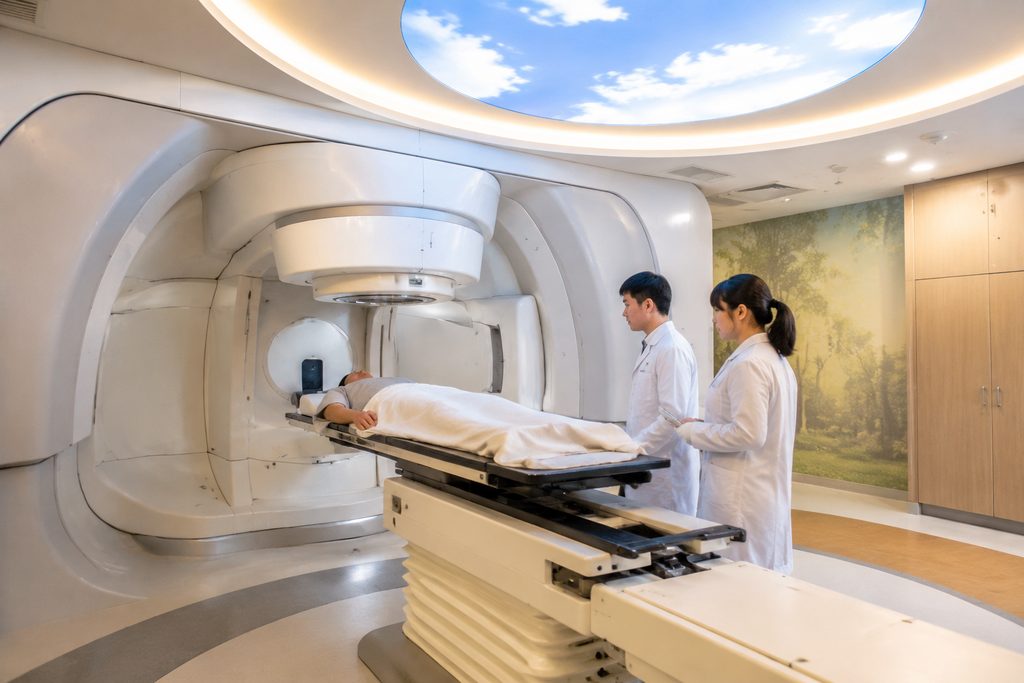
Proton therapy is, in plain terms, a form of radiation that uses protons instead of X-rays. The key difference is precision: protons deposit most of their energy at a specific depth in the body, sparing healthy tissue behind the tumor. That matters enormously for brain tumors, pediatric cancers, and tumors near critical structures like the spinal cord or optic nerves.
But the price tag in Western countries is brutal. In the United States, a full course of proton therapy runs between $90,000 and $180,000 depending on the number of fractions. Even with insurance, out-of-pocket costs frequently exceed $20,000. And that assumes your insurer approves it at all — many still classify proton therapy as investigational for certain indications, triggering denials that take months to appeal.
Wait times add another layer. The UK’s National Health Service has sent patients abroad for proton therapy because domestic capacity was insufficient. Canada has no operational proton center — patients fly to the US at their own expense. If you’re facing a chordoma, chondrosarcoma, or pediatric medulloblastoma, time is not a luxury you have.
Why Proton Therapy in China Delivers Results
China has moved aggressively into particle therapy over the past decade. The country’s first proton center opened in 2015, and the build-out has accelerated since. Today, operational facilities exist in Shanghai, Beijing, and several other cities, with a national push to expand access. What makes this relevant for international patients is the combination of modern equipment, growing clinical experience, and a cost structure that reflects China’s broader healthcare economics.
Clinical Volume and Growing Expertise
The Shanghai Proton and Heavy Ion Center has treated over 5,000 patients since opening. That’s a meaningful number when you consider that most US proton centers treat 200 to 400 patients annually. Chinese centers handle complex cases — nasopharyngeal carcinoma, skull base tumors, recurrent cancers that failed conventional radiation — at volumes that build real institutional competence. The equipment is current-generation: pencil-beam scanning, image-guided positioning, and respiratory gating are standard at the newer facilities.
Technology Without the Legacy Cost Burden
American proton centers carry enormous capital costs — a single facility can cost $150 million to $250 million to build. Those costs get passed to patients. Chinese centers benefit from lower construction costs, government subsidies, and a reimbursement environment that doesn’t inflate charges the way the US system does. The machines are the same models from the same manufacturers: IBA, Varian, Hitachi. The physics of proton delivery doesn’t change at the border.
Cost Advantage Without Quality Compromise
Proton therapy cost China is structurally lower for reasons that have nothing to do with cutting corners. Labor costs for physicists, dosimetrists, and radiation oncologists are lower. Facility overhead is lower. The centers operate at higher patient volumes, spreading fixed costs across more treatments. The result: a full course of proton therapy in China typically runs $30,000 to $80,000, versus $90,000 to $180,000 in the United States. That’s a 50 to 70 percent reduction, and the equipment and treatment protocols are comparable to what you’d find at a major US academic center.
How Foreigners Actually Access Proton Therapy in China
Here’s the honest answer: yes, foreigners can get proton therapy in China, but the path is not the same as walking into a hospital and registering at the front desk. Public hospitals in China do not allow overseas patients to book outpatient appointments remotely. You cannot email a hospital and get a treatment slot. The system is built around in-person registration and face-to-face consultation before any treatment plan is approved.
What international patients actually use is the hospital’s international department or VIP channel. Every major proton center has one. These departments handle foreign patients, provide English-speaking staff, and coordinate the evaluation process. The cost is higher than the standard public channel — roughly 1.5 to 2 times — but it’s the only realistic route for someone who doesn’t speak Chinese and isn’t physically in the country.
The process works like this: you send your medical records — imaging, pathology reports, treatment history — to the international department for review. A radiation oncologist evaluates whether proton therapy is appropriate for your case. If it is, you receive a treatment plan and cost estimate. You then travel to China for an in-person consultation and simulation. Treatment typically starts within one to two weeks after that, assuming your case is approved.
Comparing Proton Therapy Centers: Shanghai vs. Beijing
Most international patients focus on two cities: Shanghai and Beijing. Both have operational proton centers with international patient programs. The choice between them often comes down to tumor type, physician preference, and logistics.
Here’s how the main options compare:
| Factor | Shanghai Proton and Heavy Ion Center | Beijing Proton Centers |
|---|---|---|
| Operational since | 2015 | 2019-2021 (varies by facility) |
| Equipment | Proton + heavy ion (carbon ion) | Proton only (pencil-beam scanning) |
| Indications treated | Broad, including skull base tumors, sarcomas, recurrent cancers | Broad, with strong focus on CNS and pediatric cases |
| International patient program | Yes, established pathway | Yes, but newer and less streamlined |
| Approximate cost per course | $35,000 to $70,000 | $30,000 to $60,000 |
| Language support | English-speaking coordinators available | English support varies; interpreter often needed |
How much is proton therapy in Beijing specifically? The range overlaps with Shanghai but tends to run slightly lower for straightforward cases. The real variable is fractionation: a 20-fraction course costs less than a 35-fraction course regardless of city. Your tumor type and stage determine that number, not the center’s pricing sheet.
The question “is proton therapy available for international patients in China” has a clear answer: yes, at both Shanghai and Beijing facilities, through their international departments. But availability is not the same as accessibility. You need someone to coordinate the records review, schedule the consultation, and handle the language barrier. That’s where the process gets difficult for patients going it alone.
Practical Considerations: Documentation, Visa, and Payment
Before you can book proton therapy treatment China, you need to assemble a complete medical record. That means DICOM files from all imaging studies, a detailed pathology report, a summary of any prior surgery or radiation, and a list of current medications. Incomplete records are the most common reason for delayed or rejected applications.
Visa is the next hurdle. Foreigners traveling to China for medical treatment apply for an S2 visa, which covers short-term private affairs including medical care. Stays longer than 180 days require an S1 visa. Your accompanying family members also apply for S2. The hospital’s international department will issue an invitation letter and treatment confirmation, which you submit with your visa application. Approval is not guaranteed — the Chinese embassy or consulate reviews each case individually — but a documented medical need with a confirmed treatment plan is the strongest possible application.
Payment works differently than in Western hospitals. Public hospitals in China, including their international departments, require prepayment. You deposit an estimated amount upfront, and the hospital draws down from that balance as treatment progresses. Insurance reimbursement is handled after the fact — you pay first, then file a claim with your insurer. Some international private hospitals in China offer direct billing, but the major proton centers are public institutions and do not.
Language is the final practical barrier. Even in international departments, the depth of English support varies. You may have an English-speaking coordinator for administrative matters, but day-to-day interactions with nurses, technicians, and billing staff often happen in Chinese. A bilingual medical companion — someone who handles registration, queueing, payment, and translation — removes most of that friction. From $300 per day, it’s a fraction of what you’re already spending on treatment.
Frequently Asked Questions
Yes and no. You can complete the initial evaluation remotely — send your records, get a written opinion, even do a video consultation with the treating physician. But before treatment begins, you must be physically present for a consultation and simulation. No legitimate center will treat you sight unseen. Plan for at least one trip before treatment starts.
The honest range is $30,000 to $80,000 for a full course, versus $90,000 to $180,000 in the US. That’s for treatment alone. Add travel, accommodation, visa fees, and coordination services, and you’re still typically at half or less of the US price. But the comparison only matters if proton therapy is clinically appropriate for your case — and that requires an oncologist’s evaluation, not a price sheet.
Then you shouldn’t pursue it. Proton therapy is not a miracle treatment. It’s a tool with specific advantages for specific tumor types and locations. A reputable center will tell you if conventional radiation, surgery, or systemic therapy is more appropriate. If you’re rejected, it’s usually because the treatment genuinely won’t benefit you — not because the center doesn’t want your business. That’s a sign of a trustworthy institution.
Work only through the hospital’s official international department or a service that can verify its relationship with that department. Never pay a deposit to an individual or an unverifiable intermediary. Ask for the hospital’s official documentation, confirm the department’s contact information independently, and insist on a written treatment plan before any money changes hands. Legitimate coordination services charge for their labor — translation, scheduling, accompaniment — not for “access” to doctors.
Your Next Step
Proton therapy in China is real, accessible to foreigners, and significantly less expensive than in the West. But it’s not a simple transaction. The evaluation, visa, travel, and treatment process involves coordination that most patients can’t manage alone from another continent. Our team at China Medical Services helps international patients navigate Chinese healthcare — we’re not a hospital and we don’t provide diagnoses, but we do know which centers treat which conditions and how to get your records in front of the right specialists. If you’re considering proton therapy in China, start with a free consultation to understand your options before committing to anything.
For more medical information and treatment options in China, visit chinamedservices.com (China Medical Services).
