Proton Therapy for Pediatric Cancer China: Less Radiation Damage for Children with Brain Tumors
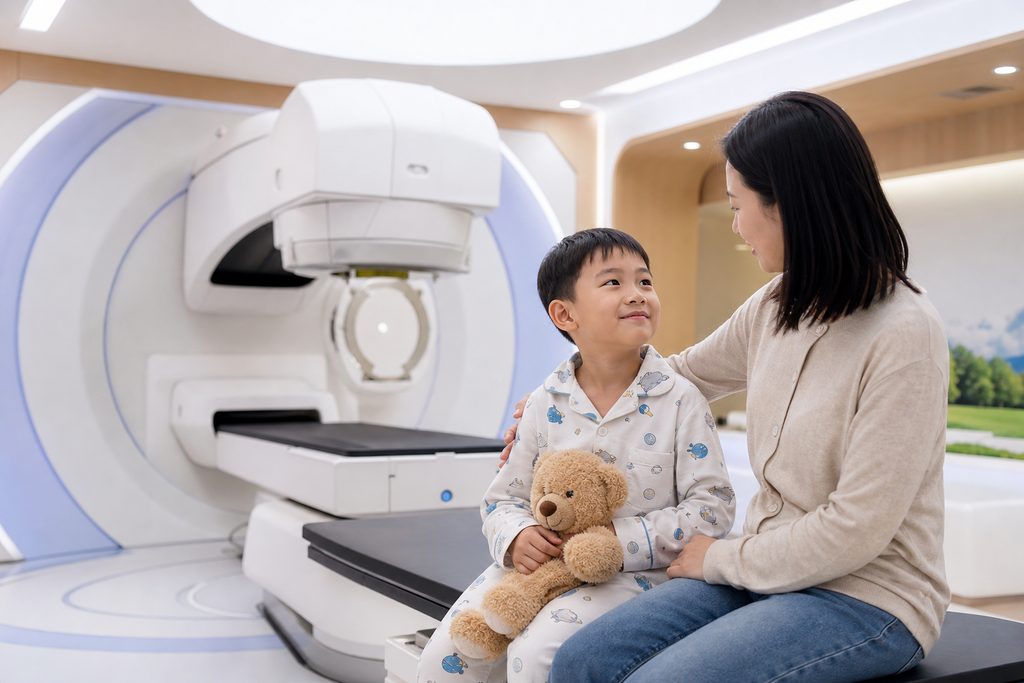
You have probably heard that advanced cancer treatment means flying to the United States or Europe. That assumption is outdated. A quiet revolution in pediatric oncology is unfolding in Shanghai and Beijing. Parents are crossing oceans to access proton therapy for pediatric brain tumors China cost structures that make treatment financially survivable—without sacrificing a shred of clinical precision.
The stakes could not be higher. A child’s brain is still developing. Conventional radiation, while effective at killing tumor cells, scatters its energy into healthy tissue. That collateral damage can mean cognitive decline, hormonal disruption, and secondary cancers later in life. Proton therapy changes the equation. It deposits its maximum energy directly inside the tumor and stops. No exit dose. No unnecessary irradiation of the hippocampus or pituitary gland. For a five-year-old with medulloblastoma, that difference is measured not just in survival rates but in IQ points, growth charts, and the ability to attend a normal school.
China has invested heavily in this technology. The country now operates a growing network of proton and heavy ion centers. And the cost to international patients? It is a fraction of what you would pay at MD Anderson or Massachusetts General Hospital. This article will walk you through what proton therapy actually does, why China has become a legitimate destination for pediatric cases, what the numbers look like, and how to navigate the logistical maze without losing your mind.
Key Takeaways
- Proton therapy reduces radiation exposure to healthy pediatric brain tissue by 50-70% compared to conventional photon radiation, significantly lowering long-term cognitive and endocrine side effects.
- China operates multiple proton centers with Pencil Beam Scanning technology—the most precise delivery method available—including facilities in Shanghai and Beijing that treat international pediatric patients.
- Total proton therapy costs in China range from $40,000 to $80,000, roughly 60-80% less than the $150,000-$250,000 typical in the United States, though exact pricing varies by hospital and case complexity.
- Language barriers, visa logistics, and hospital registration systems make independent navigation extremely difficult—professional coordination is not a luxury here, it is a practical necessity.
The Problem: Conventional Radiation Saves Lives but Steals Childhoods
Approximately 1 in 5 children with cancer has a brain tumor. Medulloblastoma, ependymoma, and low-grade gliomas are the most common. Standard treatment often involves surgery followed by radiation. Photon-based radiation works. Five-year survival rates for standard-risk medulloblastoma now exceed 80% in high-income countries. But survival is not the only metric that matters.
A 2016 study in The Lancet Oncology compared neurocognitive outcomes in pediatric brain tumor survivors treated with proton therapy versus photon radiation. The proton group scored significantly higher on IQ tests, working memory, and processing speed at five-year follow-up. The mechanism is straightforward. Photon beams deposit energy along their entire path through the skull. Protons deposit a low dose on entry, spike at the tumor site—the Bragg peak—and then stop. No radiation exits the back of the child’s head.
What does that look like in real life? A child treated with conventional whole-brain radiation for medulloblastoma faces a near-certainty of growth hormone deficiency, a high probability of hearing loss, and a measurable drop in IQ over time. Proton therapy cannot eliminate these risks entirely. But it shrinks the irradiated volume so dramatically that many children retain normal endocrine function and cognitive trajectories. Parents are not choosing between cure and quality of life anymore. They are choosing how much of both they can preserve.
Who We Are
We are not a hospital. We do not provide medical treatment or clinical diagnoses. Our team functions as your logistical architects—we bridge the gap between you and China’s top-tier medical expertise. We maintain a database of 340+ top-ranked hospitals across 37 cities, and we help international families navigate hospital matching, appointment coordination, bilingual medical interpretation, and visa logistics. We translate medical records, coordinate with hospital international departments, and ensure you are not standing alone at a registration counter in a foreign country trying to explain your child’s pathology report through a translation app. We believe transparency about what we do—and what we cannot do—is the foundation of trust.
Why Proton Therapy for Pediatric Brain Tumors in China Delivers Results
Technology Infrastructure: Pencil Beam Scanning Is the Standard
Not all proton therapy is equal. Older centers use passive scattering, which shapes the beam with physical collimators and compensators. That method works but generates neutron scatter—a low-dose radiation bath that can increase secondary cancer risk. The Shanghai Proton and Heavy Ion Center (SPHIC) and other major Chinese facilities use Pencil Beam Scanning (PBS). PBS magnetically steers a narrow proton beam across the tumor volume, layer by layer. It is the difference between painting with a fine brush and spraying with a fire hose.
SPHIC has treated pediatric patients with medulloblastoma, craniopharyngioma, and chordoma using PBS-based intensity-modulated proton therapy (IMPT). Their published clinical data show local control rates comparable to Western proton centers. The center also employs daily image guidance with cone-beam CT, which verifies the child’s position before every single fraction. A millimeter of motion matters when you are sparing the brainstem.
Clinical Volume and Pediatric-Specific Protocols
Chinese proton centers treat a high volume of patients. SPHIC alone has treated thousands of patients since opening. Volume matters in pediatric radiation oncology. Positioning a young child for treatment requires anesthesia, immobilization devices, and a team that understands pediatric physiology. Centers that treat pediatric cases daily develop workflows that general radiation departments cannot match.
Also relevant: some Chinese centers are actively enrolling patients in clinical trials and publishing outcomes data in international journals. This is not a black box. Parents can request published outcome statistics specific to their child’s diagnosis before committing to travel. We help facilitate that conversation—translating medical records, coordinating a remote video consultation, and ensuring you receive a clear treatment plan and cost estimate before you ever book a flight.
Cost Advantage Without Quality Compromise
Let us address the obvious question: is proton therapy for pediatric brain tumors China cost so much lower because the quality is lower? No. The cost difference is structural. Chinese hospitals operate with significantly lower labor costs. A radiation oncologist’s salary in Shanghai is a fraction of what the same specialist earns in Boston. Hospital construction costs are lower. Administrative overhead is leaner. The proton equipment itself—often from the same manufacturers: Varian, IBA—is identical to what you would find in a Western center. The physics does not change at the international date line.
| Cost Component | United States (USD) | China (USD) |
|---|---|---|
| Proton therapy course (6 weeks) | $150,000 – $250,000 | $40,000 – $80,000 |
| Pediatric anesthesia per fraction | $1,000 – $2,500 | $200 – $500 |
| Initial consultation & treatment planning | $5,000 – $10,000 | $1,500 – $3,000 |
| MRI imaging (per scan) | $1,500 – $3,000 | $300 – $600 |
These ranges are real but they shift. Tumor location, number of fractions, need for anesthesia, and hospital tier all affect the final number. The lower end of the Chinese range typically reflects a straightforward case at a public hospital international department. The higher end reflects a more complex treatment plan at a dedicated proton center with full pediatric support. Either way, the math is stark. Families are saving $100,000 or more. For many, that is the difference between accessing proton therapy and settling for conventional radiation because insurance will not cover the full proton bill at a US center.
What You Need to Know Before Going Alone
We are going to be direct here. China’s healthcare system is not designed for walk-in international patients. The clinical excellence is real. The barriers to accessing it independently are also real. Here is what you will face if you try to arrange everything yourself.
- Visa Requirements: Medical treatment in China requires an S2 visa with a specific annotation for medical purposes. You need an official invitation letter from the treating hospital. Hospitals do not issue these letters to patients they have not evaluated. You need a confirmed treatment plan first. It is a circular dependency that frustrates families who try to go it alone. The accompanying parent or guardian also needs an S2 visa. An M visa is for business—it will not work for medical treatment, and using it for that purpose risks denial at the border.
- Hospital Registration and Payment: Public hospitals in China operate on a prepaid deposit system. You deposit funds at admission, and the hospital draws down against that balance. International insurance is rarely accepted for direct billing at public hospitals. You pay upfront and seek reimbursement later. Private international hospitals like United Family or Jiahui do offer direct insurance billing, but they do not operate proton centers. For proton therapy, you are almost certainly dealing with a major public or semi-public institution. That means navigating a Chinese-language registration system, loading funds onto a hospital card, and managing payments at kiosks that have no English interface.
- Medical Records and Language: Your child’s pathology slides, MRI scans, and treatment history need professional translation into Chinese. Not conversational translation—medical translation with correct oncology terminology. A mistranslated pathology report can delay treatment or lead to miscommunication about tumor margins. Hospitals require hard copies of certain documents with official stamps. Email attachments are not always sufficient.
- Daily Logistics: A six-week proton therapy course means finding housing near the hospital, arranging transportation to daily treatments, and managing a child who may be nauseous, fatigued, and scared. Pediatric proton therapy often requires anesthesia for immobilization. That means fasting before each fraction. Coordinating that schedule—arrival time, anesthesia induction, treatment, recovery—without local language skills is exhausting. We have seen families burn out in the first week.
How We Help You Navigate This
These barriers exist for structural reasons. They are not insurmountable. Our role is to handle the logistics so you can focus on your child. We start with a remote assessment. You send us your child’s medical records. We translate them and submit them to the appropriate hospital international department. If the hospital agrees to evaluate the case, we coordinate a video consultation with the treating radiation oncologist. You get a treatment plan, a cost estimate, and a timeline—all before you commit to travel.
Once you decide to proceed, we handle the invitation letter for your S2 visa application. We coordinate hospital registration and deposit payment. Our bilingual medical companions meet you at the airport, accompany you to every appointment, translate every conversation with the clinical team, and manage the daily logistics of treatment. They know which kiosk to use, which floor the anesthesia team is on, and how to get a prescription filled at the hospital pharmacy. They are not doctors. They are professional navigators who speak both languages and understand both medical systems.
After treatment ends, we help coordinate follow-up imaging schedules and remote consultations. Many families return home and need to share follow-up MRI results with the Chinese treatment team. We keep those communication channels open. The relationship does not end when you board the return flight.
Can Children Get Proton Therapy in Beijing for Medulloblastoma?
Yes. Beijing is home to multiple centers with proton or advanced radiation capabilities. The Chinese Academy of Medical Sciences Cancer Hospital and other Beijing institutions have treated pediatric medulloblastoma patients with proton therapy. The process typically involves surgical resection first—often performed at a pediatric neurosurgery center—followed by proton radiation to the tumor bed and craniospinal axis as indicated by risk stratification. The timing matters. Medulloblastoma treatment protocols require radiation to begin within a specific window after surgery, usually 30 to 40 days. That compressed timeline makes advance coordination essential. You cannot arrive in Beijing, schedule a consultation, and start treatment the following week. The hospital needs time to review pathology, perform treatment planning, and schedule anesthesia support. We typically recommend initiating contact at least four to six weeks before your desired treatment start date.
How Much Does Proton Therapy Cost in Shanghai?
Shanghai is home to the Shanghai Proton and Heavy Ion Center, one of the most experienced proton facilities in Asia. For a full course of pediatric proton therapy—typically 30 to 33 fractions over six weeks—the treatment cost alone ranges from approximately $50,000 to $80,000. That does not include initial consultation fees, anesthesia costs per fraction, imaging, or hospitalization if required. Pediatric anesthesia adds roughly $200 to $500 per fraction depending on the complexity of sedation. Total all-in costs for a six-week treatment course, including basic accommodation nearby, usually land between $65,000 and $100,000. Compare that to $200,000 or more in the United States, and the arithmetic becomes compelling. But cost should not be your only criterion. Ask the center about their pediatric case volume, their immobilization technology, and their anesthesia team’s experience with young children. A center that treats ten pediatric patients a year is not the same as one that treats ten a month.
Is Proton Therapy Safer Than Radiation for Children’s Brain Cancer?
Safer is not quite the right word. Both proton therapy and conventional photon radiation are effective at killing tumor cells. The difference is in the dose delivered to healthy tissue. Proton therapy is more precise. Multiple comparative studies—including a 2020 analysis in JAMA Oncology—have demonstrated that proton therapy reduces the volume of normal brain receiving low and intermediate radiation doses by 50 to 70 percent compared to photon techniques. That translates into measurably lower rates of neurocognitive decline, hearing loss, and hormonal dysfunction in long-term survivors. Proton therapy is not risk-free. It still delivers some dose to tissue along the beam path. But for a child whose brain is still myelinating, still pruning synapses, still growing—the reduction in collateral damage is clinically meaningful. The question is not whether proton therapy is absolutely safer. The question is whether the toxicity profile is substantially better for your child’s specific tumor location and age. In most pediatric brain tumor cases, the answer is yes.
Frequently Asked Questions
Medulloblastoma, ependymoma, craniopharyngioma, low-grade glioma, germ cell tumors, and chordoma are among the most commonly treated pediatric diagnoses at Chinese proton centers. The suitability depends on tumor location, histology, and whether gross total resection has been achieved. Diffuse intrinsic pontine glioma (DIPG) is sometimes treated with proton therapy, but outcomes remain poor regardless of radiation modality. A remote consultation with a pediatric radiation oncologist is necessary to determine whether your child is a candidate. We can coordinate that consultation and ensure your questions about proton versus photon radiation are answered with specific reference to your child’s imaging.
Most US and European insurance plans do not have direct billing agreements with Chinese public hospitals. You will likely need to pay upfront and seek reimbursement. Some international insurance plans with global coverage may offer partial reimbursement for treatment at accredited Chinese centers. You should contact your insurer before traveling and ask specifically about out-of-network international proton therapy coverage. Request pre-authorization in writing. We can provide the hospital’s treatment plan, cost estimate, and accreditation documentation to support your insurance claim. But we cannot guarantee reimbursement. Budget conservatively.
This is a legitimate concern. Proton centers are radiation oncology facilities, not full-service children’s hospitals. If your child develops a fever, needs a blood transfusion, or has a seizure, they may need to be transferred to a pediatric department. In Shanghai, facilities like Jiahui International Hospital and Shanghai Children’s Medical Center have English-speaking pediatric staff. Our bilingual companions can coordinate that transfer and ensure continuity of communication. We recommend identifying the nearest pediatric emergency facility before treatment begins. We include this in our pre-arrival planning for every pediatric case.
Realistically, four to eight weeks. The timeline depends on how quickly you can provide complete medical records, how fast the hospital reviews the case, and visa processing speed in your home country. Treatment planning alone—contouring the tumor, designing the proton fields, running quality assurance checks—takes one to two weeks after the planning CT scan. You cannot compress that step. Proton therapy is not an emergency procedure. It is a precisely planned, fractionated treatment. Rushing the physics is dangerous. Plan accordingly.
Your Next Step
Proton therapy for pediatric brain tumors represents a genuine advance in reducing the long-term toxicity of radiation treatment. China has built the infrastructure to deliver this technology at a cost that keeps families from financial ruin. The barriers to access are real but navigable with the right support. If your child has been diagnosed with a brain tumor and you want to understand whether proton therapy in China is a viable option, get a free consultation with our team. We will review your case, identify suitable hospitals, and give you an honest assessment of feasibility and cost. You focus on your child. We will handle the rest.
For more medical information and treatment options in China, visit chinamedservices.com (China Medical Services).
