Rehabilitation: Tracking Your Progress with Measurable Recovery Goals
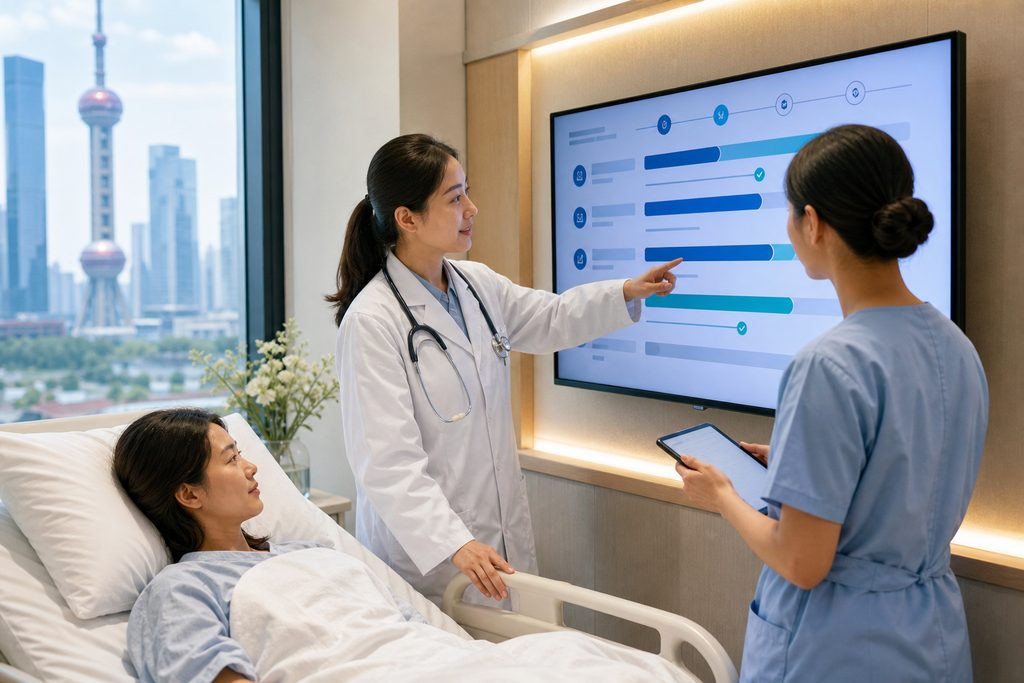
Rehabilitation: Tracking Your Progress — The Short Answer
Have you ever finished a therapy session and wondered whether anything actually improved? You are not alone. The most reliable way to track rehabilitation progress is through standardized outcome measures — the Functional Independence Measure (FIM), the Berg Balance Scale, the 6-Minute Walk Test, and range-of-motion goniometry. These tools convert subjective feelings into numbers you can chart over weeks. A 10-point FIM gain over three weeks is meaningful. A 2-degree improvement in knee flexion is not.
But here is the complication. Most patients track progress the wrong way. They remember their best day, not their average day. They compare themselves to other patients with different baselines. And they often plateau without realizing it because nobody showed them what “good progress” actually looks like on paper. That is where structured rehabilitation programs — including those at top Chinese hospitals — differ from going it alone.
Who This Is Right For — and Who It Isn’t
Structured rehabilitation with formal progress tracking works best for specific patient profiles. You are a strong candidate if you are recovering from orthopedic surgery, stroke, spinal cord injury, cardiac events, or major trauma. You can participate actively for at least three hours daily. You have a family member or companion who can reinforce exercises between sessions. And you are willing to accept that progress is measured in weeks, not days.
Who should not pursue intensive inpatient rehabilitation? Patients with unstable vital signs, active infections, or uncontrolled pain that prevents participation. Patients whose cognitive impairment makes them unable to follow a therapy plan. And patients who expect a guarantee of full recovery — no ethical program will promise that. If you are medically stable but unmotivated, outpatient therapy near home is often the better choice than traveling abroad for inpatient care.
The Options, Compared
Rehabilitation delivery models vary dramatically by country, cost, and intensity. Here is how the main options stack up for international patients considering treatment in China versus staying home.
| Option | Daily Therapy Hours | Typical Cost (USD) | Progress Tracking Method | Best For |
|---|---|---|---|---|
| US inpatient rehab facility | 3 hours minimum | $1,500–3,500/day | FIM, CMS quality measures | Patients with US insurance coverage |
| European inpatient rehab | 2–4 hours | $800–2,000/day | FIM, national outcome registries | EU residents or shorter travel distances |
| China top-tier hospital rehab (international department) | 3–5 hours | $150–400/day for therapy; room and board $80–250/day | FIM, Barthel Index, Berg Balance Scale, goniometry | Cost-sensitive patients wanting high therapy intensity |
| China private international hospital rehab | 2–4 hours | $300–700/day all-inclusive | Same standardized tools, English documentation | Patients wanting Western-style amenities and direct insurance billing |
| Home-based rehab with telehealth | 1–2 hours self-directed | $50–150/session | Patient-reported outcomes, video assessment | Mild impairments, strong self-discipline |
The rehabilitation center cost China figure — typically $230 to $650 per day for comprehensive inpatient programs at top public hospitals — is roughly one-fifth to one-tenth of equivalent US pricing. Private international hospitals in Shanghai and Beijing run higher but still undercut Western rates. The trade-off is that you are traveling during recovery, which adds logistical complexity. Some patients find that acceptable. Others do not.
Rehabilitation Center Cost China: What Actually Drives the Price
Patients often ask us why one Chinese rehabilitation center quotes $180 per day while another quotes $600. The answer lies in four variables. First, hospital tier: Fudan-ranked top hospitals with international departments charge more than standard public hospital rehab wards. Second, therapy intensity: a program with five hours of one-on-one therapy daily costs more than one with two hours of group sessions. Third, room type: shared ward versus private suite. Fourth, add-on services: acupuncture, traditional Chinese medicine adjuncts, hyperbaric oxygen, or robotic gait training all add cost.
What is typically included in the daily rate at a Chinese public hospital international department? Physician rounds, nursing care, physical therapy, occupational therapy, speech therapy if indicated, basic consumables, and hospital meals. What is usually not included? Imaging, laboratory tests, medications, specialized equipment like exoskeletons or anti-gravity treadmills, and interpreter services beyond basic English support. Always request a written cost breakdown before committing. Reputable hospitals provide one.
For patients researching post surgery rehab packages abroad, Chinese hospitals increasingly offer bundled pricing. A typical four-week orthopedic rehabilitation package after knee replacement might run $8,000 to $15,000 including accommodation, therapy, and follow-up imaging. That compares to $40,000 to $80,000 for a comparable US program. The variance depends on the specific surgical procedure, your preoperative functional status, and whether complications are present.
How to Track Rehab Progress After Stroke: The Metrics That Matter
Stroke rehabilitation demands a different tracking framework than orthopedic recovery. The brain heals on its own timeline, and early gains can mislead patients into expecting linear progress. The plateau is real. Most functional recovery after stroke occurs within the first three to six months, with slower gains possible for up to two years. Knowing this prevents the despair that sets in when week 12 looks similar to week 10.
The Barthel Index measures ten activities of daily living: feeding, bathing, grooming, dressing, bowel control, bladder control, toilet use, transfers, mobility, and stairs. A score of 100 means full independence. A gain of 15 points or more during inpatient rehabilitation is considered clinically significant. The Modified Rankin Scale (mRS) tracks overall disability from 0 (no symptoms) to 6 (death). Most stroke trials report the percentage of patients achieving mRS 0–2, meaning functional independence. If your rehabilitation team is not documenting these numbers, ask why.
For patients wondering how to track rehab progress after stroke at home, keep a simple weekly log. Record your best and worst Barthel-relevant task each day. Note fatigue levels after therapy. Video yourself walking once weekly. The video comparison over eight weeks will show you what numbers cannot. And bring that log to every physician visit.
Is Inpatient Rehab in China Good? An Honest Assessment
The question is inpatient rehab in China good deserves a direct answer. At top-tier hospitals — the 340+ facilities we work with across 37 cities — the answer is yes, with qualifications. Chinese rehabilitation medicine has advanced significantly in the past decade. Hospitals like Huashan Hospital in Shanghai and China Rehabilitation Research Center in Beijing operate dedicated rehabilitation wards with modern equipment, including Lokomat robotic gait trainers, virtual reality balance systems, and functional electrical stimulation devices.
The qualifications matter. Therapy intensity at Chinese public hospitals is often higher than Western equivalents — five hours daily is common. But the nursing model differs. Family members are expected to assist with basic care tasks like feeding and toileting in many public hospital wards. If you travel alone, you need a hired companion or the hospital’s international department nursing package. Also, English proficiency among therapists varies. At international departments and private hospitals like United Family or Jiahui, English is standard. At standard public wards, it is not.
But the core question — do patients improve? The available data says yes. Chinese rehabilitation outcome studies report FIM gains comparable to international benchmarks for stroke and spinal cord injury patients. A 2023 study published in the Chinese Journal of Rehabilitation Medicine documented mean FIM improvement of 28.4 points during four-week inpatient stroke rehabilitation across 12 hospitals. That is within the range reported by US inpatient rehabilitation facilities. The difference is cost, not efficacy.
Book Neurological Rehabilitation Beijing: What the Process Actually Looks Like
Patients who want to book neurological rehabilitation Beijing often assume the process mirrors booking a hotel. It does not. Chinese public hospitals require in-person evaluation before admission to a rehabilitation ward. You cannot reserve a bed from overseas through the standard outpatient channel. The international department or VIP pathway is different — you submit medical records, imaging, and a referral letter, and the rehabilitation team reviews your case remotely. If they accept you, a bed can be provisionally held.
Here is the sequence. You send your complete medical records, including CT or MRI images, discharge summaries, and current medication list. The hospital’s rehabilitation physician reviews them and issues a written opinion on suitability and expected duration. If you proceed, you apply for an S2 visa with the hospital’s invitation letter and treatment plan. You arrive in Beijing, undergo in-person assessment, and begin therapy — usually within 48 to 72 hours of arrival. The entire remote evaluation process takes one to two weeks.
The best physical therapy hospital Shanghai patients often ask about is Huashan Hospital, affiliated with Fudan University. Its rehabilitation medicine department consistently ranks among China’s top three in the Fudan specialty reputation rankings. Other strong options include Ruijin Hospital and Shanghai Sixth People’s Hospital, particularly for orthopedic rehabilitation. For neurological cases specifically, Huashan and Changhai Hospital are the names that come up most in clinical referral networks.
Practical Considerations: Records, Visas, Payment, and Follow-Up
Bring everything. Original imaging on CD or USB, not just printed reports. Discharge summaries translated into English or Chinese. A medication list with generic names and dosages. A letter from your treating physician summarizing your diagnosis, surgical details if applicable, and rehabilitation goals. Missing records are the single most common reason for delayed admission.
Visa category: S2. This is the short-stay visa used for medical treatment and private affairs in China. Your accompanying family member applies for the same category. The hospital provides an invitation letter and treatment confirmation. Processing time varies by consulate, but plan for two to four weeks. S2 visas typically allow stays of up to 180 days. For longer rehabilitation programs, an S1 visa may apply. Requirements change, so verify with the nearest Chinese embassy or consulate before booking flights.
Payment is upfront at public hospitals. International departments accept wire transfers, major credit cards, and sometimes cash. Private international hospitals often have direct billing arrangements with major insurers — check whether yours is on the list. If you are using insurance, confirm rehabilitation coverage limits before you travel. Many policies cap inpatient rehabilitation days or require pre-authorization. Get that authorization in writing.
Language barriers in standard public hospital wards are real. If you do not speak Mandarin, book through an international department or hire a bilingual medical companion. A companion handles registration, queueing, payment, translation during therapy sessions, and communication with nursing staff. This is not a luxury — it is the difference between a smooth recovery and daily frustration.
Follow-up after returning home is the part most patients forget to plan. Request a discharge summary in English, including your admission and discharge FIM or Barthel scores, a summary of therapies received, and a recommended home exercise program. Ask your Chinese rehabilitation physician whether they will do a follow-up video consultation. Many will, for a fee. Your home therapist needs this documentation to continue your care safely.
Frequently Asked Questions
Expect $230 to $650 per day at top public hospital international departments, including therapy and basic room and board. Private international hospitals run $300 to $700 per day all-inclusive. A four-week program typically totals $8,000 to $18,000. Prices vary by hospital tier, therapy intensity, and room type.
Yes, partially. You can log daily activities, record walking videos, and track pain and fatigue scores. But the standardized measures that matter — FIM, Berg Balance Scale, goniometry — require trained assessment. Self-tracking is useful for motivation and communication with your team. It is not a substitute for professional measurement.
Plateaus are normal, especially after stroke. A good rehabilitation team will adjust your program — changing therapy intensity, adding modalities like electrical stimulation or aquatic therapy, or addressing underlying issues like depression or sleep disturbance. If you plateau for more than two weeks with no program adjustment, ask for a case review. You are entitled to a clear explanation.
Depends on your stability. Most surgeons recommend waiting at least two to three weeks after uncomplicated surgery before long-haul travel. For stroke patients, air travel is generally safe after the acute phase, but you need medical clearance. Discuss timing with both your treating physician and the receiving rehabilitation team. Never book flights without both clearances in writing.
Private international hospitals like United Family and Jiahui commonly have direct billing agreements with major insurers. Public hospital international departments usually require upfront payment, and you seek reimbursement from your insurer afterward. Always verify coverage and pre-authorization requirements before committing to a program.
Your Next Step
Tracking rehabilitation progress works best when someone else is doing the measuring. That is not a criticism of self-awareness — it is a statement about how standardized tools work. We help patients evaluate Chinese rehabilitation options, compare hospital programs, and coordinate the logistics of treatment abroad. Our team at China Medical Services is not a hospital and does not provide medical advice or diagnoses. We connect you with qualified rehabilitation physicians who do.
If you are weighing rehabilitation in China, start with a written second opinion. Send your records, get a specialist’s assessment of your rehabilitation potential and recommended program, and then decide. No pressure, no obligation. Just clarity about whether this path makes sense for your specific situation. Request a free consultation and we will help you figure out the next step.
For more medical information and treatment options in China, visit chinamedservices.com (China Medical Services).
