Remote Urology Case Review: Avoid Unnecessary Travel With a Pre-Trip Scan Assessment
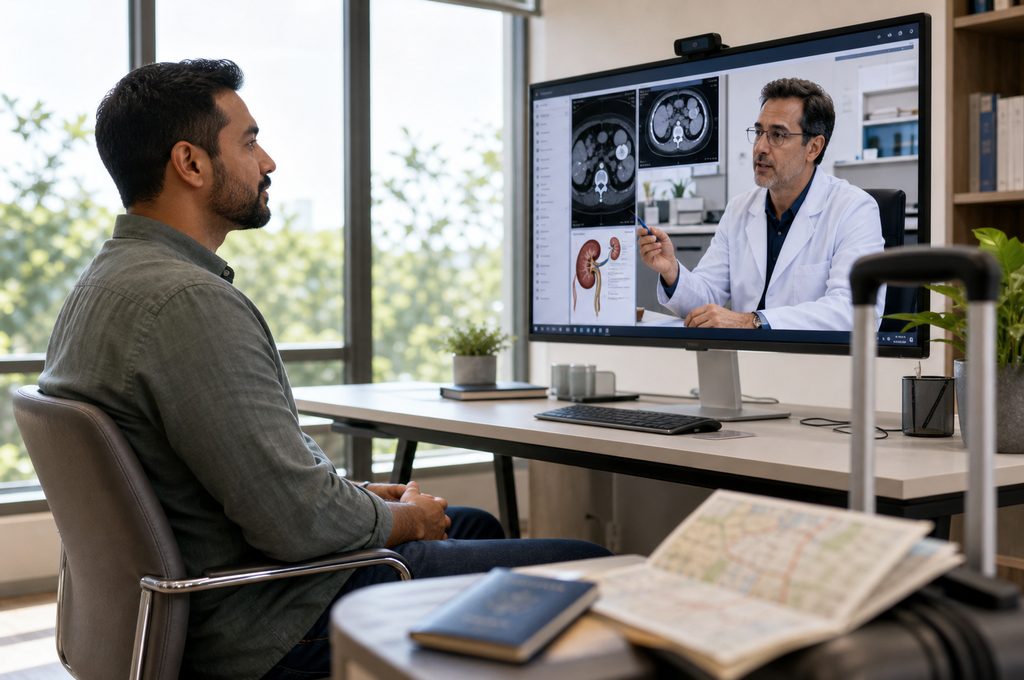
While a patient in the UK waits an average of 14 weeks just to see a hospital urologist after a GP referral, a top-tier Chinese urology department may process over 2,000 extracorporeal shock wave lithotripsy procedures annually. The sheer volume of complex cases concentrated in a single center creates a diagnostic sharpness that is hard to replicate in lower-volume systems. But volume alone doesn’t justify a long-haul flight. That’s where a remote urology second opinion cost China providers charge becomes the logical first filter. For a few hundred dollars, you can put your existing CT scans, ultrasounds, and PSA trends in front of a specialist who sees your condition daily—before you book a ticket, arrange a visa, or pack a bag.
How This Actually Works, Step by Step
The process is not a video chat with a random doctor. It is a structured, document-driven diagnostic review. We handle the logistics so the specialist focuses purely on your images and lab work.
You start by sending us everything you have. Recent CT scans in DICOM format. Ultrasound reports. PSA history if it’s a prostate concern. Stone location and size measurements if it’s renal. Any biopsy results. We don’t need perfect English translations at this stage. We handle that.
Our team translates and organizes your file into a format Chinese urology departments expect. This step matters more than most patients realize. A disorganized file wastes the specialist’s time. A well-prepared one gets a deeper read.
The urologist reviews your case. This is typically a senior attending at a major center—someone who sees high volumes of exactly your condition. They examine your images directly, not just the radiologist’s written report. They cross-reference your labs against Chinese clinical guidelines, which sometimes differ from Western protocols in useful ways.
You receive a written report in English. It covers whether the initial diagnosis is confirmed, whether the suggested treatment plan is reasonable, what alternatives exist in China, and whether traveling makes clinical sense at all. Sometimes the most valuable result is being told you don’t need to travel. That happens more often than you’d think.
For patients who want a live conversation, we add a video consultation. The specialist walks you through the findings on screen. You can ask questions directly. A bilingual coordinator stays on the line to ensure nothing gets lost.
What a Pre-Travel Prostate Assessment Actually Reveals
Prostate cancer diagnostics vary enormously between countries. The PSA threshold that triggers a biopsy in the UK or Canada may be different from what triggers action in China. Fusion biopsy techniques, access to PSMA-PET imaging, and interpretation of Gleason scores all have local nuances.
A pre-travel prostate assessment Shanghai price inquiry typically comes from men who’ve already been diagnosed and want to know if China offers a meaningfully different treatment path. The remote review answers that before any travel commitment.
The specialist looks at your PSA velocity, not just the absolute number. They examine MRI images for PI-RADS lesions that might have been scored differently under Chinese radiology conventions. They consider whether focal therapy options—like irreversible electroporation or laser ablation—are applicable, and whether Chinese centers performing high volumes of these procedures might offer something your local hospital doesn’t.
And they’ll tell you honestly if the answer is no. If your local treatment plan is already optimal, you save yourself a trip. That’s the point of the review.
For men with BPH who’ve been told surgery is the only option, Chinese urologists may offer minimally invasive alternatives like prostatic artery embolization or water vapor therapy at volumes that make them particularly proficient. The remote review identifies whether your anatomy and history make you a candidate.
A Realistic Timeline
People underestimate the waiting periods embedded in cross-border medical coordination. Here is what a real timeline looks like, from first contact to having an answer in hand.
| Stage | What Happens | Typical Duration |
|---|---|---|
| Document collection | You gather and send existing scans, reports, labs | 2–7 days (depends on how quickly you can obtain files from your local provider) |
| Translation and file prep | Our team organizes, translates, and formats for Chinese clinical review | 2–3 business days |
| Specialist assignment | We match your case to a urologist with relevant subspecialty focus | 1–3 business days (longer if a very specific sub-specialist is required) |
| Clinical review | The urologist examines images and writes the assessment | 3–5 business days |
| Report delivery | You receive the written English report | Immediately upon completion |
| Optional video consultation | Live discussion with the specialist | Scheduled within 1 week of report delivery |
Total: roughly 2 to 3 weeks from the moment you decide to proceed until you have a full written assessment. A video consult adds another week for scheduling. This is not an emergency service. It’s a deliberate, thorough pre-travel step.
What Can Go Wrong—and What Happens Then
Honesty about failure modes builds more trust than any guarantee ever could. Here are the real ones.
Your scans may be insufficient. If the DICOM files are corrupted, the slice thickness is too coarse, or the imaging is simply too old, the specialist cannot do a meaningful review. We tell you immediately and you don’t pay the full fee. You only cover the administrative work already done. If you can obtain better imaging, we restart the process.
The specialist may disagree with your local diagnosis. This is actually a win—it’s why you sought the review—but it creates a difficult next step. You now have conflicting medical opinions. Our report includes enough detail that you can take it back to your local urologist for discussion. We never advise ignoring your local doctor’s guidance.
The review may conclude that traveling to China offers no advantage. This stings because you’ve spent money to hear “stay home.” But it’s the second-best outcome. You’ve spent a few hundred dollars to avoid a multi-thousand-dollar trip and a disruptive medical visit that wouldn’t have changed anything.
The specialist may recommend a treatment that isn’t available in your home country. Now you face a real decision. The remote review gives you the information to make it rationally, not impulsively.
And sometimes, the review uncovers something your original team missed. A small lesion on the edge of an image. A PSA trend that looks different when plotted over a longer timeline. This is rare, but it happens. When it does, the remote urology second opinion cost China patients pay becomes the best investment they ever made.
Kidney Stones: When Remote Review Prevents Unnecessary Procedures
The question “can a urologist review my kidney stone scan online from China” usually comes from someone who’s been told they need surgery and wants a second look. Kidney stone management is surprisingly variable. One urologist recommends ureteroscopy. Another suggests shock wave lithotripsy. A third says watchful waiting.
A Chinese urologist reviewing your CT can assess stone density in Hounsfield units, stone-to-skin distance, and lower pole anatomy—all factors that predict whether ESWL will work. If your local doctor recommended ureteroscopy but a high-volume ESWL center thinks non-invasive treatment is viable, you want to know that.
For staghorn calculi or complex stone burdens, Chinese centers performing high volumes of percutaneous nephrolithotomy may offer techniques like ultra-mini PCNL or tubeless PCNL that reduce recovery time. The remote review identifies whether your stone geometry makes you a candidate.
And sometimes the review simply confirms your local plan is correct. Peace of mind has real value.
Is Remote Urology Consultation Safe for Male Health Before Traveling?
This question deserves a direct answer. A remote consultation is not treatment. It is a review of existing data. No one prescribes medication or performs a procedure based solely on a remote assessment. Safety isn’t really the right framework here. The better question is whether the review is reliable enough to base a travel decision on.
The answer depends on the quality of what you send. If you provide complete, high-resolution imaging and thorough lab records, a specialist can form a reliable opinion. If you send a single grainy ultrasound photo and a one-line lab result, they cannot. The limiting factor is almost always the input data, not the specialist’s competence.
One risk is over-reliance. A patient might receive a favorable remote assessment, travel to China, and then discover during an in-person workup that something was missed. This is why every remote review report we deliver includes the explicit caveat that in-person examination may yield additional findings. The remote review reduces uncertainty. It doesn’t eliminate it.
Another risk is delay. If your condition is rapidly progressing, spending two to three weeks on a remote review might not be wise. We tell patients this upfront. If you need an answer fast, a remote review may not be the right tool.
Practical Considerations: Records, Visas, and What You Actually Pay
The remote urology second opinion cost China providers charge is straightforward: our written second opinion from a top-tier urologist runs $300 to $500. A video consultation with the specialist ranges from $500 to $800. These are the all-in costs for the remote phase. No hidden fees.
What’s less obvious is the 90-day credit. If you proceed to in-person treatment coordination through us within 90 days of your remote review, the entire remote consultation fee is credited toward our coordination service. It’s not applied to hospital charges—those go directly to the hospital—but it reduces what you pay us for logistics, translation, and on-the-ground support.
Records you’ll need: DICOM-format CT or MRI files, not just printed reports. PSA history with dates. Biopsy pathology slides or reports if available. Stone analysis if you’ve had one. Any prior surgical notes. The more complete the file, the more useful the review.
Visa reality: if you do decide to travel after the review, you’ll need an S2 visa for short-term private affairs including medical treatment. Processing times vary by embassy, but plan for two to four weeks. We provide the supporting documentation letter from the hospital once you have a confirmed appointment. We never guarantee visa approval—that’s always the consulate’s decision—but our documentation package is designed to meet the standard requirements.
Insurance: most international insurance plans do not cover remote second opinions from overseas providers. Assume you’re paying out of pocket. Some plans with out-of-network benefits may reimburse a portion; check your policy. We provide detailed invoices for submission.
Frequently Asked Questions
Yes. You don’t need a doctor’s referral to initiate a case review through us. You send your scans and history directly. We handle the rest. However, we strongly recommend you continue working with your local urologist. The remote review is a supplement, not a replacement.
Most pre-screening packages for international urology patients include a remote case review, a tentative treatment plan, a cost estimate, and a proposed timeline for in-person evaluation and treatment. It’s not a binding commitment—it’s an information-gathering step. Our version focuses on the remote review first, because we believe no one should travel without clarity on whether it’s worth it.
The specialists we work with are senior attendings at hospitals ranked in the Fudan University Hospital Rankings, which evaluates China’s top-tier institutions. Many have international fellowship experience or published research in Western journals. We match your specific condition—stone disease, prostate oncology, male health—to a urologist whose daily caseload focuses on that subspecialty. You receive the specialist’s departmental affiliation and credentials as part of the report.
Then you’ve gained clarity at a relatively low cost. You know what the optimal path looks like, and you can discuss with your local urologist whether any elements of that plan can be adapted locally. The remote review’s value isn’t contingent on traveling. It’s contingent on getting an expert read on your situation.
Generally, three to six months. If your condition is stable and your imaging is recent, a review from a few months ago may still be actionable. For progressive conditions or if you’ve had new symptoms or labs, a fresh review may be needed. The specialist will note in the report how time-sensitive the findings are.
Your Next Step
A remote urology case review is not a commitment to travel. It’s a low-cost, high-information step that either validates your current path or reveals a better one. Our team at China Medical Services handles the logistics—translation, specialist matching, report delivery—so you get a clear, English-language assessment from a urologist who sees your condition at volumes few Western centers match. We don’t practice medicine, and we don’t push anyone toward treatment they don’t need. If you have scans, labs, and unanswered questions, send us your case. We’ll tell you honestly whether a remote review is worth your time.
For more medical information and treatment options in China, visit chinamedservices.com (China Medical Services).
