Sedation Dentistry in China: Complete Guide for Anxious Patients
What Sedation Dentistry Actually Means
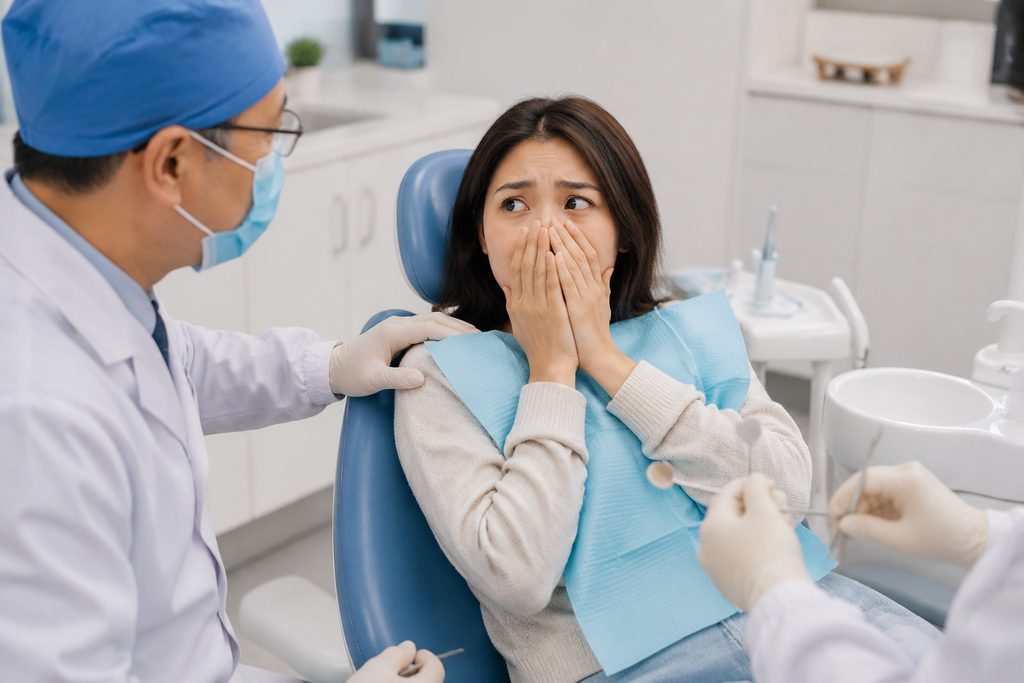
Walking into a dental clinic makes your palms sweat. Your heart races. You have not slept properly in three days thinking about that appointment. For roughly 1 in 3 adults, dental anxiety is not just nerves — it is a barrier that keeps them from getting needed care. Sedation dentistry changes that equation entirely. It uses medication to help you relax during dental procedures. The spectrum runs from mild conscious sedation, where you stay awake but calm, all the way to general anesthesia, where you are completely asleep. This guide explains what that looks like for international patients considering treatment in China — specifically, how the process works, what it costs, and whether it is the right move for you.
The sedation dentistry cost China clinics offer often surprises Western patients. A full-mouth reconstruction completed under general anesthesia at a top-tier Beijing international clinic typically runs between $8,000 and $15,000. The same procedure in the United States or United Kingdom can exceed $50,000. That gap is real. But cost is only one piece of the decision. Safety protocols, the experience of the anesthesia team, and how the clinic handles foreign patients matter just as much.
How This Actually Works, Step by Step
You are sitting at home, in London or Los Angeles or Sydney, staring at your laptop. Your dentist just told you that you need extensive work — maybe implants, multiple crowns, or a full reconstruction. The thought of doing it awake is unthinkable. Here is the sequence that gets you from that moment to treatment in China.
First, you send your existing dental records. Panoramic X-rays, any CBCT scans, and a treatment plan from your home dentist. Our team translates these and forwards them to the dental department at a partner hospital or international clinic. The dental team reviews your case — typically within 3 to 5 business days — and comes back with a preliminary assessment. They will tell you whether your case is suitable for sedation, what approach they recommend, and a rough treatment timeline.
Next comes a video consultation. You speak directly with the dentist who would handle your case. They walk through the proposed treatment plan, explain the sedation options, and answer your questions. This is the moment to ask everything: how many years they have been doing sedation cases, what monitoring equipment they use, who handles the anesthesia. A separate anesthesia provider should always be in the room when deep sedation or general anesthesia is involved. Ask about that directly.
After the video call, if you decide to proceed, the clinic issues a formal treatment plan with a detailed cost breakdown. You apply for your S2 visa — this is the short-stay visa category used for private medical treatment in China. Processing typically takes 5 to 10 business days, depending on your local Chinese embassy or consulate. You will need an invitation letter from the hospital, which we help coordinate.
You fly in. A pre-treatment exam happens on day one or two. The dentist confirms the plan, takes any additional imaging, and clears you for sedation. Treatment happens over one or more sessions, depending on complexity. Recovery monitoring follows. You fly home with a clear aftercare plan and a direct line to the clinic for follow-up questions.
Sedation Options: What Is Available and What Each Means
Not all sedation is the same. The right choice depends on the complexity of your procedure and the severity of your anxiety. Chinese international clinics and hospital dental departments generally offer four tiers.
Oral sedation involves taking a prescribed pill — usually a benzodiazepine like midazolam — about an hour before your appointment. You stay conscious but deeply relaxed. Many patients remember little of the procedure afterward. This works well for moderate anxiety and shorter treatments. The cost adds roughly $100 to $200 to your treatment bill.
Nitrous oxide, or laughing gas, is inhaled through a mask during treatment. You feel floaty and detached. The effects wear off within minutes after the mask is removed. This is the lightest form of sedation and the safest for same-day discharge. It is widely available at international clinics in Shanghai and Beijing. Expect to pay an additional $80 to $150 per session.
IV sedation delivers medication directly into your bloodstream. The depth of sedation can be adjusted moment by moment. You hover in a twilight state — technically conscious, but unlikely to remember anything. This is the most common choice for dental treatment for nervous patients China packages that involve multiple hours of work. The cost runs $300 to $600 per session, depending on the duration and the monitoring required.
General anesthesia renders you completely unconscious. An anesthesiologist manages your airway and vital signs throughout the procedure. This is the option for severe phobia, complex surgical cases, or patients who cannot cooperate with treatment while awake. A full mouth reconstruction under general anesthesia Beijing price typically falls between $8,000 and $15,000, all-inclusive of the anesthesia fees, facility costs, and the dental work itself. That is a wide range because the number of implants, the type of restoration, and the specific hospital all shift the final figure.
| Sedation Type | Consciousness Level | Added Cost per Session (USD) | Best For |
|---|---|---|---|
| Nitrous Oxide | Fully awake, relaxed | $80–$150 | Mild anxiety, short procedures |
| Oral Sedation | Drowsy, may sleep lightly | $100–$200 | Moderate anxiety, medium procedures |
| IV Sedation | Twilight state, little memory | $300–$600 | High anxiety, longer sessions |
| General Anesthesia | Fully unconscious | $800–$1,500 | Severe phobia, full-mouth reconstruction |
One thing to understand clearly: at reputable Chinese international clinics, sedation is always administered by a dedicated anesthesiologist or certified nurse anesthetist — not the dentist performing the procedure. This separation of roles is a critical safety marker. If a clinic tells you the dentist handles everything, walk away.
A Realistic Timeline
Patients often underestimate how long the end-to-end process takes. Here is what a typical timeline looks like, with the waiting steps people tend to forget.
| Stage | What Happens | Duration |
|---|---|---|
| Week 1–2 | Collect and send dental records, X-rays, treatment plan from home dentist | Depends on you — typically 1–2 weeks |
| Week 3 | Records translated and forwarded; clinic reviews case | 3–5 business days |
| Week 4 | Video consultation with treating dentist and anesthesia team | Scheduled within 1 week of review |
| Week 5–6 | Formal treatment plan issued; S2 visa application with hospital invitation letter | 5–10 business days for visa processing |
| Week 7 | Travel to China; pre-treatment exam and final clearance | 1–2 days on arrival |
| Week 7–8 | Treatment under sedation; recovery monitoring | 1–5 days depending on complexity |
| Week 8–9 | Post-treatment review; discharge; return home | 1–2 days observation for major cases |
| Month 3–6 | Follow-up remotely; your home dentist handles maintenance | Ongoing |
The visa step catches people off guard. You cannot simply book a flight and show up. The S2 visa requires documentation from the treating hospital — an invitation letter that states the purpose and duration of your medical visit. This is not a formality. Embassies scrutinize these applications. Budget at least two weeks for this step alone, and do not book non-refundable flights until your visa is in hand.
Also, if your home dentist has not taken recent X-rays, you may need to get those done before sending records. Delays at the records-gathering stage cascade through the entire timeline.
What Can Go Wrong — and What Happens Then
Honesty builds trust. Here are the real failure modes for sedation dentistry abroad, and the recourse for each.
The treatment plan changes after the in-person exam. This happens. A CBCT scan taken in China may reveal bone loss or infection that was not visible on the panoramic X-ray you sent from home. The dentist may recommend additional extractions, bone grafting, or a different restoration approach. The cost goes up. You have two choices: accept the revised plan, or walk away. You are never obligated to proceed. The pre-treatment exam is your off-ramp. You will lose the cost of the consultation and travel, but you are not locked into treatment you did not consent to.
Sedation does not work as expected. For a small percentage of patients, oral sedation produces little effect. IV sedation can sometimes cause paradoxical agitation rather than relaxation. This is rare, but it is why the anesthesia provider remains present throughout. If sedation depth is inadequate, the team can adjust medication, convert to a deeper sedation level, or — in extreme cases — reschedule under general anesthesia. Ask during your consultation what the clinic’s protocol is for inadequate sedation. A good clinic has a clear answer.
Complications during recovery. Post-operative bleeding, infection, or adverse reactions to anesthesia are possible with any surgical procedure. The difference is that you are in a foreign country. Reputable international clinics in China have protocols for managing complications and can admit patients to a partner hospital if needed. Confirm this before booking. Ask: “If something goes wrong after hours, who do I call, and where do I go?”
You need follow-up care at home. No dentist in China can manage your long-term maintenance from 6,000 miles away. Your home dentist must be willing to handle follow-up. Some are reluctant to take over care they did not initiate. Before you travel, have a conversation with your home dentist. Explain your plan. Confirm they will see you for routine maintenance and any post-treatment issues. If they refuse, find one who will — before you book the flight.
How to Evaluate a Clinic for Sedation Dentistry
Not every clinic that advertises sedation services is equipped to handle complex cases on anxious foreign patients. Here is what to look for.
Anesthesia provider credentials. The person managing your sedation should be a board-certified anesthesiologist or a certified nurse anesthetist with specific training in dental sedation. Ask for their credentials directly. A legitimate clinic will provide them without hesitation. If you want to book sleep dentistry Shanghai international clinic services, look for clinics that list their anesthesia team members by name and qualification on their website — that transparency is a positive signal.
Monitoring equipment. During deep sedation or general anesthesia, the clinic should use continuous monitoring of heart rate, blood pressure, oxygen saturation, and end-tidal CO2. A capnography monitor — which measures CO2 in exhaled air — is the gold standard for detecting respiratory depression early. Ask whether capnography is used. If the answer is vague, keep looking.
Emergency protocols. The clinic should have a written emergency protocol and a transfer agreement with a nearby hospital. They should be able to tell you, in specific terms, what happens if you need urgent medical attention. “We will call an ambulance” is not enough. “We have a direct admission agreement with the emergency department at XYZ Hospital, 8 minutes away” is what you want to hear.
Language capability. You will be sedated, so language matters less during the procedure itself. But pre-treatment consultations, consent forms, discharge instructions, and post-operative communication all require clear English. International clinics in Beijing, Shanghai, and Guangzhou typically have English-speaking dental teams and administrative staff. Public hospital dental departments, even excellent ones, often do not. If you are considering a public hospital to save on cost, factor in the need for a bilingual medical companion to bridge the communication gap.
The question is dental sedation safe in China for foreigners comes down to the specific clinic, not the country. Safety is a function of protocols, equipment, and trained personnel — not geography. JCI-accredited international clinics in China operate to the same standards as accredited facilities in Singapore, Dubai, or London. The key is verifying that accreditation and the specifics behind it, not assuming that a clinic is safe because it looks modern on a website.
Understanding How Sedation Works for Severe Anxiety
If you have never been sedated for dental work, the mechanics can sound intimidating. The question how does sedation dentistry work for severe dental anxiety is really about what you will experience — and what you will not.
With IV sedation, a thin catheter is placed in a vein, usually in your arm or hand. The medication — typically a benzodiazepine like midazolam combined with an opioid for pain control — flows in continuously. Within 30 to 60 seconds, you feel a wave of warmth and detachment. Your conscious mind steps back. You can still breathe on your own. You can respond to simple commands if the dentist asks you to turn your head. But the part of your brain that generates fear and panic is offline. Time compresses. A three-hour procedure feels like minutes. Most patients remember nothing.
General anesthesia goes further. You are completely unconscious. A breathing tube or laryngeal mask maintains your airway. The anesthesiologist stays at your head throughout the entire procedure, monitoring every vital sign. You wake up in recovery with the dental work done and no memory of the event at all. For patients with severe phobia — the kind where you have avoided the dentist for a decade — this is often the only viable path to comprehensive treatment.
The critical point: sedation does not treat the phobia itself. It creates a window in which treatment can happen. Many patients find that after a positive sedation experience, their baseline anxiety drops. They have proof that dental work can happen without trauma. Some graduate to lighter sedation or even non-sedated visits over time. Others stick with sedation for every appointment. Both outcomes are valid.
Practical Considerations: Records, Visa, Payment, and Follow-Up
Getting treated abroad requires more logistical planning than walking into your neighborhood dentist. Here are the specifics that apply to dental treatment in China.
Dental records. You need recent panoramic X-rays — ideally taken within the last six months. If your case involves implants or complex restoration, a CBCT scan is strongly recommended. Your home dentist can provide these digitally. You will also need a written treatment plan outlining what your home dentist believes you need. This gives the Chinese dental team a starting point, though they will make their own independent assessment.
Visa. The S2 visa is the correct category for short-term medical treatment in China. It is issued for private affairs, including medical visits. You apply at your local Chinese embassy or consulate. Required documents typically include your passport, a completed application form, a recent photo, and an invitation letter from the treating hospital. Processing times vary by country. Budget 5 to 10 business days, but check with your specific embassy — some take longer during peak seasons.
Payment. Most international clinics in China require a deposit to secure your treatment dates, with the balance due before or on the day of treatment. Payment is typically by wire transfer or credit card. Public hospitals generally require full prepayment. Your overseas health insurance may reimburse some costs — check with your insurer before committing. International clinics with JCI accreditation are more likely to meet the documentation standards your insurer requires.
Language. Even at English-speaking international clinics, some staff members may have limited English. Consent forms and discharge instructions should be available in English. Confirm this during your video consultation. If you are using a public hospital dental department, plan for a bilingual companion to handle registration, payment, and translation during pre-treatment consultations. This is not a luxury — it is essential for safety when sedation is involved.
Follow-up at home. Your Chinese dental team will provide a detailed treatment summary and aftercare instructions. Bring these to your home dentist. Schedule a follow-up appointment within two to four weeks of returning home so your local dentist can check healing and address any issues. If complications arise — a loose crown, an implant that feels wrong — you will need your home dentist to manage them. The Chinese clinic can consult remotely, but they cannot physically treat you.
Frequently Asked Questions
How much does sedation dentistry cost in China compared to the US or UK?
The sedation dentistry cost China clinics charge is typically 60% to 80% less than equivalent care in Western countries. A single implant with IV sedation might cost $1,200 to $2,000 in China versus $4,000 to $6,000 in the US.
For more medical information and treatment options in China, visit chinamedservices.com (China Medical Services).
