Seeing the Dermatology Team at Huashan Hospital: What to Prepare
Seeing the Dermatology Team at Huashan Hospital: What to Prepare
If you are planning a first visit to the dermatology department at Huashan Hospital in Shanghai, the practical answer is this: bring your passport, your prior medical records and skin images in English or Chinese, a list of every medication you take, and enough time to complete registration, payment, and consultation in a single day. The Huashan Hospital dermatology cost for international patients is not a single fixed number. It depends on whether you register through the standard public clinic or the international/VIP channel, which tests are ordered, and whether you need procedures such as biopsy, laser treatment, or long-term follow-up. This guide explains what to prepare, how registration works for foreigners, and where the real costs and limits sit.
Huashan Hospital, affiliated with Fudan University, is widely known in China for dermatology. Its dermatology department is one of the largest and busiest in the country, and it appears consistently in Chinese hospital rankings for the specialty. That reputation is exactly why international patients ask whether it is worth traveling for a skin problem that has been difficult to diagnose or control at home. It is also why the practical preparation matters: a busy public clinic is not designed around foreign visitors, and arriving unprepared can turn a manageable consultation into a wasted trip.
Huashan Hospital Dermatology Cost for International Patients: The Short Answer
For a straightforward first consultation through the standard public channel, the registration and consultation fees are usually modest by Western standards, often in the range of a few tens of US dollars, though this varies by clinic type and whether you see a senior specialist. The international or VIP channel costs more, commonly around one and a half to two times the standard fee, and provides English-speaking support and a more streamlined process. Diagnostic tests, pathology, and procedures are charged separately, and those are the items that can move the total significantly. Because fees change and depend on your case, we do not publish a fixed package price. Ask the hospital or a coordination service for a current written estimate once the doctor has decided what tests you need.
Who This Is Right For — and Who It Isn’t
Huashan is a strong choice for certain patients and a poor choice for others. Being honest about that distinction saves people from an expensive trip with no clear benefit.
It is often a good fit if you:
- Have a chronic or recurrent skin condition — eczema, psoriasis, chronic urticaria, acne, vitiligo, or alopecia — that has not responded well to treatment at home.
- Need a second opinion on a difficult diagnosis, especially where a biopsy or specialist pathology review would help.
- Are already traveling to Shanghai or elsewhere in China and want a credible specialist consultation while you are here.
- Want access to Chinese dermatology expertise and, where appropriate, integrated traditional Chinese medicine approaches for chronic skin disease.
It is probably not the right fit if you:
- Have an acute emergency such as a severe drug reaction, widespread infection, or rapidly spreading rash — seek local emergency care first.
- Need same-week surgery or a guaranteed appointment with a named professor. Public hospital scheduling does not work that way, and no service can promise a specific doctor or date.
- Expect a Western-style private clinic experience at public-channel prices. Huashan is a large public hospital with high daily patient volumes.
- Have a condition that can be managed perfectly well by your local dermatologist. Travel adds cost and disruption without adding clinical value.
The Options, Compared
International patients generally face three realistic routes. The table below compares them on the factors that matter most: access, language, cost level, and predictability.
| Route | How You Register | Language Support | Relative Cost | Best For |
|---|---|---|---|---|
| Standard public dermatology clinic | Register on the day, in person, with passport; queue for a number | Limited; mostly Chinese | Lowest | Patients with Chinese-language help or a companion |
| International / VIP channel | Advance coordination through the hospital international department | English-speaking staff more likely | Roughly 1.5–2× standard | Foreign patients who need a smoother, English-supported visit |
| Private international hospital in Shanghai | Direct booking, often online | English standard; direct insurance billing common | Highest | Patients prioritizing convenience, privacy, and insurance |
If your priority is specialist depth for a difficult skin condition and you can accept a busy public-hospital environment, Huashan through the standard or international channel is the sensible choice. If your priority is a calm, English-first experience with direct insurance settlement, a private international hospital may suit you better. Many patients use a written second opinion first to decide which route is worth the trip.
How to Register at Huashan Hospital Dermatology as a Foreigner
This is the part most guides skip. Chinese public hospitals generally do not allow overseas patients to book an ordinary outpatient slot in advance from abroad. Registration typically happens on the day, in person, using your passport to create a hospital card and obtain a queue number. For dermatology, demand is high, so arriving early matters. The international or VIP channel is the main way to secure a more predictable appointment in advance, and it is arranged through the hospital’s international department rather than a public booking website.
In practice, a foreign patient’s first visit usually follows this sequence: create the hospital medical card with your passport, pay the registration fee, wait for your queue number, see the dermatologist, receive test or prescription orders, pay for those separately, then complete tests or collect medication. If a biopsy or procedure is needed, it may be scheduled for another day. Bringing a bilingual companion or interpreter is the single most effective way to keep this process moving, because signage, forms, and payment steps are largely in Chinese.
What to Bring to a Huashan Hospital Dermatology First Visit
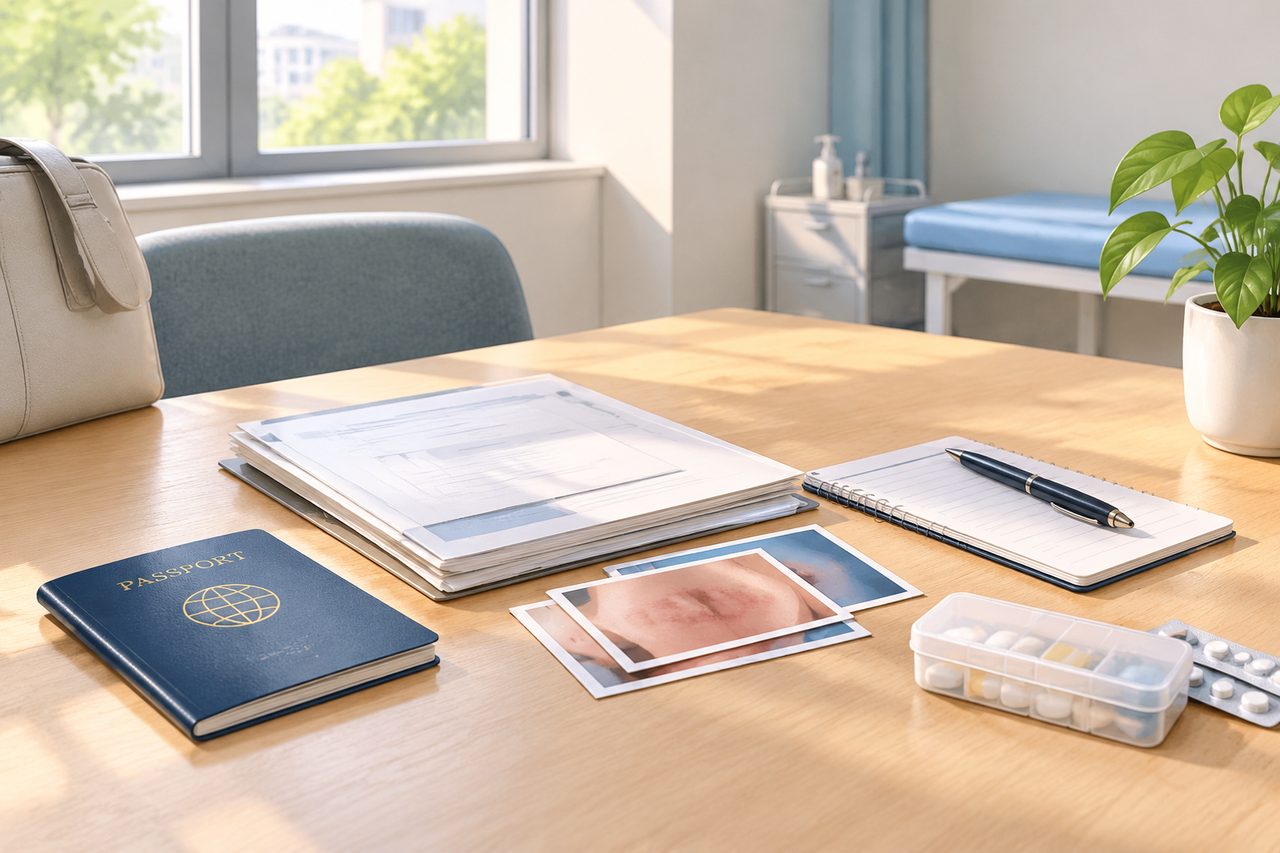
Preparation is where foreign patients most often lose time. Bring the following, ideally with Chinese translations where possible:
- Passport and a photocopy, plus any prior Chinese hospital card if you have one.
- Prior medical records: clinic notes, diagnosis letters, and discharge summaries from your home doctors.
- Skin photographs showing the condition at its worst, plus dates, since skin findings change between flares.
- Pathology slides or reports if you have had a biopsy before — these are often more useful than the images alone.
- A complete medication list, including topical steroids, biologics, antibiotics, and supplements, with doses.
- Allergy history and any known drug reactions.
- Payment method: public hospitals generally require upfront payment, and international cards may not work at every counter, so carry a card that does and some cash as backup.
- A bilingual companion or interpreter, or a translation of your key documents.
Patients frequently ask what to bring to a Huashan Hospital dermatology first visit and expect a short list. The honest answer is that the records matter more than the paperwork: a dermatologist who can see your prior biopsy report and your medication history can make a far better decision than one starting from scratch.
What It Costs and How Long It Takes
Costs fall into four buckets: registration and consultation, diagnostic tests, procedures or pathology, and medication. The first is relatively small; the last three depend entirely on your case. A simple eczema consultation with a prescription may cost very little beyond the fee, while a workup involving allergy testing, blood panels, biopsy, and pathology will cost more. Because these figures vary by hospital, clinic type, and case complexity, treat any single number you see online with caution and ask for a current written estimate.
Time is similar. A standard consultation can be completed in a morning if you arrive early, but tests and results may take additional days, and a follow-up visit to review results is common. Plan for at least two to three days in Shanghai if a biopsy or lab work is likely, and longer if treatment such as laser or phototherapy is planned. The international channel can reduce waiting and language friction but does not eliminate the need for follow-up.
Is Huashan Hospital Dermatology Good for Foreigners?
Clinically, yes — it is a serious dermatology center with deep specialist experience. Practically, it is a large public hospital built for volume, and foreigners should expect a busy environment with limited English outside the international channel. The department is well regarded for chronic and complex skin disease, and many international patients specifically seek it for difficult diagnoses. The realistic view is that the clinical strength is real, but the experience depends heavily on preparation and language support.
For patients weighing whether to travel, a staged approach works well: start with a written second opinion or video consultation using your existing records, confirm that a visit would add value, and only then plan the trip. Our team at China Medical Services helps international patients navigate exactly this kind of decision, from hospital matching to bilingual accompaniment, without promising a specific doctor or outcome.
Frequently Asked Questions
Ordinary public outpatient slots are generally not bookable in advance from overseas; registration usually happens in person on the day with your passport. The international or VIP channel is the main route to a more predictable advance appointment, arranged through the hospital’s international department.
The consultation fee itself is usually modest, but tests, biopsy, pathology, and procedures are charged separately and can dominate the total. Because fees change and depend on your case, ask for a current written estimate after the doctor decides what is needed rather than relying on a single online figure.
Strongly recommended. Signage, forms, and payment steps are largely in Chinese, and a bilingual companion keeps registration and testing moving. The international channel offers more English support but does not guarantee it for every step.
Dermatology can be genuinely difficult, and a single visit may end with tests, a working diagnosis, or a plan to review results later. Ask what the next step is and what would change the plan, and keep copies of all reports for your home doctor.
Your Next Step
The core message is simple: Huashan’s dermatology team is clinically strong, but a good visit depends on preparation — records, images, medication history, language support, and realistic expectations about cost and timing. We are a coordination service, not a hospital, and we do not diagnose or promise specific doctors or outcomes. If you would like help deciding whether a visit makes sense, start with a low-pressure conversation through our patient consultation page, and we can outline the options that fit your case.
This article is for general information only and is not medical advice. Always consult a qualified healthcare professional about your own condition.
For more medical information and treatment options in China, visit chinamedservices.com (China Medical Services).
