Is My Sleep Apnea Caused by My Jaw? Diagnosis and Treatment Costs
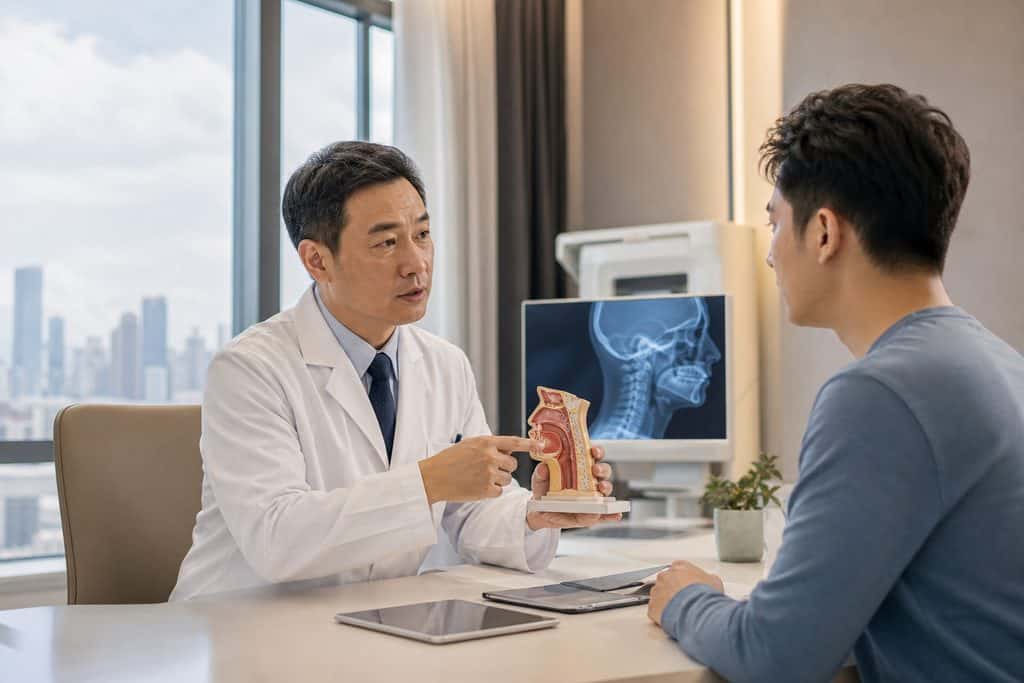
Obstructive sleep apnea affects approximately 1 in 5 adults worldwide, though most cases go undiagnosed. When you wake up exhausted despite eight hours in bed, or your partner complains about your snoring, the cause might not be what you think. A narrow airway, a recessed lower jaw, or a small chin can physically collapse your breathing passage during sleep. So, is my sleep apnea caused by my jaw? For a meaningful subset of patients, the answer is yes. And for those patients, the definitive treatment is maxillomandibular advancement surgery — a procedure that moves both jaws forward to enlarge the airway. The jaw surgery for sleep apnea cost China runs significantly lower than in Western countries, which is why more international patients are investigating this option.
Before we go further, one clarification. We are not a medical practice. We are China Medical Services, a team that connects international patients with top-tier Chinese hospitals. We handle logistics, translation, hospital selection, and coordination. The medical decisions belong to you and your doctors.
How This Actually Works, Step by Step
You suspect your jaw structure is behind your sleep apnea. What happens next? Here’s the actual sequence, stripped of abstraction.
First, you gather your existing records. A sleep study — polysomnography or a home sleep test — showing your apnea-hypopnea index, or AHI. Any imaging you have: lateral cephalometric X-rays, CBCT scans, or MRI. Dental records if you’ve had orthodontics. These documents get translated into Chinese by our team and sent to a maxillofacial surgery department at a hospital on our database.
Second, the Chinese surgical team reviews your case. They look at your AHI, your airway dimensions, your jaw position relative to your skull base, and your overall health. They determine whether you’re a candidate for maxillomandibular advancement, or whether a less invasive option — like a mandibular advancement device or soft tissue surgery — makes more sense.
Third, you receive a written second opinion. This typically costs $300–500 and includes the team’s assessment, their recommended surgical plan, and what you can expect. If you want to speak with them directly, a video consultation runs $500–800 for a top specialist.
Fourth, if you decide to proceed, we coordinate your travel. S2 visa, hospital appointment, pre-operative testing, surgery, and post-operative recovery support. The entire process, from first contact to walking into the operating room, typically spans 6 to 12 weeks.
Can Jaw Misalignment Cause Sleep Apnea? The Anatomical Reality
Yes. Jaw misalignment is one of the most underdiagnosed structural causes of obstructive sleep apnea. Here’s the mechanism in plain terms.
When you sleep, the muscles in your throat relax. For most people, the airway stays open. But if your lower jaw sits too far back — a condition called mandibular retrognathia — your tongue base follows it backward. The tongue collapses against the soft palate and the back of the throat. Airflow stops. Oxygen drops. Your brain jolts you awake to reopen the airway. This cycle repeats dozens or hundreds of times per night.
Research supports this. A 2016 systematic review in the Journal of Oral and Maxillofacial Surgery found that maxillomandibular advancement achieves surgical success rates of 85–90% for obstructive sleep apnea, defined as a greater than 50% reduction in AHI. That’s higher than soft tissue procedures like uvulopalatopharyngoplasty, which success rates hover around 40–50%. The reason is structural: moving the jaws forward pulls the tongue and soft palate forward with them, enlarging the airway in three dimensions.
But not every sleep apnea patient has a jaw problem. Some have obesity-related airway narrowing. Some have large tonsils. Some have nasal obstruction. A proper workup distinguishes these. If your sleep apnea persists despite CPAP, or you can’t tolerate CPAP, and your jaw is visibly recessed, that’s a strong signal to investigate further.
Jaw Surgery for Sleep Apnea Cost China: What the Numbers Look Like
Let’s talk about money, because for most international patients, that’s the deciding factor. The jaw surgery for sleep apnea cost China varies by hospital tier, surgeon seniority, and case complexity. But the ranges are consistent.
| Procedure | China (Public Top-Tier) | China (International/VIP) | United States | United Kingdom |
|---|---|---|---|---|
| Maxillomandibular advancement surgery | $12,000–$20,000 | $25,000–$40,000 | $50,000–$100,000 | $35,000–$60,000 |
| Pre-operative workup (imaging, sleep study, labs) | $800–$1,500 | $1,500–$3,000 | $3,000–$6,000 | $2,500–$5,000 |
| Hospital stay (3–5 days) | $500–$1,000 | $1,500–$3,000 | $8,000–$15,000 | $6,000–$12,000 |
| Total estimated package | $13,300–$22,500 | $28,000–$46,000 | $61,000–$121,000 | $43,500–$77,000 |
These figures are ranges, not quotes. They vary by hospital and case complexity. But the pattern holds: China’s top public hospitals deliver this surgery at roughly one-fifth to one-third of US prices. The maxillomandibular advancement surgery price Shanghai sits at the higher end of China’s public hospital range, reflecting Shanghai’s status as a medical hub with several Fudan-ranked maxillofacial surgery departments.
Why the price difference? Lower labor costs, high surgical volumes, and a healthcare system built on throughput. Chinese maxillofacial surgeons at top centers perform hundreds of these procedures annually. Volume breeds efficiency. Efficiency lowers cost without lowering quality — the top hospitals on our database are ranked among the Top 5% of China’s 35,000+ hospitals by Fudan and JCI standards.
A Realistic Timeline
People underestimate the waiting steps. Here’s the honest sequence, with ranges.
| Stage | Duration | What Happens |
|---|---|---|
| Day 1–7 | 1 week | You submit records. We translate them into Chinese and forward to the surgical department. |
| Week 2–3 | 1–2 weeks | Written second opinion or video consultation. The team confirms candidacy and proposes a surgical plan. |
| Week 3–5 | 2–3 weeks | S2 visa application. You’ll need the hospital’s invitation letter and treatment confirmation. Embassy processing times vary by country. |
| Week 5–6 | 1 week | Travel to China. Pre-operative testing: blood work, ECG, repeat imaging if needed. |
| Week 6–7 | 3–5 days | Surgery. Hospital stay. Initial recovery with the jaw wired or banded shut. |
| Week 7–10 | 3–4 weeks | Liquid diet phase. Follow-up with the surgical team. Suture removal. Discharge planning. |
| Month 3–6 | 3–4 months | Soft diet transition. Orthodontic adjustments if needed. Repeat sleep study to confirm AHI reduction. |
Total time from first contact to returning home: roughly 6 to 8 weeks. Full recovery, including return to normal diet and final results, takes 3 to 6 months.
One thing people forget: document translation. If your records are in English, most Chinese hospitals accept them. If they’re in another language, add 3–5 days for certified translation. Also, plan for the visa. The S2 visa is the correct category for medical treatment and private affairs, but processing times in some countries stretch to 3 weeks. Apply early.
What Can Go Wrong — and What Happens Then
Maxillomandibular advancement is major surgery. Pretending otherwise would be dishonest. Here are the real failure modes and the actual recourse for each.
The hospital rejects your case. Not every patient is a candidate. If your AHI is mild, or your jaw position is normal, the surgical team will say so. They may recommend a mandibular advancement device or weight loss instead. That’s not a failure — that’s a correct diagnosis. You’ve spent $300–500 on a written second opinion that saved you from an unnecessary operation.
Nerve damage. The inferior alveolar nerve runs through the lower jaw. During surgery, it can be stretched or bruised. Most patients experience temporary numbness in the lower lip and chin. Permanent numbness occurs in roughly 5–10% of cases. Your surgeon should discuss this risk explicitly. If numbness persists beyond 6 months, it’s likely permanent — but it rarely affects function, only sensation.
Infection or hardware failure. Titanium plates and screws hold the jaw in its new position. Infection rates are low, around 2–5%, but if a plate becomes infected, it may need removal after the bone heals. Hardware failure — a broken plate or screw — is rare but possible, especially if you chew hard foods too early. The fix is a second, smaller surgery.
Relapse. In a small percentage of cases, the jaw drifts partially back toward its original position. This is more common when the advancement is large or when post-operative orthodontics are skipped. Regular follow-up imaging catches this early.
You’re not happy with the aesthetic result. Moving both jaws forward changes your face. Most patients report improved facial balance, but some are surprised by the change. Pre-operative 3D planning software shows you a simulation of the expected result. Look at it carefully. Ask questions.
For each of these, the recourse is the same: contact the surgical team. Chinese hospitals maintain post-operative follow-up channels for international patients, and we stay involved to coordinate communication. You are not abandoned after discharge.
Best Sleep Apnea Jaw Surgery Hospital China: How to Evaluate Your Options
Candidates typically have moderate to severe obstructive sleep apnea (AHI above 15–20), a documented retrognathic mandible, and either CPAP intolerance or CPAP failure. Patients with mild sleep apnea or normal jaw position are usually directed to less invasive treatments. The surgical team reviews your imaging and sleep study before accepting your case.
Maxillomandibular advancement has success rates of 85–90%, but no surgery is guaranteed. If your AHI remains elevated after surgery, options include CPAP at a lower pressure, weight loss, positional therapy, or a revision procedure. A repeat sleep study 3–6 months after surgery provides the data to decide.
Plan for 4 to 6 weeks. That includes pre-operative testing, the surgery itself, the initial hospital stay, and early post-operative follow-up before you’re cleared to fly. Some patients return home after 3 weeks if recovery is smooth, but 4–6 weeks is the safer window.
At a top-ranked hospital, yes. The hospitals on our database are among the Top 5% of China’s 35,000+ hospitals, ranked by Fudan and JCI standards. Their maxillofacial surgery departments perform high volumes of these procedures annually. The key is choosing the right hospital and having proper coordination and translation support throughout.
Your Next Step
Jaw surgery for sleep apnea is a serious decision. The structural fix works for the right patient — but only after proper diagnosis and honest evaluation. If you’re exploring sleep apnea treatment abroad packages, start with information, not commitment. We are China Medical Services. We connect you with top-tier Chinese hospitals, coordinate your records, arrange consultations, and support you on the ground. We do not perform surgery and we do not
Frequently Asked Questions
Yes. The hospitals used for international patients are JCI-accredited and follow the same international safety standards as top hospitals in the US and Europe. Surgical teams perform high volumes of procedures — often more than their Western counterparts — which studies show leads to better outcomes.
Costs vary by procedure and hospital, but international patients typically save 40-80% compared to US prices — even when factoring in travel and accommodation. A consultation with our team will give you an exact, all-inclusive quote with no hidden fees.
Send us your existing medical reports to get started. We handle everything from hospital selection and appointment scheduling to visa assistance and post-operative recovery planning. Your medical records are reviewed by the specialist before you even book a flight.
For more medical information and treatment options in China, visit chinamedservices.com (China Medical Services).
