Sleep Study in Shanghai: How to Book and What It Costs
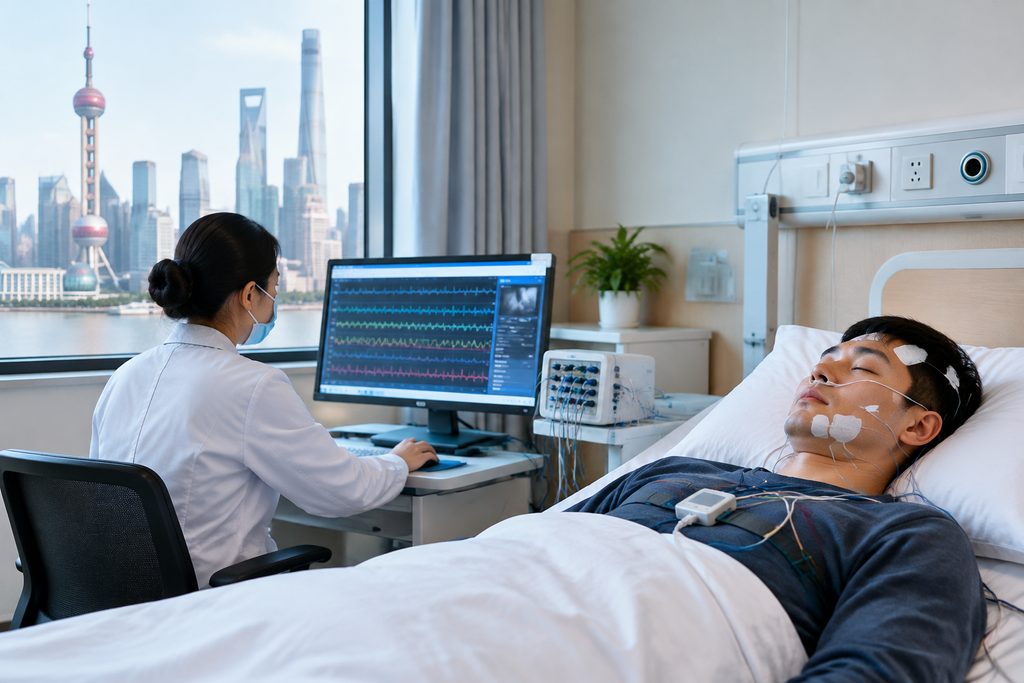
Sleep Study in Shanghai: How to Book
A sleep study — sometimes called a polysomnogram — is an overnight recording of how you breathe, how your heart behaves, how your brain cycles through sleep stages, and how much you actually rest. In plain terms, you spend a night wired to sensors while a technician watches the data. If you have searched for a sleep study in Shanghai, the short answer is this: yes, you can book one as a foreigner, and the sleep study cost in Shanghai typically runs from about $300 to $1,200 depending on the hospital tier, whether it is a full overnight polysomnogram or a home sleep apnea test, and whether you need an English-speaking international department.
That range is wider than most people expect. The reason is not hidden fees. It is that Shanghai has two parallel systems — public tertiary hospitals and private international clinics — and they price, schedule, and communicate very differently.
Sleep Study in Shanghai: The Short Answer
For a standard overnight polysomnogram at a public tertiary hospital, expect roughly $300–$600. At a private international hospital with English-speaking staff and a private room, expect $700–$1,200. A home sleep apnea test, which uses a simplified device you take home for one night, is usually cheaper — often $150–$400 — but it screens mainly for obstructive sleep apnea and captures far less data than a full lab study.
Here is the caveat that makes this more complicated than a price list. Most public hospitals do not let you book a sleep study directly from overseas. You generally need an in-person consultation first, and the sleep lab then schedules you according to its own queue. Private international hospitals are more flexible about advance booking, but you pay for that flexibility.
Who This Is Right For — and Who It Isn’t
Sleep medicine is not one condition. It covers obstructive sleep apnea, central sleep apnea, insomnia, restless legs syndrome, narcolepsy, and parasomnias. A study helps only when the clinical question is clear enough to be answered by data.
You are likely a reasonable candidate if:
- You snore loudly and have been told you stop breathing or gasp during sleep
- You wake with headaches, dry mouth, or unrefreshing sleep despite adequate hours
- You have daytime sleepiness that affects driving or work
- You have resistant high blood pressure, atrial fibrillation, or poorly controlled diabetes alongside sleep symptoms
- You are already in China for another reason and want the workup done here
You should probably not pursue this in Shanghai if:
- Your symptoms are mild and a home test at home would answer the same question for less money
- You need longitudinal follow-up with the same physician for years — continuity matters more than a single night of data
- You are on a short tourist visa with no time for a consultation plus a lab night plus a results visit
- You have a complex cardiac or neuromuscular condition where your existing specialist already knows your baseline
Being honest about that second list matters. A sleep study is a diagnostic tool, not a treatment. If nobody will manage the result afterward, the data has limited value.
The Options, Compared
| Option | Typical Cost (USD) | Booking Lead Time | English Support | Best For |
|---|---|---|---|---|
| Public tertiary hospital, standard sleep lab | $300–$600 | Consultation first, then lab queue; often 1–4 weeks | Limited; interpreter usually needed | Cost-conscious patients with time flexibility |
| Public hospital international / VIP department | $600–$1,000 | Can often be arranged in advance | Yes, English-speaking coordinators | Patients who want speed and clear communication |
| Private international hospital | $700–$1,200 | Days to 2 weeks | Yes, full English service | Short trips, insurance billing, comfort |
| Home sleep apnea test | $150–$400 | Often same week | Varies | Screening for suspected obstructive sleep apnea only |
| Sleep study in the US or Western Europe | $1,000–$3,000+ | Weeks to months | Native language | Patients who need local follow-up |
Which column suits you depends mostly on two variables: how much time you have in China, and whether you can function in a hospital where signage and nursing staff are primarily Chinese-speaking. If you have a week and no Mandarin, the private or international-department rows are realistic. If you have a month and a bilingual companion, the public row saves real money.
How to Book a Sleep Study in Shanghai as an International Patient
This is the part most search results skip. The workflow in Shanghai is sequential, and skipping a step usually means starting over.
Step one: get a physician to order the study. Sleep studies are ordered by respiratory medicine, neurology, ENT, or psychiatry depending on your dominant symptom. Loud snoring with witnessed apneas points to respiratory or ENT. Excessive daytime sleepiness with sudden muscle weakness points to neurology. You cannot usually walk into a sleep lab and request a night.
Step two: register and create a hospital card. Chinese hospitals issue their own patient card, and it is tied to that institution. Bring your passport. Some hospitals now accept passport numbers directly at the registration window, but the card is still the key to every subsequent step — payment, lab scheduling, pharmacy.
Step three: attend the consultation in person. This is the bottleneck for overseas patients. Public hospital outpatient slots generally cannot be reserved from abroad in advance; you take a number on the day. International departments and private hospitals are the exception and can often pre-arrange a specific appointment.
Step four: the sleep lab night. You arrive in the evening, usually around 8 or 9 pm. A technician applies electrodes to your scalp, face, chest, and legs. You sleep. You leave early the next morning. Bring your own pajamas, toiletries, and any medication you take at night.
Step five: the results visit. A report is generated and interpreted by the sleep physician, typically within several days to two weeks. This is where treatment — CPAP, an oral appliance, surgery, or positional therapy — gets discussed.
What It Costs, and What Drives the Variance
The sleep study cost in Shanghai is not a single number because the study itself is not a single product. A full attended polysomnogram with video, EEG, EMG, airflow, oximetry, and limb leads is a labor-intensive procedure requiring a technician present all night. A home test is a wrist or chest device with a nasal cannula and a finger probe — far cheaper to run.
Beyond the study type, four things move the price:
- Hospital tier. A public tertiary hospital charges government-set rates. A private international hospital sets its own, and a private room with a dedicated English-speaking technician costs more.
- Whether a repeat night is needed. Some patients need a second study on CPAP to titrate pressure. That doubles the lab cost.
- Consultation and interpretation fees. These are separate line items in most Chinese hospitals.
- Language support. If you need a bilingual medical companion for the consultation, the lab night, and the results visit, that is a separate service cost, typically from $300 per day.
What is usually not included: medication, CPAP equipment, and any surgical treatment that follows. Those are quoted separately by the hospital.
Practical Considerations: Visas, Payment, and Records
Visa. For short medical travel to China, the applicable category is the S2 visa, which covers short-stay private affairs including medical treatment. Family members accompanying you apply under the same category. Requirements and supporting documents are set by the Chinese embassy or consulate in your country and change from time to time — check the current list before you apply, and expect to submit a hospital-issued invitation or appointment confirmation. The M visa is for commercial and trade activity and is not the right category for medical treatment.
Payment. Public hospitals require prepayment and issue receipts you can submit to your insurer for later reimbursement. Private international hospitals frequently bill insurance directly if your plan has a relationship with them. Bring a card that works internationally, and carry a backup — some hospital payment terminals are finicky with foreign cards.
Records. Bring your prior sleep studies, CPAP download data if you use a machine, medication list, and any cardiac or pulmonary workup. Chinese physicians read English reports more readily than you might expect at the top-tier hospitals, but a translated summary speeds things up considerably.
Language. A sleep lab night involves a technician adjusting sensors in a darkened room. That is a hard moment to navigate without shared language. If your Mandarin is limited, arranging interpretation for the lab night specifically is worth the cost.
Follow-up after you go home. Ask for the full raw data and the scored report, not just the summary page. Your home physician will want the apnea-hypopnea index, oxygen desaturation index, and arousal index. Without those, the study may need to be repeated.
Frequently Asked Questions
The procedure itself is non-invasive and low-risk — sensors on the skin, no needles, no sedation. The real risks for a tourist are logistical: an unplanned second night, a results delay that outlasts your visa, or a language gap during the lab night. Plan a buffer of several days and arrange interpretation if you do not speak Mandarin.
At private international hospitals and public hospital international departments, often yes — you can pre-arrange a consultation and sometimes the lab night itself. At standard public hospital outpatient departments, generally no. You register in person on the day, and the lab is scheduled afterward. This is the single biggest planning constraint for overseas patients.
Private international hospitals in Shanghai commonly bill major international insurers directly, but coverage depends entirely on your specific plan and whether the hospital is in network. Public hospitals generally require you to pay upfront and seek reimbursement yourself. Call your insurer before you book — not after.
Not strictly. You can complete a study at a public hospital with an interpreter. But the consultation, the consent discussion, and the results visit all involve nuanced conversation about treatment options. If you are making decisions about CPAP versus surgery, understanding the reasoning matters more than saving a few hundred dollars.
Severe sleep apnea is a real finding, and it is treatable — usually with CPAP, sometimes with an oral appliance or surgery. If your study reveals a cardiac arrhythmia or significant oxygen desaturation, the physician will discuss next steps with you directly. Nothing about the study commits you to treatment in China. You can take the data home.
Your Next Step
A sleep study in Shanghai is genuinely accessible to international patients, but the path runs through a physician consultation first, and the booking rules differ sharply between public and private hospitals. Knowing which system fits your timeline is most of the battle. Our team at China Medical Services is not a hospital and does not diagnose or treat anyone — we help international patients understand their options, coordinate appointments through official hospital channels, and arrange bilingual support for the parts of the process where language becomes a barrier. If you would like a clear picture of what a sleep study in Shanghai would involve for your situation, start with a free consultation and we will walk through the realistic timeline and cost before you commit to anything.
This article is for general information only and is not medical advice. Sleep disorders require evaluation by a qualified physician. Costs vary by hospital and case complexity and should be confirmed directly with the treating institution.
For more medical information and treatment options in China, visit chinamedservices.com (China Medical Services).
