Spine Surgery China vs South Africa: Complex Fix When SA Says No
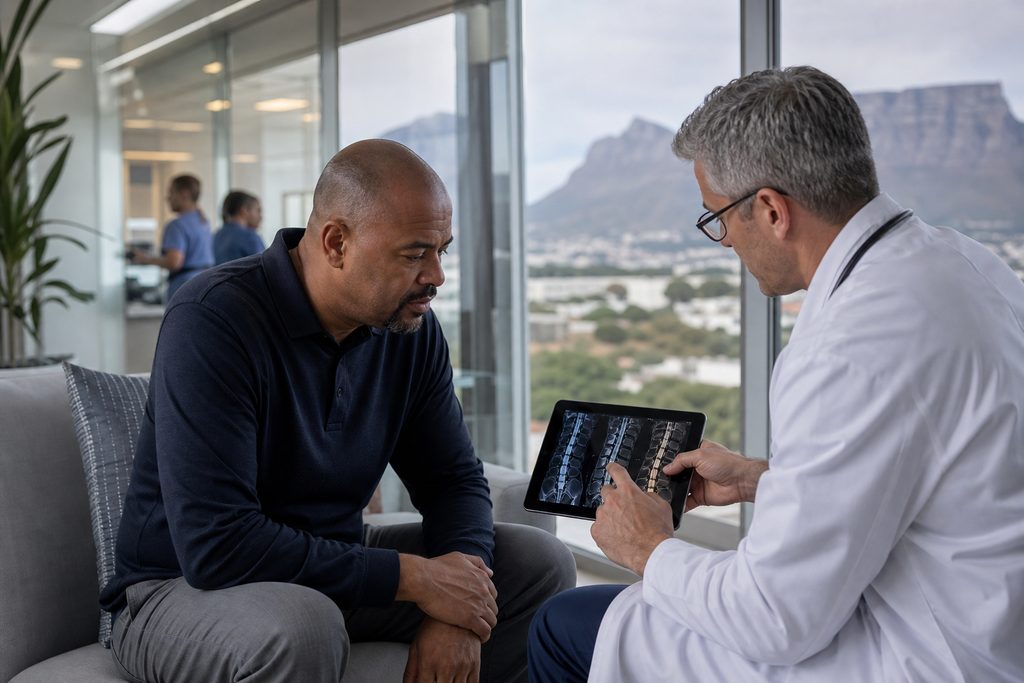
When 42-year-old Michael first heard the diagnosis, he had no idea where to start looking for treatment. A structural engineer from Johannesburg, he had been living with worsening back pain for three years. The MRI told a story his body already knew: severe degenerative scoliosis with spinal stenosis at multiple levels. His local orthopedic surgeon in Sandton was honest. The correction required a staged anterior-posterior fusion from T10 to pelvis. The surgeon had done the procedure before. But not often. And the waiting list for the one public hospital theater equipped for it stretched past fourteen months. Michael had medical aid, but the out-of-pocket gap for a private multi-level fusion would still approach R400,000. He started typing into Google: spine surgery cost China vs South Africa.
That search leads to a different set of questions than a standard discectomy or single-level fusion. Complex spinal deformity correction in adults is not routine surgery. It demands high surgical volume, specialized neuromonitoring teams, and a hospital system that does not flinch when a single case runs eight hours. For patients in South Africa facing a long wait or a procedure their local team rarely performs, looking beyond national borders becomes a rational medical decision. China has entered that conversation for a growing number of patients. Not because it is cheap. Because it handles high volumes of exactly these cases.
How This Actually Works, Step by Step
The pathway from a search query to a completed surgery abroad follows a sequence most patients underestimate. Here is the real order.
You send your existing imaging and reports. Not summaries. The actual DICOM files from the MRI and CT, plus the radiology reports, any previous operative notes, and a current clinical summary from your treating physician. Our team translates these into clinical Chinese and submits them to the department heads at two or three hospitals with strong spine deformity programs. This is not a generic inquiry. It goes to the surgeon who would actually perform the procedure.
Within five to seven business days, you receive a written second opinion. This document addresses whether the Chinese team agrees with the diagnosis, what surgical approach they recommend, how many levels they would fuse, what instrumentation they would use, and what the expected hospital stay looks like. The cost for this written assessment runs from $300 to $500. It is for reference only — not a prescription. But it gives you something South Africa rarely provides: a second set of expert eyes without a twelve-month wait.
If the opinion confirms that surgery is indicated and you want to proceed, the next step is a video consultation. You speak directly with the surgical team. They review your images on screen. You can ask about their complication rates, their experience with your specific deformity pattern, and what recovery realistically looks like. This consultation costs $500 to $800 for a top-tier specialist.
Only after that conversation do you make a decision. If you choose to move forward, we coordinate the hospital admission, the visa support documentation, and the on-ground logistics. No one buys a spine surgery package sight unseen. The process is staged for a reason.
spine surgery cost China vs South Africa: What the Numbers Actually Say
Let’s address the search query directly. Patients type “spine surgery cost China vs South Africa” because they need a financial baseline before they invest emotional energy in the idea. Here is that baseline.
A complex multi-level spinal fusion with instrumentation in a South African private hospital typically ranges from R350,000 to R550,000, depending on the number of levels, the implant system used, and the length of ICU stay. At current exchange rates, that is roughly $18,500 to $29,000. Medical aid may cover a portion, but gap payments for high-end implants and extended hospital days often leave patients with substantial out-of-pocket costs. In the public sector, the wait can exceed a year for non-emergency deformity correction.
In China, the same procedure at a top-tier public hospital through the international VIP department runs between $22,000 and $38,000. That is not cheaper than the South African private rate. It sits in a comparable band, sometimes slightly higher. The difference is not price. It is access, volume, and wait time.
| Procedure Type | South Africa Private | China Top Public (VIP) | Wait Time SA | Wait Time China |
|---|---|---|---|---|
| Single-level fusion | $12,000–$18,000 | $10,000–$16,000 | 4–8 weeks | 2–4 weeks |
| Multi-level fusion (3–5 levels) | $20,000–$29,000 | $22,000–$30,000 | 8–16 weeks | 3–5 weeks |
| Complex deformity correction (6+ levels) | $25,000–$35,000+ | $28,000–$38,000 | 12–52+ weeks | 4–6 weeks |
| Scoliosis revision surgery | $30,000–$45,000 | $32,000–$42,000 | Limited local expertise | 3–5 weeks |
These figures are surgical package estimates and vary by hospital and case complexity. They include the surgeon fee, anesthesia, implants, operating theater, and standard ward stay. They do not include international patient coordination, which runs from $5,000 to $8,000 for a VIP end-to-end service, or travel and accommodation. The full picture matters.
What the table does not show is surgical volume. A spine surgeon at a major Chinese orthopedic center may perform over 200 complex deformity corrections annually. The entire adult deformity caseload in South Africa’s public and private sectors combined is a fraction of that. When a surgery is technically demanding and infrequently performed locally, volume becomes a safety variable.
best spine hospital China for foreign patients: Where Complex Deformity Gets Done
The phrase “best spine hospital China for foreign patients” hides an important distinction. The best hospital for a foreign patient is not necessarily the one with the highest domestic ranking. It is the one that combines surgical expertise with an international patient pathway that works.
Peking University Third Hospital in Beijing runs one of the highest-volume spine surgery departments in the world. Its orthopedic division handles spinal deformity, degenerative disease, and trauma at a scale few centers match. The hospital has a dedicated international patient office, English-capable coordination staff, and experience managing the specific needs of patients arriving from abroad.
Shanghai Changzheng Hospital, affiliated with the Second Military Medical University, is another heavyweight. Its spine center performs over 10,000 surgical procedures annually. For complex deformity correction — particularly revision cases where a previous surgery failed — Changzheng is a referral destination even for domestic Chinese patients who have been turned away elsewhere.
West China Hospital in Chengdu operates a spine surgery department that is integrated with one of China’s largest rehabilitation medicine programs. For patients who will need extended post-operative rehabilitation, this integration matters. The hospital’s international medical center handles the logistics for foreign patients.
These are not the only options. Our hospital database covers 340+ top-ranked hospitals across 37 cities, including spine programs in Guangzhou, Xi’an, and Nanjing. The right match depends on the specific deformity, the patient’s age and comorbidities, and the surgical approach recommended.
What unites these centers is that they see complex spines every day. A T10-to-pelvis fusion with osteotomies is not a rare event. It is Tuesday.
A Realistic Timeline
Patients often underestimate how long the full arc of treatment takes. Here is a realistic sequence, from the moment you decide to explore the option.
| Stage | What Happens | Duration |
|---|---|---|
| Week 1–2 | Collect and send DICOM imaging, reports, clinical summary. Our team translates and submits to target hospitals. | 5–10 business days for hospital review |
| Week 3 | Receive written second opinion. Review findings. Decide whether to proceed to video consultation. | 3–5 days for patient decision |
| Week 4 | Video consultation with surgical team. Discuss approach, risks, recovery timeline. Confirm intent to proceed. | 1–2 hours for the call; scheduling takes 3–7 days |
| Week 5–6 | Hospital issues invitation letter for visa. Apply for S2 visa at Chinese embassy or consulate in South Africa. Processing time varies; budget 5–10 business days. | 2–3 weeks total for documentation and visa |
| Week 7–8 | Arrive in China. Pre-operative assessment: repeat imaging, cardiac clearance, anesthesia consult. Surgery scheduled. | 3–5 days pre-op workup |
| Week 8–9 | Surgery. Hospital stay typically 7–14 days for complex multi-level fusion. | 1–2 weeks inpatient |
| Month 2–3 | Early recovery in China or return home. If staying, rehabilitation begins. First follow-up imaging at 6–8 weeks. | 6–12 weeks before cleared for long-haul flight home |
| Month 3–12 | Continued recovery at home. Fusion consolidation takes 6–12 months. Remote follow-up with surgical team via imaging. | Ongoing |
The step most people forget is the gap between arriving in China and actually having surgery. You do not land on Monday and get operated on Tuesday. The hospital needs current imaging, lab work, and specialist clearances. This is not bureaucracy. It is safety. A patient flying in from Johannesburg after a long-haul flight needs a pulmonary and cardiac assessment before a ten-hour prone surgery. That pre-operative window also gives the surgical team time to finalize the implant plan based on fresh imaging, not scans taken months earlier.
is complex spine surgery safe in China: The Honest Answer
The question “is complex spine surgery safe in China” deserves a direct answer. Yes. At the centers that handle high volumes of these cases, safety outcomes are comparable to major spine centers in North America and Europe. But that answer comes with qualifiers.
Safety is not a property of a country. It is a property of a specific hospital, a specific surgical team, and a specific patient match. A hospital that excels at single-level lumbar fusions may not be the right place for an adult scoliosis correction requiring multiple osteotomies. The question patients should ask is narrower: is this specific team safe for my specific case?
The data that exists is encouraging but incomplete. Chinese spine centers publish extensively in international journals. Peking University Third Hospital, for example, reports infection rates for instrumented spinal fusion below 1.5%, which aligns with benchmarks from the Scoliosis Research Society. Neuromonitoring — the real-time tracking of spinal cord function during surgery — is standard at major centers. Intraoperative CT and navigation systems are widely available.
But there are things international patients should know. Informed consent processes differ from what South African patients may expect. The conversation about risks tends to be more direct and less legally scaffolded than in Western systems. You will not receive a twenty-page consent document. You will have a conversation with the surgeon. That conversation is the consent. If you need detailed written risk breakdowns, ask for them during the video consultation.
Post-operative pain management also differs. Chinese hospitals use fewer opioids than South African or Western centers. The default is multimodal analgesia with NSAIDs, acetaminophen, and regional blocks where applicable. For patients accustomed to stronger post-surgical pain control, this warrants a frank discussion with the anesthesia team before surgery.
Infection control practices are rigorous in the international and VIP wards. These units are designed for patients who expect private rooms, Western-style bathrooms, and English-speaking nursing staff. The standard ward experience is different and not recommended for patients without Mandarin fluency.
how long to recover from spinal fusion surgery abroad: Planning the Return
Recovery from a complex multi-level fusion does not end when you leave the hospital. The question “how long to recover from spinal fusion surgery abroad” is really two questions: when can I fly home, and when will I feel normal?
For the flight home, the answer is typically six to eight weeks after surgery. Sitting upright in an economy seat for twelve hours from Beijing to Johannesburg two weeks post-op is not realistic and not safe. The risk of deep vein thrombosis is elevated after major spine surgery, and the position is painful. Patients who plan to return to South Africa should budget for a six-to-eight-week stay in China, or arrange a business-class seat with the ability to recline fully.
For feeling normal, the timeline is longer. Fusion consolidation — the actual biological healing of bone across the instrumented segments — takes six to twelve months. During that period, patients follow a graduated activity protocol. Walking begins the day after surgery. Sitting is limited to thirty-minute intervals for the first six weeks. No bending, lifting, or twisting. Driving is restricted for six to eight weeks, longer if the fusion extends into the cervical spine.
The advantage of recovering in China is access to the surgical team for early follow-up. If something feels wrong, you are not sending an email from Johannesburg and waiting three days for a reply. You are in the same city as the surgeon who operated on you. Some patients choose to spend the first three months in China, doing daily physiotherapy at the hospital’s rehabilitation department before returning home. Others leave as soon as they are cleared to fly and continue rehab locally.
The handoff to a South African physiotherapist and orthopedic surgeon is critical. Before you leave China, the surgical team provides a detailed rehabilitation protocol, post-operative imaging, and a summary letter for your local doctor. Remote follow-up continues with imaging sent at six months and one year.
Chinese hospitals for complex spinal deformity correction: How to Evaluate a Center
When you search for “Chinese hospitals for complex spinal deformity correction,” you will find a list of names. But how do you evaluate which one is right for you?
Start with case volume. Ask directly during the video consultation: how many adult deformity corrections of this type did your team perform last year? A credible answer is a specific number. If the surgeon says “many” without quantifying, ask again. High-volume centers track their numbers.
Look at the implant systems they use. Major Chinese spine centers work with the same instrumentation companies that supply South African private hospitals — Medtronic, DePuy Synthes, NuVasive, Stryker. If a hospital uses a system your local surgeon recognizes, that is a good sign. It means the implants are globally standard, and your follow-up surgeon in South Africa will understand the construct.
Ask about the neuromonitoring team. Complex deformity surgery requires continuous SSEP and MEP monitoring throughout the case. The person running that monitor should be a dedicated neurophysiologist, not a rotating resident. Ask who sits at the neuromonitoring console and what their training is.
Inquire about the postoperative pathway. How many days in ICU? What is the typical length of ward stay? What physiotherapy starts on day one? A center that has a standardized enhanced recovery protocol is safer than one that improvises case by case.
Finally, ask about revision policy. If something goes wrong — a deep infection, a misplaced screw, a pseudarthrosis — what happens? The best centers have a clear answer: they manage their own complications, and they do not charge a second surgical fee for early revisions caused by technical issues. Get this answer in writing.
Practical Considerations: Visa, Money, and Follow-Up at Home
The S2 visa is the correct category for medical treatment in China. It is a short-stay visa issued for private affairs, including medical treatment. The hospital provides an invitation letter that you submit with your application at the Chinese embassy or consulate in South Africa. Processing typically takes five to ten business days. Do not book flights until the visa is in your passport.
Your accompanying family member also applies for an S2 visa. The invitation letter should name them as an accompanying person. This is straightforward but requires planning. The visa is not issued on arrival.
Payment works on a pre-deposit system. The hospital estimates the total cost of surgery and admission, and you deposit that amount before admission. Any unused funds are refunded at discharge. International bank transfers take three to five business days, so initiate the transfer well before your admission date. Credit card payments are accepted at some international departments but may carry a processing fee.
South African medical aid schemes generally do not have direct billing arrangements with Chinese hospitals. You pay upfront and claim reimbursement. Before committing, contact your scheme and ask specifically about coverage for planned surgery abroad. Some schemes cover a portion if the procedure is not available within a reasonable timeframe locally. Get pre-authorization in writing.
Language is the practical bottleneck. The international patient coordinator handles the interface with the hospital, but you need someone with you on the ward who speaks Mandarin. Nursing staff in VIP wards often have basic English, but the nuance of postoperative instructions, pain management discussions, and discharge planning requires a bilingual medical companion. Our bilingual medical companion service runs from $200 per day and covers translation, navigation, and coordination throughout the hospital stay.
Follow-up in South Africa requires a local orthopedic surgeon willing to take over care. Identify this person before you leave. Send them the surgical plan and implant details. Not every surgeon is comfortable managing a complex multi-level fusion
Frequently Asked Questions
Yes. The hospitals used for international patients are JCI-accredited and follow the same international safety standards as top hospitals in the US and Europe. Surgical teams perform high volumes of procedures — often more than their Western counterparts — which studies show leads to better outcomes.
Costs vary by procedure and hospital, but international patients typically save 40-80% compared to US prices — even when factoring in travel and accommodation. A consultation with our team will give you an exact, all-inclusive quote with no hidden fees.
Send us your existing medical reports to get started. We handle everything from hospital selection and appointment scheduling to visa assistance and post-operative recovery planning. Your medical records are reviewed by the specialist before you even book a flight.
For more medical information and treatment options in China, visit chinamedservices.com (China Medical Services).
