Spine Surgery Worth It in China: Our Service Reviews Your Case
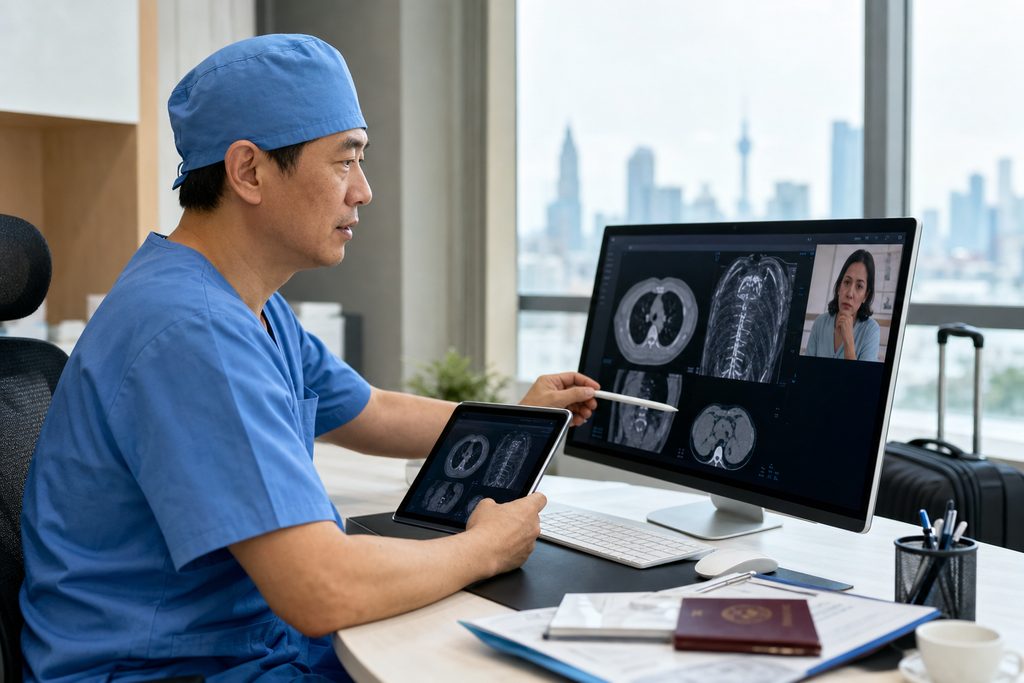
You’ve probably heard that surgery in China means compromising on quality. The reality is exactly the opposite for spine procedures at top-tier institutions. The numbers tell a stark story: a single-level lumbar fusion that runs $80,000–$150,000 in the United States typically costs $15,000–$30,000 at a Fudan-ranked Chinese hospital. That’s the spine surgery cost China equation in one breath. But cost alone doesn’t answer whether it’s worth it for you. Safety, surgeon volume, recovery logistics, and whether your specific case fits the model matter just as much. Our team reviews each inquiry against these factors before anyone books a flight.
Spine Surgery in China: The Short Answer
For the right patient, yes — spine surgery in China can be worth it. You’re looking at savings of 70–80% versus US list prices, access to orthopedic departments performing thousands of spine procedures annually, and hospital infrastructure that rivals anything in North America or Europe. But the honest caveat: China’s public hospital system does not let overseas patients book surgery remotely. You must attend an in-person consultation first. That means a two-trip model for most people — one for evaluation, one for the procedure — unless you use a hospital’s international VIP channel, which can compress this into a single stay at roughly 1.5–2x the standard rate.
Who This Is Right For — and Who It Isn’t
We review every case individually, and some patterns emerge quickly. Here’s who typically fits the China spine surgery model well.
- Patients with degenerative conditions — herniated discs, spinal stenosis, spondylolisthesis — where the surgical technique is well standardized globally.
- People who need multi-level fusions or complex reconstructions that carry six-figure US price tags.
- Patients with clear MRI/CT imaging already in hand, so the Chinese surgical team can give a preliminary assessment remotely.
- Those with a family member or companion able to travel, since recovery support matters.
- Patients who can commit to a 3–6 week stay for surgery plus initial rehabilitation.
Who should not pursue this route. Patients with unstable acute trauma requiring immediate intervention — you should not board a long-haul flight. Anyone with complex revision surgery after multiple failed operations where the original hardware and surgical notes are incomplete. Patients whose primary concern is a rare congenital deformity requiring highly individualized planning. And people who cannot tolerate the reality of navigating a foreign healthcare system, even with a bilingual companion. If communication friction will cause you more stress than the savings justify, staying closer to home is the right call.
The Options, Compared
Spine surgery abroad isn’t a binary choice between your home country and China. Here’s how the genuine alternatives stack up for a single-level lumbar fusion, the most common procedure international patients inquire about.
| Option | Typical Cost (USD) | Wait Time for Surgery | Surgeon Volume | Key Trade-off |
|---|---|---|---|---|
| United States | $80,000–$150,000 | 2–8 weeks | Moderate | Highest cost; insurance complexity |
| Germany | $35,000–$60,000 | 3–6 weeks | Moderate | Strong quality, still expensive |
| Turkey | $18,000–$28,000 | 1–3 weeks | High | Good value; fewer academic centers |
| India | $10,000–$18,000 | 1–2 weeks | High | Lowest cost; variable infrastructure |
| China (Top Public) | $15,000–$30,000 | 2–6 weeks after in-person consult | Very high | Two-trip model; language barrier |
| China (International VIP) | $25,000–$50,000 | 1–3 weeks | Very high | Single-trip possible; higher price |
Turkey and India compete on price, but China’s advantage is volume combined with academic rigor. Hospitals like Peking Union Medical College Hospital and West China Hospital in Chengdu run orthopedic departments that handle spine cases daily at a scale few Western centers match. If your priority is the lowest possible price, India wins. If you want a top-ranked academic center with English-speaking international departments and a cost still far below US rates, China occupies a unique middle ground.
How Our Service Reviews Your Spine Case
This is where the title’s promise gets concrete. We don’t just hand you a hospital list. We review your imaging, your surgical history, your functional limitations, and your goals — then match you to a department where your specific pathology is routine, not exotic. A patient with a straightforward L4-L5 herniation and a patient with multilevel degenerative scoliosis need different hospitals, different surgeons, and different logistical plans. Our team includes bilingual coordinators who translate your records into Chinese medical terminology before they reach the specialist’s desk. That step alone prevents the most common failure point in cross-border spine care: a surgeon who can’t fully read your history and orders redundant diagnostics. We then arrange a written second opinion (from $300–$500) or a video consultation ($100–$300 for standard international departments, $500–$800 for top specialists) so you can hear the Chinese team’s assessment before you commit to travel.
Is Spine Surgery Safe in China? What the Data Shows
The short answer: at Fudan-ranked and JCI-accredited hospitals, yes — safety outcomes are comparable to Western benchmarks. The longer answer requires nuance. China’s top 100 hospitals represent the top 5% of the country’s 35,000+ institutions, and that concentration matters. A hospital like Fuwai Hospital performs over 14,000 cardiac surgeries annually — the spine equivalents in orthopedics at major centers run similarly high volumes. High-volume spine surgeons have lower complication rates. That’s not marketing language; it’s the volume-outcome relationship documented across surgical literature for decades. But safety is hospital-specific, not country-specific. A patient who chooses a mid-tier Chinese hospital without international accreditation is making a different bet than one who chooses a Fudan Top 100 institution. Our reviews steer toward the latter exclusively. We also recommend checking whether your target hospital holds JCI accreditation, which signals adherence to international patient-safety standards.
Spine Surgery Recovery Time China: What to Expect
Recovery timelines don’t compress just because you cross a time zone. For a single-level microdiscectomy, expect 1–2 nights in hospital, 2–4 weeks before flying home, and 6–12 weeks before returning to desk work. For a lumbar fusion, plan on 4–7 days inpatient, 4–6 weeks in China for initial rehab and follow-up imaging, and 3–6 months before full activity. Chinese hospitals increasingly offer integrated rehabilitation — physiotherapy, acupuncture, and TCM-adjacent recovery protocols — that many Western patients find accelerates their return to function. Our TCM hospital partners provide post-surgical rehab programs that blend conventional physio with acupuncture and tuina massage. But the critical planning factor is your flight home. Long-haul sitting after spine surgery is genuinely risky for the first 2–3 weeks. You should budget for a hotel or serviced apartment near the hospital, not a quick turnaround.
How Much Does Back Surgery Cost Abroad? A Line-by-Line Breakdown
The headline number is only part of the picture. Here’s what a typical single-level fusion at a top Chinese public hospital actually includes, based on cases we’ve coordinated.
- Pre-operative workup (MRI, CT, X-ray, blood panels, ECG): $800–$1,500
- Surgeon and anesthesia fees: $3,000–$6,000
- Implant hardware (cage, screws, rods — brand-dependent): $6,000–$15,000
- Hospital stay (5–7 days, ward bed): $2,000–$4,000
- Operating room and consumables: $3,000–$5,000
- Post-operative medications and basic rehab: $500–$1,500
Total: roughly $15,000–$30,000. The variance comes from implant choice (imported brands cost more), hospital tier, and whether you use the standard public channel or the international VIP department. The same procedure in the US breaks down differently — the implant itself might cost $15,000–$40,000, the OR time $20,000+, and the hospital stay $5,000–$10,000 per night. That’s why the gap persists even after you add flights, accommodation, and our coordination fees. One thing to understand clearly: Chinese public hospitals require prepayment. You settle the estimate before admission, and insurance reimbursement happens after you return home. Private international hospitals like United Family or Jiahui offer direct insurance billing, but their spine surgery prices run closer to $40,000–$70,000 — still below US rates, but not the dramatic bargain of the public tier.
Practical Considerations: Records, Visas, and Follow-Up
Your medical records are the foundation of everything. Chinese spine surgeons expect complete imaging — not just the radiology report, but the actual DICOM files on CD or USB. Bring every prior surgical note, especially if this is a revision case. We translate and organize these before your consultation. Gaps here cause delays or outright rejections.
Visas are straightforward but specific. You’ll apply for an S2 visa, which covers short-term private affairs including medical treatment. Your accompanying family member applies for the same category. The hospital’s international department issues an invitation letter and treatment confirmation that supports the application. If your recovery extends beyond 180 days, you’d need the S1 category. We provide document checklists and liaise with the hospital to ensure the paperwork matches current consulate requirements. Approval is never guaranteed — we prepare applications carefully, but the decision rests with the consulate.
Payment methods: Chinese public hospitals accept major credit cards at international departments, but large deposits often clear faster via wire transfer. We help you structure this. Language: even at top hospitals, ward nurses and junior staff may speak limited English. That’s precisely why a bilingual medical companion (from $300/day) changes the experience — handling registration, queueing, payment, translation during rounds, and discharge instructions. Follow-up after returning home happens via video consultation with the same surgical team. Most surgeons expect a 3-month and 12-month check-in, with new imaging sent electronically.
Frequently Asked Questions
At Fudan-ranked and JCI-accredited hospitals, complication rates for standard spine procedures are comparable to Western benchmarks. The key variable is hospital selection, not country. A top-tier Chinese orthopedic department performs high volumes of spine surgery annually, and volume correlates with better outcomes. Choosing a mid-tier hospital without international accreditation is where risk rises. We only coordinate with hospitals in the top tier.
For a single-level lumbar fusion, China runs $15,000–$30,000 at top public hospitals, $25,000–$50,000 through international VIP channels. Turkey and India are cheaper at the low end. Germany and the US are significantly more expensive. Your total cost includes flights, 3–6 weeks of accommodation, and coordination or companion fees — typically adding $5,000–$10,000 to the surgical price. The savings versus US list prices remain substantial even after those additions.
No. Chinese public hospitals do not allow remote surgical booking. The standard pathway requires an in-person consultation first, then a scheduled surgery date. The international VIP channel can sometimes compress this into one trip, but even then, the surgeon must see you before the operation. Any service claiming to guarantee a surgery date before you’ve been examined is not operating within the rules of China’s public hospital system. Our coordination service (from $300) handles registration and appointment logistics, with a full refund if the appointment we arrange falls through.
Chinese hospitals carry medical liability insurance, and international departments have protocols for managing complications. But the practical reality is that post-operative complications are harder to manage from another continent. That’s why we recommend staying in China for the full initial recovery window — 4–6 weeks for fusions — rather than flying home at the earliest possible moment. If a complication arises after you return home, your local orthopedic surgeon can usually manage it, but communication with the Chinese surgical team via video consultation is essential. We facilitate those follow-ups. This is not a risk-free path, and we tell every patient that plainly.
For a microdiscectomy, 2–4 weeks. For a single-level fusion, 4–6 weeks. For multi-level or revision surgery, 6–8 weeks or longer. The limiting factor is not the hospital’s discharge criteria — it’s the risk of prolonged sitting on a long-haul flight. Deep vein thrombosis and hardware strain are real concerns in the first weeks after spine surgery. Your surgeon will clear you for travel based on imaging and clinical progress, not a calendar date.
Your Next Step
Spine surgery in China is not a universal yes and not a universal no. It’s a calculation that depends on your specific pathology, your imaging, your budget, and your tolerance for navigating a foreign system. We are not a hospital and we do not diagnose or treat. What we do is review your case honestly, connect you with the right department at a Fudan-ranked orthopedic center, and handle the coordination that makes the journey feasible. If you’re weighing whether the spine surgery cost China offers justifies the logistics, start with a conversation. Send us your imaging and a brief history, and our team will tell you whether this path makes sense for your case — before you spend a dollar on flights.
If you have existing MRI or CT scans and a clear diagnosis, the fastest way to get an honest assessment is to request a free consultation. We’ll review your case and tell you plainly whether China is the right move.
For more medical information and treatment options in China, visit chinamedservices.com (China Medical Services).
