Stress Test Cost China: What It Is, When You Need One, and 2026 Pricing
Stress Test Cost China: What a Cardiac Stress Test Reveals and Whether You Actually Need One
Key Takeaways
- A cardiac stress test in China costs between $150 and $600 at top-tier public hospitals, compared to $1,500–$4,000 in the United States.
- Fuwai Hospital in Beijing performs over 14,000 cardiac surgeries annually — the highest volume of any heart center worldwide — which translates to highly experienced interpretation of stress test results.
- You cannot book a stress test at a Chinese public hospital from overseas through regular outpatient channels; you need either an in-person visit or coordination through an international department.
- A stress test is not a universal pre-surgery requirement. It is indicated for specific risk profiles — and ordering one unnecessarily adds cost and delay without improving safety.
According to the American Heart Association’s 2024 Heart Disease and Stroke Statistics update, approximately 127.9 million US adults — nearly half the adult population — live with some form of cardiovascular disease. For many of them, the first question after a chest pain episode or an abnormal ECG is whether they need a stress test. And if you are considering medical travel, the stress test cost China offers becomes a relevant data point. A standard exercise treadmill test at a Beijing or Shanghai tertiary hospital typically runs $150–$350, while a full nuclear stress test with imaging lands between $400 and $600. That is a fraction of what the same procedure costs in the US, UK, or Australia.
But cost is only one piece of the decision. The real question — the one your cardiologist will ask before anything else — is whether a stress test is even the right test for you. This article walks through what a cardiac stress test actually measures, when it is genuinely indicated, when it is not, and what to expect if you book one in China.
The Problem: Cardiac Testing Is Expensive, Confusing, and Often Over-Ordered
Let’s start with the numbers that shape the status quo. A 2023 analysis published in the Journal of the American College of Cardiology found that up to 30% of stress tests ordered in US outpatient settings were classified as “rarely appropriate” under current guidelines. That means millions of patients each year undergo a test that exposes them to radiation, costs them money, and produces results that do not change their clinical management.
Meanwhile, the price tag keeps climbing. The Healthcare Bluebook lists the fair price for a nuclear stress test in the US at $1,650–$2,800, with hospital-based facilities charging as much as $4,000. An echocardiogram stress test — the kind that uses ultrasound instead of radioactive tracers — still averages $1,200–$2,500. For a patient with a high-deductible insurance plan, that is an out-of-pocket hit that often delays the test entirely. Delayed testing means delayed diagnosis. And delayed diagnosis of coronary artery disease is how a treatable condition becomes a cardiac event.
This is not just an American problem. In the UK, NHS waiting times for non-urgent cardiac diagnostic tests reached a median of 9.4 weeks in early 2025, according to NHS England’s diagnostic waiting times data. In Canada, the Fraser Institute reported a median wait of 11.2 weeks between referral and cardiology consultation in 2024. Patients who cannot wait, or who want answers before making a surgery decision, are increasingly looking across borders.
What Is a Cardiac Stress Test and Why It Matters
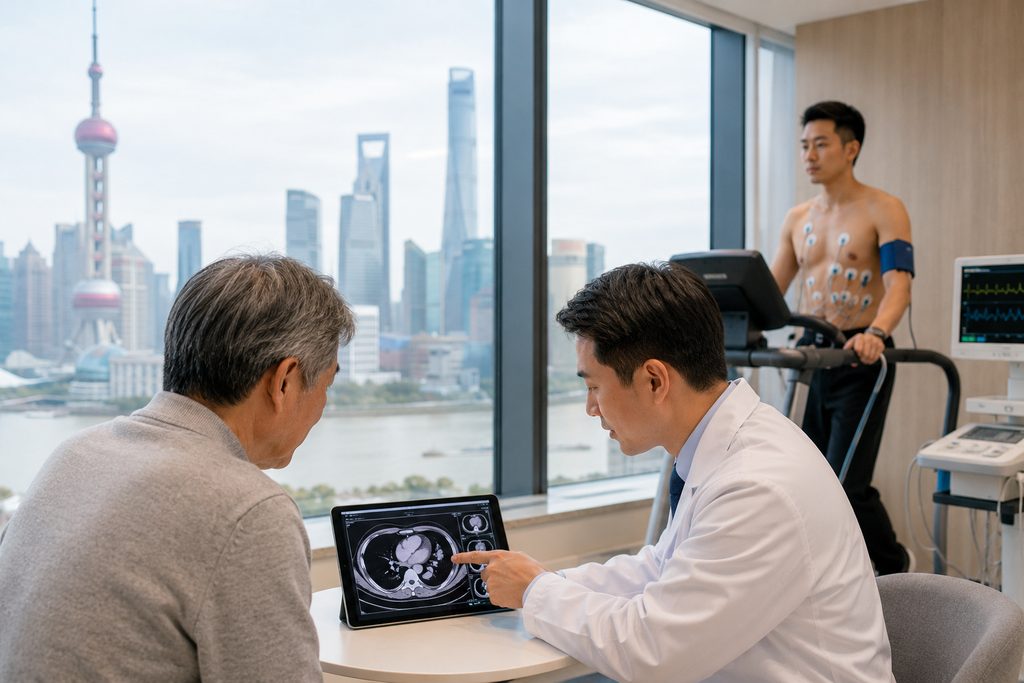
A cardiac stress test measures how your heart responds to physical exertion. The principle is simple: coronary artery blockages may not show up at rest, but they become visible when the heart demands more oxygen. You walk on a treadmill or pedal a stationary bike while your ECG, blood pressure, and heart rate are monitored. The workload increases every 2–3 minutes. If a blockage is significant enough, the ECG will show characteristic changes, or you will develop symptoms — chest tightness, shortness of breath, or excessive fatigue.
There are three main types. The standard exercise treadmill test uses ECG only. The stress echocardiogram adds ultrasound imaging before and immediately after exercise to visualize how well the heart muscle contracts. The nuclear stress test — also called myocardial perfusion imaging — injects a small amount of radioactive tracer to map blood flow to the heart muscle at rest and under stress. Each has different sensitivity and specificity profiles, and each has a different cost.
What the Numbers Actually Tell You
A normal stress test is reassuring but not a guarantee. The sensitivity of a standard exercise ECG for detecting significant coronary artery disease is approximately 68%, according to a meta-analysis published in the American Heart Journal. That means roughly one in three significant blockages is missed. The nuclear stress test performs better, with sensitivity around 87–90%, but it costs more and involves radiation exposure equivalent to about 600 chest X-rays.
So the test has real limitations. It is a screening tool, not a definitive diagnostic. A positive result typically leads to further imaging — a CT coronary angiogram or an invasive angiogram. A negative result in a high-risk patient does not close the case. This is why the decision to test should be made carefully, not reflexively.
Why China Delivers Results for Cardiac Diagnostics
Clinical Volume Drives Better Interpretation
Interpreting a stress test is a skill. The more tests a cardiologist reads, the better they get at distinguishing true positives from false ones. This is where Chinese cardiac centers have a structural advantage. Fuwai Hospital in Beijing — officially the National Center for Cardiovascular Diseases — performs over 14,000 cardiac surgeries and tens of thousands of diagnostic procedures every year. That volume exceeds any single heart center in the US or Europe. The cardiologists reading your stress test at Fuwai have likely seen more abnormal ECGs in a month than a typical Western cardiologist sees in a year.
Volume matters for a second reason: protocol consistency. High-volume centers have standardized stress testing protocols that reduce variability. The treadmill protocol, the imaging timing, the interpretation criteria — all are tightly controlled. That consistency is what makes a result from a top Chinese hospital comparable to one from a leading US academic center.
Technology and Efficiency at Scale
Top-tier Chinese hospitals operate on a scale that is hard to grasp until you see it. Peking Union Medical College Hospital sees over 10,000 outpatient visits per day. That scale funds investment in diagnostic equipment that would be financially unsustainable for smaller Western hospitals. The cardiac imaging departments at Fuwai and Zhongshan Hospital in Shanghai run multiple nuclear cameras, advanced CT scanners, and dedicated stress echocardiography suites simultaneously.
But there is a catch, and you should hear it clearly: that scale also means crowds. A public hospital stress test in China is not a boutique experience. You will navigate large buildings, long corridors, and queues. Without Chinese language ability, the logistics are genuinely difficult. This is the honest trade-off: world-class clinical expertise at a fraction of Western prices, in exchange for a system that was not designed with foreign patients in mind.
Cost Advantage Without Quality Compromise
The stress test cost China offers is structurally lower for reasons that have nothing to do with quality. Chinese physician salaries are lower than Western counterparts, but that does not translate to lower skill — the top cardiac centers recruit from the country’s most competitive residency programs. Hospital overhead is lower. Equipment costs are amortized across vastly higher patient volumes. The result: a nuclear stress test at a top-tier Chinese hospital costs $400–$600, while the same test at a US hospital costs $1,650–$2,800.
That is a 70–80% reduction. And the clinical interpretation quality at the top centers is comparable to what you would get at a leading Western academic hospital. The key phrase is “top centers.” The quality range across Chinese hospitals is wide. Choosing a hospital from the Fudan ranking matters enormously.
Do I Need a Stress Test Before Surgery? The Real Indications
This is the question that drives most of the searches for stress test packages. Patients scheduled for major surgery — joint replacement, abdominal surgery, cancer resection — are often told they need “cardiac clearance.” Does that mean a stress test? Not automatically.
The American College of Cardiology and American Heart Association guidelines are clear on this. For patients undergoing low-risk surgery — and most outpatient procedures fall into this category — routine stress testing is not recommended, even in patients with stable coronary artery disease. The test adds cost, delay, and sometimes unnecessary downstream procedures without improving perioperative outcomes. A 2022 study in the New England Journal of Medicine randomized patients with stable ischemic heart disease undergoing major noncardiac surgery to stress testing versus no stress testing. The result: no difference in 30-day mortality or myocardial infarction rates.
So when is a stress test before surgery actually indicated? The guidelines point to three scenarios. First, if you have new or worsening cardiac symptoms — chest pain, unexplained shortness of breath, significant fatigue with exertion. Second, if you have poor functional capacity, meaning you cannot climb two flights of stairs without stopping. Third, if you have multiple cardiac risk factors and are undergoing high-risk surgery such as vascular or major thoracic procedures.
If none of these apply, a stress test is probably not necessary — and a good cardiologist will tell you that. The problem is that some pre-operative clearance processes default to ordering tests rather than doing a careful clinical assessment. That is how patients end up paying for tests they did not need. Before you book a stress test package, ask your doctor one question: “Will the result of this test change what we do next?” If the answer is no, the test is not indicated.
Heart Stress Test Price Shanghai and Beijing: A Real Cost Comparison
Prices vary by hospital tier, test type, and whether you access the international department or the standard public channel. The table below reflects 2026 price ranges for international patients at top-ranked cardiac centers in Beijing and Shanghai. These are self-pay prices, not insurance-adjusted rates.
| Test Type | Beijing (Fuwai / PUMCH) | Shanghai (Zhongshan / Ruijin) | United States (Average) |
|---|---|---|---|
| Exercise Treadmill Test (ECG only) | $150–$250 | $130–$220 | $800–$1,500 |
| Stress Echocardiogram | $250–$400 | $220–$380 | $1,200–$2,500 |
| Nuclear Stress Test (Myocardial Perfusion) | $400–$600 | $380–$550 | $1,650–$2,800 |
| Cardiology Consultation (International Dept.) | $100–$250 | $90–$200 | $250–$500 |
These figures are self-pay prices at top-ranked public hospital international departments. Private international hospitals in China — such as United Family or Jiahui — charge more, typically $600–$1,200 for a stress test, but offer English-speaking staff throughout and direct insurance billing. The choice depends on your priorities: the lowest price with excellent clinical quality, or a smoother experience with higher cost.
Note that the international department price is typically 1.5–2 times the standard public channel price. The standard channel is cheaper but requires Chinese language ability and in-person registration. The international department adds English coordination, shorter queues, and the ability to book in advance from overseas — which is not possible through the regular outpatient system.
How to Book a Stress Test Package in China: The Step-by-Step Reality
Here is what actually happens when an international patient tries to book a stress test at a top Chinese hospital. The process is not like booking a test at a private clinic in the West. Understanding the sequence saves time and frustration.
Step 1: Choose the hospital and test type. For cardiac diagnostics, the strongest options are Fuwai Hospital in Beijing (the national cardiac center) and Zhongshan Hospital in Shanghai (affiliated with Fudan University). Both appear in the Fudan specialty reputation rankings for cardiology and cardiac surgery. You can explore the full list of ranked cardiac departments on our specialty rankings page.
Step 2: Decide between the international department and the standard channel. The international department allows advance booking from overseas, provides English coordination, and charges 1.5–2 times the standard price. The standard channel requires you to register in person on the day of the appointment, queue for a number, and navigate the process in Chinese. For most international patients, the international department is the pragmatic choice.
Step 3: Prepare your medical records. Bring any previous ECGs, echocardiogram reports, cardiac catheterization results, and a list of current medications. If you have a referral letter from your home cardiologist, bring that too. Chinese cardiologists will want to see the full picture before ordering a stress test.
Step 4: Attend the consultation first. In China, you do not book a stress test directly. You book a cardiology consultation first. The cardiologist assesses your symptoms, risk factors, and history, then decides whether a stress test is indicated and which type. This is actually good clinical practice — it prevents unnecessary testing. But it means the process takes two visits: the consultation and then the test itself.
Step 5: Complete the test and receive results. A standard exercise stress test takes 30–45 minutes. A nuclear stress test takes 3–4 hours because of the waiting periods between tracer injection and imaging. Results are typically available the same day for the exercise test and within 24 hours for nuclear imaging. The written report will be in Chinese unless you request an English translation, which the international department can arrange.
Practical tip: If you are traveling to China specifically for cardiac evaluation, schedule at least 3–4 days in Beijing or Shanghai. Day 1 for the consultation, Day 2 for the stress test, Day 3 for results and follow-up discussion. This is not a test you can complete in a single afternoon.
Practical Considerations: Documents, Payment, and Follow-Up
If you decide to pursue a stress test in China, several logistics need attention before you board the plane. The visa is the first one. For medical evaluation and treatment, the applicable visa category is the S2 visa — a short-stay visa for private affairs, which includes medical treatment. Your family members accompanying you also apply for S2 visas. The hospital’s international department can provide a medical invitation letter and appointment confirmation to support your application. Processing times vary by country, so apply at least 4–6 weeks before your planned travel.
Payment is the second consideration. Chinese public hospitals require prepayment for diagnostic tests and consultations. Major international credit cards are accepted at international departments, but transaction limits and foreign card fees may apply — check with your bank before departure. Private international hospitals in China often accept direct insurance billing, which can simplify the process if your insurer has a network agreement. For public hospital international departments, you pay out of pocket and submit claims to your insurer afterward.
Language is the third practical hurdle. Even at international departments, not every staff member speaks fluent English. The cardiologist likely will, but the technician running the treadmill test may not. If you are navigating the standard public channel, assume zero English support. This is where a bilingual medical companion becomes genuinely valuable — not as a luxury, but as a practical necessity for anyone who does not speak Mandarin.
Follow-up after returning home is the fourth consideration. Bring your Chinese test results to your home cardiologist. The ECG tracings, echocardiogram images, and nuclear perfusion scans are all portable — request digital copies on a USB drive or DVD before you leave. Your home physician can review them and integrate the findings into your ongoing care. Chinese hospitals do not typically provide ongoing remote follow-up for international patients after you return home, so the handoff to your local doctor matters.
Frequently Asked Questions
No, a stress test is not painful. You will exercise on a treadmill or stationary bike while connected to ECG leads. The exercise is progressive — it starts easy and gets harder every few minutes. You can stop at any time. The risk of a serious complication during a medically supervised stress test is very low, approximately 1 in 10,000 for a heart attack or serious arrhythmia. The test is performed with a cardiologist or trained technician present and resuscitation equipment available.
A standard exercise ECG stress test detects significant coronary artery disease with approximately 68% sensitivity, meaning it misses roughly one in three significant blockages. A nuclear stress test is more accurate, with sensitivity around 87–90%. A normal stress test does not rule out heart disease completely, especially in patients with multiple risk factors. Your cardiologist will interpret the result in the context of your symptoms, risk profile, and other test findings.
What if my stress test result is abnormal?
An abnormal stress test does not automatically mean you need surgery or a stent. It means further evaluation is indicated. The next step is usually a CT coronary angiogram or an invasive coronary angiogram to visualize the arteries directly. Some patients with abnormal stress tests are managed with medication and lifestyle
For more medical information and treatment options in China, visit chinamedservices.com (China Medical Services).
