SYSU Cancer Center Guangzhou: Your Guide to International Patient Services
Key Takeaways
- Sun Yat-sen University Cancer Center performs over 18,000 cancer surgeries annually, placing it among the highest-volume oncology centers globally.
- The international patient service provides a structured pathway, with treatment costs typically ranging from one-fifth to one-tenth of comparable care in the United States.
- Independent navigation of the public hospital system without Mandarin fluency is extremely difficult; the international department operates on a distinct, pre-arranged model.
- An S2 visa is mandatory for medical treatment, and a confirmed hospital invitation letter is required before you can apply for it.
The Problem: When a Cancer Diagnosis Meets a Broken System
Waiting six weeks for an oncology appointment can feel like a lifetime when you have just received a difficult diagnosis. In the United Kingdom, the NHS constitutional standard mandates a 62-day wait from urgent GP referral to first cancer treatment, yet in 2023, nearly 40% of patients missed this target in certain trusts. In Canada, the median wait time from specialist assessment to treatment hovers around 27 days, but complex oncology cases frequently stretch far beyond that. The anxiety does not come from the disease alone. It comes from the silence between phone calls, the unreturned messages, and the calendar pages turning without a plan. Patients and families start searching for options that move faster, without sacrificing clinical quality. That search often leads to a specific question: can I access world-class cancer care in China, and what does the SYSU Cancer Center international patient price actually look like when you factor in everything?
This is not a theoretical exercise. Approximately 1 in 5 cancer patients globally now consider traveling across borders for treatment at some point during their journey. The motivations vary. Some face prohibitive costs at home. Others confront long queues for specific procedures like proton therapy or complex surgical resections. A growing number simply refuse to wait while a tumor progresses. Sun Yat-sen University Cancer Center in Guangzhou has emerged as a serious destination for these patients, particularly those from Southeast Asia, the Middle East, and increasingly, Western countries.
Who We Are
We are not a hospital. We do not provide medical treatment, clinical diagnoses, or second opinion reports ourselves. Our team functions as your logistical architects for accessing care in China. We maintain direct relationships with the international patient offices at more than 340 top-ranked hospitals across 37 cities, including the SYSU Cancer Center. When a patient contacts us, we translate medical records, coordinate directly with the hospital’s international department to confirm whether they can accept the case, arrange the official invitation letter required for your S2 visa, and deploy a bilingual medical companion to accompany you through every consultation, scan, and payment counter inside the hospital. We bridge the gap between your need and China’s medical expertise, handling the friction so you can focus on treatment. For a deeper understanding of how we match patients to the right facility, visit our hospital matching and coordination service.
Why SYSU Cancer Center Draws International Patients
Sun Yat-sen University Cancer Center is not simply another large hospital. It is one of the few standalone cancer centers in China with a research footprint that rivals major Western comprehensive cancer institutes. Founded in 1964, it now operates two campuses in Guangzhou with over 2,100 beds and runs more than 60 clinical departments dedicated exclusively to oncology. The center is consistently ranked among China’s top three cancer hospitals in the Fudan University Hospital Rankings, a peer-reviewed assessment that evaluates clinical reputation and research output across 45 specialties. For international patients trying to understand the SYSU Cancer Center international patient price and value equation, the starting point is understanding what this institution actually delivers compared to options at home.
Clinical Volume That Reshapes Surgical Expertise
Volume matters in cancer surgery. Studies published in The Lancet Oncology and JAMA Surgery have repeatedly demonstrated a strong inverse relationship between surgical volume and postoperative mortality for complex procedures like esophagectomy, pancreatectomy, and liver resection. SYSU Cancer Center surgeons performed over 18,000 cancer surgeries in 2023 alone. To put that in perspective, a high-volume academic medical center in the United States might perform 2,000 to 3,000 cancer surgeries annually across all specialties. The center’s thoracic surgery department completes more than 3,000 lung cancer resections per year. Its nasopharyngeal carcinoma (NPC) program is the largest in the world, treating over 7,000 new NPC patients annually—a disease where Chinese oncologists have literally written the global treatment guidelines. For a patient with a rare or complex tumor, being treated by a team that sees your specific cancer subtype dozens of times per week, rather than per year, changes the risk calculus entirely.
Technology Infrastructure Without the Wait
The center houses eight linear accelerators for radiation therapy, including two TomoTherapy units and a dedicated brachytherapy suite. Their proton therapy center, one of only a handful operating in mainland China, began treating patients in recent years and offers pencil-beam scanning technology comparable to the latest proton centers in the United States or Europe. The critical difference is access. In the UK, patients who meet the clinical criteria for proton therapy often wait months for a slot, and many are sent abroad to centers in Germany or Switzerland at significant public expense. At SYSU Cancer Center, the international department can typically confirm a proton therapy treatment slot within two to three weeks of accepting a case. The imaging infrastructure follows the same pattern. PET-CT scans, 3T MRI, and next-generation sequencing for tumor profiling are available on-site with turnaround times measured in days, not weeks. This is not because the technology is superior to Western equipment—it is the same Siemens, Varian, and GE machines found in top American hospitals. The difference is operational throughput and the absence of the scheduling gridlock that plagues many publicly funded systems.
Cost Structure: Why the SYSU Cancer Center International Patient Price Is Lower
Let us address the question that sits at the center of every international patient’s decision: what does treatment actually cost? The SYSU Cancer Center international patient price for common procedures reflects structural economic differences, not a compromise on clinical standards. A comprehensive cancer surgery with a two-week inpatient stay—say, a complex colorectal resection with lymph node dissection—typically ranges from $15,000 to $25,000 through the international department. The same procedure in the United States, before insurance negotiations, routinely exceeds $100,000 and can reach $150,000 at major academic centers. A course of intensity-modulated radiation therapy (IMRT) for head and neck cancer runs approximately $8,000 to $15,000 at SYSU Cancer Center, compared to $50,000 to $80,000 in the US. Chemotherapy protocols vary widely by drug regimen, but the cost of drug administration and monitoring is consistently 60 to 80 percent lower than American hospital outpatient rates.
These prices are not a sign of inferior care. They reflect China’s lower physician labor costs, the sheer scale of hospital operations that spreads fixed costs across vastly more patients, and a pharmaceutical pricing environment where many generic chemotherapies are manufactured domestically. The international department charges a premium over the standard public patient rate—typically 1.5 to 2 times higher—which funds English-language coordination, priority scheduling, and private or semi-private inpatient rooms. Even with this premium, the total cost lands far below Western private-pay rates. For patients paying out of pocket or facing high deductibles, the math is straightforward. A detailed breakdown of oncology treatment costs across different Chinese hospitals can be found on our oncology department comparison page.
How to Get Cancer Treatment at SYSU Cancer Center as an International Patient
The pathway to receiving care is structured and specific. It begins before you ever book a flight. The center’s International Medical Service Department reviews all overseas cases before confirming an appointment. You cannot simply walk in and register at the general outpatient window. The process requires a formal referral package that includes your complete medical records, pathology reports, imaging studies on CD or via secure cloud transfer, and a summary of all prior treatments including chemotherapy regimens, radiation doses, and surgical notes. Our team handles this preparation. We translate all documents into clinical Chinese, ensuring that terminology is precise—an error in translating a pathology report can delay a case by weeks or lead to an outright rejection. Once the department reviews the package and confirms they can accept the case, they issue an official hospital invitation letter. This document is non-negotiable for your visa application.
The visa step is where many independent patients stumble. Medical treatment in China requires an S2 visa with a notation specifying the medical purpose. You must present the hospital invitation letter, your passport, a completed visa application form, and proof of sufficient funds to cover your treatment and stay. The S2 visa typically allows a stay of up to 180 days. If your treatment plan extends beyond that, an S1 visa for long-term medical stays is required. Family members accompanying you apply under the same S2 category, not a tourist L visa. Processing times vary by consulate, but four to six weeks is a realistic window. Rushing this step leads to errors and rejections. We guide every patient through this process because an S2 rejection resets the entire timeline.
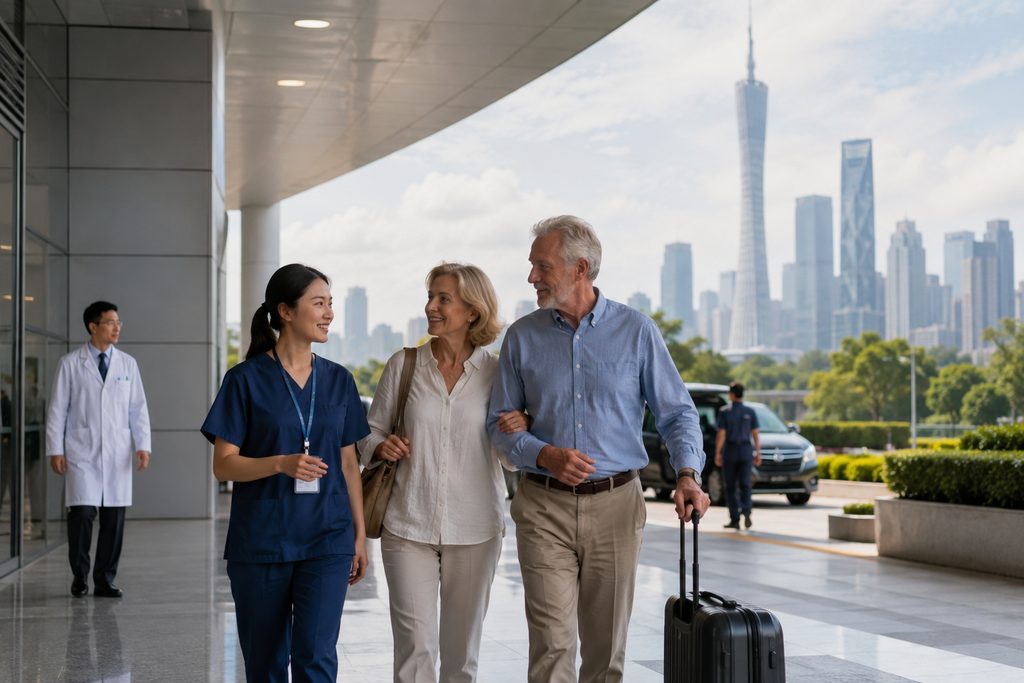
After the visa is secured, we coordinate your arrival. A bilingual medical companion meets you at Guangzhou Baiyun International Airport and accompanies you to your accommodation. The next morning, they walk with you into the international department, handle registration, navigate the payment of the initial deposit, and sit beside you during the first consultation with your attending oncologist. This companion stays with you for every subsequent appointment, scan, blood draw, and billing counter interaction. The value is not just translation. It is knowing which floor the PET-CT center is on, which window processes international insurance paperwork, and how to read a Chinese hospital bill line by line. For patients researching the best cancer hospital in Guangzhou for foreigners, the quality of this logistical support often determines whether the experience is manageable or overwhelming.
What You Need to Know Before Going Alone
Honesty about the barriers builds trust. Attempting to navigate SYSU Cancer Center independently as a non-Mandarin speaker is not merely difficult—it is genuinely disorienting. Here are the friction points that every international patient should understand before they decide to go it alone.
- Visa Requirements Are Strict and Sequential: The S2 medical visa depends entirely on the hospital invitation letter. You cannot apply for the visa first and then find a hospital. The hospital will not issue the letter until they have reviewed your complete medical records and confirmed they can accept your case. This creates a sequential dependency: records translation and submission first, hospital review second, invitation letter third, visa application fourth. Each step takes time, and none can be skipped or parallel-processed.
- Payment Systems Do Not Work Like Home: The international department requires an upfront deposit before treatment begins, typically calculated as an estimate of your entire treatment cost. This deposit is paid via wire transfer or in person with a credit card that works on Chinese payment networks. Not all international Visa or Mastercard transactions process smoothly at hospital counters. WeChat Pay and Alipay dominate local transactions, and linking a foreign card to these platforms is not always straightforward. Hospital bills are settled in Chinese yuan, and you receive official bilingual invoices for insurance reimbursement purposes.
- Medical Records and Pathology Require Physical Materials: Chinese oncology departments place heavy emphasis on original pathology slides for review. Your home hospital’s pathology report is not sufficient on its own. The center’s pathologists will want to re-examine your tissue blocks or unstained slides to confirm the diagnosis before initiating a major treatment plan. Shipping these materials internationally with proper documentation and customs clearance is a logistical task that can delay your case by weeks if mishandled.
How We Help You Navigate This
These barriers exist for structural reasons, not because the system is designed to exclude foreigners. The SYSU Cancer Center international department is genuinely welcoming to overseas patients, but it operates on the assumption that someone on the ground is handling the logistics. That is our role. When a patient contacts us, we start by collecting your medical records and having them professionally translated by our clinical team—not by a general translation service that does not understand the difference between adenocarcinoma and squamous cell carcinoma. We submit the package to the international department and track its progress through the review pipeline. When the invitation letter arrives, we courier it to you with clear, step-by-step visa application instructions specific to your nearest Chinese consulate.
During your treatment in Guangzhou, our bilingual medical companion is present for every interaction inside the hospital. They translate your oncologist’s explanation of treatment options in real time, ensuring you understand the rationale behind a recommended chemotherapy regimen or the risks of a proposed surgical approach. They sit with you during infusion sessions, help you schedule follow-up scans, and manage the administrative flow so you are never standing at the wrong counter with a stack of papers you cannot read. After you return home, we coordinate the secure transfer of your complete Chinese medical records—translated back into English—to your local oncologist for continuity of care. For patients who need ongoing monitoring, we can arrange periodic video consultations with your SYSU Cancer Center specialist through our telemedicine coordination service. The goal is not just to get you through treatment. It is to ensure that your local medical team has everything they need to manage your long-term follow-up. If you are still evaluating whether this center is right for you, our overview of Guangzhou’s top-ranked hospitals provides broader context on the city’s medical landscape.
Frequently Asked Questions
A standard course of IMRT radiation therapy through the international department generally ranges from $8,000 to $18,000, depending on the number of fractions and the complexity of the treatment plan. Proton therapy costs more, typically falling between $30,000 and $60,000 for a complete course. These are cash-pay estimates for international patients and include treatment planning, delivery, and weekly oncology reviews. The hospital will provide a formal quotation after reviewing your specific case.
No. The international department requires a complete medical records package before scheduling any appointment. This includes your pathology report, imaging studies, and a detailed treatment history. The department reviews these materials to determine whether your case falls within their clinical scope and capacity. Once accepted, they issue an invitation letter and schedule your first consultation. Our team manages this entire submission and scheduling process on your behalf.
The clinical quality is excellent—the center’s outcomes for nasopharyngeal, liver, lung, and colorectal cancers are comparable to top Western cancer institutes. But the patient experience without language support is extremely challenging. The international department has some English-speaking staff, but consultations, nursing interactions, and billing processes still occur primarily in Mandarin. A bilingual companion who understands both the language and the hospital’s internal workflows transforms the experience from overwhelming to manageable. The center itself is very good for international patients. Going there alone, without support, is not.
A realistic timeline is six to ten weeks. Medical records translation and preparation takes one to two weeks. Hospital case review typically takes one to two weeks. Visa processing after receiving the invitation letter takes four to six weeks at most consulates. Travel arrangements and treatment initiation add another week. Urgent cases can sometimes be expedited, but the visa timeline is largely outside anyone’s control. Planning for two months from first inquiry to first treatment is prudent.
This happens. Not every case is appropriate for treatment at SYSU Cancer Center. If your cancer is at a stage where curative-intent treatment is no longer feasible, or if your specific tumor type falls outside the center’s clinical strengths, they may decline the case. When this occurs, we immediately pivot to alternative hospitals in our network. China has multiple top-tier oncology centers, including those in Beijing and Shanghai, and we work to find a facility that can accept your case. If no suitable option exists, we are honest about that reality and do not charge a coordination fee for cases that cannot be placed.
Your Next Step
Choosing to pursue cancer treatment in a country thousands of miles from home is not a simple decision. It sits at the intersection of clinical urgency, financial calculation, and emotional resilience. What we have seen repeatedly is that patients who make this journey with proper logistical support focus their energy where it belongs—on treatment and recovery—while those who attempt it alone spend their energy fighting administrative battles they should never have to face. If you are considering SYSU Cancer Center, start by gathering your medical records. Then reach out to us. We will review your case, provide an honest assessment of whether this center is a strong fit for your diagnosis, and walk you through the process from beginning to end. The consultation is free, and you will come away with clarity about your options, regardless of whether you ultimately choose to travel.
For more medical information and treatment options in China, visit chinamedservices.com (China Medical Services).
