Tattoo Removal Clinics in China: Costs, Safety, and How to Book
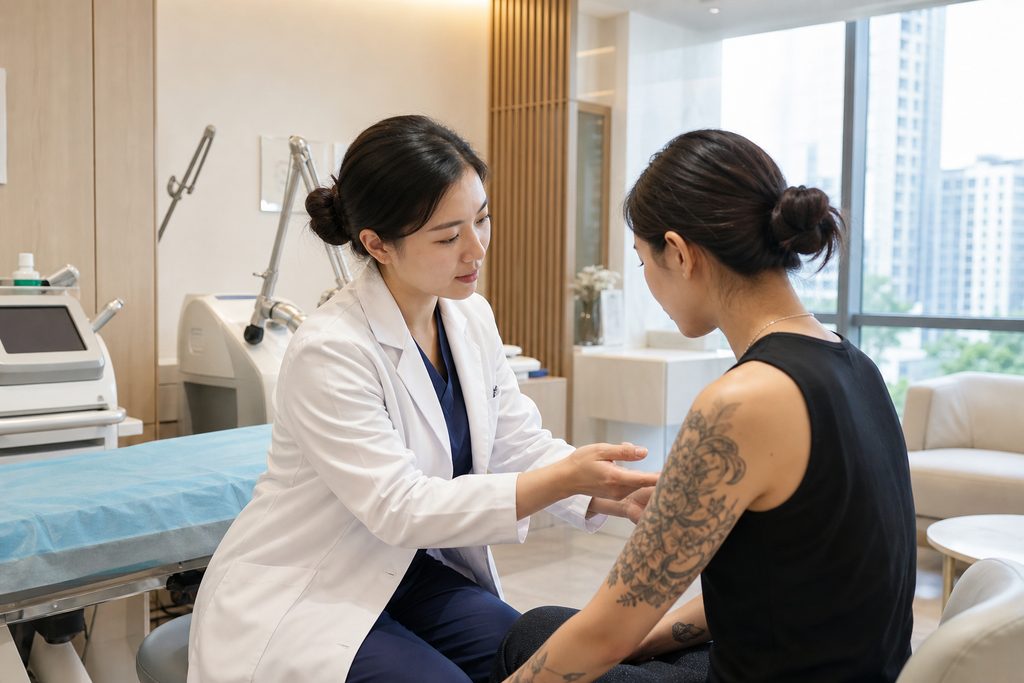
Tattoo Removal Clinics in China: What International Patients Need to Know
What if the ink you chose years ago now stands between you and a job, a wedding photo, or simply a version of yourself you’ve outgrown? For international patients, the practical question is rarely about regret. It’s about where to go, what it costs, and whether the result will be safe. The tattoo removal cost China clinics quote often surprises people — usually in a good way — but price alone shouldn’t drive the decision.
This guide walks through how laser removal actually works in China’s top hospitals, what you’ll pay, the real timeline, and the mistakes that lead to scarring or wasted money.
How This Actually Works, Step by Step
Most people assume they can fly in, get zapped, and fly home the same week. That’s not how reputable Chinese hospitals operate, and the ones that would let you do that are the ones you should avoid.
Here’s the real sequence, from first contact to final session:
- Step 1 — Send photos and history. You photograph the tattoo in natural light and share details: size in centimeters, ink colors, how old it is, whether it was professionally applied or done in a kitchen, and any prior removal attempts. You also disclose skin type, keloid history, and medications.
- Step 2 — Dermatology review. A dermatologist at the hospital assesses whether you’re a candidate. Some tattoos — certain greens, yellows, and white inks — respond poorly to lasers. Some patients with active keloid scarring shouldn’t proceed at all.
- Step 3 — Written plan and quote. You receive a proposed number of sessions, the laser type, and a cost estimate. This is where you learn whether you need 4 sessions or 12.
- Step 4 — Appointment scheduling. Public hospital dermatology departments generally require an in-person consultation before booking treatment sessions. International departments can often compress this into a single visit.
- Step 5 — Treatment sessions. Sessions run 6–10 weeks apart to let the immune system clear fragmented ink. You cannot rush this.
That last point matters more than anything else on this page. Laser tattoo removal works by breaking pigment into particles small enough for your body’s macrophages to carry away. Your immune system sets the pace. No clinic, anywhere, can safely accelerate it.
What Tattoo Removal Costs in China Versus the US and Europe
Here’s where China’s pricing becomes genuinely interesting. A single laser session at a top-tier Chinese public hospital typically runs $150 to $600, depending on tattoo size, location, and the laser platform used. The same session in the United States averages $200 to $500 for a small tattoo — but climbs past $1,000 for larger pieces, and you’re often paying per square inch.
| Factor | China (Top Public Hospital) | United States | Western Europe |
|---|---|---|---|
| Small tattoo (under 5 cm), per session | $150–$300 | $200–$500 | $180–$450 |
| Medium tattoo (5–15 cm), per session | $250–$450 | $400–$800 | $350–$700 |
| Large tattoo (15 cm+), per session | $400–$600 | $800–$1,500+ | $700–$1,200 |
| Typical session count | 5–12 | 5–12 | 5–12 |
| Consultation fee | $20–$60 | $50–$200 | Often included |
Total course costs land roughly 40–60% below US pricing for comparable laser platforms at major academic hospitals. Note the qualifier: comparable platforms. A Q-switched Nd:YAG or picosecond laser at a Fudan-ranked dermatology department is the same class of equipment you’d find in Seoul or Los Angeles.
Prices vary by hospital and case complexity. Multi-color tattoos, tattoos over joints, and cosmetic tattoos (eyebrows, lips) all carry different pricing structures.
A Realistic Timeline
Patients consistently underestimate this. Here’s what a genuine schedule looks like for a medium, multi-color tattoo requiring eight sessions.
| Stage | Timeframe | What Happens |
|---|---|---|
| Records submission | Day 1–3 | Photos, history, skin type sent for review |
| Dermatology assessment | Day 3–10 | Written evaluation, session estimate, quote |
| Visa processing (S2) | 1–3 weeks | Requires hospital invitation documents |
| Appointment lead time | 1–4 weeks | Varies by hospital and department load |
| First in-person consult + session 1 | Trip 1 | Often combined for international patients |
| Sessions 2–4 | Months 2–5 | 6–10 weeks apart |
| Sessions 5–8 | Months 6–14 | Interval may extend as ink fades |
| Final assessment | Month 14–18 | Evaluate residual pigment; decide on touch-ups |
That’s 14 to 18 months for a full course. Some tattoos clear faster. Dark, professionally applied black ink on fair skin can resolve in 5–6 sessions. Cosmetic tattoos with white or flesh-toned pigment may never fully clear — and no honest clinic will promise otherwise.
If you’re planning a single trip, expect to complete only the first two or three sessions. The rest can be done locally if you find a comparable laser platform, or across return visits.
What Can Go Wrong — and What Happens Then
We’d rather you hear this now than discover it afterward.
Hypopigmentation. The laser removes melanin along with ink. On darker skin types, this can leave lighter patches that may be permanent. Chinese dermatologists experienced with Fitzpatrick IV–VI skin handle this carefully, but the risk never reaches zero. If it occurs, treatment focuses on managing contrast and, in some cases, repigmentation therapy.
Scarring and keloids. Anyone with a personal or family history of keloid formation should reconsider laser removal entirely. Hypertrophic scarring from aggressive settings or too-frequent sessions is the most common serious complication. Recourse: silicone sheeting, intralesional steroid injections, and time. It’s manageable, not reversible overnight.
Paradoxical darkening. Certain inks — especially whites, light blues, and flesh tones — can oxidize and turn darker after laser exposure. This is a known phenomenon, not a mistake. It sometimes responds to additional sessions with a different wavelength; sometimes it doesn’t.
Incomplete clearance. Some pigment simply resists. If you’ve completed a full course and residual ink remains, the honest options are surgical excision (for small tattoos) or accepting the result.
How to Evaluate a Clinic — Not Just a Price List
China has thousands of facilities offering laser tattoo removal. They are not equivalent.
Start with the laser platform. Picosecond lasers (PicoSure, PicoWay, and equivalent systems) generally clear ink in fewer sessions than older nanosecond Q-switched devices, particularly for blues and greens. Ask which platform the hospital uses and whether it’s the genuine device or a domestic equivalent. Both can work; the pricing and session estimates differ.
Look at who performs the treatment. At top-tier public hospitals, laser procedures are typically performed by dermatology physicians, not technicians. That matters when complications arise.
For international patients, two hospital categories make sense. Public tertiary hospitals ranked in the Fudan index offer deep dermatology expertise at the lowest cost, but require navigating a high-volume system — often 10,000+ outpatient visits per day. Private international hospitals offer English-speaking staff, JCI accreditation, and direct insurance billing, at roughly 1.5–2x the public-channel price.
You can browse ranked dermatology departments through our specialty rankings by department, or compare English-language facilities on the private international hospitals page.
For patients specifically searching for the best laser tattoo removal clinic Shanghai has to offer, the concentration of Fudan-ranked hospitals and international facilities makes it the strongest single city for this procedure. Beijing follows closely, with a deeper bench of academic dermatology departments.
Practical Considerations: Records, Visas, Payment, and Follow-Up
Records. Bring photographs of the tattoo at its darkest, any documentation of prior removal attempts, and a list of current medications. If you have a history of cold sores, mention it — laser treatment near the mouth can trigger outbreaks.
Visa. Medical treatment in China falls under the S2 visa, which covers short-stay visits for medical treatment and private affairs. Accompanying family members apply for S2 as well. Stays exceeding 180 days require an S1. Requirements shift, so confirm current documentation with your nearest Chinese embassy or consulate. The M visa is for commercial and trade activity and has nothing to do with medical care.
Payment. Public hospitals require prepayment; you’ll seek reimbursement from your insurer afterward. Private international hospitals frequently bill insurers directly. Laser tattoo removal is almost universally considered cosmetic, so check your policy before assuming coverage.
Language. This is the practical wall most patients hit. Registration, payment, pharmacy, and treatment rooms sit in different buildings across a campus the size of a small town. Bilingual accompaniment exists precisely for this reason.
Follow-up at home. Ask your treating physician for a written session summary — laser type, wavelength, fluence, and settings. A clinic in your home country can continue the protocol if it has comparable equipment. Without that record, you may restart from zero.
Frequently Asked Questions
At accredited hospitals using genuine laser platforms and physician-performed treatment, the safety profile is comparable to Western clinics. The variables that matter are the device, the operator’s training, and whether the clinic screens you properly beforehand. Facilities that skip assessment are the risk — not the country.
At major Beijing public hospitals, expect $150–$600 per session depending on size and complexity, with full courses often landing between $1,200 and $4,500. International departments charge more but bundle consultation and English support.
Consultations can sometimes be arranged in advance through international departments, but public hospital treatment sessions generally require an in-person visit first. Planning a trip that combines consultation and first session is the practical approach.
Bundled packages exist, but scrutinize what’s included. A package that promises a fixed number of sessions before assessing your tattoo is selling a number, not an outcome. Session counts vary enormously by ink color and depth.
Between 5 and 12 for most tattoos, spaced 6–10 weeks apart. Amateur tattoos clear faster than professional ones. Multi-color and cosmetic tattoos take longest, and some pigments may never fully resolve.
Your Next Step
The core message is simple: laser tattoo removal in China is affordable, technically strong, and genuinely safe at the right facilities — but it’s a 12-to-18-month commitment, not a vacation procedure. Understanding the timeline before you book saves money and disappointment.
China Medical Services connects international patients with 340+ top-ranked hospitals across 37 cities, handling records review, appointment coordination, and bilingual accompaniment. We don’t provide medical advice or perform procedures — your treating physicians do that. If you’d like a written assessment of your tattoo and a realistic session estimate, start with a free consultation. No pressure, no obligation.
This article is for general information only and does not constitute medical advice. Treatment suitability, risks, and outcomes vary by individual. Consult a qualified dermatologist before pursuing any procedure.
For more medical information and treatment options in China, visit chinamedservices.com (China Medical Services).
