Thyroid Disorder Treatment in Shanghai: Why Ruijin Hospital’s Endocrinology Leads Nationally
Key Takeaways
- Ruijin Hospital’s Department of Endocrinology and Metabolism is consistently ranked among China’s top 3 nationally in the Fudan Ranking specialty reputation list, managing over 600,000 outpatient visits annually with a dedicated thyroid center.
- International patients cannot simply book a specialist online. Access requires navigating the hospital’s International Medical Center, which offers a distinct pathway with English-speaking coordination and shorter wait times for initial consultations.
- The structural cost advantage is significant. A total thyroidectomy at a top-tier Chinese public hospital typically ranges from $4,000 to $8,000 USD, compared to $20,000 to $35,000 in the United States, without a compromise in surgical volume or technology.
- You cannot arrive and expect immediate surgery. The standard workflow requires an in-person consultation, a diagnostic workup that may take 2–4 days, and then surgical scheduling. Planning for a minimum two-week stay is realistic.
The Problem: Thyroid Disorders Are Common, But Expert Care Feels Out of Reach
Affecting approximately 1 in 8 people globally, thyroid dysfunction ranges from subtle fatigue to life-disrupting metabolic chaos. But finding a specialist who sees thousands of cases—not dozens—is the real challenge. In many Western healthcare systems, a patient with a complex nodule or refractory Graves’ disease might wait months for a 15-minute endocrinology consult. That wait often comes after a cascade of insurance referrals and inconclusive biopsies.
The anxiety is specific. You have imaging showing a TI-RADS 4 nodule. Your TSH levels won’t stabilize. You are facing a recommendation for surgery or radioactive iodine, and you want a second perspective from a team that handles high-acuity thyroid pathology daily. You are not looking for a general internist. You want the department that writes the clinical guidelines other hospitals follow.
Why Ruijin Hospital’s Endocrinology Department Delivers Results
Shanghai Ruijin Hospital, affiliated with Shanghai Jiao Tong University School of Medicine, houses a clinical powerhouse. The Department of Endocrinology and Metabolism is not simply a large division; it is a national center that has shaped diabetes and thyroid care standards across China for decades. For a patient considering thyroid disorder treatment in Shanghai, understanding the department’s structure is the starting point.
Clinical Volume Drives Diagnostic Precision
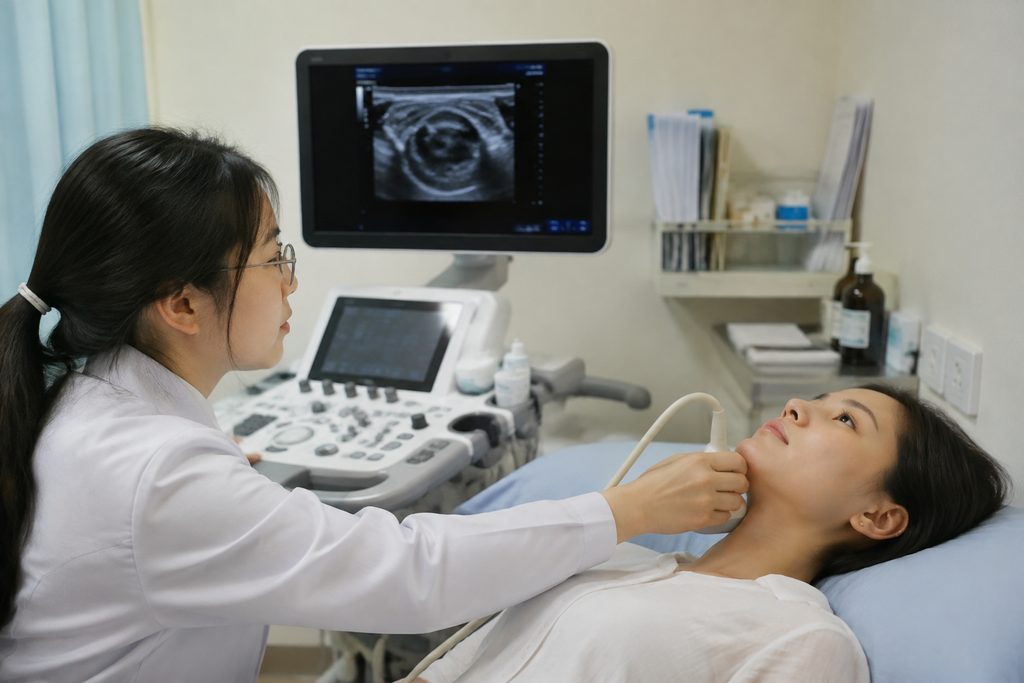
Volume matters in thyroid care. A clinician who interprets 50 thyroid ultrasounds a week sees patterns that a general radiologist might miss. Ruijin’s thyroid center operates within a department that logs over 600,000 outpatient visits per year. A significant fraction of those visits are thyroid-specific. This caseload includes the full spectrum: simple hypothyroidism, complex multi-nodular goiters, thyroid-associated ophthalmopathy, and medullary thyroid carcinoma. The department pioneered the clinical application of thyroid fine-needle aspiration biopsy in China, and its cytopathology workflow is integrated directly with endocrinology—not siloed in a separate pathology department that never sees the patient.
That integration changes the diagnostic timeline. A patient with a suspicious nodule can often move from ultrasound to biopsy to results discussion within a compressed window, because the endocrinologist performing the ultrasound is the same specialist interpreting the cytology report in the context of the patient’s full history.
Research Infrastructure That Informs Treatment
The Shanghai Institute of Endocrine and Metabolic Diseases is housed within Ruijin. This is not a separate academic silo; it is embedded in the clinical department. The institute has produced foundational research on thyroid-stimulating hormone receptor autoantibodies and the genetic underpinnings of thyroid cancer. For a patient, this means the treatment protocols are not simply imported from Western guidelines. They are often shaped by the same investigators who contributed to the evidence base.
For hyperthyroidism management, the department has extensive experience with both antithyroid drug titration and block-and-replace regimens, as well as radioactive iodine dosing protocols refined on a patient population with diverse iodine intake backgrounds. This matters because optimal RAI dosing is not one-size-fits-all, and a center that performs thousands of these treatments annually has the data to personalize the approach.
Cost Advantage Without Quality Compromise
The question of how does Ruijin Hospital endocrinology department treat hyperthyroidism often circles back to affordability. The hospital’s public-service mandate, combined with China’s lower cost structure for hospital services and physician labor, creates a price differential that is structural, not promotional. A new patient consultation with a senior endocrinologist through the International Medical Center typically falls in the $150–$300 USD range. A thyroid ultrasound with elastography may cost $80–$150. A fine-needle aspiration biopsy, including cytopathology, often ranges from $200 to $400.
These are not discounted rates. They are the standard pricing for a top-tier Chinese hospital’s international wing, and they reflect the economic reality that hospital services in China operate at a fraction of US or European overhead. The Ruijin Hospital thyroid treatment price international patient structure is transparent: you pay for each service line item, and the total cost of a diagnostic workup that might exceed $5,000 in the US can be completed for under $1,500 in Shanghai.
From Suspicious Nodule to Treatment Plan: The Actual Workflow
International patients often assume they can email the hospital, book a surgery date, and fly in. The reality is different, and understanding it prevents wasted trips.
The standard pathway begins with a face-to-face consultation. You cannot bypass this step. A senior endocrinologist will review your existing imaging and laboratory reports—bring everything on a USB drive and in printed form—but will almost certainly order repeat imaging on Ruijin’s own equipment. This is not a revenue tactic. It is a quality-control measure. The department’s ultrasound machines are calibrated to their radiologists’ specifications, and the endocrinologists who perform thyroid ultrasound are trained in a specific scanning protocol that captures views a community imaging center might omit.
If a biopsy is indicated, it is typically performed by the endocrinologist during the same visit or scheduled within 1–2 days. Results return in 3–5 business days. If surgery is recommended, the case is discussed at a multidisciplinary meeting that includes endocrinology, head and neck surgery, and nuclear medicine. Only then is a surgical date proposed. The entire diagnostic phase, from arrival to a definitive recommendation, usually spans 5–7 business days.
Is Ruijin Hospital Good for Thyroid Surgery? What the Data Shows
The question is Ruijin Hospital good for thyroid surgery reviews reflects a reasonable concern: a hospital famous for endocrinology might not be equally strong in the operating room. Ruijin’s Department of General Surgery includes a dedicated thyroid and parathyroid surgery unit. The surgeons in this unit perform a high volume of thyroidectomies annually, and their outcomes data—including rates of recurrent laryngeal nerve injury and permanent hypoparathyroidism—are tracked and published in peer-reviewed literature.
The surgical team uses intraoperative neuromonitoring as a standard practice, not an optional add-on. For patients with papillary thyroid carcinoma, the department has adopted active surveillance protocols for microcarcinomas where appropriate, reflecting the global shift away from overtreatment. When surgery is indicated, the approach is tailored: endoscopic thyroidectomy via trans-axillary or trans-oral routes is available for patients who prioritize scar avoidance, and the surgeons have published their technique refinements in indexed journals.
Recovery support is where the system shows its public-hospital character. Post-operative monitoring is thorough, but the nursing model expects family involvement or a hired companion. A bilingual medical escort who understands the discharge instructions and can coordinate follow-up calcium monitoring is not a luxury—it is a practical necessity for a foreign patient who does not speak Mandarin.
| Procedure | Estimated Cost Range (USD) | Notes |
|---|---|---|
| Initial Endocrinology Consult (Intl. Medical Center) | $150 – $300 | Includes review of outside records; new imaging often ordered separately |
| Thyroid Ultrasound with Elastography | $80 – $150 | Performed by endocrinology, not a separate radiology department |
| Ultrasound-Guided FNA Biopsy | $200 – $400 | Includes cytopathology report; results in 3–5 business days |
| Total Thyroidectomy (Uncomplicated) | $4,000 – $8,000 | Surgeon fee, anesthesia, operating room, 3–5 day inpatient stay |
| Radioactive Iodine Therapy (Graves’ Disease) | $800 – $1,500 | Dosing, administration, and short-term monitoring |
| Thyroid Nodule Ablation (Radiofrequency/Microwave) | $2,500 – $5,000 | Per nodule; includes ultrasound guidance and post-procedure observation |
Thyroid Nodule Ablation: A Shanghai Option Worth Understanding
The phrase thyroid nodule ablation Shanghai medical tourism package suggests a packaged product. The reality is more clinical. Thermal ablation—using radiofrequency or microwave energy to shrink benign thyroid nodules without surgery—is widely performed in Shanghai. Ruijin’s interventional endocrinologists have been early adopters of the technique, and their patient selection criteria are strict. Not every nodule is suitable. The nodule must be confirmed benign via at least two concordant biopsies, and it must be causing compressive symptoms or cosmetic concern.
The procedure itself is performed under local anesthesia with ultrasound guidance. A thin electrode is inserted into the nodule, and thermal energy destroys the tissue in a controlled zone. The treated nodule shrinks over 6–12 months. The cost, typically $2,500 to $5,000 per nodule, is significantly lower than in private US centers, where the same procedure can exceed $10,000. But the real value is in the operator experience: a specialist who performs 300 ablations a year has an intuitive understanding of the danger zones—the recurrent laryngeal nerve, the parathyroid glands—that a low-volume operator cannot replicate.
Practical Considerations: Documentation, Visa, and Payment
Arriving prepared is the difference between a smooth diagnostic process and a frustrating one. The hospital’s International Medical Center will request your passport, your complete medical records (translated into English or Chinese), and a summary letter from your referring physician outlining the clinical question. You do not need to translate records into Chinese if they are in English; the international team handles that.
For visa purposes, medical treatment in China falls under the S2 short-term private affairs visa category. The hospital will issue an invitation letter and a medical treatment confirmation document once your consultation is scheduled. Apply at the Chinese embassy or consulate in your home country with these documents. Processing typically takes 5–10 business days. Do not attempt to enter on a tourist visa for scheduled treatment; if immigration officials determine your purpose is medical, you risk denial of entry.
Payment at Ruijin’s International Medical Center is upfront. You pay for each service at the time it is rendered. The center accepts international credit cards, but daily transaction limits on some cards can cause problems. Confirm your daily limit with your bank before traveling. The hospital does not direct-bill international insurance; you pay and then submit claims for reimbursement. Request detailed invoices and medical reports in English at every step—the international team provides these, but you must ask.
Frequently Asked Questions
Yes, but not through the standard public registration system. The public system requires a Chinese ID number or a physical visit to a registration window. Foreign patients use the International Medical Center, which accepts advance scheduling via phone or email. You will need to provide passport details and a brief medical summary. The appointment is then confirmed with a specific date and time, and you pay the consultation fee on arrival.
There is no single “best” endocrinologist—there are senior specialists with different sub-focuses. Ruijin’s thyroid team includes clinicians who specialize in nodule management, others who focus on autoimmune thyroid disease, and still others who manage thyroid cancer surveillance. A consultation with a senior specialist through the International Medical Center costs $150–$300. The value lies in matching your specific condition to the right sub-specialist, which requires a detailed case review before scheduling.
This is a question that deserves a direct answer. Surgical complications—recurrent laryngeal nerve injury, hematoma, hypocalcemia—occur at a low but real rate in every center worldwide. Ruijin’s surgical team has published outcomes data, and their complication rates are consistent with international benchmarks for high-volume centers. Chinese hospitals carry medical liability insurance, and the International Medical Center has a patient relations office that handles foreign patient concerns. You should also carry your own medical travel insurance that covers complication management and, if necessary, medical evacuation. Do not travel without it.
Plan for a minimum of 10–14 days. The initial consultation, ultrasound, and biopsy (if needed) take 3–5 days. If ablation is indicated and you consent, the procedure is typically scheduled within 2–3 days of biopsy results. You will need 1–2 days of post-procedure observation. Factor in a buffer for scheduling gaps. Rushing the process increases the risk of a decision you later regret.
Your Next Step
The decision to travel for thyroid care is not simply a financial calculation. It is a bet on volume, on specific clinical expertise, and on a system that can compress a diagnostic process that might stretch over months at home into a matter of days. Our team at China Medical Services exists to bridge the logistical gap. We are not a hospital, and we do not provide medical advice or diagnoses. What we do is handle the coordination: identifying the right department for your specific thyroid condition, scheduling the International Medical Center consultation, arranging a bilingual medical companion who can navigate the hospital’s physical and administrative layout, and ensuring your records are complete before you board the plane. If you want to understand whether Ruijin’s thyroid center is the right fit for your case, start with a free consultation. We will review your situation honestly and tell you if this pathway makes sense—or if it does not.
For more medical information and treatment options in China, visit chinamedservices.com (China Medical Services).
