Tianjin First Teaching Hospital TCM: Stroke Recovery Through Acupuncture in North China
Key Takeaways
- Acupuncture combined with standard rehabilitation can improve motor function recovery by approximately 30-40% compared to standard therapy alone, based on a 2022 meta-analysis published in Frontiers in Neurology covering 2,800+ stroke patients.
- Tianjin First Teaching Hospital’s acupuncture-moxibustion department is among the most clinically active TCM stroke units in North China, treating thousands of post-stroke patients annually with protocols refined over four decades.
- No TCM treatment guarantees recovery. Outcomes depend heavily on stroke severity, time elapsed since the event, and the patient’s overall health. Expect a realistic timeline, not a miracle.
- International patients face real logistical hurdles: language, visas, and payment systems. Understanding these before booking a flight saves time, money, and emotional strain.
The Problem: Stroke Rehabilitation Often Hits a Plateau
Around 1 in 4 people over age 25 will experience a stroke in their lifetime, according to the World Stroke Organization’s 2022 Global Stroke Fact Sheet. For survivors, the acute event is only the beginning. The months that follow determine whether someone regains the ability to walk, speak, or use their hands. Traditional Western rehabilitation — physical therapy, occupational therapy, speech therapy — is essential. But many patients hit a frustrating plateau. Progress slows. Insurance-covered sessions run out. A 2023 study in The Lancet Neurology noted that approximately 40% of stroke survivors still have significant motor deficits six months post-event, despite completing standard rehab programs.
That is where families start searching for alternatives. They ask different questions. Can acupuncture reawaken dormant neural pathways? Is there clinical evidence, not just anecdotes, that TCM moves the needle when conventional therapy stalls? And if so, where in China can a foreign patient actually access this care safely and affordably?
The search for answers often leads to one place: Tianjin First Teaching Hospital of Tianjin University of Traditional Chinese Medicine. It is not a wellness retreat. It is a high-volume, research-active teaching hospital where acupuncture has been used for stroke sequelae since the 1970s. The question is not whether they do it. The question is whether it makes sense for you.
Who We Are
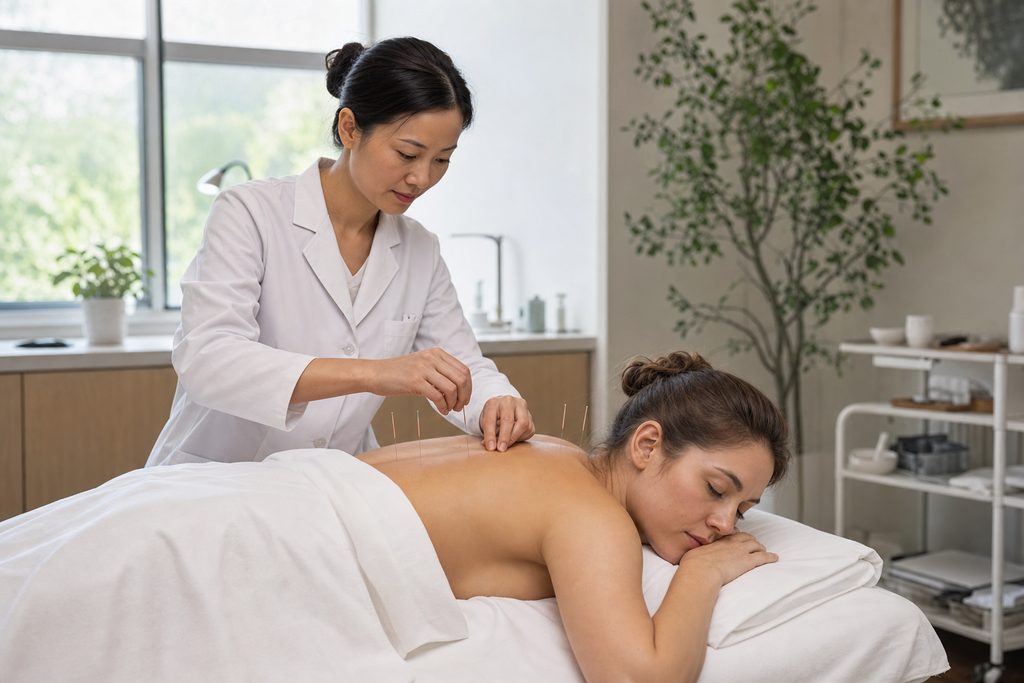
Volume matters in rehabilitation. A therapist who sees five post-stroke patients a week develops a different intuition than one who sees fifty. The department handles an enormous caseload — stroke patients make up a substantial portion of daily outpatient and inpatient acupuncture sessions across multiple wards. This repetition breeds pattern recognition. Clinicians learn to read subtle changes in muscle tone, facial expression, and gait that signal whether a protocol needs adjustment. The “Xing Nao Kai Qiao” method itself is specific: it targets acupoints like Neiguan (PC6), Renzhong (GV26), and Sanyinjiao (SP6) with defined needle manipulation techniques — lifting, thrusting, twirling — at precise frequencies. This is not vague “energy balancing.” It is a reproducible clinical intervention.
The data is not unanimous, but it is substantial. A 2022 systematic review and meta-analysis in Frontiers in Neurology pooled data from 2,800+ patients across 35 randomized controlled trials. The finding: acupuncture combined with conventional rehabilitation improved Fugl-Meyer Assessment scores (a standard motor function measure) by a clinically meaningful margin over rehab alone. Another 2021 trial published in Stroke journal examined electro-acupuncture for post-stroke spasticity and found statistically significant reductions in muscle tone after an eight-week protocol. None of this proves acupuncture works for everyone. It does show that, for a meaningful subset of patients, the intervention changes outcomes. The key variable is timing. Most studies suggest the optimal window is within the first six months post-stroke, when neuroplasticity is most active. After 12 months, gains are still possible but typically smaller and slower.
Acupuncture is the headliner, but the hospital’s TCM approach usually includes Chinese herbal formulas as an adjunct. These are not off-the-shelf supplements. Formulas like Bu Yang Huan Wu Tang are prescribed based on pattern differentiation — a TCM diagnostic process that assesses whether the patient’s presentation is one of Qi deficiency, blood stasis, phlegm obstruction, or a combination. The herbs are decocted daily in the hospital pharmacy. The goal is to support circulation, reduce inflammation, and improve energy levels during the grueling work of physical therapy. A 2020 study in the Journal of Ethnopharmacology identified bioactive compounds in astragalus root (a common ingredient) that may promote angiogenesis — the formation of new blood vessels — in ischemic brain tissue. This is laboratory evidence, not clinical proof. But it provides a plausible biological mechanism for what TCM practitioners have observed for centuries.
Let us talk numbers. For international patients, the acupuncture stroke rehabilitation cost Tianjin is a fraction of what comparable inpatient rehabilitation costs in the United States or Europe. A typical daily acupuncture session at the hospital’s international department runs between $60 and $120, depending on whether electro-acupuncture or additional modalities are used. A two-week inpatient rehabilitation program, including daily acupuncture, physical therapy, herbal medicine, and a basic ward bed, typically ranges from $3,000 to $6,000. This varies by case complexity and room type.
Compare this to the United States, where a single inpatient rehabilitation facility stay averages $1,700 per day, according to a 2023 Medicare Payment Advisory Commission report. A two-week stay can exceed $24,000. The cost advantage in Tianjin is structural: lower labor costs, high patient volume, and a hospital system optimized for throughput rather than billing complexity. Lower cost does not mean lower quality. In the 2022 Fudan University hospital rankings, the Tianjin University of Traditional Chinese Medicine affiliated hospital system was ranked among China’s top TCM institutions — a designation based on clinical reputation and research output, not price.
What You Need to Know Before Going Alone
Accessing Tianjin First Teaching Hospital as a foreign patient is entirely possible. It is also entirely overwhelming if you try it solo. Here is what stands between you and treatment:
- Visa Requirements: Medical treatment in China requires an S2 visa with a “for medical treatment” annotation. The application demands an invitation letter from the hospital, a detailed treatment plan, and proof of financial means. The hospital’s international department issues invitation letters, but only after you have completed a preliminary consultation and they have accepted your case. This is a chicken-and-egg problem: you need the letter to apply for the visa, but you need to engage the hospital to get the letter. Processing times vary by consulate. Plan for four to six weeks minimum.
- Language Barrier in a High-Volume Hospital: Tianjin First Teaching Hospital is a Chinese-language environment. Registration forms, consent documents, daily treatment schedules — all in Chinese. The hospital sees thousands of patients daily. A nurse or acupuncturist cannot pause to translate during a busy morning shift. Without a bilingual companion, you will miss critical information: changes in herbal dosage, scheduling adjustments, signs of complications to watch for. This is not about comfort. It is about safety.
- Payment Systems: The hospital requires prepayment for international patients. This is not unusual in China. You deposit funds at admission, and treatment costs are deducted daily. The hospital accepts wire transfers and UnionPay cards. International credit cards are not reliably accepted at public hospital counters. WeChat Pay and Alipay dominate daily transactions in China, but linking a foreign bank card to these platforms is increasingly difficult under current regulations. You need a local payment strategy before you arrive.
How We Help You Navigate This
These barriers are real. They exist because China’s public hospital system was built for domestic patients, not international ones. The system works brilliantly once you are inside it. Getting inside it requires a guide.
Our process starts with a free consultation. You tell us about the stroke — when it happened, what deficits remain, what medical records you have. We review your case with the hospital’s international department to determine if you are a suitable candidate. Not everyone is. If the hospital’s specialists believe the therapeutic window has closed or the risks of travel outweigh potential benefits, we tell you honestly. We do not take cases where the expected value is negligible.
If you are a candidate, we handle the invitation letter, coordinate the visa application with supporting documents, and schedule your initial consultation. When you land in Tianjin, a bilingual medical companion meets you. This person is not a translator on a phone app. They are physically present — navigating registration, translating during the acupuncturist’s intake exam, explaining the herbal regimen, and ensuring you understand every step. Our companion stays with you through the treatment course. We also arrange airport transfers, accommodation near the hospital, and ongoing logistical support. The coordination fee for a two-week stroke rehabilitation program starts from $300, with the bilingual companion service from $200 per day. Any remote consultation fees you pay are credited in full toward in-person coordination if you proceed within 90 days.
We do not promise you will walk again. No ethical service does. We promise you will not face the system alone.
Frequently Asked Questions
What is the acupuncture stroke rehabilitation cost Tianjin compared to Beijing or Shanghai?
Tianjin is generally more affordable than Beijing or Shanghai for comparable TCM stroke rehabilitation. A two-week inpatient program in Tianjin typically runs $3,000 to $6,000, while similar programs at top TCM hospitals in Beijing can range from $5,000 to $10,000. The cost difference reflects lower accommodation and operational costs in Tianjin, not lower clinical quality. The acupuncture-moxibustion department at Tianjin First Teaching Hospital is considered a peer to the best TCM stroke units in the capital.
How effective is acupuncture for stroke paralysis if the stroke happened more than a year ago?
Honest answer: the evidence is weaker for late-stage recovery. Most clinical trials showing significant motor improvement enrolled patients within six months of stroke onset. After 12 months, the brain’s neuroplastic window narrows. Gains are still possible — some patients report improved spasticity management and reduced pain — but full motor recovery is unlikely. The hospital’s specialists will review your imaging and current functional status before accepting your case. If they believe the expected benefit is marginal, they will tell you.
Can I book a stroke rehabilitation program at Tianjin First Teaching Hospital directly as a foreigner?
Yes, but with difficulty. The hospital’s international department accepts direct inquiries. You will need to submit medical records translated into Chinese, wait for a review, and handle visa paperwork independently. The process is slow and prone to miscommunication. Most international patients work through a medical coordination service like ours to manage the logistics. The hospital’s clinical staff focuses on treatment, not visa paperwork or airport pickups. That division of labor exists for a reason.
What does a typical day in the stroke rehabilitation program look like?
Expect an early start. A typical inpatient day begins with a morning acupuncture session lasting 30 to 45 minutes, often using electro-acupuncture on affected limbs. This is followed by a physical therapy session with a rehabilitation therapist — stretching, gait training, resistance exercises. After lunch, you may have a second acupuncture session or occupational therapy focused on fine motor skills. Herbal medicine is taken twice daily, decocted and delivered warm. The schedule is intensive. This is not a spa. Patients are often fatigued by evening. That fatigue is part of the process — neurorehabilitation is physically demanding work.
Are there Tianjin First Teaching Hospital acupuncture packages for foreigners that include accommodation?
The hospital itself does not offer bundled packages with hotel accommodation. The international department provides the treatment plan and inpatient ward if needed. Accommodation for family members or patients who do not require overnight admission is arranged separately. We assist with booking nearby serviced apartments or hotels that are a short walk or taxi ride from the hospital. Tianjin’s cost of living is reasonable — a comfortable serviced apartment near the hospital typically runs $50 to $80 per night.
Your Next Step
Stroke recovery is a long road. When standard rehabilitation plateaus, exploring an evidence-based TCM program at a major Chinese teaching hospital is a rational next step — not a desperate one. Tianjin First Teaching Hospital has the clinical volume, the research pedigree, and the cost structure to make it worth serious consideration. The barriers are real but solvable with the right support.
If you want to understand whether this program fits your specific case, start with a conversation. Visit our patient coordination page to schedule a free consultation. We review your medical history, consult the hospital’s specialists, and give you an honest assessment — no pressure, no false hope. You can also explore our TCM hospital directory to compare programs across China, or browse our top-ranked hospitals database to understand the broader landscape of Chinese medical care. The decision is yours. We just make sure you have the information to make it well.
For more medical information and treatment options in China, visit chinamedservices.com (China Medical Services).
