Vascular Tests in China: English Reports at Top Hospitals
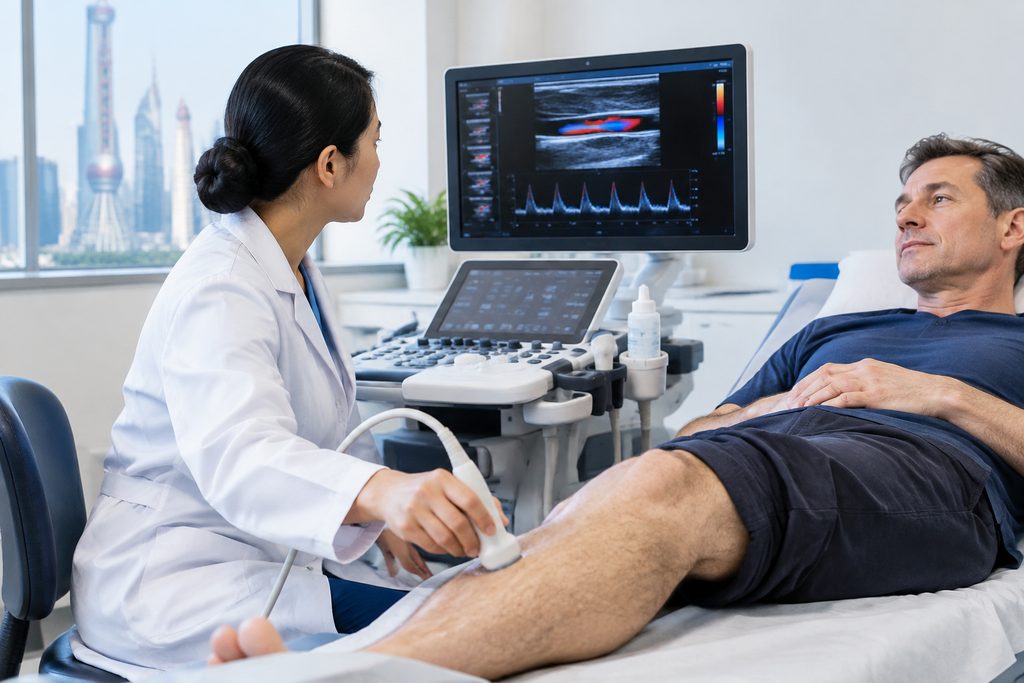
When 58-year-old David from Portland was told he needed a full vascular workup — carotid ultrasound, ankle-brachial index, CT angiography — his insurance quoted him $4,200 out of pocket. His cardiologist mentioned, almost in passing, that patients sometimes fly to Asia for the same panel of scans. David spent three weeks googling before he found a single page explaining what vascular tests cost in China, let alone whether the reports would come back in English.
That gap is exactly what this article fills.
Key Takeaways
- A complete vascular testing panel in China — ultrasound, ABI, CT angiography — typically runs $300 to $1,500 depending on the hospital tier and how many studies you need, versus $2,000 to $5,000 in the United States for the same set.
- Top-tier Chinese hospitals issue bilingual reports as standard practice for international patients, and the major vascular centers handle tens of thousands of imaging studies annually.
- The real friction is not the scan. It is scheduling. Public hospital outpatient slots cannot be reserved from overseas in advance, and you will need either an international department or an on-the-ground coordinator to lock in a date.
- Report quality depends heavily on which hospital you choose. A community clinic and a Fudan-ranked vascular center are not interchangeable, and the price difference between them is smaller than most people assume.
The Problem: Vascular Testing Is Expensive, Slow, and Confusing Abroad
In the United States, a carotid duplex ultrasound alone averages $500 to $1,000 before insurance. Add a CT angiogram of the lower extremities and you are looking at $1,500 to $3,000 for a single visit. A 2023 analysis by the Peterson-KFF Health System Tracker found that diagnostic imaging costs in the US run roughly four to eight times higher than in comparable high-income countries.
Wait times compound the pain. In Canada and the UK, non-urgent vascular ultrasound appointments routinely stretch past eight weeks. In the US, the delay is less about scheduling and more about prior authorization — a process that can consume two to four weeks before a single image is taken.
And then there is the question nobody answers clearly: if you do travel for testing, will the report be usable when you get home?
Why China Delivers Reliable Vascular Diagnostics at a Fraction of Western Prices
The case for China rests on three structural facts, not marketing claims.
Clinical Volume That Most Western Centers Cannot Match
Fuwai Hospital in Beijing performs more than 14,000 cardiac surgeries annually — the highest volume of any single heart center worldwide. That kind of throughput extends into diagnostics. A major Chinese vascular department may read 200 to 400 vascular ultrasound studies per week. Radiologists and sonographers who interpret that many studies develop pattern recognition that low-volume centers simply cannot replicate.
Equipment Parity, Not Compromise
China’s top-ranked hospitals operate the same imaging platforms you would find at Cleveland Clinic or Charité — Siemens, GE, Philips, Canon. The 340+ hospitals in our network are drawn from the top 5% of China’s 35,000+ hospitals, ranked by the Fudan Hospital Ranking and JCI accreditation standards. You are not choosing between “cheap” and “good.” You are choosing between two good options at very different price points.
Cost Structure, Explained Honestly
Why is vascular tests cost China so much lower? Three reasons. Physician salaries are lower in absolute terms. Hospital administrative overhead is thinner — no multi-layer insurance bureaucracy to feed. And volume spreads fixed equipment costs across far more patients. None of that affects the quality of the image on the screen.
| Vascular Study | Typical US Price | Typical China Price (Top Hospital) |
|---|---|---|
| Carotid duplex ultrasound | $500 – $1,000 | $80 – $200 |
| Ankle-brachial index (ABI) | $200 – $400 | $40 – $100 |
| CT angiography (lower extremity) | $1,200 – $2,500 | $250 – $600 |
| MR angiography | $1,500 – $3,000 | $300 – $700 |
| Full vascular panel (combined) | $3,000 – $5,000 | $400 – $1,500 |
Prices vary by hospital tier, city, and case complexity. Figures are reference ranges, not quotes.
What English Reports From Chinese Vascular Labs Actually Contain
This is where most patients have real anxiety, and it is fair. A report you cannot read is worthless.
At international departments and private international hospitals, the standard vascular report includes the following:
- Patient demographics and study date, formatted to Western conventions (month/day/year)
- Indication and referring physician, translated into English
- Technique description — probe type, insonation angles, contrast use if applicable
- Quantitative measurements — peak systolic velocity, intima-media thickness, stenosis percentage, ABI values with right/left comparison
- Imaging findings narrative in English, written by the interpreting physician
- Impression and recommendations, signed and stamped with the hospital’s official seal
- DICOM image files on a USB drive or cloud link, readable by any Western PACS system
What is included in vascular test reports in China at the top tier is functionally identical to a US report. The measurement units are the same. The nomenclature follows international standards. Your cardiologist in Chicago or Manchester will have no difficulty reading it.
Choosing the Right Hospital: Shanghai, Beijing, or Elsewhere
If you are searching for the best hospital in Shanghai for vascular testing, the short answer is that Shanghai has several strong options, and the right one depends on what you need.
Shanghai’s Fudan-ranked hospitals include 18 institutions in the national Top 100 — the second-highest concentration in China after Beijing. For vascular specifically, you want a hospital with a dedicated vascular surgery department, not just a general imaging center. Zhongshan Hospital and Ruijin Hospital both maintain active vascular programs with international patient services.
Beijing offers 21 Top 100 hospitals, including Peking Union Medical College Hospital and Fuwai. If your case involves the aorta or carotid arteries, Fuwai’s cardiac and vascular volume is unmatched globally.
Beyond the two giants, cities like Guangzhou, Chengdu, and Hangzhou each host internationally accredited hospitals with English-capable vascular labs. The Fudan-ranked hospital directory lets you filter by city and specialty.
One practical note: private international hospitals like United Family and Jiahui offer direct insurance billing and English-speaking staff throughout. Public hospital international departments cost less but require more advance coordination. Both are legitimate paths.
How to Book Vascular Testing in China as an International Patient
Here is the honest sequence, including the parts that trip people up.
Step one: get your existing records translated. Chinese specialists want to see your prior imaging and lab work. A translated summary of your medical history, current medications, and previous vascular studies saves an entire consultation cycle.
Step two: choose your access route. Public hospital general outpatient clinics cannot be pre-booked from overseas. You show up, you queue, you take whatever slot is available that day. If you need a specific date — and most international travelers do — you go through the hospital’s international department or VIP channel. Expect to pay roughly 1.5 to 2 times the standard fee for that access. It is still a fraction of US pricing.
Step three: confirm the visa category. Medical travel to China uses the S2 visa, which covers short-stay visits for medical treatment and private affairs. Accompanying family members apply under the same category. The M visa is for commercial and trade activities and has nothing to do with medical treatment. Requirements shift, so verify current documentation with your nearest Chinese embassy or consulate before applying.
Step four: arrange interpretation and logistics. A top Chinese hospital may see 10,000 or more outpatients in a single day. Signage, registration systems, and payment kiosks operate primarily in Chinese. Even a straightforward ultrasound appointment involves four or five separate counters. This is the single biggest practical barrier, and it is solvable — but it needs planning, not improvisation.
Step five: plan for payment. Public hospitals require prepayment for imaging services. International credit cards work at international departments and private hospitals; public hospital general counters often prefer local payment methods. Private international hospitals frequently bill insurance directly, while public hospitals issue receipts you submit for reimbursement after you return home.
Is Vascular Testing in China Reliable? What the Evidence Says
This is the question that decides everything, so let us address it directly.
Chinese medical imaging operates under the same technical standards as Western facilities — equipment from the same manufacturers, protocols aligned with international guidelines, and accreditation through bodies like JCI at the top tier. The 340+ hospitals we work with are not a random sample; they are the upper slice of a system that graduates hundreds of thousands of physicians annually.
Where reliability does vary is by hospital tier. A rural county hospital and a Fudan Top 100 center are different universes. The price gap between them, for a vascular ultrasound, might be $30. The difference in interpretive quality can be substantial.
Second opinions matter here. If your home physician reviews the images and disagrees with the interpretation, you have lost nothing — you still have the raw data, and you paid a fraction of what a repeat study would cost at home.
For patients who want a specialist’s read before committing to travel, a written second opinion from a Chinese vascular specialist — reviewing your existing reports — runs $300 to $500. Video consultations with a top specialist range from $500 to $800, and multidisciplinary team reviews $1,500 to $2,000. Any consultation fee is credited in full toward on-the-ground coordination if you proceed within 90 days.
Frequently Asked Questions
In most cases, yes. English-language reports with DICOM images from an accredited Chinese hospital are readable by any Western specialist. Some physicians may want to repeat specific measurements for their own baseline, but the diagnostic content is transferable. Bring both the written report and the image files.
Expect $400 to $1,500 for a combined panel at a top Chinese hospital, versus $3,000 to $5,000 in the US. The range reflects hospital tier, city, and how many individual studies your physician orders. Final pricing is confirmed by the hospital based on your specific case.
Your DICOM files and English report give your home physician a complete baseline. Follow-up scans can be done locally and compared against the Chinese study. If you need ongoing monitoring in China, repeat visits are straightforward once you have an established hospital record.
Yes, particularly at private international hospitals, which accept direct inquiries and offer English-language patient services. Public hospital international departments are also accessible directly, though response times vary. A coordinator mainly saves you time and reduces the risk of arriving to find no available slot.
Your Next Step
Vascular testing in China offers genuine value — comparable technology, faster access, and costs that are a fraction of Western pricing — but the logistics require navigation. Our team at China Medical Services connects international patients with 340+ top-ranked hospitals across 37 cities, handles appointment coordination, and provides bilingual medical companions who stay with you through registration, imaging, and payment. We are not a hospital and we do not provide diagnoses. We handle the ground-level complexity so your physician can focus on your results. If you would like to explore whether this path fits your situation, you can start with a free consultation — no commitment, just a conversation about your options.
This article is for informational purposes only and does not constitute medical advice. Always consult a qualified physician regarding your specific condition and testing needs.
For more medical information and treatment options in China, visit chinamedservices.com (China Medical Services).
