Wearable Device Health Monitoring in China: Remote Vitals Tracking After Returning Home
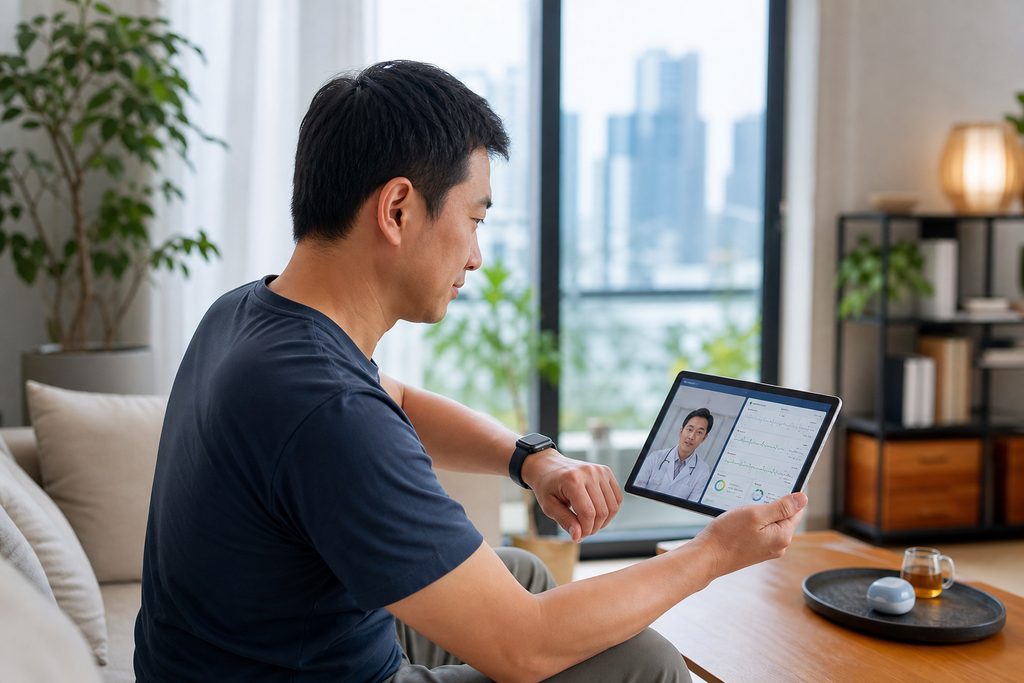
You flew home. The surgery went well. The incision is healing. And then, at 3 AM, you feel something odd—a flutter, a twinge, a number on your home blood pressure cuff that looks higher than you expected. The hospital in Shanghai is 6,000 miles away. Your local doctor has never seen the procedure you received. This is the moment when a structured, data-driven bridge between you and your Chinese care team stops being a luxury and becomes the only thing holding your peace of mind together.
We see this gap every week. A patient leaves our partner hospitals with excellent surgical results but no plan for the 90 days that follow. Recovery does not end at the departure gate. It continues in your living room, and the data your body generates during those weeks is often more important than the surgery itself. Remote vitals tracking solves this. But it only works if the system is set up before you leave China—and if the data actually reaches the surgeon who operated on you.
Key Takeaways
- Remote patient monitoring services in China typically cost $150–$400 per month for device rental, data transmission, and asynchronous specialist review, a fraction of comparable Western programs.
- Continuous ECG, blood pressure, glucose, and oxygen saturation data can detect post-operative complications up to 48 hours before a patient feels symptoms, according to a 2023 study published in The Lancet Digital Health.
- Most wearable monitoring devices purchased on Amazon cannot transmit data to a Chinese hospital’s EHR system—you need a device provisioned specifically for that hospital’s platform, which is why rental programs exist.
- Without a formal data-sharing agreement and a bilingual coordinator, the monitoring data you collect at home will likely never reach the surgeon who needs to see it.
The Problem: Your Surgeon Is Blind the Moment You Board the Plane
Post-surgical monitoring is not about convenience. It is about catching the 7% to 15% of patients who develop complications after discharge—arrhythmias, wound infections, hypertensive spikes, early signs of organ rejection—before those complications become emergencies. A 2022 meta-analysis in *BMJ Open* covering 38,000 surgical patients found that continuous remote monitoring reduced readmission rates by 38% and emergency department visits by 26% compared to standard discharge instructions alone.
The problem is structural. Your surgeon in China operates inside an electronic health record system that is not connected to your MyChart, your NHS app, or whatever portal your local GP uses. When you take a blood pressure reading at home, that number goes nowhere unless someone has built a pipeline for it. Most international patients assume the monitoring happens automatically. It does not. Someone has to rent the right device, provision it to the correct hospital server, train you on usage, monitor compliance, flag abnormal readings, translate those flags into Chinese medical terminology, and route them to the attending surgeon’s team. That is not a gadget. That is a service layer.
We build that layer.
Who We Are
We are not a hospital. We do not diagnose, treat, or prescribe. Our team at China Medical Services operates as your logistical and coordination backbone—we connect international patients with China’s top-tier hospitals, handle the operational complexity, and ensure continuity of care after you return home. We work with over 340 top-ranked hospitals across 37 cities. When your surgeon at Fuwai Hospital or Peking Union Medical College Hospital needs to see your post-operative ECG rhythm strip from your living room in London or Dubai, we make sure that data arrives in a format they can read, on a platform they trust, with the clinical context they need.
How Remote Vitals Tracking Works After Treatment in China
The phrase “wearable device” conjures images of Apple Watches and Fitbits. Those are wellness tools. They are not cleared for post-surgical surveillance, and their data is not admissible in a clinical decision-making workflow. What we arrange is different.
The Device Layer: What Gets Monitored and Why
The specific device depends on your procedure. A patient recovering from cardiac ablation needs continuous single-lead ECG monitoring—we typically provision a medical-grade patch monitor that records every heartbeat for 14 to 30 days and flags atrial fibrillation, pauses, and tachyarrhythmias. A patient post-spinal fusion may need only twice-daily blood pressure and oxygen saturation checks with a cellular-enabled cuff and pulse oximeter. A diabetic patient post-organ transplant needs continuous glucose monitoring plus vital sign tracking.
None of these devices are off-the-shelf consumer products. They are provisioned specifically for the hospital’s monitoring platform. When you rent a device through our coordination service, it arrives pre-configured. You put it on. It transmits. You do not need to pair it with your phone, install a Chinese app, or navigate a Mandarin interface. That is the difference between buying a gadget and renting a clinical monitoring tool.
The wearable health monitor rental China price typically ranges from $150 to $400 per month, depending on the device complexity and monitoring intensity. A basic vital signs kit—blood pressure, SpO₂, temperature—starts around $150. A continuous multi-lead ECG patch with 24/7 arrhythmia detection runs closer to $350–$400. These are rental fees that include the hardware, cellular data transmission, the monitoring platform license, and asynchronous review by a clinical coordinator. They do not include real-time specialist interpretation, which is priced separately if required.
The Data Pipeline: From Your Wrist to Your Surgeon’s Screen
This is where most remote patient monitoring service China cost comparisons miss the point. The device fee is only one line item. The actual value is in the routing logic.
Your readings do not float in the cloud. They land on a dashboard monitored by a bilingual clinical coordinator—a nurse or physician assistant in China who reviews flagged events daily. A single elevated blood pressure reading at 10 PM on a Tuesday? Probably nothing. Three consecutive systolic readings above 160 mmHg over 48 hours in a patient who had a carotid endarterectomy? That gets escalated. The coordinator writes a structured summary in Chinese, attaches the raw data, and sends it through the hospital’s internal messaging system to your surgeon’s team. The surgeon reviews it, typically within 24 to 48 hours, and issues guidance: adjust medication, come in for an echo, or continue monitoring.
Without this human layer, the data is noise. With it, the data becomes a clinical safety net.
Can My Doctor Abroad Monitor My Health After Surgery in China?
This is the question we hear most often. The answer is yes—but not automatically, and not without a formal handoff.
Your local cardiologist or GP can absolutely review the data. But they need three things: the raw data in a readable format, a discharge summary translated into English (or your local language) with the procedure details and expected post-operative parameters, and a direct line of communication to the operating surgeon for questions. Most Chinese hospitals provide a discharge summary in Chinese. Some international departments provide an English version. Very few provide the structured data export your local doctor needs to load into their own EHR.
We handle all three. Our post-treatment wearable device monitoring package China includes a translated clinical summary, a data export in PDF and CSV formats, and a secure channel for your local physician to submit questions to the Chinese surgical team. This is not a telehealth consult—it is a care coordination bridge. Your local doctor remains in charge of your day-to-day management. The Chinese team provides specialist input on procedure-specific concerns.
What You Need to Know Before Booking Remote Health Tracking
The process is straightforward, but there are prerequisites that catch people off guard.
- Device provisioning takes 3 to 5 business days. You cannot walk into a hospital the day before your flight and pick up a monitor. The device must be ordered, configured to the hospital’s platform, tested, and assigned to your patient ID. We initiate this process during your hospital stay so the device is ready at discharge.
- You need a smartphone with internet access. Most devices use cellular transmission and do not require pairing, but the companion app—used for symptom logging and messaging—needs a modern phone. We provide an English-language interface. No Chinese app store downloads required.
- Monitoring duration is typically 30 or 90 days. Thirty days covers most acute post-surgical surveillance. Ninety days is standard for cardiac procedures, transplant recipients, and patients on complex medication titration. We help your surgeon determine the appropriate window.
- Insurance reimbursement varies. Some international insurers cover remote monitoring as part of post-operative care. Most do not. We provide itemized invoices with procedure codes to help you file a claim, but we cannot guarantee reimbursement. The out-of-pocket book remote health tracking service after medical trip China cost is typically $450 to $1,200 total for a 30-day program, all-inclusive.
How We Help You Navigate This
The monitoring program begins before you leave the hospital. Our bilingual coordinator meets you at discharge—in person, at your bedside—with the device kit. You get a 30-minute training session in English. You practice putting the device on, taking a reading, and sending a test transmission. The coordinator verifies that data appears on the hospital dashboard before you walk out the door.
Once you are home, the coordinator checks the dashboard daily. You receive a weekly summary email in English with your trend data and any notes from the surgical team. If a reading triggers an alert, the coordinator contacts you within 12 hours—usually much faster—to gather context and escalate if needed. At the end of the monitoring period, you receive a final report suitable for sharing with your local physician, and we coordinate the device return (a prepaid shipping label, dropped at any DHL location).
This is not a software subscription. It is a managed service. The technology works because the humans work.
Frequently Asked Questions
The rental fee covers the medical device hardware, cellular data transmission, access to the hospital’s monitoring platform, and daily dashboard review by a bilingual clinical coordinator. It does not include specialist interpretation fees if the surgeon needs to review raw ECG tracings in detail—that is billed separately at standard video consultation rates, typically $100–$300 per review. Device shipping and return are included.
US-based remote cardiac monitoring programs typically bill $500 to $1,200 per month, often with additional interpretation fees. European programs run €300 to €800 monthly. The Chinese programs we coordinate are structurally less expensive because the clinical coordinator labor cost is lower, not because the technology or clinical standards are inferior. You are paying for the same FDA-equivalent or CE-marked devices, the same cloud infrastructure, and a clinician reviewing your data—just at Chinese labor economics.
We facilitate that. A scheduled video call between your local physician and the Chinese surgical team—with a medical interpreter present—costs $500 to $800 for a 30-minute session. This is booked in advance and includes a translated case summary sent to both parties beforehand. It is not an emergency service, but it closes the communication loop when complex questions arise.
You can, but it will not work the way you hope. Consumer ECG devices produce single-lead rhythm strips that are not integrated into any hospital’s EHR. Your Chinese surgeon cannot accept an unverified PDF from your email and make clinical decisions from it—the liability and regulatory barriers are too high. The value of our rental program is that the device is part of the hospital’s clinical workflow. The data is admissible. The surgeon can act on it. That is the difference between monitoring and just measuring.
Your Next Step
Recovery after a major procedure in China should not feel like jumping off a cliff and hoping there is water below. The surgical teams at hospitals like Fuwai, Zhongshan, and Peking Union Medical College are world-class. But their ability to care for you ends at the airport curb unless someone builds the bridge. Remote vitals tracking is that bridge.
If you are planning a medical trip to China—or if you are already here and staring at a discharge date—start the conversation early. The monitoring program needs to be in motion before your surgery, not after. We will help you understand what devices apply to your procedure, what the total program cost will be, and how the data will flow to your surgeon and your local doctor. No pressure. Just clarity.
Learn more about our post-operative care coordination and remote monitoring programs.
For more medical information and treatment options in China, visit chinamedservices.com (China Medical Services).
