West China Hospital Chengdu: Inside Southwest China’s Largest Medical Center with Three National #1 Specialties
When 48-year-old David from Manchester was told he needed a complex liver resection, the NHS wait time stretched past four months. His condition would not wait that long. A colleague mentioned West China Hospital in Chengdu — a name David had never heard before. He typed “West China Hospital Chengdu price list international patients” into Google at 2 a.m., desperate for options. The search results overwhelmed him. Fragmented information. Confusing pricing. No clear path for a foreigner who spoke zero Mandarin.
David’s frustration is exactly what we solve every day.
We are China Medical Services. We are not a hospital. We do not provide medical treatment or clinical diagnoses. We are your logistical architects — we bridge the gap between you and China’s most elite medical institutions. West China Hospital sits at the very top of that list.
Key Takeaways
- West China Hospital holds three national #1 specialty rankings on China’s most authoritative hospital evaluation system — a distinction matched by fewer than five hospitals nationwide.
- The hospital performs over 18,000 cardiac interventions and 6,000+ neurosurgical procedures annually, placing it among the highest-volume centers globally for complex surgery.
- International patients cannot simply book online — the hospital’s international department requires in-country registration, medical documentation in Chinese, and upfront deposit payments. Going alone means navigating this in Mandarin.
- Treatment costs for major procedures run 60-80% below US prices, but the real question is whether you can access the right specialist — not just any doctor in the department.
The Problem: When Your Local Healthcare System Cannot Move Fast Enough
Wait times for specialized surgery in the UK, Canada, and parts of Europe have hit crisis levels. The British Medical Association reported in 2024 that over 7.5 million people in England alone were waiting for NHS treatment — with cardiothoracic surgery waitlists stretching beyond 18 weeks for nearly 30% of patients. In Canada, the median wait time from specialist referral to treatment reached 27.7 weeks in 2023, according to the Fraser Institute.
These are not just numbers. They are people with progressing conditions. A tumor that grows while you wait. A heart valve that deteriorates. A neurological disorder that steals function month by month.
Private alternatives in the West come with eye-watering price tags. A coronary artery bypass graft in the United States costs $120,000 to $180,000 on average. The same procedure at a top Chinese public hospital runs $12,000 to $20,000. That is not a discount. That is a structural difference in how healthcare is funded and delivered.
But cost means nothing if the quality is not there. This is where West China Hospital enters the conversation — and where most international patients get stuck.
Who We Are
China Medical Services connects international patients with China’s 340+ top-ranked hospitals across 37 cities. We handle the entire logistical chain: hospital matching, appointment coordination, bilingual medical companion services, visa guidance, and post-operative recovery planning. Our team has walked hundreds of foreign patients through West China Hospital’s international department. We know which specialists accept international cases. We know the documentation requirements before you book a flight. We know what the price list actually means — because the listed prices are only the starting point.
What Is West China Hospital Famous For: Three National #1 Specialties and a Reputation Built on Volume
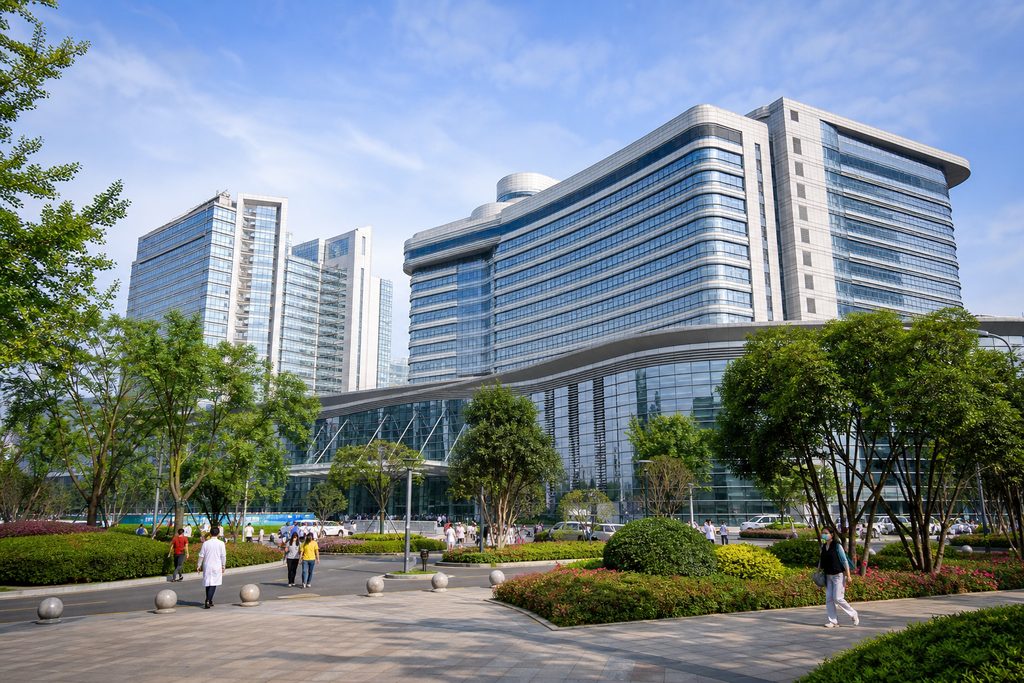
West China Hospital of Sichuan University is not just large. It is the largest hospital in Southwest China by patient volume, bed capacity, and clinical output. The hospital operates over 4,300 beds and handles more than 6 million outpatient visits annually. For context, Mayo Clinic’s flagship campus in Rochester handles approximately 1.3 million outpatient visits per year. West China Hospital sees nearly five times that volume.
But what is West China Hospital famous for among Chinese medical professionals? Three words: respiratory medicine, neurosurgery, and anesthesiology.
Respiratory Medicine: China’s Undisputed Leader
West China Hospital’s Department of Respiratory and Critical Care Medicine has held the #1 national ranking in Fudan University’s China Hospital Specialty Reputation Ranking for over a decade. The department manages approximately 300,000 outpatient visits and 10,000 inpatient admissions annually. It houses China’s largest pulmonary function testing center and runs one of the world’s most active lung cancer early screening programs.
For international patients, this matters in practical terms. The department has dedicated subspecialty teams for interstitial lung disease, pulmonary hypertension, lung cancer, and respiratory infections. When a patient arrives with a complex or undiagnosed respiratory condition, they are not seeing a general pulmonologist — they are routed to the specific team that handles their suspected condition daily.
The department also leads multiple international clinical trials. A patient who qualifies for a trial protocol may access cutting-edge therapies years before they reach Western markets. This is not hypothetical — West China Hospital has been a trial site for novel EGFR inhibitors and immunotherapy combinations that later became global standards.
Neurosurgery: 6,000-Plus Procedures Per Year
Is West China Hospital good for neurosurgery? The volume data answers this question before we even discuss outcomes. The Department of Neurosurgery performs over 6,000 surgical procedures annually, including more than 1,200 brain tumor resections and 800-plus cerebrovascular interventions. The department has dedicated operating rooms equipped with intraoperative MRI, neuronavigation systems, and awake craniotomy capabilities.
The department ranks #1 nationally in the Fudan specialty reputation ranking for neurosurgery — a position it has held consecutively for multiple years. Specific strengths include skull base tumor surgery, functional neurosurgery for Parkinson’s disease and epilepsy, and complex cerebrovascular procedures.
For a foreign patient considering neurosurgery abroad, surgeon volume is one of the strongest predictors of outcome. Studies published in The Lancet and JAMA have consistently shown that hospitals performing more than 100 craniotomies annually have significantly lower mortality rates than lower-volume centers. West China Hospital’s neurosurgery department performs over 500 craniotomies per month. The attending neurosurgeons each complete 200 to 400 major procedures per year — numbers that exceed the typical US neurosurgeon’s annual volume by a factor of three to five.
Anesthesiology: The Invisible Specialty That Determines Surgical Safety
Most patients never think about anesthesiology until something goes wrong. West China Hospital’s Department of Anesthesiology has been ranked #1 nationally for over a decade — a dominance that reflects both clinical volume and research output. The department manages over 200,000 anesthesia cases per year across more than 100 operating rooms.
Why does this matter for an international surgical patient? Anesthesiology is the specialty that keeps you alive during surgery. West China Hospital’s anesthesiology team has extensive experience with high-risk patients — the elderly, those with multiple comorbidities, patients undergoing prolonged procedures lasting 10 hours or more. The department pioneered enhanced recovery after surgery protocols in China and maintains one of the lowest perioperative mortality rates among large Chinese teaching hospitals.
Top Hospital in Southwest China for Cancer Treatment: The Oncology Ecosystem
Cancer patients searching for the top hospital in southwest China for cancer treatment will find West China Hospital’s Cancer Center at the core of their research. The center integrates medical oncology, radiation oncology, surgical oncology, and interventional oncology under one organizational roof.
The Cancer Center treats over 150,000 patients annually and runs more than 300 active clinical trials at any given time. Specific strengths include lung cancer, liver cancer, gastric cancer, and nasopharyngeal carcinoma — cancers with high incidence rates in Asia where Chinese oncologists have accumulated enormous clinical experience.
West China Hospital was an early adopter of proton therapy planning and now operates advanced linear accelerators capable of stereotactic body radiation therapy and intensity-modulated radiation therapy. The hospital also performs transcatheter arterial chemoembolization for liver cancer at volumes exceeding 3,000 cases per year — a procedure that can control tumor growth while patients await surgery or transplantation.
The multidisciplinary team model means a newly diagnosed cancer patient is typically reviewed by a tumor board that includes surgeons, medical oncologists, radiation oncologists, pathologists, and radiologists. This is standard at top Western cancer centers. The difference is speed — the tumor board at West China Hospital often convenes within days, not weeks.
West China Hospital Chengdu Price List for International Patients: What You Actually Pay
This is the question that brings most readers here. A direct answer requires honesty about how Chinese public hospital pricing works.
There is no single published price list that applies to all international patients. West China Hospital operates multiple service tiers. The standard public ward charges government-regulated rates that are astonishingly low by Western standards — a specialist consultation may cost 50 to 200 RMB, or roughly $7 to $28. But these standard channels are not accessible to foreigners without Chinese residency, language fluency, and the ability to navigate a system where patients line up at 5 a.m. for a chance at a same-day registration number.
The international department operates on a different model. Consultation fees with senior specialists range from $100 to $300. Inpatient room rates for international wards start at approximately $150 to $400 per night depending on room class. Surgical procedure pricing varies dramatically by complexity.
Here is what we tell our patients to expect for common procedures at West China Hospital’s international department:
| Procedure | Estimated Cost (USD) | US Comparison (USD) |
|---|---|---|
| Coronary Artery Bypass Graft | $15,000 – $22,000 | $120,000 – $180,000 |
| Brain Tumor Resection | $18,000 – $30,000 | $80,000 – $150,000 |
| Lung Cancer Lobectomy | $10,000 – $18,000 | $50,000 – $90,000 |
| Liver Resection | $12,000 – $25,000 | $60,000 – $120,000 |
| Knee Replacement | $10,000 – $16,000 | $35,000 – $55,000 |
| PET-CT Scan | $800 – $1,200 | $3,000 – $6,000 |
These figures are estimates based on cases we have coordinated. Final costs depend on the specific specialist, length of stay, implant choices, and whether complications arise. The international department requires an upfront deposit — typically $10,000 to $30,000 depending on the planned procedure — with final settlement upon discharge.
Medical tourism packages in Chengdu cost between $5,000 and $50,000 depending on the procedure and service level. These packages typically bundle hospital fees, accommodation, local transportation, and translation services. We caution patients that the cheapest packages often include junior specialists rather than the nationally recognized experts they traveled to see. Our team helps patients distinguish between package marketing and actual specialist credentials.
Book Appointment at West China Hospital Chengdu as a Foreigner: The Real Process
Google “book appointment West China Hospital Chengdu foreigner” and you will find dozens of unofficial agents making promises they cannot keep. The actual process is more complex than most websites suggest.
West China Hospital’s international medical center accepts foreign patients, but it does not operate an online booking system accessible from overseas. The standard workflow requires:
A local contact to visit the hospital in person to register and obtain a medical record number. Submission of all prior medical records translated into Chinese. A deposit payment processed through Chinese banking channels. Scheduling that depends on the specific specialist’s availability — which can range from a few days to several weeks.
The hospital does not accept foreign credit cards for deposit payments. International wire transfers are possible but slow — they can take five to seven business days to clear. Alipay and WeChat Pay dominate the payment ecosystem, but these platforms require a Chinese bank account to set up with full functionality.
This is not a system designed for international patients. It is a system designed for domestic patients that has been partially adapted. The gap between what foreign patients expect and what the hospital provides is exactly where our bilingual medical companion service operates.
What You Need to Know Before Going Alone
The barriers to accessing West China Hospital independently are real and structural. Understanding them before you book a flight prevents costly mistakes.
- Visa Requirements: Medical treatment in China requires an S2 visa with a specific annotation for medical purposes. This is not a tourist visa. The hospital must issue an official invitation letter and treatment confirmation before the visa application can proceed. Consulates require original stamped documents — not emailed PDFs. Processing times range from one to four weeks depending on your home country.
- Language Barrier in Clinical Settings: Even in the international department, not all nurses and junior doctors speak functional medical English. Informed consent forms, surgical agreements, and discharge instructions are in Chinese. A misunderstanding about medication dosage or post-operative restrictions can have serious consequences.
- Medical Records and Imaging Standards: Chinese hospitals require all prior imaging to be submitted in DICOM format on CD or USB — not cloud links, not emailed JPEGs. Pathology slides must be physically transported with proper documentation. Radiology reports need certified Chinese translation. One missing document can delay a surgical slot by weeks.
How We Help You Navigate This
These barriers exist for structural reasons — not because anyone wants to exclude foreign patients. West China Hospital treats international patients regularly. The hospital simply has not built the infrastructure to handle the pre-arrival coordination that foreign patients require.
That is our role.
Before you travel, we obtain the official invitation letter from the hospital’s international department, coordinate the translation and notarization of your medical records, and confirm specialist availability for your specific condition — not just any doctor in the department, but the subspecialist whose clinical focus matches your diagnosis.
During your treatment, our bilingual medical companions handle registration, payment, queue management, and real-time translation during consultations. They ensure you understand what the doctor is saying — and that the doctor understands your questions. They are not interpreters on a screen. They are physically present, walking you from the consultation room to the imaging center to the payment counter.
After discharge, we coordinate follow-up appointments, medication refills, and recovery accommodations. Chengdu is a livable city with excellent infrastructure and moderate costs. Many of our patients choose to spend their recovery period here rather than rushing home — the city’s slower pace and renowned food culture make it an unexpectedly pleasant place to heal.
Frequently Asked Questions
You can get a detailed estimate, but not a fixed quote. Chinese public hospitals settle bills upon discharge based on actual services rendered, consumables used, and length of stay. Our team provides estimates based on similar cases we have coordinated at the same hospital with the same specialist team. These estimates are typically accurate within 15-20%. Unexpected findings during surgery or post-operative complications change the final amount — this is true in every hospital in every country.
West China Hospital has fully equipped intensive care units, 24-hour emergency surgical capacity, and specialists across every major discipline on-site. The hospital manages complications at a rate comparable to top Western academic medical centers. The practical concern for international patients is not clinical capability — it is communication during a crisis. Our bilingual companions remain on call throughout your hospitalization. If a complication arises at 2 a.m., they are reachable. This is not a luxury service. It is a safety measure.
This depends entirely on the procedure. For a knee replacement, expect to stay 10-14 days in the hospital plus another 1-2 weeks locally for early rehabilitation. For a major cancer surgery, hospital stays of 2-4 weeks are common, with some patients staying in Chengdu for an additional month before flying home. Your surgeon will provide a clearance-to-fly assessment based on wound healing, mobility, and risk of deep vein thrombosis. We help arrange extended-stay accommodations near the hospital for patients who need them.
The international department works with some major insurers, but the standard model is fee-for-service with post-treatment reimbursement. The hospital requires upfront deposit payment. You then submit itemized receipts to your insurer for reimbursement according to your policy terms. We recommend contacting your insurer before travel to confirm coverage for treatment in China and to understand documentation requirements. Some policies require pre-authorization. We can provide the hospital’s licensing documentation and treatment plan to support your pre-authorization request.
For the specialties where West China Hospital holds #1 national rankings — respiratory medicine, neurosurgery, anesthesiology — the clinical outcomes are comparable to leading Western academic medical centers. The hospital publishes outcomes data in peer-reviewed international journals and participates in multinational clinical trials with rigorous external monitoring. The difference is not in surgical capability. It is in the patient experience infrastructure — the language support, the billing transparency, the hotel-like amenities. If you expect a Western private hospital experience, you will be surprised by the clinical efficiency and the no-frills environment. If you are seeking world-class surgical expertise at a fraction of Western prices, West China Hospital delivers.
Your Next Step
David from Manchester had his liver resection at West China Hospital six weeks after his initial search. The surgeon who performed the procedure had done over 800 similar resections. David’s total cost, including flights, accommodation, our coordination fee, and the hospital bill, came to just under $28,000. A comparable private-pay procedure in the UK would have cost over £60,000 — and the wait would have been months longer.
Every patient’s situation is different. The right hospital depends on your specific diagnosis, the specialist whose expertise matches your condition, and your personal priorities around cost, timing, and recovery environment. West China Hospital is not the answer for every patient. But for those who need what it offers best — high-volume surgical expertise, nationally leading specialists, and costs that make treatment accessible — it is one of the most compelling options in global healthcare today.
If you want to understand whether West China Hospital is the right fit for your situation, start with a conversation. No commitment. No pressure. Just an honest assessment based on real experience coordinating care at this hospital.
Request a free consultation with our team — we will review your medical situation and give you a candid assessment of your options at West China Hospital and other top-ranked Chinese hospitals.
For more medical information and treatment options in China, visit chinamedservices.com (China Medical Services).
