Medical Treatment in Xi’an China: Xijing Hospital Access and Terracotta Warrior Recovery
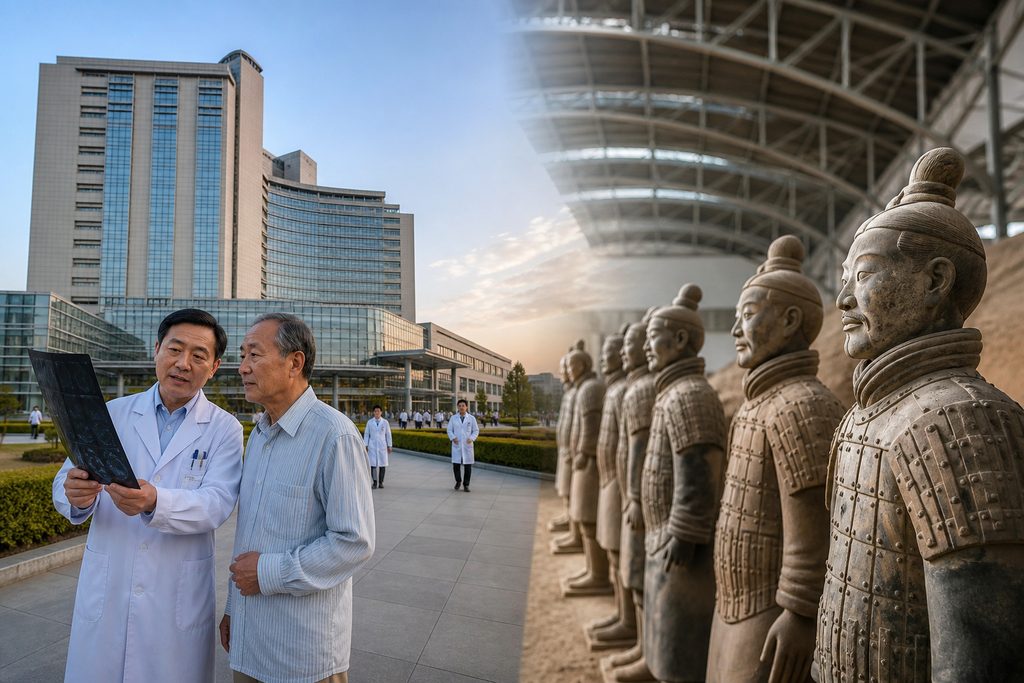
According to the World Health Organization, medical tourism moves roughly 14 million patients across borders each year. A growing number are looking beyond the familiar. They are looking for clinical depth, surgical volume, and a different value equation. For many, that search leads to a single institution: Xijing Hospital in Xi’an. Navigating the Xijing hospital international patient price list feels like reading a map in a language you don’t speak. The numbers are there, but the context is missing. Our team helps patients find that context. We don’t practice medicine. We translate the system.
Xijing Hospital International Patient Price List: The Short Answer
There is no single, fixed price list posted online. Xijing Hospital, like all Chinese public tertiary hospitals, sets fees according to government-regulated schedules that vary by department, surgeon seniority, and the specific international pathway used. You are not buying a product off a shelf.
That said, a cardiac bypass graft that runs $120,000 in the United States typically lands between $15,000 and $22,000 through the hospital’s international VIP channel. A complex spinal fusion might cost $18,000 to $28,000. These are surgical quotes, not all-inclusive travel packages. The Xijing hospital international patient price list is a living document assembled after a specialist reviews your existing scans and medical history. You provide the records. The clinical team provides a tailored treatment plan and cost estimate. That is the real sequence.
Who This Is Right For — and Who It Isn’t
A patient with a clear diagnosis, stable vitals, and existing imaging is typically a good candidate for remote evaluation. So is someone who needs a high-volume surgical team for a complex procedure—Xijing’s neurosurgeons and cardiac surgeons perform thousands of cases annually. The repetition builds a specific kind of expertise that smaller centers cannot replicate.
This path is not right for everyone. A patient in acute crisis should not get on a long-haul flight. Someone without a definitive diagnosis should probably complete that workup at home first. And if the idea of navigating a massive hospital campus where English is rare sounds overwhelming, that fear is real. We won’t pretend otherwise. A 2023 study in the *Journal of Healthcare Management* found that language barriers and unfamiliar administrative systems are the top two stressors reported by international patients in non-English-speaking destinations. A bilingual companion solves the second problem. The first requires patience.
How to Arrange Medical Treatment at Xijing Hospital for Foreigners
The process is linear, but the steps surprise people who are used to emailing a doctor’s office and getting an appointment the same week.
First, you need a formal evaluation. You send your medical records—translated into Chinese, ideally by a medical translator—to the hospital’s international department or through a coordination service. A specialist reviews everything. This written second opinion, which typically costs between $300 and $500, confirms whether the hospital will accept your case and outlines a proposed treatment plan.
Then comes the scheduling. Xijing Hospital is a top-tier military medical university hospital. Its outpatient clinics see over 10,000 patients daily. The international VIP channel bypasses that chaos, but it does not bypass clinical triage. The department head or a senior attending physician must agree to take your case. Once they do, a surgery window is proposed. You do not book a date like a hotel room. You accept a window and plan travel around it.
The visa step follows. For medical treatment, you apply for an S2 visa with a letter of invitation or acceptance from the hospital. Family members accompanying you also apply for S2 visas. The M visa is for commercial trade. It has nothing to do with healthcare. Using the wrong category will get you turned away at the border.
Can I Visit Terracotta Warriors After Surgery?
This is the question that makes our team smile. It comes up in nearly every consultation about Xi’an. The short answer: yes, with a timeline that respects your body’s healing.
The Terracotta Army museum sits about 40 kilometers east of the city center. It is a level-ground site with paved walkways and plenty of benches. That makes it accessible for someone moving slowly. But “moving slowly” is the operative phrase.
For a laparoscopic procedure—a gallbladder removal, a hernia repair—most surgeons clear patients for light walking within a week. A visit on day eight or nine post-surgery, with a private car and a companion to manage crowds, is reasonable. For a major open surgery—a spinal fusion or a thoracotomy—you are looking at a minimum of three to four weeks before a two-hour museum visit makes any sense. Xi’an’s climate matters too. Summers hit 38°C with humidity. Surgical wounds and extreme heat are a bad combination. Spring and autumn are far better windows for recovery tourism.
We have seen patients plan their surgery around this. They arrive two weeks early. They visit the warriors before the operation while they are still mobile and pain-free. Then they focus entirely on recovery afterward. It is a smarter sequence.
What to Do in Xi’an During Medical Recovery
Recovery is not a vacation. But it is also not solitary confinement. The goal is low-impact engagement that does not raise your heart rate or compromise a surgical site.
The Xi’an City Wall is a good option. At 14 kilometers around, you do not need to walk the whole thing. A short stroll on the wide, flat ramparts gives you fresh air and a view of the city without crowds pressing in. The Great Mosque in the Muslim Quarter is another gentle outing. It is a quiet, shaded courtyard complex built in the Tang Dynasty. You can sit on a stone bench for an hour and nobody will rush you.
For longer stays, the hot springs at Huaqing Palace near Mount Li offer a change of scenery. The water is mineral-rich, and the gardens are designed for slow walking. But here is the hard rule: no soaking in hot water until your surgeon explicitly clears it. Incisions and public thermal pools do not mix. The risk of infection is real.
Diet during recovery in Xi’an deserves attention. The local cuisine is heavy on wheat noodles, lamb, and chili oil. Delicious. Not ideal for a post-surgical digestive system. We connect patients with nutrition-focused meal delivery services that prepare bland, high-protein, easily digestible food. Bone broth, steamed fish, congee. Boring, but effective.
What It Costs: A Realistic Breakdown
The Xijing hospital international patient price list is only one line item in the total budget. Here is how the numbers typically break down for a major surgical procedure.
| Cost Category | Estimated Range (USD) | Notes |
|---|---|---|
| Surgical procedure (VIP channel) | $15,000 – $30,000 | Varies by specialty and complexity |
| Pre-op evaluation & imaging | $800 – $2,000 | Includes labs, CT/MRI if not provided |
| Hospital stay (private VIP room) | $200 – $400 per night | Typically 5–14 nights post-surgery |
| Medications & consumables | $1,000 – $3,000 | Anesthesia, antibiotics, dressings |
| Written second opinion (remote) | $300 – $500 | Required before scheduling |
| Bilingual companion (daily) | From $300/day | 8-hour day; hospital navigation & translation |
| Airport transfer (round-trip) | $200 | Private vehicle, meet-and-greet |
| Accommodation (near hospital) | $60 – $150 per night | Service apartment or hotel, 2–4 week stay |
The total for a cardiac or neurosurgical procedure, including a three-week stay and full coordination support, usually lands between $25,000 and $45,000. That is a wide range. But it is an honest one. The final number depends on exactly what the surgeon finds when they open the operating field.
Practical Considerations: Records, Payments, and Follow-Up
Hospitals in China operate on a prepayment model. You deposit funds at admission. The hospital draws down from that deposit as services are rendered. If the balance runs low, you top it up. Any remainder is refunded at discharge. International credit cards are accepted at the VIP counter, but not always reliably. We advise patients to carry a backup debit card and to confirm with their bank that overseas transactions will not be blocked.
Medical records must be complete. Not almost complete. Complete. A missing CT scan from three years ago can delay a surgical decision by a week while you chase down a CD from a clinic back home. We tell patients to gather everything: operative notes, pathology reports, radiology images on disc, current medication list, allergy history. Then we arrange professional medical translation. Google Translate is not sufficient for a surgeon deciding whether to operate on your spine.
After you return home, continuity of care becomes the priority. Xijing Hospital provides a discharge summary in Chinese. We arrange certified translation so your local physician receives a document they can actually read. The surgeon in Xi’an will typically agree to one follow-up video consultation included in the surgical fee. Additional consultations cost between $100 and $300. You need a local doctor who is willing to manage post-operative care based on a Chinese surgical plan. Find that doctor before you travel. Not after.
Frequently Asked Questions
Can I book surgery at Xijing Hospital as a medical tourism package?
No. There is no “book surgery Xijing Hospital medical tourism package” in the way you might book a cosmetic surgery trip to Seoul. Xijing is a military medical university hospital. It treats complex, serious pathology. You cannot purchase a bundled package that includes surgery, hotel, and sightseeing from a single vendor. What you can do is work with a coordination service that arranges the medical evaluation, the surgical scheduling, the visa support, and the on-ground logistics. The surgery itself is a clinical decision made by the hospital. The tourism part is something you build around the edges, carefully, after the surgeon clears you.
What is the cost of kidney transplant at Xijing Hospital?
We need to be direct here. Organ transplantation in China is governed by strict national regulations. Foreign nationals cannot simply arrive and receive a transplant. The system does not work that way. We do not facilitate organ transplant arrangements, and we do not publish pricing that might imply otherwise. If you are researching the cost of kidney transplant at Xijing hospital, you should first speak with your home-country nephrologist about what is clinically appropriate and then engage directly with the hospital’s international department through formal channels. No reputable coordination service will quote you a transplant price. That is a red flag.
What happens if a complication arises after I return home?
This is the hardest question, and the one that keeps people awake. Your surgical team in Xi’an is 10,000 kilometers away. They cannot examine you. You need a local surgeon who agrees, in advance, to accept you as a patient for post-operative complications. Some will. Many will not—they do not want the liability of managing another surgeon’s complication. Our team helps patients identify a receptive local physician before travel. We also arrange a detailed, translated operative report and imaging file that the local surgeon can review. The Xi’an team remains available for phone consultation with your local doctor. But the hands-on care must come from someone in the same room as you. Plan for this reality.
Is the Terracotta Army really accessible for someone recovering from major surgery?
It depends on the surgery and the timeline. The museum has wheelchair ramps and accessible restrooms. You can rent a wheelchair at the entrance. But the site is large, and the pits involve looking down from elevated walkways. If you are four weeks post-spinal fusion and still on lifting restrictions, sitting in a wheelchair for two hours while someone pushes you is feasible. Walking the entire site is not. We advise patients to discuss the specific physical demands with their surgeon at the pre-operative consultation. Ask directly: “When can I walk two kilometers on flat ground? When can I tolerate a 40-minute car ride?” The surgeon’s answers become your recovery tourism timeline.
Your Next Step
Xi’an offers something no other medical destination can. A hospital with one of the highest surgical volumes in China, sitting in the shadow of a 600-year-old city wall, 40 minutes from a 2,200-year-old army frozen in clay. The combination is genuinely unique.
Our team at China Medical Services does not diagnose conditions. We are not a hospital, and we do not employ doctors. What we do is reduce the friction between you and the care you are seeking. We translate records, coordinate with the hospital’s international department, arrange bilingual companions who know which elevator bank leads to the cardiology wing, and help you plan a recovery that might include a slow walk on an ancient wall. If you want to understand the real Xijing hospital international patient price list—the one that applies to your specific case—send us your records. We will get you a written second opinion and a transparent cost breakdown. Then you decide.
Start with a free consultation. There is no pressure and no commitment. Just an honest conversation about whether this path makes sense for you.
For more medical information and treatment options in China, visit chinamedservices.com (China Medical Services).
