Xijing Hospital International Patients: Northwest China’s Top Medical Destination
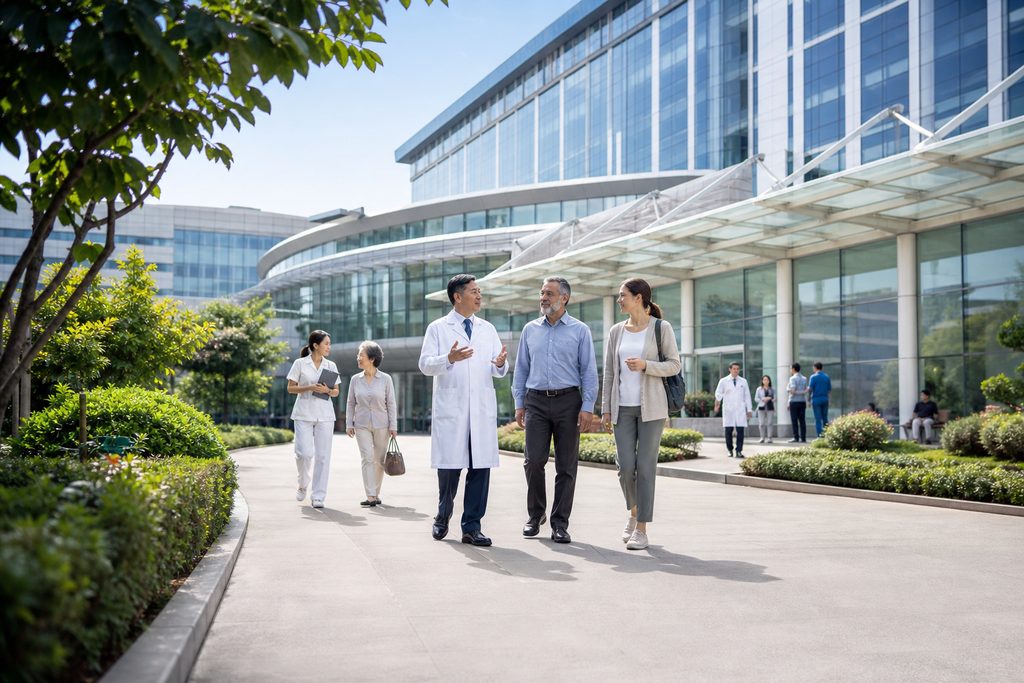
You have probably heard that getting top-tier medical care in China means you have to be in Beijing or Shanghai. That assumption could cost you better outcomes and significant savings. One of the country’s most clinically aggressive and academically rigorous hospitals sits 900 kilometers southwest of Beijing, in Xi’an. Xijing Hospital, the primary teaching hospital of the Air Force Medical University, is not just the best hospital in northwest China for foreigners. It is a national powerhouse that regularly places among the top 10 hospitals in the entire country on the authoritative Fudan University hospital rankings. Our team at China Medical Services has coordinated care here for patients from over a dozen countries. The clinical expertise is staggering. The Xijing Hospital international patients price structure, however, remains one of the most misunderstood aspects of planning care here. Let us fix that.
Key Takeaways
- Xijing Hospital performs over 300,000 surgeries annually and ranks in China’s top 10 nationally, with particular dominance in gastroenterology, neurosurgery, and burns treatment.
- The Xijing Hospital international patients price for major procedures typically ranges from 30% to 70% less than comparable care in Singapore or South Korea, and roughly one-tenth of US rates.
- Independent registration as a foreigner is extremely difficult. The hospital’s standard outpatient system requires in-person queuing, a Chinese ID-linked app, and Mandarin fluency. There is no English-language online booking portal for the public channel.
- All international patients should budget for the VIP International Department channel, which provides English coordination, expedited specialist access, and a transparent pricing schedule before travel.
The Problem: World-Class Surgery, Invisible to the Outside World
Xijing Hospital is not a household name in London or Los Angeles. That is a failure of marketing, not medicine. The hospital houses 3,500 beds. Its outpatient volume exceeds 4 million visits per year. The burn surgery department is the national reference center for all of China. The gastroenterology team, led by some of the most cited researchers in the field, has pioneered digestive tumor endoscopic resection techniques that colleagues in Europe and North America have traveled here to learn. Yet a patient searching for “Xijing Hospital review international patient” will find almost nothing in English. The information gap is real and it is dangerous. It pushes patients toward better-marketed but clinically weaker options.
What does this mean for you? If you need complex abdominal surgery, a revision neurosurgical procedure, or advanced burn reconstruction, you might never know that one of the highest-volume, lowest-complication-rate centers in the world is available. The hospital’s own website is almost entirely in Mandarin. The international patient office exists, but it is not structured for inbound cold inquiries the way a Western private hospital would be. You need a bridge.
Who We Are
We are China Medical Services. We are not a hospital. We do not provide medical treatment, offer clinical diagnoses, or make clinical recommendations. We are your logistical architects. Our team connects international patients with over 340 top-ranked hospitals across 37 Chinese cities. For Xijing Hospital specifically, we handle the pre-arrival coordination that the hospital’s own international desk is not staffed to manage at scale: translating and formatting your medical records to Chinese clinical standards, scheduling specialist consultations through the International Department channel, arranging bilingual medical companions, and ensuring your visa documentation is correct. We bridge the operational gap between a world-class institution and a patient who does not speak the language or navigate the system.
Why Xijing Hospital Delivers Results That Rival Any Global Center
Clinical Volume That Creates Unmatched Surgical Instinct
There is a hard truth in surgery: volume predicts outcomes. A 2023 analysis in The Lancet demonstrated a strong inverse relationship between hospital procedural volume and 30-day postoperative mortality across multiple surgical specialties. Xijing’s volumes are almost difficult to comprehend from a Western perspective. The gastroenterology department performs over 100,000 endoscopic procedures annually. The neurosurgery service completes more than 6,000 cranial cases per year. For context, a busy academic neurosurgery center in the United States might perform 2,000 to 3,000. The surgeons here see rare pathology with regularity. That clinical pattern recognition is not something you can train for. It is something you earn through repetition.
Cost Structures That Defy Western Logic Without Sacrificing Safety
Let us address the elephant in the room directly. The Xijing Hospital international patients price is dramatically lower than Western equivalents. A complex Whipple procedure might cost $18,000 to $25,000 through the International Department. The same procedure in the United States averages $150,000 to $250,000. A craniotomy for tumor resection: $15,000 to $22,000 in Xi’an, versus $70,000 to $150,000 in Germany or the US. These numbers make people nervous. They should not. The cost differential is not explained by lower quality. It is explained by structural economics: lower physician labor costs, higher patient throughput, standardized surgical pathways that reduce length of stay, and the near-total absence of the administrative billing bloat that consumes roughly 25% of US hospital expenditures. The sterilization protocols, imaging technology, and surgical instrumentation are equivalent to any JCI-accredited center globally.
| Procedure | Xijing Hospital (USD) | US Average (USD) | Germany (USD) |
|---|---|---|---|
| Craniotomy (tumor resection) | $15,000 – $22,000 | $70,000 – $150,000 | $45,000 – $80,000 |
| Whipple procedure | $18,000 – $25,000 | $150,000 – $250,000 | $60,000 – $100,000 |
| Total knee replacement | $8,000 – $14,000 | $35,000 – $55,000 | $18,000 – $28,000 |
| Endoscopic submucosal dissection (ESD) | $2,000 – $4,000 | $15,000 – $25,000 | $8,000 – $15,000 |
Prices are estimates through the hospital’s International Department channel and vary by case complexity. Final quotes are provided after medical record review.
Specialties Where Xijing Is the National Benchmark
Some hospitals are good at everything. Xijing is genuinely elite in a few domains that matter enormously. The digestive disease department is consistently ranked among China’s top three by the Fudan Hospital Rankings. The burn and plastic surgery center is the military’s national referral unit and handles reconstruction cases of a complexity rarely seen outside of dedicated trauma centers in conflict zones. The neurosurgery department pioneered awake craniotomy techniques for glioma resection in China and maintains one of the country’s largest brain tumor databases. If your condition falls within these areas, you are looking at a center whose outcomes data competes with MD Anderson or Charité, not with a regional hospital.
What You Need to Know Before Going Alone
We have seen intelligent, resourceful patients try to arrange care at Xijing Hospital independently. Most fail. Not because the hospital is unwelcoming, but because the system was designed for domestic patients who speak Mandarin and hold Chinese national ID cards. Here is what you are up against.
- Registration requires a Chinese ID-linked app or physical queuing: The standard outpatient booking system operates through WeChat mini-programs that authenticate via Chinese national ID. Foreign passport holders cannot complete this process. The alternative is showing up at 6:00 AM to queue for a limited number of same-day tickets, with no guarantee the specialist you need is available. If you do not speak Mandarin, you cannot communicate at the registration window.
- Medical records must be translated to clinical-grade Chinese: The hospital will not accept English-language pathology reports, imaging summaries, or referral letters. Your records need to be translated by someone who understands medical terminology in both languages. A generic translation service will mistranslate “moderately differentiated adenocarcinoma” in ways that affect triage decisions.
- Surgery scheduling requires an in-person specialist consultation first: There is no mechanism to book a surgery date remotely through the public channel. You must see the specialist in person. They must agree to take your case. Only then does scheduling begin. This means you need to be physically in Xi’an before you know your surgical timeline.
How We Help You Navigate This
Our process exists because these barriers are structural, not incidental. We do not ask the hospital to make exceptions. We use the correct channel from the start.
Before you travel, we collect your medical records, imaging files, and referral documentation. Our team translates everything to the standard required by Chinese teaching hospitals — including pathology reports, surgical notes, and DICOM imaging summaries. We submit your case through the Air Force Medical University hospital international service desk, not the public queue. This triggers a specialist review. If the relevant department accepts your case, we confirm the consultation date, the estimated Xijing Hospital international patients price for your procedure, and the expected length of stay. Only then do you book your flight.
On the ground in Xi’an, a bilingual medical companion meets you at the hospital. This person handles registration, payment, pharmacy runs, and real-time interpretation during every doctor interaction. You focus on your health. We handle the friction. After discharge, we coordinate follow-up imaging reviews and any necessary telemedicine consultations with your surgeon before you fly home.
Frequently Asked Questions
The Xijing Hospital international patients price varies significantly by procedure and the channel used. Through the International Department, a major surgery like a craniotomy or Whipple procedure typically ranges from $15,000 to $25,000. Less invasive procedures like advanced endoscopic resections run $2,000 to $4,000. These prices include the surgeon’s fee, anesthesia, operating theater costs, and standard ward hospitalization. They do not include pre-operative imaging, specialized implants, or extended ICU stays. Every case receives a customized quote after the department reviews your medical records. The public channel is cheaper but functionally inaccessible to non-Mandarin speakers without local assistance.
The honest answer: you cannot easily do it alone. The public registration system requires a Chinese ID-authenticated app or in-person queuing with Mandarin communication. The practical path is through the hospital’s International Department, which accepts foreign passport holders and provides English coordination. This requires advance submission of translated medical records and a case review by the relevant specialist. Our team handles this entire process. We translate your documents, submit through the correct channel, and confirm your appointment before you travel. Attempting to register independently through the public system without Mandarin fluency will almost certainly waste days and may fail entirely.
No. Xijing Hospital is a public military medical university teaching hospital. It does not offer pre-packaged “medical tourism” products with bundled pricing, hotel arrangements, or fixed itineraries. Any entity claiming to sell a “Xijing Hospital medical tourism package” is a third-party intermediary, not the hospital itself. What exists is the International Department channel, which provides expedited specialist access and English coordination at a premium. Accommodation, local transport, and post-operative recovery logistics are arranged separately. We coordinate all of this for our patients, but we are transparent that it is a customized service, not a fixed-price product.
Any honest Xijing Hospital review international patient will mention two things: the clinical expertise is undeniable, and the administrative experience is chaotic without help. The hospital is enormous, crowded, and operates on a scale that can overwhelm someone accustomed to a 200-bed private hospital. Surgeons are direct, consultations are efficient rather than leisurely, and the environment is functional rather than luxurious. Patients who come through the International Department channel with a bilingual companion consistently report high satisfaction with surgical outcomes. Patients who attempt the public channel alone frequently describe frustration with language barriers and navigation. The medicine is world-class. The patient experience requires a guide.
Xijing Hospital is a tertiary referral center with full intensive care capability, 24-hour in-house attending coverage, and the capacity to manage complex post-operative complications. The hospital’s complication rates for high-volume procedures are published in Chinese medical literature and benchmark favorably against international standards. That said, no surgery is risk-free. We advise all patients to carry comprehensive medical evacuation insurance that covers repatriation in the unlikely event of a catastrophic complication requiring long-term care in your home country. We also recommend bringing a family member or companion. Our bilingual medical companions are present throughout your hospitalization, but they are coordinators and interpreters, not substitute family members.
Your Next Step
Xijing Hospital represents a genuine opportunity: access to elite surgical care at a fraction of Western prices, in a center whose clinical volumes create a level of specialist expertise that is difficult to match anywhere. The barrier has never been the quality of the medicine. It has been the complexity of access. That barrier is solvable.
If you are considering treatment at the Air Force Medical University’s flagship hospital, start with a conversation. We will review your case, explain the realistic timeline and costs, and tell you honestly whether Xijing is the right fit. There is no pressure and no obligation. Just clarity. Request a free consultation here.
Medical Disclaimer: This article is for informational purposes only and does not constitute medical advice. Treatment decisions should be made in consultation with a qualified physician. Prices cited are estimates based on historical cases and vary by hospital, procedure complexity, and individual patient factors. China Medical Services does not provide medical treatment or clinical diagnoses.
For more medical information and treatment options in China, visit chinamedservices.com (China Medical Services).
