Medication Refill in China: How Our Pharmacy Service Works for Foreigners
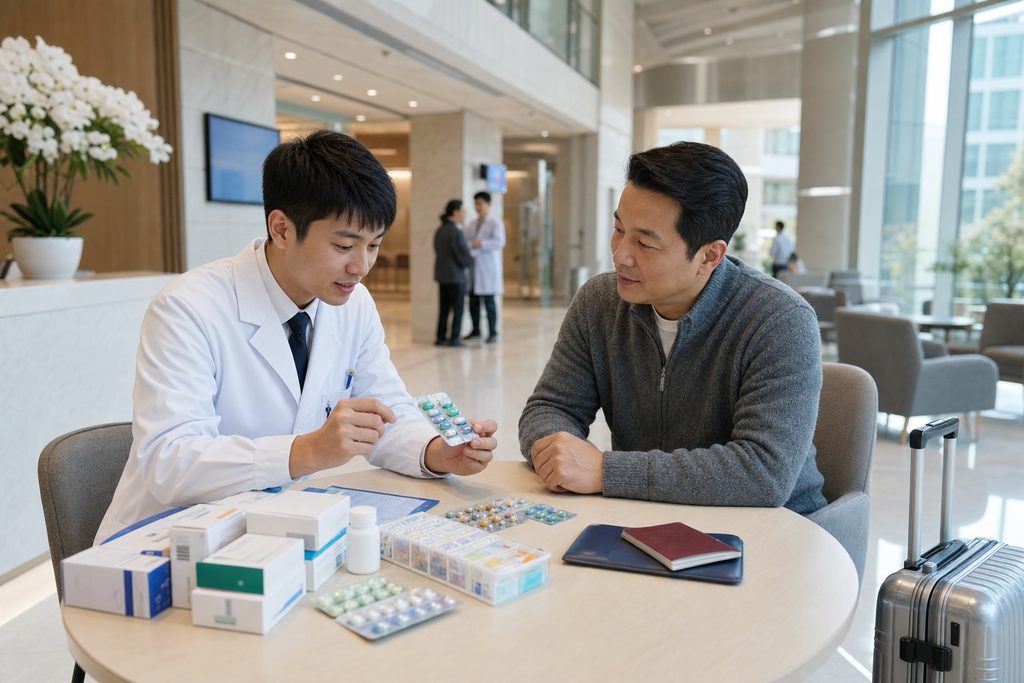
You have probably heard that getting prescription medication in China as a foreigner is a bureaucratic nightmare. The reality is more nuanced. A medication refill China pharmacy service does exist, and with the right preparation, the process is far smoother than most expats and medical travelers expect. This guide explains exactly how refills work, what you need to bring, what it costs, and where the real friction points are — so you can plan around them instead of being surprised by them.
Key Takeaways
- China has over 600,000 licensed retail pharmacies, but only hospital-affiliated pharmacies routinely stock the exact brand-name and specialty medications foreign patients need.
- Prescriptions from overseas doctors are not directly honored at Chinese pharmacies — you need a Chinese physician to reissue the prescription after reviewing your medical records.
- Refill costs for common chronic medications run 30–70% lower than US cash prices, though imported brand-name drugs carry a premium.
- Language barriers, not regulation, are the biggest practical obstacle — most community pharmacists do not speak English.
The Problem: Refilling a Foreign Prescription Is Not a Simple Counter Transaction
Walk into any pharmacy in Shanghai, Beijing, or Guangzhou with a prescription from your doctor in London, Dubai, or Los Angeles, and you will hit a wall. Chinese pharmacies operate under the National Medical Products Administration (NMPA) framework, which requires prescriptions to be issued by a physician licensed in China. Your overseas script is a useful reference document. It is not a dispensing order.
This surprises many international patients. A 2023 survey of foreign residents in China found that 68% struggled with at least one aspect of the medication refill process during their first six months in the country. The issue is not medication availability — China manufactures and imports a vast range of pharmaceuticals. The issue is process. You need a local prescription, and getting one requires a hospital visit or a telemedicine consultation with a Chinese-licensed physician.
Why a Medication Refill China Pharmacy Service Delivers Results
Once you understand the system, it works with surprising efficiency. The key is knowing which channel to use for your specific medication.
Hospital Pharmacies Stock What Community Pharmacies Do Not
China’s top-tier public hospitals — the 340+ facilities in our database — operate their own in-house pharmacies. These are not like Western outpatient pharmacies. They are integrated into the hospital’s formulary system and stock the exact medications prescribed by that hospital’s physicians. For patients managing chronic conditions like hypertension, diabetes, or thyroid disorders, this is the most reliable refill channel. You see a specialist, they write a prescription in the hospital’s electronic system, and you collect the medication on-site. Same building. Same visit.
Community pharmacies, by contrast, stock a narrower range — mostly over-the-counter products, traditional Chinese medicine preparations, and common generics. If you need a specific imported brand-name medication, a hospital pharmacy is almost always your best bet.
Electronic Prescriptions and Delivery Are Widely Available
China has built one of the world’s most advanced digital pharmacy infrastructures. Major platforms like Alibaba Health and JD Health connect patients with licensed physicians for online consultations, after which e-prescriptions are issued and medications delivered — often within 24–48 hours in major cities. This is the backbone of any China pharmacy delivery for international patients model. You do not need to physically revisit a hospital for every refill. Once a Chinese physician has issued the initial prescription, follow-up refills can frequently be handled through hospital apps or third-party platforms, depending on the medication class.
Cost Advantage Without Quality Compromise
Let’s talk numbers. A 30-day supply of generic amlodipine (a common blood pressure medication) costs roughly $3–8 at a Chinese hospital pharmacy. The same medication retails for $15–40 in the United States without insurance. Metformin for diabetes? Around $2–5 per month in China versus $10–30 in the US. These are structural differences driven by government price controls, domestic manufacturing scale, and lower distribution costs — not quality shortcuts. Chinese generic drug manufacturers must meet NMPA bioequivalence standards, which align closely with FDA requirements.
How to Refill Prescription in China as Foreigner: The Step-by-Step Process
This section walks through the exact sequence you will follow, whether you are already in China or planning ahead from abroad.
Step 1: Gather your medical records. Bring your current prescription, a letter from your home physician stating your diagnosis and medication history, and any relevant lab results. These documents do not authorize a refill, but they dramatically speed up the Chinese physician’s assessment.
Step 2: Book a consultation with a Chinese-licensed physician. This can be an in-person visit at a hospital’s international department or a video consultation. Many top hospitals in Beijing and Shanghai offer English-speaking international clinics. The physician reviews your records and issues a Chinese prescription if they agree the medication is appropriate.
Step 3: Fill the prescription at the hospital pharmacy. In most public hospitals, the pharmacy is on the ground floor or clearly signposted. You pay first at the cashier, then present the receipt at the pharmacy counter. Wait times are typically 10–30 minutes.
Step 4: Arrange refills. For ongoing medications, ask the physician about the hospital’s refill protocol. Many hospitals allow repeat prescriptions through their official app or patient portal. Some medications, particularly controlled substances, require an in-person visit for every refill.
Controlled medications are different. Narcotics, psychotropics, and certain sleep medications fall under China’s strict controlled substance regulations. Refills require a special prescription form, in-person visits, and often a hospital pharmacy only. Do not assume your home country’s rules apply.
Can Foreigners Get Medication Refills in Shanghai? City-Specific Realities
Shanghai deserves its own section because it is China’s most international medical hub and the city where most foreign patients first encounter the refill system. The short answer: yes, foreigners can get medication refills in Shanghai, and the city offers more English-language pharmacy support than anywhere else in mainland China.
Shanghai’s top-tier hospitals — including Zhongshan Hospital, Ruijin Hospital, and Huashan Hospital — all operate international departments with English-speaking staff. These departments handle the full refill workflow: physician consultation, prescription issuance, and pharmacy collection. Several private international hospitals in Shanghai, such as Jiahui and United Family, offer direct insurance billing and Western-style pharmacy services, which can simplify the process considerably if your insurance covers them.
Community pharmacy access in Shanghai is also better than in smaller cities. Some pharmacies in expat-heavy districts like Jing’an and Pudong employ English-speaking staff, though this is not guaranteed. For reliable English-language service, the hospital international department remains the safest route.
Prescription Refill Cost China: What You Will Actually Pay
| Medication Category | Typical Monthly Cost in China (USD) | Typical Monthly Cost in US Without Insurance (USD) |
|---|---|---|
| Generic blood pressure medication (e.g., amlodipine) | $3–8 | $15–40 |
| Generic diabetes medication (e.g., metformin) | $2–5 | $10–30 |
| Imported brand-name statin (e.g., Lipitor equivalent) | $25–50 | $80–200 |
| Asthma inhaler (brand-name) | $30–60 | $100–300 |
| Physician consultation for prescription issuance | $30–150 (international department) | $100–400 (specialist visit) |
These figures vary by hospital tier and case complexity. Private international hospitals charge more — consultation fees run $100–250, and medications carry a markup. Public hospital international departments sit in the middle. Standard public hospital clinics are cheapest but offer limited English support.
If you are wondering how to book medication refill service China before you travel, the most practical approach is a remote consultation. Many hospitals now offer video consultations where a physician reviews your records and issues a prescription that can be collected when you arrive — or in some cases, delivered to a local address. This is exactly the kind of coordination our team handles regularly.
Practical Considerations: Documentation, Payment, and Follow-Up
Here is what you need to handle the refill process without unnecessary friction.
Documents. Bring your passport, your overseas prescription, a physician’s letter, and ideally a translated summary of your medical history. Chinese physicians will not accept a foreign prescription as valid, but they will use it as clinical context. A professional medical translation helps, though many international department physicians read English.
Payment. Public hospitals require upfront payment — cash, Chinese debit cards, or major mobile payment platforms like WeChat Pay and Alipay. International credit cards are accepted at some international departments and most private hospitals, but do not count on it everywhere. If you have international health insurance, confirm whether the hospital offers direct billing or whether you must pay and seek reimbursement.
Visa. For medical travel to China, the applicable short-stay category is the S2 visa, annotated for medical treatment. This is the correct visa for coming to China for consultations, prescription issuance, and medication collection. Accompanying family members also apply for S2 visas. Requirements vary by embassy, so check with the Chinese consulate in your home country before applying.
Language. Outside international departments, English is rare. Hospital pharmacies, cashiers, and nursing stations operate in Chinese. If you are navigating a standard public hospital without language support, a bilingual companion saves hours of confusion. This is a practical reality, not a sales pitch.
Follow-up after returning home. Most Chinese prescriptions are valid for 30 days. If you need ongoing refills after leaving China, ask the hospital about their international refill policy. Some hospitals will reissue prescriptions via telemedicine for established patients. Others require a new in-person visit. Clarify this before you depart.
Frequently Asked Questions
China allows travelers to bring personal-use medication for the duration of their stay, typically up to a 90-day supply, with a doctor’s letter and prescription. Beyond that, you need a local refill. Controlled substances require prior approval from Chinese customs authorities.
Most common medications have a locally available equivalent, either as a generic or a different brand of the same molecule. Your Chinese physician will identify the closest match. If no equivalent exists, you may need to explore importation through a hospital’s special approval pathway, which is possible but slow. Always confirm availability before relying on a China refill.
For a hospital international department visit: 2–4 hours including consultation, payment, and pharmacy collection. For a telemedicine consultation with e-prescription and delivery: 24–72 hours in major cities. For controlled substances requiring in-person visits: allow a full day and expect stricter documentation requirements.
Most hospital apps and pharmacy delivery platforms require a Chinese phone number for registration. A Chinese bank account is not strictly necessary if you pay via international credit card where accepted, but mobile payment platforms like WeChat Pay and Alipay are far more convenient and often require a local bank card. Some international hospitals accept foreign cards directly.
Your Next Step
Refilling a prescription in China is manageable once you know the rules: get a Chinese physician to reissue the prescription, use hospital pharmacies for reliable stock, and plan around language barriers. Our team at China Medical Services helps international patients coordinate consultations, navigate hospital pharmacies, and arrange bilingual support — we are not a hospital and do not provide medical advice or diagnoses. If you are planning a medical trip and need clarity on your medication situation, start with a free consultation to map out your specific needs.
For more medical information and treatment options in China, visit chinamedservices.com (China Medical Services).
