How Does All-on-4 Work in China? Our Full Mouth Process Explained
All-on-4 Dental Implants in China: The Short Answer
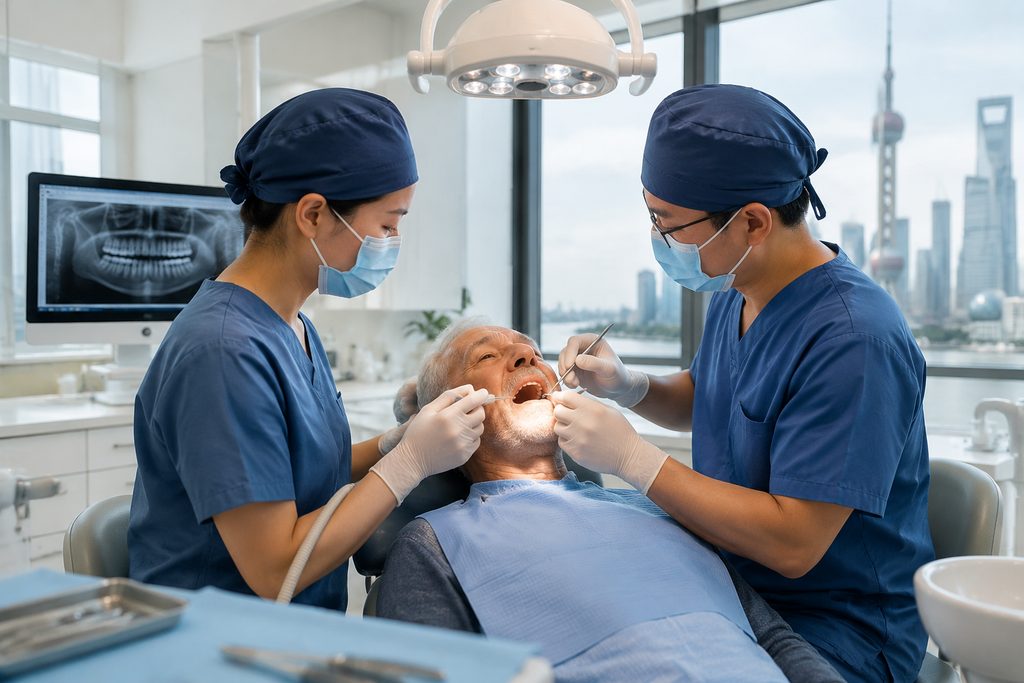
All-on-4 works in China the same way it does in the United States or Europe: four titanium implants per arch support a full fixed bridge of prosthetic teeth. The surgical protocol was developed by Nobel Biocare and is used by certified oral surgeons across China’s top dental hospitals. For international patients, the real difference is cost and coordination. A full mouth All-on-4 procedure in China typically ranges from $18,000 to $35,000, compared with $45,000 to $80,000 in the U.S. The process requires two trips or one extended stay of roughly two to three weeks for the surgical placement and initial prosthesis fitting.
But the logistics are more complicated than a price tag suggests. Hospital selection, language barriers, and follow-up care all shape whether your outcome matches the brochure. Let’s walk through exactly how the process works, what it costs, and where it makes sense.
Who This Is Right For — and Who It Isn’t
All-on-4 suits patients who have lost most or all of their teeth in one or both arches and have enough bone volume to support implants without extensive grafting. The angled posterior implants, typically placed at 30 to 45 degrees, allow surgeons to avoid the sinus cavity in the upper jaw and the inferior alveolar nerve in the lower jaw. That’s the core engineering advantage over traditional implant-supported bridges requiring six to eight implants.
Good candidates typically have:
- Full or near-full edentulism in at least one arch
- Adequate bone density in the anterior maxilla or mandible
- Controlled diabetes (HbA1c below 7.0%)
- No active periodontal infection
- Realistic expectations about prosthetic aesthetics and maintenance
Poor candidates include:
- Patients with severe, uncontrolled osteoporosis who have been on IV bisphosphonates
- Heavy smokers unwilling to pause for at least two weeks before and eight weeks after surgery
- Those with active, untreated gum disease
- Patients whose primary motivation is purely cosmetic and who retain salvageable natural teeth
- Anyone unable to return for at least one follow-up visit or commit to remote monitoring
If you have a single missing tooth or only a few gaps, All-on-4 is the wrong tool. A conventional implant bridge or partial denture costs less and preserves more natural structure. We say this plainly because a reputable Chinese oral surgeon will say the same thing.
The Options, Compared
Not every full-arch restoration is the same. The table below compares the genuine alternatives a patient should consider before committing to All-on-4 in China.
| Option | Implants per Arch | Cost in China (USD) | Cost in U.S. (USD) | Treatment Timeline | Best For |
|---|---|---|---|---|---|
| Conventional Full Bridge | 6–8 | $22,000–$40,000 | $50,000–$90,000 | 4–8 months | Patients with adequate bone volume who want maximum load distribution |
| All-on-4 | 4 | $18,000–$35,000 | $45,000–$80,000 | 2–4 weeks (immediate load) or 3–6 months (delayed load) | Patients with moderate bone loss who want a fixed prosthesis without grafting |
| All-on-6 | 6 | $24,000–$42,000 | $55,000–$95,000 | 3–6 months | Patients with good bone who want extra stability and easier single-implant repair |
| Implant-Retained Overdenture | 2–4 | $8,000–$18,000 | $20,000–$40,000 | 2–3 months | Budget-conscious patients who accept a removable prosthesis |
| Zygomatic Implants | 2–4 zygomatic + 2–4 standard | $30,000–$50,000 | $70,000–$120,000 | 4–8 months | Severe maxillary bone loss where conventional implants are impossible |
The All-on-4 column suits most international patients because it avoids the cost and recovery time of bone grafting. But if your CBCT scan shows severe posterior maxillary atrophy, a Chinese oral surgeon may recommend zygomatic implants instead — a specialty in which several Shanghai and Beijing hospitals have substantial case volume. If cost is the dominant factor and you can tolerate a removable prosthesis, an implant-retained overdenture at a public hospital’s international department may be the smarter financial decision.
How Does All-on-4 Work Step by Step in China?
The clinical steps are universal. The coordination steps are what differ for foreign patients. Here is the sequence we typically facilitate for patients traveling to Shanghai or Beijing for full mouth dental implants.
Step 1: Remote records review. You send a recent panoramic X-ray and, ideally, a CBCT scan. A Chinese oral surgeon reviews the images and gives a preliminary assessment of bone volume, sinus position, and nerve proximity. This is not a treatment plan yet — it is a feasibility screen. Expect to pay $100 to $300 for a video consultation at a top hospital’s international department.
Step 2: In-person examination and CBCT. You fly to China. The hospital takes its own CBCT scan, intraoral photographs, and impressions. The surgeon confirms implant positions using digital planning software. This visit usually takes one day.
Step 3: Surgical placement. Under local anesthesia with sedation or general anesthesia, the surgeon places four implants per arch. The two anterior implants go in vertically. The two posterior implants angle at 30 to 45 degrees. Surgery for both arches takes roughly 2.5 to 4 hours.
Step 4: Immediate prosthesis. In most cases, the surgeon attaches a temporary fixed acrylic bridge on the same day or within 48 hours. You leave the hospital with functional teeth. This immediate-load protocol is the defining feature of All-on-4, but it requires sufficient primary implant stability — typically a torque value above 35 Ncm. If stability is borderline, the surgeon may choose a delayed-load protocol and you wear a temporary denture for three to six months.
Step 5: Healing and final prosthesis. Osseointegration takes three to six months. You return home during this period. After integration, you fly back for the final zirconia or porcelain-fused-to-metal bridge. This second trip takes about one week for fitting and adjustments.
That’s the honest sequence. Two trips, or one extended stay if you prefer to remain in China during healing. Some patients ask whether they can do everything in one week. The answer is no, not if you want a final prosthesis that fits properly.
What All-on-4 Dental Implants Cost in China
The headline number for all-on-4 dental implants cost China is $18,000 to $35,000 for a full mouth, depending on hospital tier and prosthetic material. Single-arch treatment runs $9,000 to $18,000. These figures include the surgical placement, the temporary prosthesis, and the final bridge. They do not include flights, accommodation, or visa fees.
What drives the variance?
- Hospital tier: A public tertiary hospital’s international department in Shanghai charges 1.5 to 2 times the standard outpatient rate. A private international hospital like United Family or Jiahui charges more again, but offers direct insurance billing and fully English-speaking staff.
- Prosthetic material: Acrylic temporary bridges are included. The final prosthesis in zirconia costs $3,000 to $6,000 per arch. Porcelain-fused-to-metal costs less but shows a metal margin at the gumline over time.
- Implant brand: Nobel Biocare and Straumann implants carry a premium. Domestic Chinese brands approved by the NMPA cost 30 to 40 percent less and have published five-year survival rates comparable to imported systems in several Chinese clinical studies.
- Bone grafting: If the CBCT shows insufficient bone for even angled implants, a minor sinus lift or ridge augmentation adds $1,500 to $4,000 per site.
Full mouth dental implants price Shanghai tends to sit at the higher end of the national range. Beijing is similar. Cities like Chengdu, Hangzhou, and Guangzhou often run 10 to 20 percent lower for the same clinical protocol. The trade-off is fewer English-speaking staff and less experience with international patients. Our team works across 340+ top-ranked hospitals in 37 cities, so we can match your budget to the right tier.
Is All-on-4 Safe in China?
The short answer is yes, at accredited hospitals. The longer answer requires distinguishing between surgical safety and regulatory oversight. China’s top oral and maxillofacial surgery departments — those ranked among the top 10 nationally in the Fudan specialty reputation rankings — perform thousands of implant procedures annually. Infection control protocols at tertiary public hospitals and JCI-accredited private facilities meet international standards. Published implant survival rates from Chinese university hospitals range from 94 to 98 percent at five years for All-on-4 protocols, consistent with European and North American data.
Where safety concerns are legitimate is in unaccredited clinics. China has over 35,000 hospitals, and the bottom tier includes small private dental chains with variable sterilization practices and limited surgeon training. The price gap exists for a reason. A clinic quoting $6,000 for full-mouth All-on-4 is cutting costs somewhere — usually implant brand, prosthetic lab quality, or surgeon experience. We only coordinate with hospitals on the Fudan top 100 list or JCI-accredited international facilities. You can browse specialty rankings across 45 departments to see which hospitals lead in oral surgery.
Practical Considerations for Booking All-on-4 in China
Visa: You will need an S2 visa for short-term private affairs including medical treatment. The hospital’s international department issues an invitation letter and treatment confirmation document. Your accompanying family member applies for the same S2 category. Processing takes one to three weeks depending on your home country’s Chinese embassy or consulate. We provide document checklists but do not guarantee approval — that decision rests entirely with the visa officer.
Payment: Public hospitals require prepayment before surgery. Most international departments accept major credit cards and international wire transfers. Private international hospitals often bill your insurer directly if you have a plan with overseas coverage. Check whether your policy covers treatment in China before committing. Many expatriate and travel medical policies do; most U.S. domestic dental plans do not.
Language: Even at top-tier public hospitals, the front desk and nursing staff may not speak English. The surgeon may speak some English but will explain complex surgical details in Chinese. A bilingual medical companion handles registration, payment, queueing, and translation during consultations. This is the single most underrated factor in whether an international patient’s experience goes smoothly. Our companion service starts from $300 per day and includes full-day hospital accompaniment.
Records: Bring every dental record you have. Previous X-rays, failed implant reports, periodontal charts, and a list of medications. Chinese surgeons are thorough but will not have access to your home country’s dental history unless you provide it. A written second opinion from a top specialist costs $300 to $500 and is credited toward coordination if you proceed.
Follow-up after returning home: You need a local dentist willing to monitor your implants. Not every Western dentist is comfortable taking over a case performed abroad. Find one before you book surgery, not after. Ask whether they will handle maintenance, adjustments, and any complications. If they refuse, factor that into your decision.
Frequently Asked Questions
Four implants per arch are placed surgically, with the two posterior implants angled to maximize bone contact. A temporary fixed bridge is attached within 48 hours in most cases. The final prosthesis is fitted after three to six months of healing. The full process from first consultation to final bridge takes four to eight months, including two trips to China.
At Fudan-ranked or JCI-accredited hospitals, yes. Published five-year implant survival rates from Chinese university hospitals range from 94 to 98 percent. The risk lies in choosing an unaccredited low-cost clinic. If a quote seems too good to be true, it usually reflects corners cut on implant brand, lab quality, or surgeon experience.
Shanghai and Beijing are comparable, typically $22,000 to $35,000 for full-mouth All-on-4 at top international departments. Second-tier cities like Chengdu or Hangzhou often run 10 to 20 percent lower. The price difference reflects lower operating costs, not lower clinical standards at top-ranked public hospitals.
You can book the consultation and records review remotely. You cannot book surgery itself without an in-person examination — public hospital rules require the surgeon to see you before scheduling the operating room. The standard path is a video consultation first, then travel for the exam, then surgery within the same trip. A hospital appointment coordination service starts from $300 and is fully refunded if the appointment cannot be secured.
Implant failure rates for All-on-4 are roughly 2 to 6 percent at five years. If a single implant fails, the bridge can often be modified to function on three implants until a replacement is placed. The Chinese hospital will provide your records and imaging to your local dentist. Some hospitals offer a warranty period for the prosthesis, but this varies — confirm the terms in writing before surgery.
Your Next Step
All-on-4 in China offers a genuine cost advantage — typically 50 to 60 percent below U.S. pricing — without compromising clinical standards at top-tier hospitals. The process is well-defined, the technology is mature, and the outcomes are documented. What makes or breaks the experience is coordination: choosing the right hospital, navigating the visa, and having someone in the room who speaks both languages fluently.
We are not a hospital and we do not diagnose or treat. Our team at China Medical Services helps you evaluate whether Chinese dental care is right for your case, then handles the logistics if you decide to proceed. If you are considering full mouth rehabilitation and want an honest assessment of your options, request a free consultation. We will review your situation and tell you plainly whether China is worth the trip.
For more medical information and treatment options in China, visit chinamedservices.com (China Medical Services).
