Sleep Study: Do You Need One? Costs, Process, and Options in China
How This Actually Works, Step by Step
You’ve probably heard that getting a sleep study abroad means navigating a maze of unfamiliar hospitals, language barriers, and uncertain pricing. The reality is more straightforward than you might think, especially if you know the sequence. Here is what actually happens when an international patient pursues a sleep study in China.
First, you send us your existing medical records: any referral letters, previous sleep questionnaires like the Epworth Sleepiness Scale, relevant blood work, and notes from your primary care physician. Our team translates these into Chinese and forwards them to the sleep medicine department at a hospital that matches your needs. A sleep specialist reviews the documents and determines whether polysomnography is clinically indicated. That review typically takes three to five business days.
Second, if the specialist agrees that a study is warranted, we coordinate with the hospital’s international patient center to find an available overnight slot. You are not booking a specific specialist’s calendar months in advance; you are booking a bed in a monitored sleep lab. This is an important distinction. For a standard diagnostic polysomnogram, the wait is usually one to three weeks once your documents are accepted.
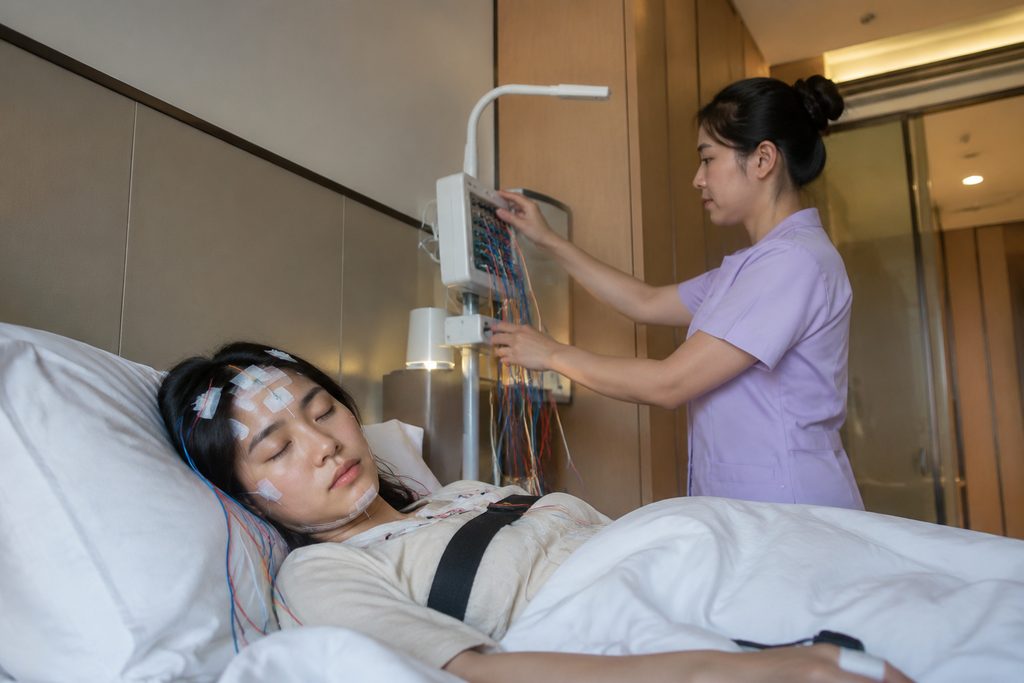
Third, you arrive. The study itself runs one night. You are connected to sensors that track brain waves, eye movement, heart rate, breathing effort, airflow, blood oxygen, and leg movement. A technician monitors you from a separate room. In the morning, the sensors come off, and you leave. The raw data goes to a scoring technologist, then to a sleep physician for interpretation.
Fourth, the report. You receive a written summary with your apnea-hypopnea index (AHI), oxygen saturation patterns, sleep staging, and a diagnostic impression. If obstructive sleep apnea is confirmed, the report includes severity classification and treatment direction. That report is yours to take back to your home physician or to use as the basis for further treatment in China.
Is a Sleep Study Necessary for Sleep Apnea? The Clinical Threshold
Not everyone who snores needs a lab study. But a surprising number of people skip one when they genuinely need it. The American Academy of Sleep Medicine (AASM) recommends polysomnography when clinical suspicion for moderate to severe obstructive sleep apnea is high, when home sleep testing is inconclusive, or when comorbid conditions like heart failure, chronic opioid use, or neuromuscular disease complicate the picture.
So how do you know if you cross that threshold? Three signals matter most. Witnessed apneas — a bed partner who reports that you stop breathing, gasp, or choke during sleep — are the strongest single predictor. Daytime impairment that resists explanation, such as falling asleep at red lights or during meetings, raises the urgency. And resistant hypertension or atrial fibrillation that does not respond to standard treatment often traces back to untreated sleep-disordered breathing. If any of those fit, a lab study is not a luxury. It is the diagnostic standard.
Home sleep tests exist. They are cheaper and more convenient. But they measure fewer channels, miss non-apnea sleep disorders entirely, and underestimate severity in roughly 10 to 15 percent of cases according to published validation studies. A negative home test in a symptomatic patient does not close the case. That is when an attended overnight study becomes necessary.
What a Sleep Study Actually Measures — and How Long an Overnight Sleep Study Takes
People often ask how long does an overnight sleep study take. The honest answer: expect to be in the lab for eight to ten hours from check-in to discharge. You arrive between 8:00 and 9:00 PM. Sensor application takes 30 to 60 minutes depending on your hair, skin, and how many electrodes the protocol requires. Lights-out typically happens between 10:00 and 11:00 PM. Recording continues for six to eight hours, ending between 5:00 and 6:30 AM. You leave after a brief morning questionnaire and sensor removal.
What does the equipment track? A standard in-lab polysomnogram records electroencephalography (EEG) for sleep staging, electrooculography (EOG) for eye movement, electromyography (EMG) for chin and leg muscle activity, electrocardiography (ECG), nasal airflow, respiratory effort via chest and abdominal belts, pulse oximetry, body position, and sometimes audio-video recording. That is a lot of channels. The technician’s job is to ensure signal quality all night. If a sensor slips, they reattach it. If you need to use the bathroom, they disconnect you temporarily.
Some patients worry they will not sleep. That happens. Even four hours of recorded sleep is usually enough for a valid study. Sleep labs know this and design protocols accordingly. The key variable is not comfort; it is signal integrity. A well-run lab gets usable data on the first night in the large majority of cases.
Sleep Study Cost China: What International Patients Actually Pay
Here is where the numbers get concrete. A full attended polysomnography in a top-tier Chinese hospital international department or VIP sleep center typically runs between $400 and $900. That includes the overnight stay, all sensor materials, technician monitoring, and the physician’s interpretation report. Public hospital standard departments charge less — sometimes $150 to $350 — but those slots rarely accommodate English-speaking patients without a bilingual coordinator, and the report will be in Chinese.
Compare that to the United States, where an in-lab sleep study frequently bills between $2,000 and $5,000 before insurance, and even insured patients often face $500 to $1,500 in deductibles and coinsurance. The sleep study cost China offers is roughly one-fifth to one-third of the American cash price. In Europe, prices vary widely: Germany and Switzerland run €1,200 to €2,500; the UK’s private sector charges £1,000 to £2,000. China’s pricing sits at the lower end of the global range while the equipment — often Philips Respironics, Natus, or Compumedics systems — is the same generation used in Western labs.
| Location | Typical Attended Polysomnography Cost | Notes for International Patients |
|---|---|---|
| China — public hospital, standard dept. | $150–$350 | Chinese-language report; limited English support |
| China — international/VIP dept. | $400–$900 | English report; bilingual coordination available |
| United States | $2,000–$5,000 | Insurance-dependent; high deductibles common |
| United Kingdom (private) | $1,300–$2,600 | Long wait times in NHS; private faster |
| Germany / Switzerland | $1,500–$2,800 | High quality; high cost |
Prices vary by hospital tier and case complexity. A split-night study — where the first half diagnoses and the second half titrates CPAP pressure — costs more than a diagnostic-only night. Multiple-night protocols for complex parasomnias cost more still. The figures above are reference ranges, not quotes.
Polysomnography Price Shanghai vs. Beijing: Where to Book
If you are deciding between cities, the polysomnography price Shanghai and Beijing clinics charge is broadly similar, with Shanghai’s private international hospitals sometimes running 10 to 20 percent higher than Beijing’s public hospital international departments. What differs more is availability and specialization.
Shanghai has a concentration of JCI-accredited private hospitals — United Family, Jiahui, Parkway — that run Western-style sleep labs with English-speaking technicians and direct insurance billing. A polysomnography at one of these facilities typically lands in the $700 to $900 range. The experience feels familiar to Western patients: private room, hotel-like amenities, English-language report.
Beijing offers strong public hospital options. Several top-ranked respiratory and neurology departments in the capital operate dedicated sleep centers with high patient volumes. The international departments of these hospitals charge $400 to $700 for an attended study. You get access to physicians who see complex sleep-disordered breathing cases daily. The trade-off is a more clinical environment and less hand-holding.
For patients who want to book sleep apnea test Beijing slots, the process works best through the hospital’s official international patient center. Walk-in booking is not realistic for overseas patients. You need a coordinator who can submit your records, confirm medical necessity, and hold the slot. That is exactly the role we play.
Other cities worth considering: Guangzhou and Chengdu both have reputable sleep medicine programs with lower demand and shorter waits than Beijing or Shanghai. If your priority is speed and cost rather than a specific city, those are practical alternatives. Our hospital database covers 340+ top-ranked facilities across 37 cities, so the sleep lab you need is rarely limited to one location.
A Realistic Timeline
| Stage | What Happens | Realistic Duration |
|---|---|---|
| Day 1–3 | You submit records; we translate and forward to sleep specialist | Document prep: 1–2 days |
| Day 3–8 | Specialist reviews records, confirms indication for polysomnography | Clinical review: 3–5 business days |
| Day 8–15 | Hospital confirms available overnight slot; we coordinate logistics | Slot booking: 1–2 weeks |
| Day 15–30 | Visa processing (S2 for medical treatment) and travel arrangements | Visa: 5–10 business days after submission |
| Arrival | Overnight study, 8–10 hours in lab | One night |
| Day after study | Data scoring and physician interpretation | Report: 3–7 days |
People forget the document translation step. It adds days you did not plan for. Visa processing is another hidden delay — the S2 visa for short-term medical treatment requires an invitation letter from the hospital, which takes time to obtain. Budget four to six weeks from first contact to completed study if everything moves smoothly. It can be faster. It can also be slower if the specialist requests additional records.
What Can Go Wrong — and What Happens Then
Let us be direct about failure modes. The most common problem is that the specialist reviews your records and says a lab study is not indicated. This happens when a home sleep test already provided a clear diagnosis, or when symptoms point to insomnia rather than sleep-disordered breathing. If that occurs, we relay the reasoning and suggest alternatives — a home test, an actigraphy study, or a consultation with a sleep neurologist. You are not forced into an unnecessary procedure.
Another failure mode: you arrive and cannot sleep. It happens to perhaps 10 to 15 percent of first-time patients. The lab technician will try repositioning, adjusting room temperature, or reducing sensor discomfort. If you genuinely cannot sleep enough for valid data, the study is rescheduled. Most hospitals do not charge a full second fee for a failed first night, but policies vary — we clarify this before you commit.
Equipment failure is rare but real. A faulty pulse oximeter or a loose EEG lead can corrupt data. Labs run signal checks before lights-out to catch this early. If the data is unusable, the study is repeated at no additional charge in reputable centers. Ask about this policy when booking.
Finally, the report may reveal findings you did not expect: periodic limb movement disorder, REM sleep behavior disorder, or central sleep apnea rather than obstructive. That is not a failure. That is the study doing its job. The report will direct you to the appropriate follow-up, whether that is CPAP titration, a neurologist referral, or further testing.
How to Choose the Best Sleep Clinic China for Foreigners
Not every sleep lab is equal. When evaluating the best sleep clinic China for foreigners, weigh four factors. Accreditation matters: JCI-accredited private hospitals follow international protocols for sensor placement, scoring criteria, and reporting standards. That means your report will be readable by any sleep physician back home. Public hospital international departments are not always JCI-accredited, but their physicians often have higher clinical volumes and deeper experience with complex cases.
Second, ask about scoring standards. The AASM scoring manual is the global reference. Some Chinese labs still use the older Rechtschaffen and Kales criteria. The difference affects your AHI calculation and severity classification. A lab that scores by AASM standards is preferable for international patients.
Third, language. The technician who monitors you overnight may not speak English. That is fine — you are asleep most of the time — but the pre-study instructions and the final report need to be in English. Confirm this before booking. A bilingual medical companion can bridge the gap during check-in and sensor setup if the lab staff are Chinese-speaking only.
Fourth, report turnaround. Some labs deliver results in three days; others take two weeks. If you are traveling specifically for this study, you want the report before you fly home. Ask for the turnaround commitment in writing.
For patients considering treatment after diagnosis, the same hospitals that run sleep labs often have specialized respiratory and ENT departments with strong reputations in sleep apnea surgery and CPAP management. That continuity matters if your study leads to a treatment plan.
Practical Considerations: Records, Visa, Payment, and Follow-Up
Bring everything. Your referral letter, any prior sleep study reports, a medication list, and your home sleep test data if you have one. Chinese sleep specialists want to see the full picture before they interpret your overnight data. Incomplete records cause delays.
Visa is straightforward but not instant. Medical treatment falls under the S2 visa category for short stays. The hospital’s international patient center issues an invitation letter that supports your application. Family members accompanying you apply for their own S2 visas. Processing takes five to ten business days at most consulates. Do not book flights before the visa is approved.
Payment works differently than in the West. Public hospital international departments require prepayment for the study, typically by credit card, bank transfer, or WeChat Pay. Private international hospitals often bill insurance directly — United Family and Jiahui have direct billing agreements with major international insurers. If you plan to claim reimbursement, request an itemized invoice with diagnosis codes before you leave.
Follow-up at home is the step people underestimate. Your Chinese sleep report will recommend a treatment pathway: CPAP, oral appliance, positional therapy, or surgical consultation. Implementing that pathway back in your home country requires a physician who accepts the report. Most Western sleep specialists do — the data is standardized — but confirm with your home doctor before traveling. If you prefer to continue treatment in China, that is a separate coordination process.
Frequently Asked Questions
Buying a CPAP without a diagnostic study is like buying prescription glasses without an eye exam. You may guess the pressure wrong, treat the wrong condition, or miss central sleep apnea, which CPAP does not fully address. A lab study establishes your AHI, oxygen profile, and apnea type, which determines whether CPAP, BiPAP, or another therapy is appropriate.
Plan for eight to ten hours in the lab, from evening check-in to morning discharge. Most people sleep less than they do at home, but even four to five hours of recorded sleep yields valid data. The sensors are uncomfortable for the first 30 minutes, then most patients habituate. If you need a sleep aid, discuss it with the lab in advance — some medications alter sleep architecture and should be avoided.
The sleep study cost China international patients pay ranges from roughly $400 to $900 in international or VIP departments, depending on the city and hospital tier. Standard public departments cost less but rarely provide English-language reports or support. Private JCI-accredited hospitals in Shanghai and Beijing sit at the higher end of the range and offer direct insurance billing.
Yes, but not by walking in. Overseas patients book through the hospital’s international patient center, which requires your existing medical records and a preliminary review by a sleep specialist. That review determines whether polysomnography is indicated. We handle this coordination, including document translation and slot confirmation, so you are not navigating it alone.
In most cases, yes. Reports from JCI-accredited labs and top-tier public hospital sleep centers use internationally recognized scoring standards and include raw data summaries. Confirm with your home physician before traveling. If they require a specific format or additional metrics, we can request that from the lab at the time of booking.
Your Next Step
A sleep study is a diagnostic tool, not a treatment. It tells you what is happening during the hours you cannot observe yourself, and
For more medical information and treatment options in China, visit chinamedservices.com (China Medical Services).
