Will I Wake Up With a Drain After Surgery? What to Expect
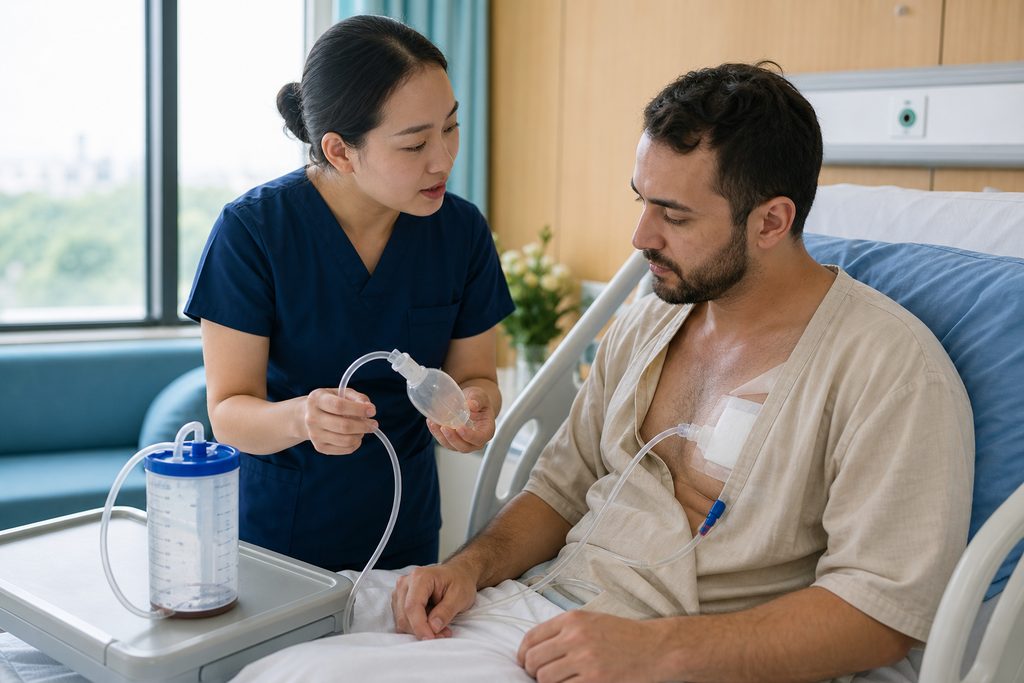
According to a 2023 review in the Annals of Surgery, surgical drains are used in roughly 25% to 50% of major abdominal and thoracic procedures worldwide. So if you are asking, “Will I wake up with a drain after surgery?” — the honest answer is: maybe. It depends on the procedure, the surgeon’s technique, and the hospital’s protocol. For patients planning surgery abroad, including in China, the question carries extra weight. You are not just wondering about discomfort. You are wondering about the surgery drain cost in China, who will manage it, and what happens if something goes wrong after you fly home.
Let’s walk through exactly what a surgical drain is, when surgeons use one, what it costs in Chinese hospitals, and how medical travelers should plan for post-operative drain care.
Will I Wake Up With a Drain After Surgery? The Short Answer
For many procedures, yes. But not for all. A surgical drain is a thin, flexible tube placed near a surgical site to remove blood, fluid, or pus that can accumulate after tissue is cut. Drains reduce the risk of seroma (fluid pocket) and hematoma (blood collection), both of which can delay healing or cause infection. Surgeons commonly place drains after mastectomy, abdominoplasty (tummy tuck), major orthopedic work like joint replacement, thoracic surgery, and complex abdominal operations.
But here is the nuance. Drain use is falling in some specialties. Enhanced Recovery After Surgery (ERAS) protocols, now standard in many top Chinese hospitals, actively discourage routine drain placement when evidence shows no benefit. A 2022 meta-analysis covering 18,000 patients found that routine drains after uncomplicated gallbladder removal or simple hernia repair did not reduce complications — and sometimes increased infection risk. So whether you wake up with a tube depends more on your specific operation than on the country where you have it.
Who This Is Right For — and Who It Isn’t
Drains are not a choice. They are a clinical decision. But understanding who typically needs one helps set expectations for medical travel.
Patients most likely to wake up with a drain:
- Those having large-surface-area surgery — abdominoplasty, mastectomy, extensive liposuction with skin excision
- Joint replacement patients, especially total knee or hip arthroplasty, where bleeding into the joint space is a concern
- Thoracic surgery patients — lung resection, esophageal work, cardiac procedures
- Complex abdominal surgery — liver resection, pancreatic surgery, major bowel resection
- Patients with higher bleeding risk, including those on anticoagulants that cannot be fully stopped
Patients less likely to need a drain:
- Minor laparoscopic procedures — uncomplicated appendectomy, simple cholecystectomy
- Small superficial excisions or biopsies
- Certain thyroid and parathyroid operations where meticulous hemostasis replaces routine drainage
- Patients undergoing ERAS-protocol surgery at hospitals that have moved away from prophylactic drains
If you are traveling to China specifically for a procedure with a high drain-placement rate, you should plan for drain management as part of your recovery timeline. If you are having a minor procedure, the question may not even come up.
The Options, Compared
Where you have surgery changes how drain care is delivered. Here is how the three main paths compare for an international patient considering China.
| Factor | Top Chinese Public Hospital (International/VIP Dept.) | Chinese Private International Hospital | Typical Western Hospital (US/UK/EU) |
|---|---|---|---|
| Drain placement practices | Surgeon-dependent; ERAS protocols common in top-tier centers | Often follows Western-style ERAS; drains used selectively | Varies widely by surgeon and hospital system |
| Daily drain care cost (nursing + dressing) | $30–$80 per day | $80–$150 per day | $200–$600 per day |
| Drain removal cost | $50–$120 | $100–$200 | $300–$800 |
| Included in surgery package? | Usually yes for inpatient stays; outpatient drain care billed separately | Often bundled into fixed-price packages | Rarely bundled; separate line items common |
| Language support for drain instructions | Variable; international departments provide English-speaking coordinators | English-speaking nurses standard | Native language standard |
| Post-discharge drain management | Requires in-country follow-up or local nurse coordination | Can arrange telehealth drain checks | Home health nursing widely available |
For most international patients, the private international hospital route offers the smoothest drain-care experience in China — English-speaking staff, predictable bundled pricing, and telehealth follow-up. But the public hospital VIP department often delivers the same clinical quality at roughly half the cost, provided you have bilingual support. That is where a medical coordinator earns their fee.
What “Will I Wake Up With a Drain” Actually Means for Your China Trip
Here is what a reader of this exact title still needs: a timeline. If you do wake up with a drain after surgery in China, what does the next week actually look like?
Day 0 (surgery day): The drain is placed while you are under anesthesia. You wake up with it taped to your skin, connected to a small bulb or bag. You will not remember the placement. You will notice the tugging sensation.
Day 1–2: Nurses measure and record drain output every shift. The fluid starts bloody, then turns pink, then straw-colored. Your surgeon checks the volume daily. Most drains come out when output falls below 30–50 mL per 24 hours, depending on the procedure.
Day 3–5: For many procedures, the drain is removed before discharge. Removal takes about 10 seconds. It stings briefly. No anesthesia needed. For larger operations, you may be discharged with the drain still in place and instructed to record output yourself.
Day 5–10: If you are still in China, you return to the hospital outpatient clinic for drain removal. If you have flown home, a local nurse or your primary doctor removes it. That handoff — from Chinese surgical team to Western home care — is the single most overlooked planning gap for medical travelers.
So the real question is not just “will I wake up with a drain?” It is “if I do, who manages it after I leave the hospital?” Plan for that before you book the flight.
What a Surgery Drain Costs in China
The surgery drain cost China patients actually pay depends on three things: whether the drain is part of the inpatient package, how long it stays in, and whether you need outpatient follow-up.
A typical closed-suction drain (Jackson-Pratt style or similar silicone drain) costs $20–$60 as a device in Chinese hospitals. The nursing care to manage it — emptying, measuring, dressing changes — runs $30–$80 per day in a public hospital international department. In a private international hospital like United Family or Jiahui, expect $80–$150 per day for the same care.
Drain removal itself is inexpensive: $50–$120 in public VIP departments, $100–$200 in private facilities. Compare that to the United States, where drain removal alone can bill at $300–$800, and daily home nursing visits often exceed $200. Even with travel costs, managing a post-surgical drain in China typically costs one-fifth to one-third of what the same care costs in the US or UK.
What is not included: if you need a bilingual nurse to come to your hotel to check the drain, that is a separate concierge service, typically from $300 per day. If you extend your hotel stay by five days waiting for drain removal, that is an out-of-pocket cost no hospital invoice will show. Budget for both.
Practical Considerations: Drains, Documentation, and Discharge Abroad
If you are traveling to China for surgery where a drain is likely, get specific answers before you commit. Ask the hospital directly: “What is your standard drain protocol for this procedure? What output threshold triggers removal? Will I be discharged with the drain in place?”
Request a written discharge summary that includes drain type, placement date, output log, and removal criteria. This document is what your home doctor needs to take over care safely. Without it, you may struggle to find a local clinician willing to remove a drain placed in another country.
Payment is straightforward. Chinese hospitals require prepayment for surgical packages. Public hospital international departments accept major credit cards and bank transfers. Private international hospitals often bill insurance directly. Drain-related outpatient visits are billed separately from the surgery package in most cases — clarify this before admission, not after.
Visa timing matters. Medical treatment in China falls under the S2 visa category, which covers short-term private affairs including medical care. If your drain care extends your stay beyond your original plan, you need buffer days in your itinerary. Do not book a return flight for day three after surgery if your drain protocol typically requires five to seven days of monitoring.
Language is the quiet risk. Drain care instructions are simple — record output, keep the site clean, watch for redness. But when something looks wrong at 2 a.m. in a Shanghai hotel, “is this normal?” is a hard question to ask in Mandarin. A bilingual medical companion is not a luxury in that moment. It is the difference between a resolved concern and a panicked emergency room visit.
Frequently Asked Questions
It is never optional in the sense of patient preference. A drain is placed when the surgeon judges that fluid accumulation poses a real risk of complication. You cannot request to skip it, and you cannot request one if the surgeon sees no need. The decision is clinical. What you can do is choose a hospital whose protocols align with current evidence — and ask about drain rates for your specific procedure before booking.
Not necessarily. Drain use in top Chinese hospitals is generally comparable to Western practice. In fact, many Chinese academic centers adopted ERAS protocols early and are aggressive about avoiding unnecessary drains. But practice varies by surgeon. A surgeon trained in a traditional technique may use drains more liberally than a younger surgeon trained in minimally invasive methods. Ask the specific surgeon, not the hospital generally.
For a typical five-day drain management period in a Chinese private international hospital, expect $400–$750 total, excluding the surgery itself. In a public hospital international department, the same period runs $150–$400. That covers nursing care, dressing supplies, output monitoring, and removal. It does not cover hotel, food, or transportation. If you fly home with the drain still in, your home-country costs will likely be higher and may not be reimbursed by your travel insurance.
This is the scenario every medical traveler should plan for. A blocked drain can cause fluid to build up under the skin. An infected drain site needs prompt attention. Your home doctor can manage both — but they need the Chinese hospital’s discharge documentation. Insist on a detailed written summary before you leave China. Include the hospital’s international department contact information. Many Chinese hospitals now offer WeChat-based follow-up for international patients, which allows you to send photos of the drain site to the original surgical team for guidance.
Yes, and this is increasingly common. Several private international hospitals in Beijing and Shanghai offer fixed-price surgical packages that explicitly include post-operative drain care for a defined number of days. Public hospital international departments are less likely to bundle, but they will itemize drain care clearly if you ask. A medical coordinator can help you compare what is actually included — some “packages” exclude outpatient drain checks, which defeats the purpose. Read the line items.
Your Next Step
Waking up with a drain after surgery is common, manageable, and usually brief. The real question is whether your drain care plan survives the trip home. That is where preparation beats optimism.
Our team at China Medical Services helps international patients understand exactly what a specific surgeon at a specific hospital will do — including drain protocols — before any money changes hands. We are not a hospital. We do not diagnose or treat. We translate medical records, coordinate with hospital international departments, and arrange bilingual support so you are never alone with a drain bag and a language barrier. If you are considering surgery in China, start with a conversation. Request a free consultation and get clear answers before you book anything.
Drains are temporary. Poor planning is not.
For more medical information and treatment options in China, visit chinamedservices.com (China Medical Services).
