Spine Surgery Rehab: What to Expect and How to Plan Recovery
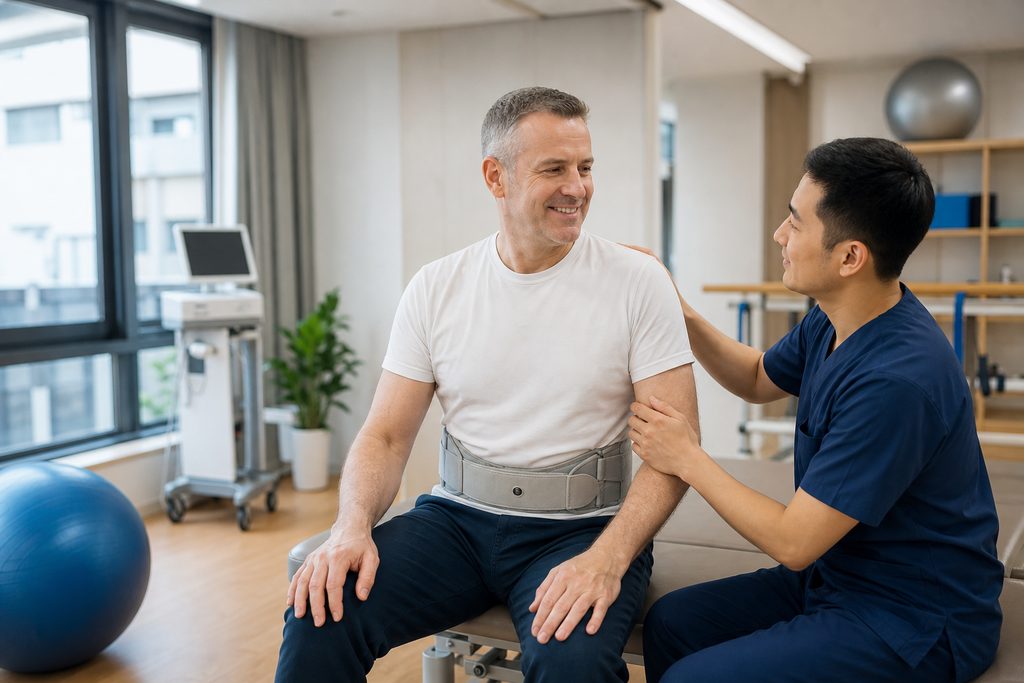
You’ve probably heard that traveling abroad for spine surgery means gambling on quality. The reality is messier than that. China’s top orthopedic centers now perform complex spinal reconstructions at volumes most Western hospitals never see, and the spine surgery cost China patients pay often lands between one-fifth and one-tenth of a U.S. bill. But volume and price mean nothing if you don’t understand what happens after the incision closes. Rehab is where outcomes are won or lost.
This article walks through the recovery timeline, the real costs, where to go, and what can go wrong. No sugarcoating. No miracle promises.
Spine Surgery Rehab: The Short Answer
For a single-level lumbar fusion, most patients are walking within 24 hours, discharged in 3 to 7 days, and back to light desk work in 4 to 6 weeks. Full bony fusion takes 6 to 12 months. For a microdiscectomy, the timeline is much shorter: home in 1 to 3 days, driving in 2 weeks, gym at 6 to 8 weeks. The caveat: these numbers assume an uncomplicated surgery, a motivated patient, and a structured rehab program. Miss any of those, and the timeline stretches.
Where you have the surgery changes the rehab equation. Flying home too early after a fusion can be dangerous. Staying abroad for the first critical weeks costs money. We’ll get into those trade-offs below.
Who This Is Right For — and Who It Isn’t
Spine surgery is never the first option. It becomes reasonable when conservative care has failed and imaging matches symptoms. Good candidates typically share these traits:
- Nerve compression confirmed by MRI with matching leg or arm pain, numbness, or weakness
- Progressive neurological deficit — foot drop, grip weakness, bladder changes
- Failed at least 6 to 12 weeks of physical therapy, medication, and injections
- Structurally unstable spine from fracture, tumor, or severe spondylolisthesis
- Medically cleared for anesthesia and positioned for a realistic recovery
Who should not fly abroad for this? Patients with unstable cardiac or pulmonary disease. Patients whose pain is diffuse and doesn’t match a specific structural finding. Patients who smoke heavily — fusion rates drop significantly. And patients who cannot commit to 3 to 6 weeks of restricted activity after surgery. If you can’t take the time off work or arrange help at home, stay local.
The Options, Compared
Not all spine surgery is the same, and not all destinations deliver the same value. Here is a straight comparison of what you’re actually choosing between when you search for spine surgery abroad.
| Factor | U.S. Private Hospital | China Top Public (International Dept) | China Private International (JCI) |
|---|---|---|---|
| Single-level fusion cost | $80,000 – $150,000 | $15,000 – $30,000 | $35,000 – $60,000 |
| Microdiscectomy cost | $20,000 – $40,000 | $6,000 – $12,000 | $12,000 – $20,000 |
| Surgeon volume (fusions/year) | 50 – 150 | 200 – 500+ | 80 – 200 |
| English-speaking staff | Standard | International dept only | Standard |
| Wait for surgery | 2 – 8 weeks | 1 – 3 weeks after consultation | 1 – 4 weeks |
| Insurance direct billing | Yes | Rarely — pay upfront, claim later | Often yes |
The public hospital international department is where you get the highest surgical volume at the lowest price, but you pay upfront and handle insurance claims yourself. The private international hospitals cost more but feel familiar — English everywhere, direct billing, Western-style nursing ratios. Which one suits you depends on whether you’re optimizing for price or for friction.
What Rehabilitation Actually Looks Like After Discharge
Here is the part most medical tourism articles skip. The surgery itself is a few hours. The next twelve weeks decide whether it worked.
Days 0–3: Hospital stay. You’ll be up with a physical therapist on day one. Walking to the bathroom, then the hallway. Pain is managed with a PCA pump or oral opioids, tapered quickly. The drain comes out, the incision is checked, and discharge planning starts. If you had a fusion, you’ll be fitted for a brace and taught log-rolling to get out of bed.
Weeks 1–2: The hardest part. No bending, lifting, or twisting. That means no tying shoes, no picking up a dropped phone, no reaching into the fridge. You need someone with you. Showers require a waterproof dressing and a shower chair. Walking is your rehab — 10 minutes, three times a day, building to 20. Sitting is limited to 20–30 minute blocks. If you flew abroad for surgery, this is the window where staying in a serviced apartment near the hospital matters enormously.
Weeks 3–6: Light return. The incision is healed. Walking increases to 30–45 minutes daily. You can start gentle core activation — pelvic tilts, diaphragmatic breathing, isometric holds — but only under a physiotherapist’s guidance. Desk work is possible if you alternate sitting and standing. No driving yet if you’re still on opioids or wearing a rigid brace.
Weeks 6–12: Functional rehab. The brace comes off (for single-level fusions). Physical therapy gets real: progressive core strengthening, hip mobility, gait retraining. You can lift 5–10 pounds. Swimming starts once the wound is fully closed and your surgeon clears it. Most patients return to non-manual jobs in this window.
Months 3–6: The fusion gamble. This is when a CT scan shows whether bone is actually bridging the vertebrae. If it isn’t — pseudarthrosis — you may need revision surgery. If it is, you gradually return to normal activity. No contact sports, no heavy deadlifts, no high-impact anything until month 6 at the earliest.
Months 6–12: The long tail. Full fusion strength takes a year. Some patients still feel stiffness and muscle fatigue at month 9. That’s normal. What matters is the trend: less nerve pain, better function, improving endurance.
How Long Is Rehab After Spinal Fusion, Really?
The honest answer: you’ll feel “recovered” at 3 months, but your spine isn’t fully fused until 6 to 12 months. Patients who rush back to heavy activity at week 8 are the ones who show up with broken screws and failed fusions. The spine surgery recovery timeline abroad adds a layer of complexity — you need to decide early whether to stay near the hospital for the first 4 to 6 weeks or return home and manage rehab remotely.
Staying in China for the first month costs more in accommodation and living expenses, but gives you direct access to your surgical team for wound checks, brace adjustments, and early physiotherapy. Returning home early saves money but means your local doctor inherits a patient they never operated on. Think carefully about which risk you prefer.
What It Costs: Spine Surgery Cost China and the Hidden Extras
The headline number is only part of the bill. A single-level lumbar fusion at a top public hospital in Shanghai or Beijing runs roughly $15,000 to $30,000 through the international department. A microdiscectomy lands between $6,000 and $12,000. Those figures typically include the surgeon’s fee, anesthesia, operating room, implants, hospital stay, and basic medications.
What they do not include: pre-operative imaging if you haven’t brought your own MRI (add $500–$1,500), the consultation fee for the specialist who reviews your case before you travel ($100–$300 for video consultation, $300–$500 for a written second opinion), your flights, accommodation for 2 to 6 weeks, food, local transport, and any post-discharge physiotherapy sessions ($40–$80 per session at a private clinic).
Budget realistically. A $20,000 surgery can easily become $30,000 all-in once you add travel, lodging, and rehab. Still cheaper than $120,000 in the U.S., but not pocket change.
Practical Considerations: Records, Visas, and Follow-Up
Before you book anything, get your documentation in order. Chinese spine surgeons will want a recent MRI (within 3 months), a CT scan if there’s a structural question, X-rays, and a clear summary of what conservative treatments you’ve already tried. Bring everything on a USB drive and in printed form. If your records are not in English, get them translated — the international department can usually handle this, but it adds time.
For the visa: medical travel to China falls under the S2 visa, which covers short stays for private affairs including medical treatment. Your accompanying family member applies for the same category. The hospital’s international department will issue an invitation letter and treatment confirmation to support your application. This is not a guarantee of approval — the embassy or consulate makes the final call. Start the visa process 4 to 6 weeks before your planned travel date.
Payment: public hospital international departments generally require a deposit upfront — often 50% to 100% of the estimated surgical cost — with the balance settled before discharge. Bring a credit card with a high limit or arrange a wire transfer. Private international hospitals like those listed on our JCI-accredited private hospital directory are more likely to accept direct insurance billing, but you’ll still need pre-authorization from your insurer.
After you return home, your local doctor needs a full discharge summary, operative notes, implant card, and imaging. Request these before you leave the hospital. Some Chinese hospitals provide them in English; others only in Chinese, in which case a certified translation is worth the $100–$200.
Is Spine Surgery in China Safe? A Straight Answer
Safety depends on which hospital you choose. China has over 35,000 hospitals, but the top 5% — roughly the 340+ institutions in our database — operate at international standards. The best orthopedic departments, like those found in Shanghai’s top-ranked medical centers, perform more spinal fusions per surgeon per year than almost any Western center. That volume translates into lower complication rates for routine procedures.
What’s less safe: walking into a random hospital without verification, skipping the international department, or assuming every facility is equal. Accreditation matters. Look for JCI certification or Fudan ranking. Ask about the surgeon’s annual case volume. Ask about infection rates. A serious hospital will answer. A defensive one won’t.
If you’re evaluating whether to book spine surgery package China through a coordinator, understand what you’re paying for. A legitimate service handles record translation, appointment scheduling through official channels, and bilingual accompaniment — it does not sell you a queue jump or promise a specific surgeon’s availability. Anyone who guarantees a specific surgical date before your records have been reviewed is not being honest with you.
Frequently Asked Questions
For a microdiscectomy, plan for 2 to 3 weeks. For a single-level fusion, 4 to 6 weeks is safer. Your surgeon will want to see you at least once or twice after discharge to check the wound and review X-rays before clearing you to fly. Flying long-haul too soon after fusion increases the risk of blood clots and hardware complications.
Some hospitals and coordinators offer bundled packages that include the surgery, hospital stay, and a block of physiotherapy sessions. These vary widely in quality. Read the fine print: does the package include the surgeon’s fee, implants, and anesthesia, or just the room? Does rehab happen at the hospital or a separate clinic? Is there a refund policy if your surgery is cancelled? Get everything in writing before you send money.
This is the hardest question in medical travel. If you develop an infection, hardware failure, or pseudarthrosis after returning home, your local surgeon may be reluctant to revise someone else’s work. You may need to travel back to China for revision, which adds cost and complexity. Some patients mitigate this by choosing a hospital with an international follow-up program that offers video consultations for the first 12 months. Ask about this before you book.
Shanghai has several of China’s strongest orthopedic and neurosurgery departments, but Beijing, Guangzhou, and Chengdu also have excellent options. The specialty-specific hospital rankings are a better guide than city reputation alone. Look at the orthopedic and neurosurgery rankings, then cross-reference with JCI accreditation and international department services. The best hospital for a complex scoliosis correction may not be the best for a routine microdiscectomy.
Most U.S. and European insurers do not cover elective surgery abroad. Some international health plans do, especially those designed for expatriates. Check your policy for “worldwide coverage” and whether it includes planned procedures, not just emergencies. If your insurer won’t pay, you’re looking at full self-pay. Keep every receipt and request itemized billing — you may be able to claim a partial reimbursement depending on your plan.
Your Next Step
Spine surgery abroad is a serious decision with real risks and real rewards. The spine surgery cost China offers is compelling, but the outcome depends on choosing the right hospital, preparing your records properly, and committing to a structured recovery. We help international patients navigate Chinese healthcare — matching you with appropriate hospitals, coordinating appointments through official channels, and providing bilingual support on the ground. We are not a hospital, and we do not provide medical advice or diagnoses. If you’d like to understand your options, start with a free consultation at China Medical Services and we’ll help you sort through the noise.
Recovery is not a passive process. The surgery opens the door. Your rehab walks through it. Plan for both, and the odds tilt in your favor.
For more medical information and treatment options in China, visit chinamedservices.com (China Medical Services).
