Airport Transfer for Medical Travelers: What to Expect on Arrival in China
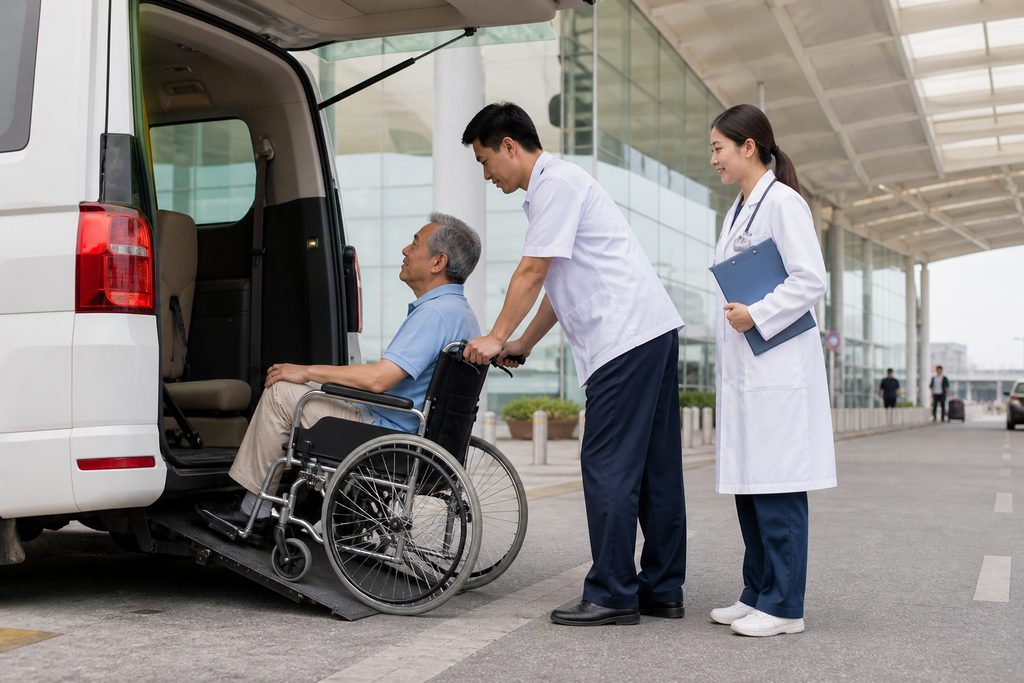
Airport Transfer Hospital Pickup China Medical Tourism: The Short Answer
Landing in a foreign country for surgery is disorienting enough without navigating a chaotic arrivals hall. An airport transfer hospital pickup for China medical tourism means a pre-arranged driver meets you at the airport, helps with luggage, and takes you directly to your hospital or hotel. The cost for a private airport transfer in Shanghai or Beijing typically ranges from $60 to $120 one-way, depending on distance and vehicle type. Our round-trip service is priced at $200.
What complicates the picture is that Chinese airports are not uniformly easy to navigate. Beijing Capital International Airport and Shanghai Pudong are massive, with multiple terminals and limited English signage in some areas. A driver who knows exactly where to stand, what your flight number means in real time, and how to communicate with you via translation app makes a measurable difference.
Who This Is Right For — and Who It Isn’t
Most international patients benefit from a pre-arranged transfer. But not everyone needs one. Here is the honest breakdown.
Good candidates for a pre-arranged airport transfer:
- Patients arriving after a 10+ hour flight, often jet-lagged and physically depleted
- Anyone traveling alone for treatment — there is no one to watch luggage while you figure out taxis
- First-time visitors to China who do not read Chinese characters
- Patients with mobility limitations, heavy medical records, or post-operative travel needs
- Family groups accompanying a patient, where coordination between terminals and vehicles gets complicated
Who can reasonably skip it:
- Experienced business travelers who have used Didi (the Chinese ride-hailing app) before and have a working Chinese SIM card
- Patients arriving at smaller airports like Hangzhou or Chengdu where taxi queues are shorter and less chaotic
- Those staying at international hotels with their own shuttle service
- Budget travelers willing to use the airport express train plus metro — which is genuinely cheap and efficient if you pack light
If you are coming for a major procedure, the transfer is not where you want to test your navigation skills.
The Options, Compared
You have four realistic ways to get from the airport to your hospital or hotel in China. Here is how they stack up.
| Option | Typical Cost (USD) | Door-to-Door Time | English Support | Best For |
|---|---|---|---|---|
| Pre-arranged private transfer | $60–120 one-way | 45–90 min | Yes — driver briefed in advance | First-time patients, post-surgery travel, family groups |
| Airport taxi (official queue) | $30–60 | 45–90 min | Rarely — show address in Chinese | Budget-conscious travelers comfortable with uncertainty |
| Didi (ride-hailing app) | $25–50 | 45–90 min | App has English interface; driver may not speak English | Return visitors with Chinese SIM and payment setup |
| Airport express train + metro | $5–10 | 60–120 min | Signage in English at major airports | Light packers staying near a metro line |
The private transfer costs more because someone is tracking your flight, waiting through customs delays, and confirming your destination before you land. That coordination is what you are paying for — not just the car.
What to Expect Arriving in China for Surgery: The Arrival Sequence
Here is what actually happens when you land, step by step, so nothing surprises you.
Step 1: Disembarkation and health screening. Depending on the airport and current public health policies, you may pass through a temperature scanner or be asked to complete a health declaration form. This is routine and usually takes under ten minutes. Have your passport and boarding pass accessible.
Step 2: Immigration. Foreign nationals use the designated channels. Processing time varies widely — anywhere from 15 minutes to over an hour during peak arrival windows. There is no fast-track lane for medical travelers unless arranged through a VIP service.
Step 3: Baggage claim. Large airports have clear English signage. Luggage carts are free at most Chinese airports. If a bag is lost, the airline desk is before customs — do not exit the baggage hall without filing a report.
Step 4: Customs. You walk through the green channel if you have nothing to declare. Bring a letter from your hospital confirming your treatment — it helps if you are carrying medication or medical equipment. Keep prescriptions in original packaging.
Step 5: The arrivals hall. This is where a pre-arranged driver matters. The hall at Beijing Capital or Shanghai Pudong is loud, crowded, and full of people holding signs. A driver holding a sign with your name — in English — eliminates the single most stressful moment of the journey.
So what should you actually expect arriving in China for surgery? Expect the process to take 45 to 90 minutes from landing to curb, assuming no unusual delays. A transfer service that tracks your flight will adjust if you are late. A taxi queue will not.
Private Airport Transfer Cost Shanghai for Patients: What Drives the Price
Private airport transfer cost in Shanghai for patients runs from $60 to $120 one-way. The range reflects three variables: distance, vehicle class, and timing.
Distance. Shanghai Pudong International Airport sits roughly 30–50 km from most downtown hospitals, depending on the district. Hongqiao Airport is closer to the city center but handles mostly domestic flights. A transfer from Pudong to a hospital in Xuhui or Huangpu district takes 50–70 minutes in normal traffic. Longer routes cost more.
Vehicle class. A standard sedan fits one patient plus two suitcases. A business van fits a family group, a wheelchair, or extra medical luggage. Vans cost 30–50% more than sedans.
Timing. Late-night arrivals between 11 PM and 5 AM often carry a surcharge. Chinese airports are quieter at night, but driver availability drops and the fee reflects that.
What is included in a pre-arranged transfer? Flight tracking, meet-and-greet with a name sign, help with luggage, and direct transport to your stated destination. What is not included? Waiting time beyond a reasonable grace period — usually 60–90 minutes after landing — and any stops along the way. If you need a pharmacy stop or a SIM card, tell us in advance so the driver can plan the route.
Can Hospital Arrange Airport Transfer for International Patients China?
The short answer: sometimes, but not reliably. Can a hospital arrange airport transfer for international patients in China? Large private international hospitals — such as United Family, Jiahui, and Parkway — often have a patient services desk that coordinates airport pickup. Public hospitals, even top-tier ones like Fuwai Hospital or Peking Union Medical College Hospital, generally do not offer this as a standard service. Their international departments may help with in-hospital logistics, but the curb-to-curb transfer is usually outsourced or left to the patient.
This is where a medical coordinator fills the gap. We handle the transfer independently of the hospital, which means the pickup happens even if your admission time shifts or your hospital changes at the last minute. The driver is briefed on your flight, your destination, and your language needs before you land.
Practical Considerations: Documents, Payment, and Communication
Before you board the plane, sort out these logistics. They affect how smoothly your arrival goes.
Visa category. For medical treatment in China, you apply for an S2 visa with the treatment purpose noted. Family members accompanying you also apply for S2. The M visa is for commercial and trade activities — it is not the correct category for medical travel. Requirements vary by embassy, so check the latest guidance from the Chinese consulate in your country before applying.
Payment methods. Cash still works in China, but mobile payment dominates. WeChat Pay and Alipay now accept foreign credit cards with identity verification, but setup takes time. Do it before you fly. For the transfer itself, pre-payment in USD via bank transfer or card is standard for pre-arranged services.
Communication at the airport. Free Wi-Fi at Chinese airports requires a Chinese phone number for SMS verification in many cases. This catches people off guard. Arrange an eSIM or international roaming plan before departure, or ask your transfer service to include a local SIM card as part of the pickup.
Medical documentation. Carry a printed letter from your hospital confirming your appointment or admission. If you are bringing prescription medication, keep it in original packaging with a copy of the prescription. Chinese customs officers rarely inspect personal medication, but if they do, documentation resolves it quickly.
Tip: Screenshot your hospital’s address in Chinese characters and save it offline. Even with a pre-arranged transfer, having the address on hand helps if plans change.
Frequently Asked Questions
A pre-arranged transfer tracks your flight number and adjusts the pickup time automatically. If you booked a taxi or Didi on arrival, you simply wait in the queue whenever you exit. Delays of two to three hours are common on international routes, so a tracked service removes the anxiety of whether your driver will still be there. If your flight is cancelled entirely, contact your coordinator — rescheduling a transfer is usually straightforward with advance notice.
Beijing and Shanghai prices are nearly identical for comparable distances. A medical tourism airport pickup service in Beijing runs $60 to $120 one-way, same as Shanghai. Beijing Capital International Airport is about 25–35 km from central hospitals, while Shanghai Pudong is 30–50 km. The price difference comes down to vehicle class and timing more than city. Both cities have reliable pre-arranged transfer infrastructure.
Request wheelchair assistance through your airline at least 48 hours before departure. The airline provides wheelchair service from check-in through the gate and from the aircraft through immigration and baggage claim. Once you exit into the arrivals hall, your pre-arranged driver takes over. Specify the wheelchair requirement when booking the transfer so the vehicle has adequate trunk space and the driver knows to assist with boarding.
Official taxi queues at major Chinese airports are monitored and generally safe. The bigger risk is overcharging — some drivers quote inflated flat rates to foreigners at night. If you take a taxi, insist on the meter or agree on a price before getting in. A pre-arranged transfer eliminates this negotiation entirely. For late-night arrivals, the predictability of a booked service is worth the premium.
You can, but it is not recommended. Last-minute bookings at the airport mean waiting 30–60 minutes for a driver to arrive, assuming one is available. During peak hours or late at night, availability drops sharply. Booking at least 48 hours in advance ensures the driver is briefed, the vehicle is appropriate for your needs, and the flight tracking is active before you take off.
Your Next Step
Arriving for medical treatment in a foreign country is stressful enough without navigating an unfamiliar airport on your own. A pre-arranged transfer is a small line item that removes a large variable from your first hours in China. We are not a hospital and we do not provide medical advice — we coordinate the logistics that get you from the arrivals gate to the doctor’s office. If you are planning treatment in China and want the arrival handled before you board, request a free consultation and we will walk you through the full arrival plan.
You have enough on your mind. The drive from the airport should not be one of those things.
For more medical information and treatment options in China, visit chinamedservices.com (China Medical Services).
