Inpatient Companion: Privacy and Trust When Hospitalized in China
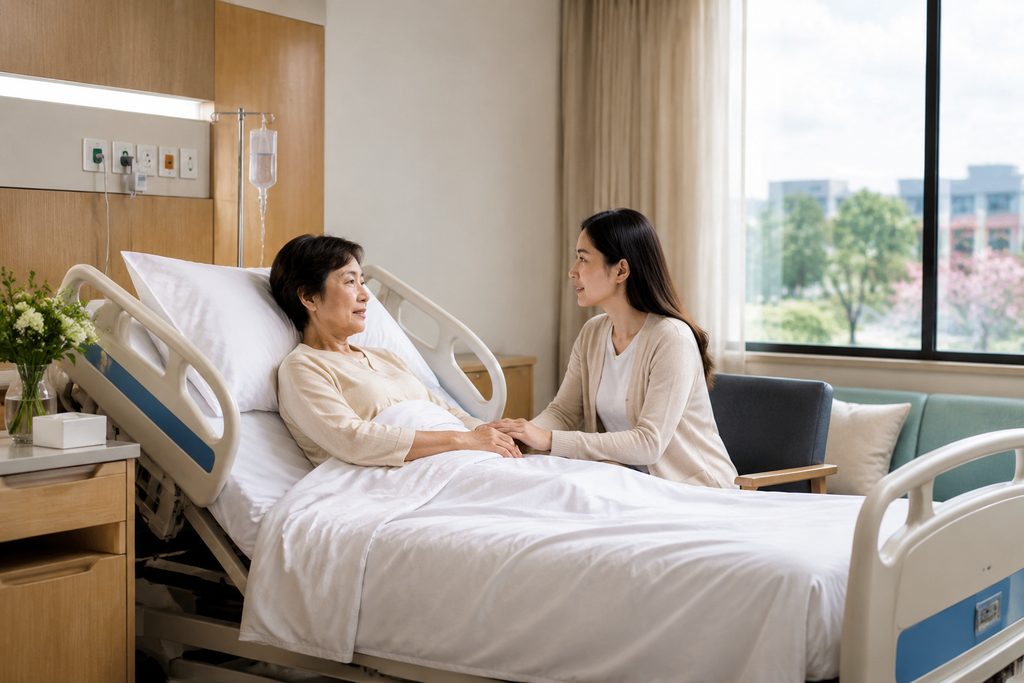
You’ve probably heard that navigating a Chinese hospital as a foreigner means accepting chaos, language barriers, and a complete loss of privacy. The reality is more nuanced. A well-vetted inpatient companion changes the experience entirely — but only if you understand what you’re actually paying for and how to verify the person standing at your bedside. The inpatient companion service cost in China varies widely, from roughly $300 per day for basic bilingual support to over $1,000 daily for 24/7 private nursing care. That range exists because “companion” means different things to different providers.
Inpatient Companion Service Cost China: The Short Answer
Expect to pay between $300 and $1,200 per day for a legitimate inpatient companion service in China. The lower end covers an 8-hour daytime bilingual escort who handles paperwork, translates doctor rounds, and communicates with nurses. The upper end buys a licensed private nurse with clinical training who stays overnight, monitors vitals, and coordinates directly with the attending physician. Shanghai and Beijing command premium pricing — a private nurse for hospital stay Shanghai packages typically start at $600 daily. The caveat: cheap services under $200 per day usually mean an untrained freelancer with no hospital affiliation, no insurance, and no accountability if something goes wrong.
What drives the cost? Three factors. First, clinical qualification — a registered nurse costs double what a language facilitator costs. Second, shift structure — 24-hour coverage means two people rotating, not one exhausted person working 18 hours. Third, hospital tier — international departments at Peking Union Medical College Hospital or Zhongshan Hospital have in-house companion protocols that private agencies must coordinate with, adding administrative overhead.
Who This Is Right For — and Who It Isn’t
An inpatient companion makes sense for specific situations. You’re a good candidate if you’re traveling alone for surgery and face a 3–7 day hospital stay. If you have a chronic condition requiring complex medication schedules you can’t manage while sedated. If your English-speaking family member can’t be present for the full admission. Or if you’re undergoing a procedure where post-operative monitoring matters — cardiac surgery, orthopedic reconstruction, major abdominal work.
Who should not hire one? If you’re having a minor outpatient procedure with same-day discharge, a companion is overkill — a standard bilingual medical escort for the day suffices. If you have a family member who speaks fluent Mandarin and understands Chinese hospital logistics, you likely don’t need paid help. If your hospital stay is in a private international facility like United Family or Jiahui, English-speaking nursing staff already handle most communication. And if your condition is stable enough that the hospital considers you low-acuity, an overnight sitter may be unnecessary.
The Options, Compared
| Service Type | Daily Cost (USD) | Clinical Training | Overnight Coverage | Best For |
|---|---|---|---|---|
| Bilingual Medical Companion | $300–450 | None — language and logistics | No | Daytime translation, paperwork, family communication |
| Private Nurse (RN) | $500–800 | Registered nurse license | Optional | Post-op monitoring, medication management, wound care |
| 24/7 Care Package | $800–1,200 | RN + rotating assistant | Yes — two-person rotation | High-acuity patients, ICU step-down, elderly travelers |
| Hospital-Provided Sitter | $150–250 | Minimal — basic patient safety | Varies | Fall prevention, basic observation, no translation |
The right column depends on your clinical reality. A stable patient who just needs someone to explain what the surgeon said can use a $350 bilingual companion. A patient who just had a spinal fusion and can’t reach the call button needs the 24/7 package. The hospital-provided sitter is the budget option — but they won’t translate, won’t advocate, and won’t explain your medication schedule. You get what the hospital assigns, often with no English capability.
How to Verify a Medical Companion’s Credentials in Beijing
Beijing has the strictest verification environment in China, partly because the city’s top hospitals — PUMCH, Fuwai, Beijing Tiantan — see the highest volume of foreign inpatients. When you’re asking how to verify a medical companion’s credentials in Beijing, start with three documents. First, the provider’s business license, which should list “medical support services” or “healthcare coordination” in its scope. Second, the individual companion’s nursing license if they claim clinical training — the Chinese nursing license is issued by the National Health Commission and has a verifiable registration number. Third, proof of hospital affiliation or prior work authorization at the specific hospital where you’ll be admitted.
Any legitimate agency will provide these before payment. A freelancer who refuses to show a license isn’t being modest — they’re unlicensed. And if someone claims to be a “registered nurse” but can’t produce a Chinese nursing certificate, walk away. Foreign nursing licenses are not automatically valid in China.
Also worth checking: does the agency carry liability insurance? Reputable providers do. What happens if the companion doesn’t show up on surgery day? A real contract specifies replacement protocols and refund terms. If the answer is “don’t worry, we’ll handle it,” that’s not a contract — that’s a hope.
Is It Safe to Hire a Patient Sitter in China?
Is it safe to hire a patient sitter in China? Yes, when you hire through a licensed agency that vets its staff and carries insurance. No, when you hire someone from a WeChat group or a card left at a nursing station. The safety question has two dimensions: clinical safety and personal security. Clinically, an untrained sitter can cause harm — giving water to a patient who’s NPO before surgery, helping someone stand after a spinal block, misreading a monitor alarm. Personally, you’re vulnerable in a hospital bed. An unvetted stranger has access to your passport, your wallet, your phone.
The practical safeguard is simple: hire through an organization that has a physical office, a verifiable business registration, and a track record of serving foreign patients. Ask for references from previous clients. A legitimate service will connect you with past patients who can speak to the experience. A scammer will dodge.
Book 24/7 Inpatient Care Package China: What You’re Actually Getting
When you book a 24/7 inpatient care package in China, the service should include more than a warm body in a chair. A proper package covers two rotating staff members — usually one RN and one trained assistant — with a handoff protocol between shifts. That handoff matters. The night person needs to know your medication schedule, your surgeon’s overnight orders, and which symptoms warrant calling the nurse station versus waiting until morning.
The package should also include a daily written summary in English: what the doctors said on rounds, which medications changed, what tests are scheduled for tomorrow. Without that documentation, you’re relying on memory from someone who worked a 12-hour shift. And the package should include an escalation path — a supervisor at the agency who can intervene if the companion isn’t performing or if there’s a conflict with hospital staff.
What it won’t include: medical decisions. A companion is not a substitute for your attending physician. They don’t prescribe, they don’t diagnose, they don’t override hospital protocol. Anyone who promises to “make sure you get the best treatment” is overstepping. The companion’s job is communication and coordination, not clinical judgment.
Trusted Medical Escort Services for Foreigners in Shanghai
Shanghai’s international medical infrastructure is deeper than any other Chinese city, which means trusted medical escort services for foreigners in Shanghai are easier to find — but also easier to fake. The city hosts multiple JCI-accredited private hospitals with their own in-house international patient departments. That’s the baseline: if a service claims to work with Shanghai hospitals, ask which specific departments and verify by calling the hospital’s international office directly.
Shanghai pricing runs 15–20% higher than Beijing for equivalent services. A bilingual companion in Shanghai typically costs $350–500 daily, reflecting higher labor costs and the concentration of expatriate demand. The tradeoff: more providers to choose from, more English-speaking hospital staff, and a more established ecosystem for foreign patients. If you’re comparing cities, Shanghai offers more options; Beijing offers deeper access to certain top-tier specialties like cardiology at Fuwai. Your choice depends on the procedure, not just the companion.
Practical Considerations: Documentation, Payment, and Privacy
Before you arrive, prepare a packet: passport copy, visa page, hospital admission letter, medication list in English and Chinese, emergency contact, and any advance directives. Your companion will need all of this on day one. Without it, they’re translating from scratch while you’re groggy from anesthesia.
Payment terms matter. Reputable agencies charge a deposit — usually 30–50% — with the balance due after the first day of service. Some require full prepayment for 24/7 packages. Get the refund policy in writing: what happens if your surgery is postponed? What if you’re discharged a day early? What if the companion is a no-show? A legitimate contract addresses all three.
Privacy is the unspoken concern. Your companion will hear your medical history, see your body during post-op care, and access your personal information. Before hiring, ask directly: what confidentiality agreement does the companion sign? What data do they retain after your discharge? How are your records stored? A professional service has clear answers. A casual provider will look confused — that’s your red flag.
Insurance rarely covers companion costs. Some international health plans reimburse private nursing if it’s medically necessary and ordered by a physician, but bilingual companionship is almost never covered. Budget for it out of pocket.
Frequently Asked Questions
Some public hospitals in China offer internal “patient sitter” services, but these staff are typically untrained in translation and assigned to multiple patients simultaneously. International departments at top hospitals may recommend affiliated agencies, but direct hospital hiring for a dedicated bilingual companion is rare. You’ll almost always work through an external provider.
This is where contract quality shows. A good agreement allows rescheduling without penalty within a reasonable window — usually 48–72 hours’ notice. If your surgery is postponed by a week, the agency should hold your deposit and adjust dates. If they demand full payment for days you didn’t use, that’s a sign of a predatory provider. Ask this question before signing.
You don’t — unless the agency has a written confidentiality policy and a track record. Ask for the policy in writing before you pay. Reputable providers treat patient privacy as a core service feature, not an afterthought. Some will sign a non-disclosure agreement specific to your case. If the provider hesitates, consider it a warning.
This varies by hospital and ward type. Many public hospital wards have strict visiting hours and do not permit overnight companions except in private or VIP rooms. International departments and private hospitals are more flexible. Your companion service should verify overnight access with the specific hospital before you commit — and if they can’t confirm, assume daytime-only coverage.
Your Next Step
Choosing an inpatient companion is a trust decision made under pressure, often from a hospital bed in a country where you don’t speak the language. The right provider gives you documentation, verifiable credentials, and a clear contract. The wrong one gives you excuses. We’re China Medical Services, a coordination team that connects international patients with vetted hospitals and support services across 37 cities. We don’t provide medical care, and we don’t make diagnoses. What we do is help you evaluate your options with clear information — including whether a companion is even necessary for your specific case. If you’re considering treatment in China and want an honest assessment of what support you’ll actually need, start with a conversation on our patient services page. No obligation, no pressure. Just answers.
Trust in a foreign hospital is built before you ever check in. Verify credentials, read the contract, and know exactly what your money buys. That’s the difference between a companion who advocates for you and a stranger who just sits in the chair.
For more medical information and treatment options in China, visit chinamedservices.com (China Medical Services).
