Special Needs Child Care During Parent Medical Tourism in China: A Complete Guide
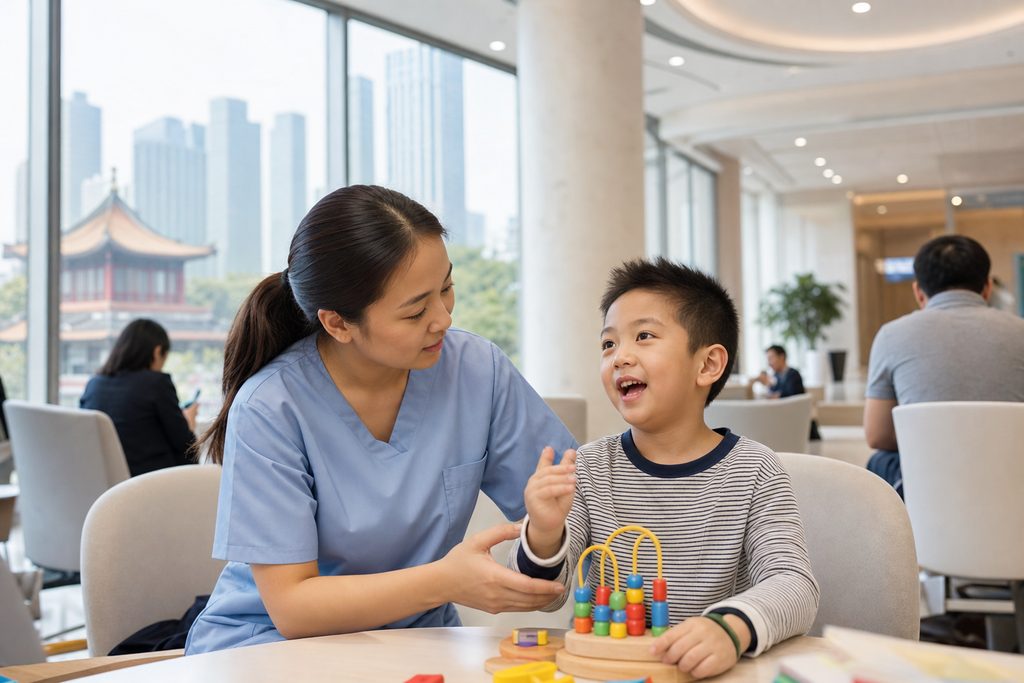
What do you actually do with your child when you need major surgery 7,000 miles from home and there is no one to leave them with back in Chicago or London or Riyadh? The question stops people cold. Parents cancel or delay needed procedures because the logistics feel impossible. You are not the first family to face this. Our team coordinates medical travel for international patients across China Medical Services network of 340+ top-ranked hospitals, and we have seen families find workable solutions — often ones they had not considered before reaching out.
Key Takeaways
- Families successfully bring special needs children to China for a parent’s surgery, but it requires planning that starts weeks — not days — before travel.
- Specialized childcare during medical treatment in China costs between $150 and $400 per day depending on the child’s needs, the caregiver’s qualifications, and whether overnight support is required.
- China’s major medical cities have international schools, therapy centers, and bilingual caregivers who work with children with autism, cerebral palsy, Down syndrome, and other developmental conditions.
- Without local coordination, language barriers and unfamiliar systems can turn a manageable situation into a crisis. Having a logistics partner on the ground changes the equation entirely.
The Problem: You Cannot Postpone Surgery, and You Cannot Leave Your Child Behind
Roughly 1 in 6 children in the United States has a developmental disability, according to CDC data. Many of these children have parents who also need medical care — sometimes care they cannot get at home, or cannot afford. A cardiac bypass that costs $120,000 in the US runs $12,000 to $20,000 at a top Chinese public hospital. That is not a small difference. It is the difference between getting treatment and going without.
But the math only works if the family logistics work. And for parents of children with autism, cerebral palsy, or other special needs, the logistics feel like a wall. Who watches your non-verbal 8-year-old while you are under anesthesia for six hours? What if your child has a meltdown in a Shanghai hospital corridor where no one speaks English? These are not hypotheticals. They are the exact scenarios families ask us about during initial consultations.
Some parents consider coming alone. That rarely goes well. Recovery from major surgery is hard enough without the emotional weight of being separated from your child for weeks. Others postpone. The condition worsens. The window for a less invasive procedure closes. We see this pattern repeat. It does not have to.
Who We Are
We are not a hospital. We do not provide medical treatment, clinical diagnoses, or childcare services directly. China Medical Services functions as your logistical architects — we bridge the gap between you and China’s top-tier medical expertise. Our team handles hospital matching, appointment coordination, visa guidance, bilingual medical companionship, and the thousand practical details that make medical travel possible. When families ask us about special needs child care during medical treatment China cost and logistics, we draw on years of coordinating complex cases across 37 Chinese cities. We know which hospitals have family-friendly international wards. We know which cities have the strongest special needs support infrastructure. And we know what it realistically costs.
Why Families Choose China Despite the Complexity
The cost advantage gets people’s attention. It is what keeps the conversation going. But families who actually make the trip discover other reasons to feel good about their decision.
Clinical Volume That Translates to Expertise
A top Chinese cardiac surgeon performs 300 to 500 procedures annually. The average US cardiac surgeon performs roughly 100 to 150. Volume matters in surgery. Study after study in The Lancet and BMJ has shown that higher surgical volumes correlate with lower complication rates and shorter hospital stays. Chinese hospitals operate at a scale that is hard to grasp until you see it — Fuwai Hospital in Beijing alone performs over 14,000 cardiac surgeries per year. That is more than many entire countries.
For a parent facing surgery, this matters. Better outcomes mean less time in the hospital. Less time in the hospital means less time your child needs alternative care arrangements. The math is straightforward.
International Wards Designed for Accompanying Family
Most of the top-tier hospitals in our network — including those on the Fudan University hospital rankings — operate international or VIP wards. These are not just nicer rooms. They are designed for foreign patients who travel with family. Private rooms often include a sofa bed or adjacent accommodation for a spouse or caregiver. Some hospitals, particularly in Shanghai and Beijing, have dedicated family coordinators who speak English and can help arrange additional support.
This infrastructure exists because China’s medical tourism sector has matured significantly over the past decade. Hospitals understand that international patients do not arrive alone.
What to Do With a Special Needs Child While Getting Surgery in China: The Real Options
There is no single answer that fits every family. The right solution depends on your child’s specific needs, your surgery type and recovery timeline, whether a spouse or other family member is traveling with you, and your budget. Here is what we have seen work in practice.
Option 1: A Dedicated Bilingual Caregiver for Your Child
This is the most common arrangement for families where both parents travel, or where a single parent comes with the child and no other support. We help families connect with qualified bilingual caregivers — often professionals with backgrounds in special education, pediatric nursing, or applied behavior analysis. These are not random babysitters. They are people who understand autism spectrum disorders, sensory processing challenges, and the specific routines that keep a special needs child regulated in an unfamiliar environment.
The caregiver stays with your child during your surgery and hospital stay. They can remain at your hotel or serviced apartment, accompany your child to nearby parks or attractions, and communicate with you via WeChat throughout the day. Some families arrange for the caregiver to bring the child to the hospital for short visits once the parent is stable enough. Daily rates start around $150 and can reach $400 for children with high support needs or when overnight care is required.
Option 2: International School or Therapy Center Day Programs
Major Chinese cities — Beijing, Shanghai, Guangzhou, Shenzhen — have international schools and therapy centers that accept short-term enrollments or offer drop-in programs. This option works well for children who thrive on structure and benefit from peer interaction. Some centers specialize in autism support and have English-speaking staff trained in DIR/Floortime or TEACCH methodologies.
The catch is availability. These programs are not designed primarily for medical tourists. Spots fill up. You need to inquire and confirm weeks ahead. Our team can make those inquiries on your behalf, in Mandarin, and confirm the specifics before you book a flight. Expect to pay $200 to $500 per week for a structured day program, though pricing varies dramatically by city and program type.
Option 3: A Second Family Member as Primary Caregiver
If your spouse, parent, or sibling can travel with you, this simplifies things enormously. Your family member handles the child while you focus on surgery and recovery. Our bilingual medical companion service — from $200 per day — handles all hospital-side logistics: registration, queueing, payment, translation during consultations, and communication with nurses. This frees your family member to stay with your child without also having to navigate a Chinese hospital system they do not understand.
Many families underestimate how disorienting a Chinese public hospital can be. Outpatient volumes at a major hospital like West China Hospital in Chengdu can exceed 20,000 visits per day. The physical environment is overwhelming even for neurotypical adults. Having a dedicated hospital companion means your spouse is not trying to simultaneously calm a distressed child and figure out which floor the lab is on.
How to Arrange Care for an Autistic Child During a Medical Trip to China
Autistic children present specific challenges during medical travel. Routine disruption, sensory overload, and communication barriers can trigger severe distress. We have coordinated enough of these cases to know what makes the difference between a trip that works and one that falls apart.
First, accommodation matters enormously. A standard hotel room is a bad idea. You need a serviced apartment with a kitchen, separate bedroom, and washing machine. Your child needs familiar food, a quiet space to decompress, and the ability to maintain some version of their home routine. Serviced apartments in medical districts of Shanghai and Beijing run $80 to $200 per night — more than a hotel in some cases, but worth every dollar when your child can eat their safe foods and retreat to a quiet room.
Second, prepare a detailed care document before you travel. This is not optional. Write down your child’s triggers, communication methods, preferred activities, dietary restrictions, and de-escalation strategies. Translate it into Mandarin. Your caregiver and any hospital staff who might interact with your child need this information. We handle the translation as part of our coordination service — accurate medical and behavioral terminology requires a human translator who understands both languages deeply.
Third, identify a quiet space at the hospital before your surgery day. Many Chinese hospital international wards have consultation rooms or family waiting areas that can be reserved. Knowing where you can take your child if the main waiting area becomes overwhelming removes a huge source of anxiety.
Can I Bring My Special Needs Child to China for My Operation? The Visa and Logistics Reality
Yes, you can. There is no Chinese regulation barring foreign minors with disabilities from entering the country. The practical question is not whether it is allowed — it is whether you have the support structure in place to make it work.
Visas are straightforward. You and any accompanying family members apply for S2 visas, which cover medical treatment and accompaniment. Children need their own S2 visas regardless of age. Processing takes one to two weeks at most Chinese consulates. We provide invitation letters and hospital documentation to support your application. The visa itself does not require any disclosure of your child’s disability status.
Medical insurance is trickier. Your international health insurance may or may not cover your child’s care while you are hospitalized. Most policies exclude custodial care — meaning a caregiver for your child is an out-of-pocket expense. Budget for this. It is one of the line items families forget until the last minute, and then it becomes a source of stress they do not need.
Medical Tourism China Family Support Special Needs Child Services: What Actually Exists
The market for special needs childcare services aimed at medical tourists is still developing. It is not like booking a hotel where you can browse options on a clean website and click “reserve.” The services exist, but they are fragmented — individual caregivers, small agencies, therapy centers that do not advertise internationally. Finding them requires local knowledge and Mandarin fluency.
Here is what is realistically available in China’s major medical cities:
- Bilingual special needs caregivers: Available in Beijing, Shanghai, Guangzhou, and Shenzhen. Harder to find in second-tier medical cities like Changsha or Zhengzhou. Rates range from $150 to $400 daily depending on qualifications and the child’s support needs.
- ABA therapists and special educators: Some international clinics and therapy centers offer hourly sessions. These are not full-day childcare — they are therapeutic support that can supplement a caregiver arrangement. Expect $50 to $100 per hour.
- Hospital-based child life specialists: Rare. A handful of private international hospitals — United Family, Jiahui, Parkway — have staff who can engage children during short outpatient visits. But for multi-hour surgeries or inpatient stays, this is not a reliable option.
- Hotel babysitting services: Avoid these for special needs children. Hotel-referred sitters are not vetted for developmental disabilities, sensory issues, or behavioral challenges. The risk is not worth the savings.
Our role is to connect you with vetted options. We do not employ caregivers directly. We maintain relationships with agencies and independent professionals in our network cities, and we verify qualifications, references, and English proficiency before making introductions. Families pay caregivers directly. We do not take a commission on care arrangements — our coordination fee covers the search, vetting, and introduction.
Childcare for Disabled Children Medical Tourism China Packages: What to Expect to Pay
Let us talk numbers. Families need realistic budgets, not vague estimates.
| Service | Cost Range (USD) | Notes |
|---|---|---|
| Bilingual special needs caregiver (day rate, 8 hours) | $150 – $250 | Higher in Beijing/Shanghai; lower in Guangzhou/Chengdu |
| Bilingual special needs caregiver (24-hour rate) | $300 – $400 | Recommended for surgery day and first 48 hours post-op |
| International school/therapy center day program (weekly) | $200 – $500 | Availability varies; advance booking essential |
| ABA therapy session (hourly) | $50 – $100 | Supplemental only; not a childcare substitute |
| Serviced apartment (nightly, 1-bedroom) | $80 – $200 | Shanghai and Beijing at the higher end |
| Bilingual medical companion for the patient (daily) | From $200 | Covers all hospital-side logistics; see our companion service page |
A typical two-week trip — including surgery, hospital stay, and initial recovery — with one parent as patient, one special needs child, and a spouse or caregiver might look like this: $2,100 to $5,600 for childcare, $1,120 to $2,800 for accommodation, and $2,800 minimum for a bilingual medical companion. That is $6,000 to $11,000 in logistics costs before you pay a single hospital bill. It is not cheap. But set against the $100,000+ savings on a major surgery compared to US prices, the math still works for most families who make the trip.
What You Need to Know Before You Go
Honesty builds trust. Here are the barriers that catch families off guard.
- Public hospital environments are intense. Even the international wards are located within massive public hospital complexes. The main lobbies are crowded, loud, and visually chaotic. A child with sensory sensitivities will struggle. Plan routes that avoid peak hours and main entrances. Your medical companion knows these routes.
- Emergency pediatric care for your child is a separate system. If your child gets sick or injured while you are hospitalized, they need a pediatric hospital — not the adult hospital where you are having surgery. Major cities have excellent children’s hospitals, but you need to know which one and how to get there. We provide this information as part of pre-travel preparation.
- Payment for childcare is almost always cash or WeChat. Independent caregivers and small agencies rarely accept international credit cards or bank transfers. You need a payment method that works in China. We help families set up WeChat Pay or Alipay before departure, or arrange alternative payment channels.
- Your child’s routine will be disrupted no matter how well you plan. Accept this upfront. The goal is not a perfect trip — it is a manageable one. Build buffer days into your itinerary. Do not schedule your flight home for the day after discharge. Give your child — and yourself — time to decompress.
How We Help You Navigate This
These barriers exist for structural reasons. Language, culture, payment systems, hospital operations — none of it was designed with foreign families in mind. That is not a complaint. It is just reality. Our job is to bridge the gap.
Before you travel, we handle hospital matching based on your medical needs and your family situation. A hospital that is perfect for a solo traveler may be wrong for a family with a special needs child. Proximity to suitable accommodation matters. Availability of quiet spaces matters. We factor all of this into our recommendations.
During your stay, our bilingual medical companion manages every hospital interaction so your spouse or family member can focus entirely on your child. We also make introductions to vetted caregivers and confirm arrangements before you arrive. If something falls through — a caregiver gets sick, a day program cancels — we work the problem. That is the value of having a team on the ground who speaks the language and knows the systems.
After discharge, we coordinate follow-up appointments, medication instructions translated into English, and any rehabilitation or therapy scheduling. We stay reachable until you board your flight home.
This is what medical tourism China family support special
Frequently Asked Questions
Yes. We work with JCI-accredited and major Grade 3A tertiary hospitals that follow international safety standards comparable to top hospitals in the US and Europe. Surgical teams perform high volumes of procedures — often more than their Western counterparts — which studies show leads to better outcomes.
Costs vary by procedure and hospital, but international patients typically save 40-80% compared to US prices — even when factoring in travel and accommodation. A consultation with our team will give you an exact, all-inclusive quote with no hidden fees.
Send us your existing medical reports. The relevant specialty reviews them and gives you a written opinion, including treatment direction and options, before you commit to any travel. From there you can add a video consultation with the doctor, or have us attend an appointment on your behalf.
For more medical information and treatment options in China, visit chinamedservices.com (China Medical Services).
